PlayItOut — Predict Your Future. Change Your Odds.
Inspiration
We have sophisticated prediction models for sports, financial markets, and elections. Yet when it comes to predicting outcomes that arguably matter more to us personally—getting into our dream university, landing a job, building a successful startup, or achieving a fitness goal—we're largely flying blind.
Traditional goal trackers like Notion and habit-tracking apps help us organize our ambitions, but they don't answer the most important question: Are the things we're doing actually increasing our chances of success?
There's also a psychological problem with personal goals: consequences are often invisible or delayed. If you skip work, your boss might notice. But if you skip the gym or neglect interview preparation, nothing immediately happens. It's easy to lose momentum because we can't see the long-term implications of our daily decisions.
We were inspired by prediction markets and quantitative decision-making. What if we could apply mathematical forecasting to personal ambitions? What if every meaningful action could contribute to an evolving probability of success? And what if we could simulate decisions before making them?
That became PlayItOut: a prediction market for your personal goals, powered by statistical models, machine learning, and personal AI agents.
Our vision is to transform goal-setting from passive tracking into evidence-driven decision-making.
What it does
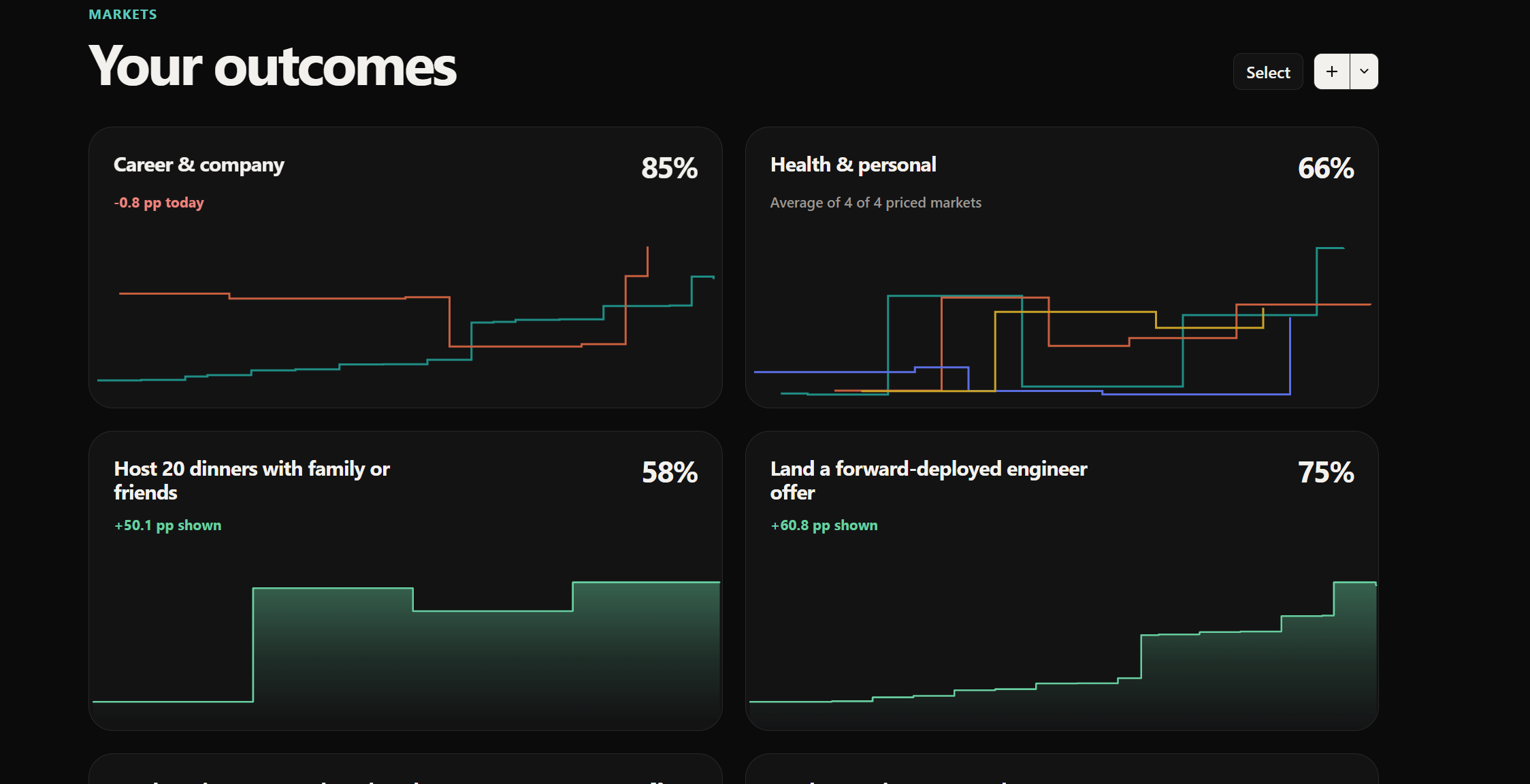
PlayItOut transforms personal goals into measurable prediction markets, allowing users to understand their probability of success, track how their actions influence their forecasts, and simulate strategies to improve their outcomes.
1. Goal Creation and Probabilistic Forecasting
Users can create goals ranging from landing a Forward Deployed Engineer offer to getting into the University of Waterloo.
Personal AI agents help structure each goal into measurable milestones, success criteria, and actionable blueprints. Our forecasting engine then estimates the probability of success using statistical models rather than relying on arbitrary LLM-generated percentages.
2. Real-World Evidence and Integrations
Users can upload files, record progress, and connect external data sources through our Composio-powered integration architecture.
For example, an aspiring software engineer can track job applications, recruiter responses, technical interview preparation, and GitHub contributions.
New evidence can update the underlying forecast, allowing users to visualize how their probability evolves.
3. What If — Simulating Alternate Futures
What if you submitted 20 job applications per week? What if you spent an additional 10 hours preparing for interviews? Would networking with startup founders have a greater impact than cold applications?
PlayItOut lets users simulate hypothetical interventions and compare their projected outcomes against their existing forecasts.
Rather than blindly following generic advice, users can evaluate different strategies, assumptions, and trade-offs before committing their time.
4. Personalized Profiles and Radar Charts
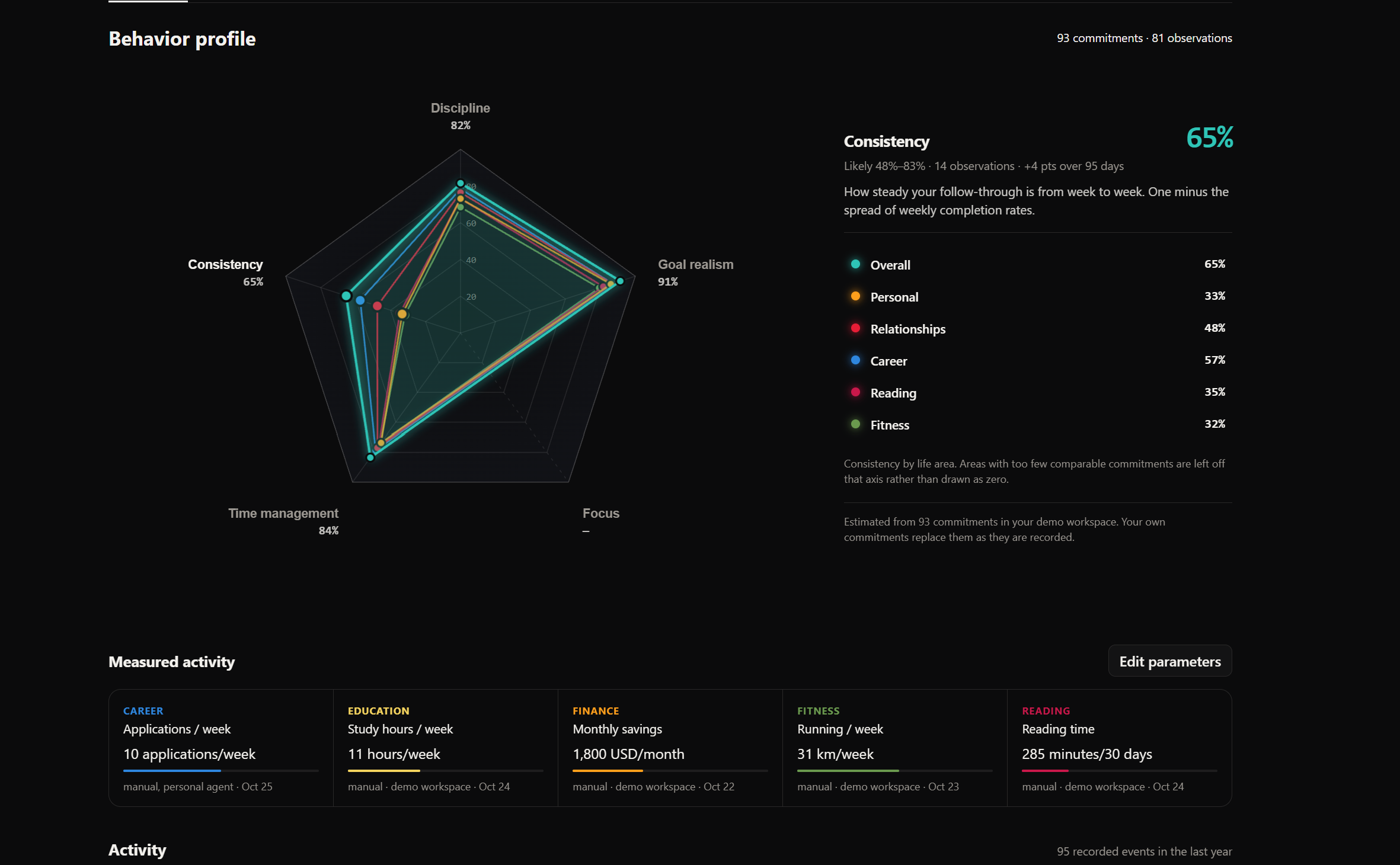
PlayItOut builds a profile of each user's progress and goal-relevant capabilities. Radar charts visualize dimensions such as technical preparation, networking, and interview readiness, making it easier to identify strengths, weaknesses, and areas requiring attention.
5. Social Prediction Markets and Reusable Blueprints
Users can discover public goals, star interesting markets, explore other people's progress, and fork published blueprints into their own personalized goals.
Imagine wanting to get into Waterloo and being able to study the milestones, decisions, and progress of students who successfully got accepted.
Our longer-term vision extends this to successful founders, athletes, and professionals, transforming documented personal experiences into reusable knowledge.
6. Personal Agents, MCP, and BYOK
We believe goal intelligence should be accessible through the AI assistants people already use.
PlayItOut exposes its capabilities through the Model Context Protocol (MCP), enabling integrations with assistants like ChatGPT and Grok. Users can retrieve goals, inspect forecasts, and access supported actions conversationally.
Our architecture also supports bring-your-own-key (BYOK), offering flexibility over AI providers and inference costs.
7. A Self-Learning Feedback Loop
Our strategy-learning system records recommendations, user feedback, attempted interventions, and observed outcomes.
This allows future recommendations to incorporate previous experiences rather than repeatedly providing generic advice. As we accumulate sufficient verified, consented data, we aim to use these observations to evaluate and improve the forecasting models themselves.
How we built it
We designed PlayItOut around one fundamental architectural principle: AI agents handle reasoning and orchestration, while mathematical models handle probabilities.
We didn't want to build another LLM wrapper that generates convincing but ungrounded predictions.
Our platform combines several interconnected systems:
Forecasting and simulation engine
We built a Python-based forecasting system using statistical and deterministic models, Monte Carlo simulation, and structured evidence.
The engine supports reproducible forecasts, probability histories, and scenario comparisons. Hypothetical What If interventions remain separate from real observations, preserving the integrity of published forecasts.
Agent architecture
We use LangGraph to orchestrate specialized AI workflows for goal creation, planning, evidence interpretation, strategy recommendations, and other interactions.
By separating agent reasoning from probability computation, we can use LLMs for their strengths without allowing them to arbitrarily determine numerical outcomes.
Evidence and data infrastructure
We integrated Composio to support external data connections and built evidence-ingestion workflows to normalize observations into goal-specific metrics.
Our system also supports manual submissions, file previews, evidence provenance, and persistent forecast histories.
MCP and external AI integrations
We implemented an MCP server to expose PlayItOut's functionality to compatible AI agents and assistants, including ChatGPT and Grok.
Rather than forcing users into a single AI interface, we're designing PlayItOut as an interoperable goal-intelligence platform.
Full-stack infrastructure
Our technology stack includes:
- Frontend: React, TypeScript, Vite, and Recharts
- Backend: Python, FastAPI, and Pydantic
- Database: PostgreSQL
- AI orchestration: LangGraph and structured LLM inference
- Statistical modeling: NumPy, SciPy, and scikit-learn
- Integrations: Composio and Model Context Protocol
- Authentication: Clerk
- Deployment: Vercel and Render
We also implemented user-scoped data access, inference-budget controls, BYOK credential management, automated testing, and persistent model and evidence records.
Challenges we ran into
1. Building a meaningful forecasting engine
Our biggest technical challenge was translating highly diverse personal goals into mathematically tractable problems.
Predicting whether someone will receive a job offer is fundamentally different from predicting whether they'll complete a 5K under 20 minutes.
We had to establish structured goal contracts, measurable evidence, explicit assumptions, and numerical models that could support different types of outcomes.
More importantly, we needed to ensure that probabilities weren't simply invented by an LLM.
2. Making What If simulations genuinely useful
It's relatively easy to ask an AI what might happen if someone studies more or applies to more jobs.
It's considerably harder to translate those interventions into measurable variables, calculate scenario-dependent effects, and preserve reproducibility without modifying the user's actual forecast.
We worked on separating hypothetical scenarios from observed evidence so users could compare possibilities without compromising historical records.
3. Integrating real-world evidence
Different applications expose fundamentally different data. GitHub commits, job applications, emails, fitness activities, and uploaded documents cannot all be interpreted in the same way.
Building a scalable ingestion architecture while handling authorization, duplicate submissions, data provenance, and incomplete evidence was one of our most demanding engineering problems.
4. Balancing agent autonomy with reliability
We wanted personal agents capable of helping users manage goals, but not agents that invented evidence, submitted unsupported claims, or made unauthorized changes.
Designing clear boundaries between AI-generated recommendations, user-approved actions, and deterministic model calculations became essential.
5. Building an interconnected product under hackathon constraints
PlayItOut combines forecasting, simulations, personal agents, social features, external integrations, and authentication.
Ensuring these systems worked together while managing inference costs, deployment complexity, and limited development time required us to prioritize reliable functionality over superficial demonstrations.
Accomplishments that we're proud of
Our biggest accomplishment was building something substantially more ambitious than a conventional AI goal tracker.
We developed a mathematical forecasting architecture that separates statistical probability estimation from LLM reasoning, allowing the system to produce traceable forecasts rather than simply generating confident-sounding predictions.
We also built a What If simulation experience where users can explore alternative decisions and compare projected outcomes against their baseline.
We're particularly proud of our agent-native architecture. Through MCP, PlayItOut can extend beyond its own website and become accessible through external AI assistants, supporting our belief that future software should integrate directly into users' existing workflows.
We implemented evidence ingestion, extensible integrations, forecast histories, personalized profiles, and social features such as discovering, starring, and forking goals.
Another important achievement was laying the foundation for a feedback-driven learning system that connects recommendations with subsequent evidence and observed outcomes.
Finally, we deployed a full-stack application with persistent data, authentication, inference controls, and automated tests rather than limiting the project to a static prototype.
We're proud that PlayItOut has a foundation in statistical modeling, software engineering, and measurable evidence—not just generative AI.
What we learned
The most important lesson was that AI reasoning and quantitative prediction are fundamentally different problems.
LLMs are incredibly useful for interpreting goals, understanding user intent, generating plans, and orchestrating tools. But generating a plausible explanation is not equivalent to producing a reliable probability.
This pushed us to design an architecture where mathematical models are responsible for forecasting while AI agents provide the intelligence and flexibility around them.
We also learned that evidence quality is just as important as model sophistication. A mathematically advanced model cannot produce reliable insights from inconsistent, duplicated, or unsupported observations.
Another realization was that minimizing friction is essential for sustained goal tracking.
Even the most sophisticated goal tracker will eventually be abandoned if users must manually update it every day. Integrating external data sources and personal agents isn't just a convenience feature; it's fundamental to making the product useful over time.
Finally, we realized the greatest opportunity might not be individual forecasting alone.
As people document their strategies, evidence, predictions, and outcomes, PlayItOut has the potential to evolve into a collective knowledge system—one that helps others learn from real experiences instead of starting from scratch.
What's next for PlayItOut
1. More accurate, self-improving forecasts
We want to continue improving model calibration and evaluating predictions against verified real-world outcomes.
As our dataset grows, we plan to research ways to learn from comparable goals, interventions, and outcomes while accounting for uncertainty and differences between users.
2. More autonomous personal agents
Our vision is to eliminate as much manual progress tracking as possible.
By expanding integrations with tools like GitHub, Outlook, LinkedIn, Strava, and other platforms, we want personal agents to help gather relevant evidence, identify meaningful changes, and proactively recommend next steps.
3. A marketplace for goal blueprints
Imagine aspiring founders learning from documented startup journeys or students discovering the approaches used by successful university applicants.
We want to expand social markets into a marketplace where users can publish, discover, star, and fork evidence-backed blueprints.
Eventually, experienced creators, mentors, and professionals could monetize valuable blueprints and insights.
4. An ecosystem of AI agents
We believe the future of software is increasingly agent-native.
Rather than expecting users to open PlayItOut every day, we want its forecasting and goal-management capabilities to be available wherever users already interact with AI.
We're continuing to expand our MCP infrastructure and support for external agents, AI assistants, and developer integrations.
5. Bringing probabilistic decision-making to everyday life
Ultimately, our ambition is much bigger than goal tracking.
We want to make the tools traditionally reserved for quantitative finance, professional sports, and sophisticated business decision-making accessible to everyone.
A world where people don't just set goals and hope for the best, but can understand their odds, test different strategies, learn from others, and make more informed decisions about their futures.
Because the question shouldn't just be whether you're working toward your goals. It should be whether you're doing the things most likely to help you achieve them.
That's the future we're building with PlayItOut.
Built With
- clerk
- grokbot
- langgraph
- muse
- python
- render
- typescript
- vercel

Log in or sign up for Devpost to join the conversation.