-
-
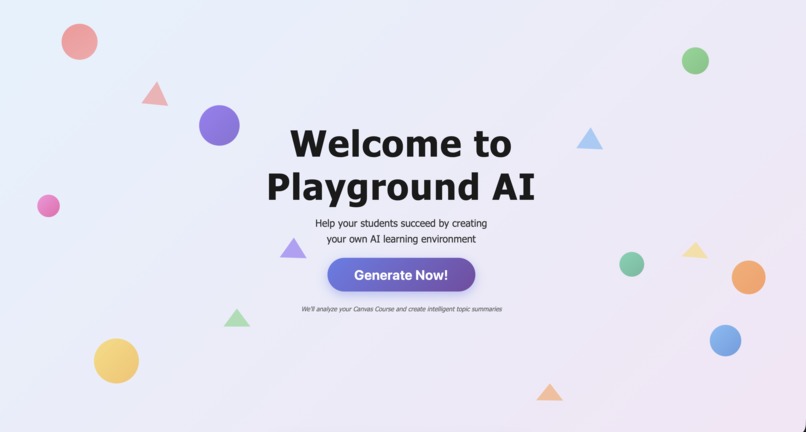
Playground_AI
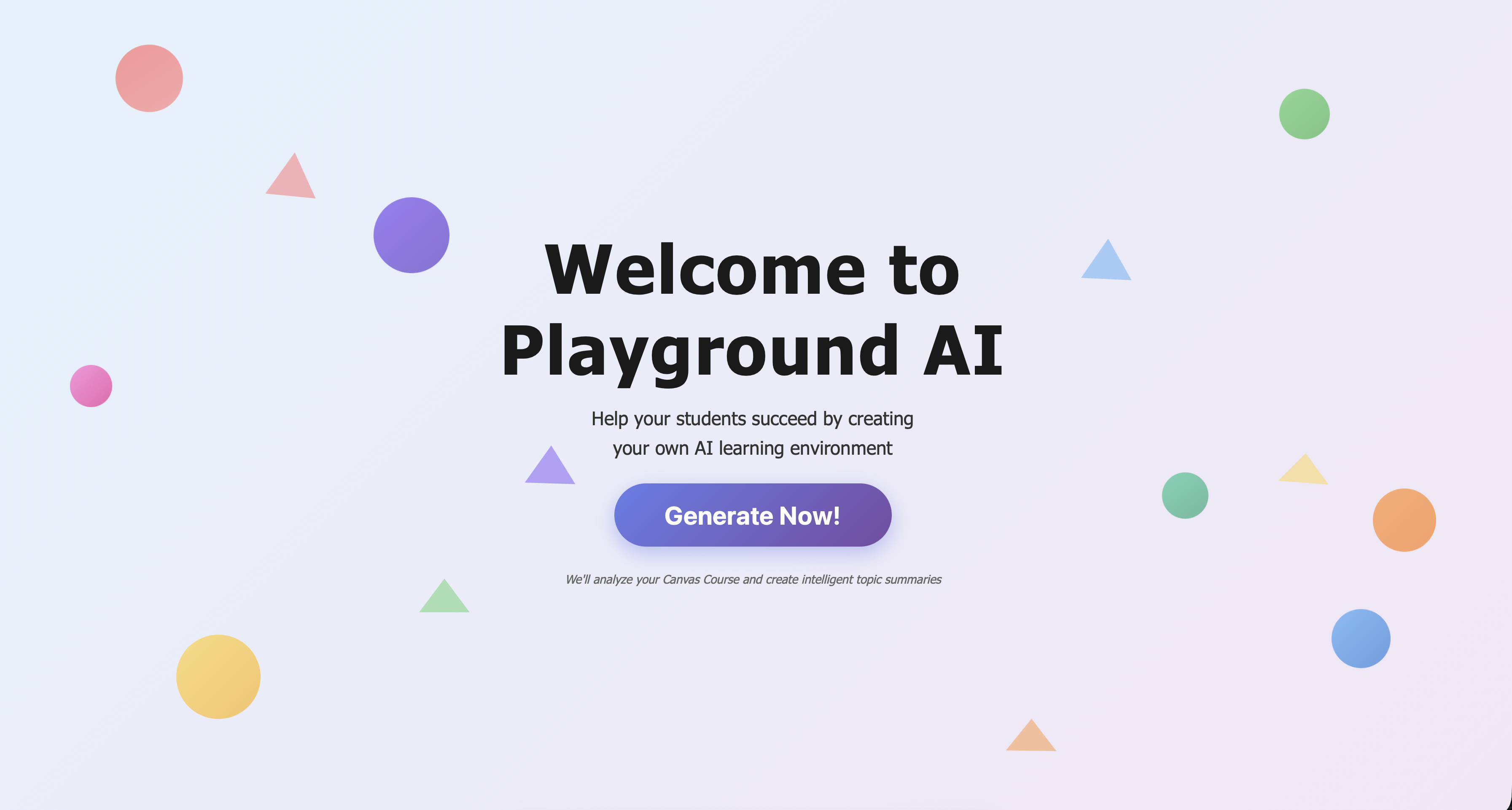
InspirationTBD
As AI becomes easier and easier for students to use, the student/teacher relationship is being redefined in real time. Just a few years ago, students would spend hours in office hours and frequently talk to teachers for help, but now, students just AI. AI is a powerful tool, but without teachers knowing where students need help and why, the quality of instruction is bound to decline. In fact, professors at Duke are constantly in meetings attempting to revamp the function of TAs and other systems to adapt to this new world. Our solution solves this.
What it does
We built Playground AI to close the gaps between students as a new way for students to interact with AI and course material. It ingests entire course's files and feeds it into our RAG-powered model to build an interactive Knowledge Graph and help students visualise course content.
Students can ask our model questions and get instant, trustworthy answers with citations to course notes and materials, all while our ML model provides professors with real-time insights into what topics are confusing to students, and what types of questions are being asked.
How we built it
To build this project, we architected a cloud-native application designed to integrate seamlessly within Canvas as an LTI tool. We used a modular Flask backend to handle the LTI launch and serve as an API for our core services. The primary feature is a Vertex AI RAG Engine that we built to automatically ingest all course content, such as PDFs, providing students with a safe, citation-backed AI TA that is grounded only in verified materials. We elevated this beyond a simple chatbot by creating an interactive knowledge graph that visually connects professor-defined topics to their source files, acting as an exploratory gateway for students. Finally, we implemented a full analytics pipeline that captures every student query, uses K-Means clustering on their vector embeddings to identify "topics of confusion," and visualizes these insights for professors on a dedicated dashboard, complete with answer-quality ratings.
Challenges we ran into
The primary challenge of this project was attempting to finish and connect all the different pieces in time, as well as the usual struggle of a large project held together by wonderfully written spaghetti code. Luckily, none of the features took an absolute monstrous amount of time to finish, but there was a ton to get done, so little sleep was had.
Accomplishments that we're proud of
Restoring "Office Hour" Insights with a Professor Dashboard: As students increasingly turn to generic LLMs instead of office hours, professors are losing a critical feedback loop. We're proud of our data analytics dashboard, which tracks student questions and topic confusion in real-time. This allows instructors to see exactly what students are struggling with (like a "hot topic" heatmap) and adapt their teaching, bringing back the insights that were once lost.
Seamless Canvas LTI Integration: Playground AI is built as a fully-compliant LTI app, meaning it works inside Canvas with zero setup for the student. It automatically ingests all course files (PDFs, lecture notes, etc.) directly from the course's module. This isn't a separate app; it's a true, seamless enhancement of the existing learning environment.
Context-Aware AI That Builds Trust: Instead of a generic LLM that hallucinates, our AI is better because it's grounded only in the course materials. We are incredibly proud of our RAG pipeline, which provides accurate answers and cites its sources. When a student asks a question, they see the answer and a link to the exact text chunk in the original PDF it came from, building trust and allowing them to go deeper. This allows the AI to understand complex, specific queries like, "What topics from Chapter 3 will be on the midterm?"
What we learned
We learned the importance of team communication
What's next for Playground
Playground AI is hoping to fully integrate in Canvas and other LMS by becoming a fully fledged LTI. This will allow greater API access and even more seamless integration. We hope to clean up our code and add additional features, such as canvas quiz creation and individual student learning options. We have already set up the pipeline to implement a reinforcement learning system for our RAG model, as this is also something we wish to explore. Overall, there are a lot of exciting possibilities for Playground AI, and we cannot wait to start exploring!


Log in or sign up for Devpost to join the conversation.