PlayCraft
Inspiration
As a game developer and designer, I lived a frustrating reality: great game ideas die in the gap between imagination and implementation.
Every time I had a new concept, I faced the same walls:
- Validation took weeks — By the time I built a prototype, the excitement was gone
- Explaining ideas to teams was painful — Words and sketches never captured the vision
- Simple prototypes weren't simple — Even "quick" games took days of boilerplate code
Then I noticed something: this wasn't just my problem. Game studios waste months on prototypes that get rejected in minutes. Publishers can't visualize pitches. Indie developers abandon ideas because the barrier to "just try it" is too high.
I was already using AI tools to hack together web-based prototypes. One day it clicked: What if anyone could describe a game and play it 60 seconds later?
That's when PlayCraft was born — not as a toy, but as a tool to democratize game creation and give every idea a fair chance to be seen, played, and validated.
What it does
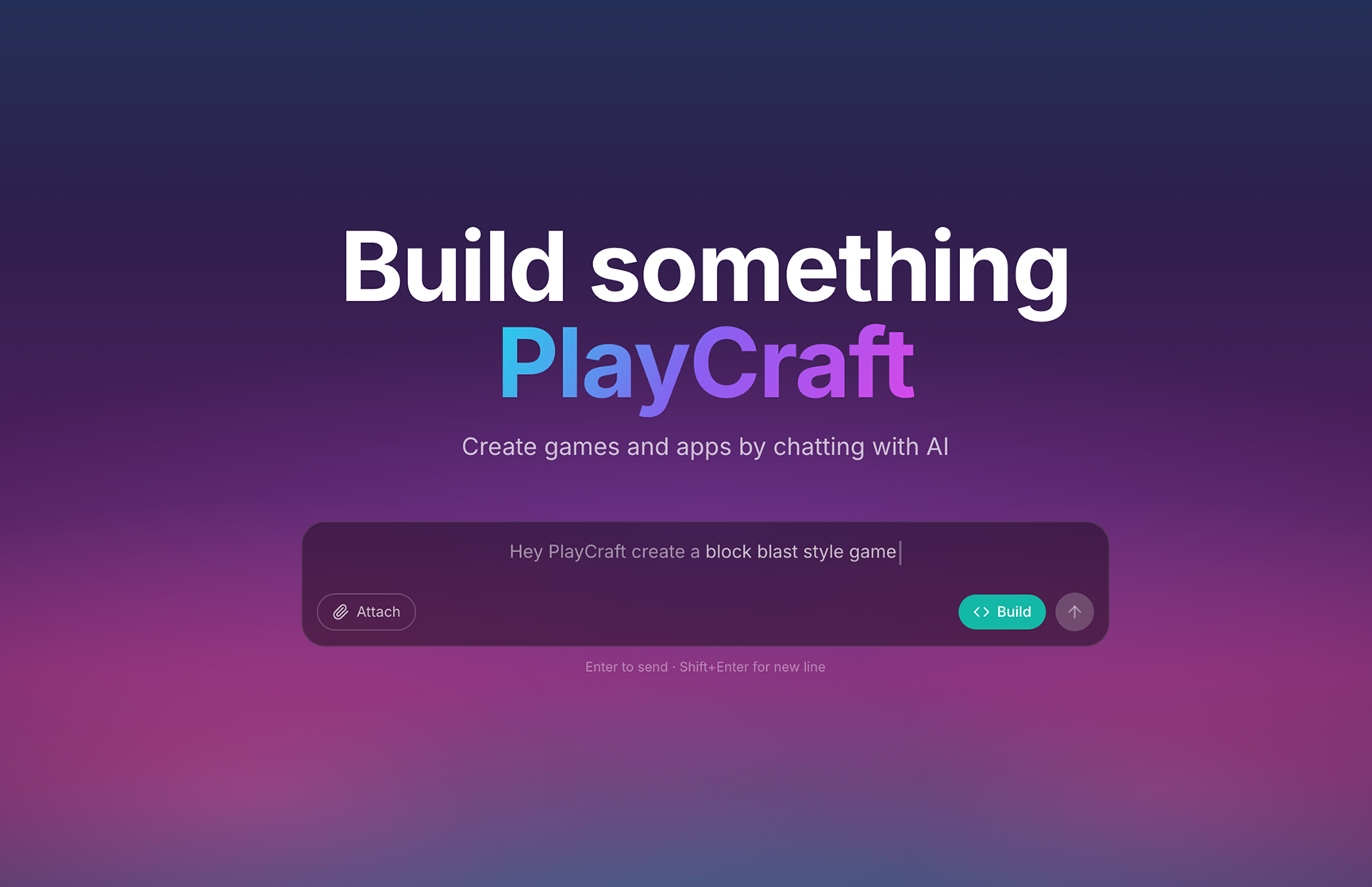
PlayCraft transforms natural language into playable games in real-time.
Pitch Deck: https://www.playcraft.games/pitch
Simply describe what you want:
"Create a falling blocks puzzle game with neon colors and synth music"
And watch as AI writes the code, the preview updates live, and you're playing your game — all within a minute.
Core Features
🎮 Conversational Game Building — Chat naturally to create, modify, and refine your game. Say "make the enemies faster" or "add a power-up system" and see changes instantly.
⚡ Real-Time Preview — Every change appears immediately in a live, playable preview. No waiting, no refreshing.
🧠 Smart Context Memory — PlayCraft remembers your entire project. It understands your game's architecture and makes intelligent suggestions.
🚀 One-Click Publishing — Share your creation with a unique URL. Anyone can play directly in their browser.
💻 Professional Code Export — Under the hood, PlayCraft generates clean React/TypeScript code. Export anytime and continue in your favorite IDE.
🎨 2D & 3D Support — From classic arcade games to immersive Three.js experiences.
🔧 Auto-Fix Errors — AI automatically detects and fixes TypeScript and runtime errors, so you focus on creating, not debugging.
How we built it
PlayCraft is built on a modern, scalable architecture designed for real-time AI-powered development:
Frontend
- React 18 + TypeScript — Strict typing with zero
anytypes for reliability - Vite 5 — Lightning-fast builds and hot module replacement
- Tailwind CSS + Radix UI — Beautiful, accessible components
- Monaco Editor — VS Code's editor for when users want to see/edit code
- Zustand + TanStack Query — Efficient state management
AI & Backend
- Supabase — PostgreSQL database, authentication, edge functions, and storage
- Google Gemini — Primary AI model for code generation with extended thinking
- Claude (Anthropic) — Orchestration layer for complex multi-step tasks
- Voyage AI — Semantic search for intelligent file context selection
Code Execution
- WebContainer API — Full Node.js environment running in the browser
- Real-time compilation — Vite dev server running entirely client-side
- IndexedDB caching — Instant project restoration with cached dependencies
Infrastructure
- Vercel — Frontend deployment with edge functions
- Cloudflare Workers — Game hosting proxy for published games
- Sentry — Error monitoring and performance tracking
Key Technical Innovations
- Smart Context System — Embedding-based semantic search selects only relevant files, minimizing tokens while maximizing AI understanding
- Edit Mode — For small changes, AI sends surgical search/replace operations instead of full files
- Timeout Recovery — Automatic retry with simplified context when requests take too long
- Project Memory — Persistent memory of game type, completed features, and conversation history
Challenges we ran into
1. The Context Window Problem
AI models have token limits, but games have many files. We couldn't just send everything.
Solution: Built a sophisticated context builder with dependency graph analysis, semantic search, and intelligent file selection. It picks the 5-10 most relevant files from projects with 50+.
2. WebContainer Reliability
Running Node.js in the browser is cutting-edge but fragile. Page refreshes killed running processes, and dependency installation was slow.
Solution: Implemented IndexedDB caching for node_modules, session persistence for project state, and process management to handle zombie processes gracefully.
3. AI Timeouts on Complex Requests
Large game modifications would sometimes timeout, leaving users staring at a spinner.
Solution: Built a timeout monitoring system with warnings at 30s, automatic retry with simplified context at 60s, and a cancel button so users stay in control.
4. Edit Accuracy
AI-generated search/replace edits sometimes targeted the wrong code section when patterns repeated.
Solution: Implemented fuzzy matching with context-aware resolution — using surrounding code to pick the correct location when multiple matches exist.
5. Security with User-Generated Code
Executing AI-generated code in the browser opens attack vectors.
Solution: Added Zod schema validation for all JSON parsing, sandboxed execution in WebContainer, and strict CSP headers.
Accomplishments that we're proud of
🏆 Zero to Playable in Under 60 Seconds From a blank slate to a working, shareable game faster than you can explain your idea in a meeting.
🏆 Production-Grade Code Quality
Zero any types in the entire codebase. Strict TypeScript, comprehensive error boundaries, and structured logging.
🏆 True Real-Time Collaboration with AI Not just code generation — a genuine back-and-forth where you describe, AI builds, you refine, AI adapts. It feels like pair programming with a tireless partner.
🏆 Smart Context That Actually Works Our embedding-based file selection consistently picks the right context, making AI responses accurate even in large projects.
🏆 Seamless Error Recovery Auto-fix catches TypeScript errors, ESLint issues, and runtime crashes — then fixes them without user intervention.
🏆 Professional Export Path Games aren't locked in. Export clean, documented code and continue development anywhere.
What we learned
On AI-Assisted Development
- Context is everything. The difference between a helpful AI and a hallucinating one is the quality of context you provide.
- Streaming matters for UX. Users need to see progress, not just results. Showing what AI is "thinking" builds trust.
- Fallbacks are essential. AI will fail. Having graceful degradation (retry, simplify, cancel) keeps users happy.
On Technical Architecture
- Browser-based Node.js is powerful but immature. WebContainer is amazing but requires defensive coding for edge cases.
- Type safety pays dividends. Our zero-any policy caught countless bugs during development.
- Caching transforms UX. IndexedDB caching turned 30-second installs into instant restoration.
On Product Design
- Validation is the killer use case. Studios don't just want to build games — they want to test ideas before committing resources.
- Simplicity beats features. Every feature we removed made the product better.
- Show, don't tell. A playable prototype convinces better than any pitch deck.
What's next for PlayCraft
Short-term (Next 3 Months)
- Multiplayer game support — Real-time multiplayer with WebSocket integration
- Asset library — Built-in sprites, sounds, and music to accelerate creation
- Template marketplace — Start from proven game templates (platformer, puzzle, shooter)
- Collaboration — Real-time multi-user editing for teams
Medium-term (6 Months)
- Mobile export — Generate React Native or Capacitor builds for iOS/Android
- AI playtesting — Let AI play your game and suggest balance improvements
- Version control — Built-in branching to experiment without fear
- Analytics dashboard — See how players interact with your published games
Long-term Vision
- PlayCraft Studio — Full game studio workflow: design docs → prototypes → production
- Publisher integrations — Direct submission pipeline to game publishers
- Educational partnerships — Bring game development to schools without requiring coding classes
- Enterprise tier — Private deployments for large studios with custom AI models
Our Mission
We believe every game idea deserves a chance to be played.
Not just by the developer who imagined it, but by players who can experience it. PlayCraft removes the months of work between "what if..." and "try this."
Whether you're a solo creator with a dream, a designer pitching to stakeholders, or a studio validating concepts — PlayCraft turns imagination into reality.
The future of game development isn't writing code. It's describing what you want to create.
PlayCraft — Where ideas become games.
Built With
- gemini
- google-cloud
- nextjs
- react


Log in or sign up for Devpost to join the conversation.