-
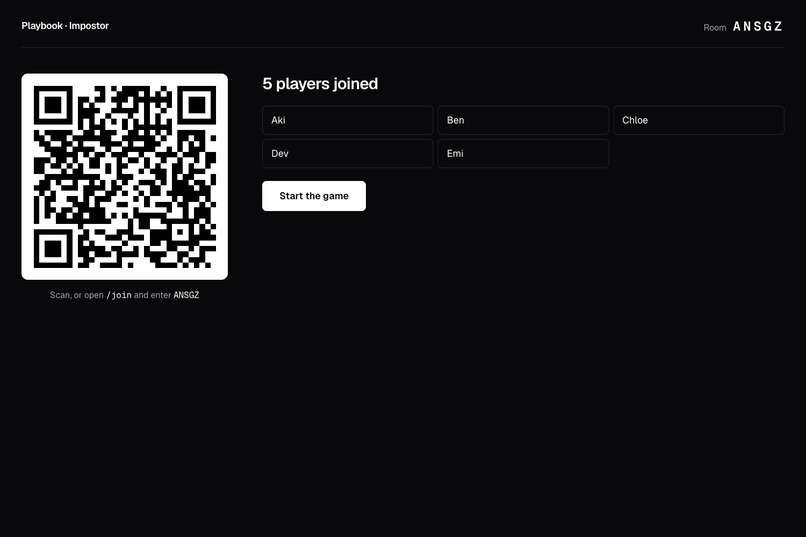
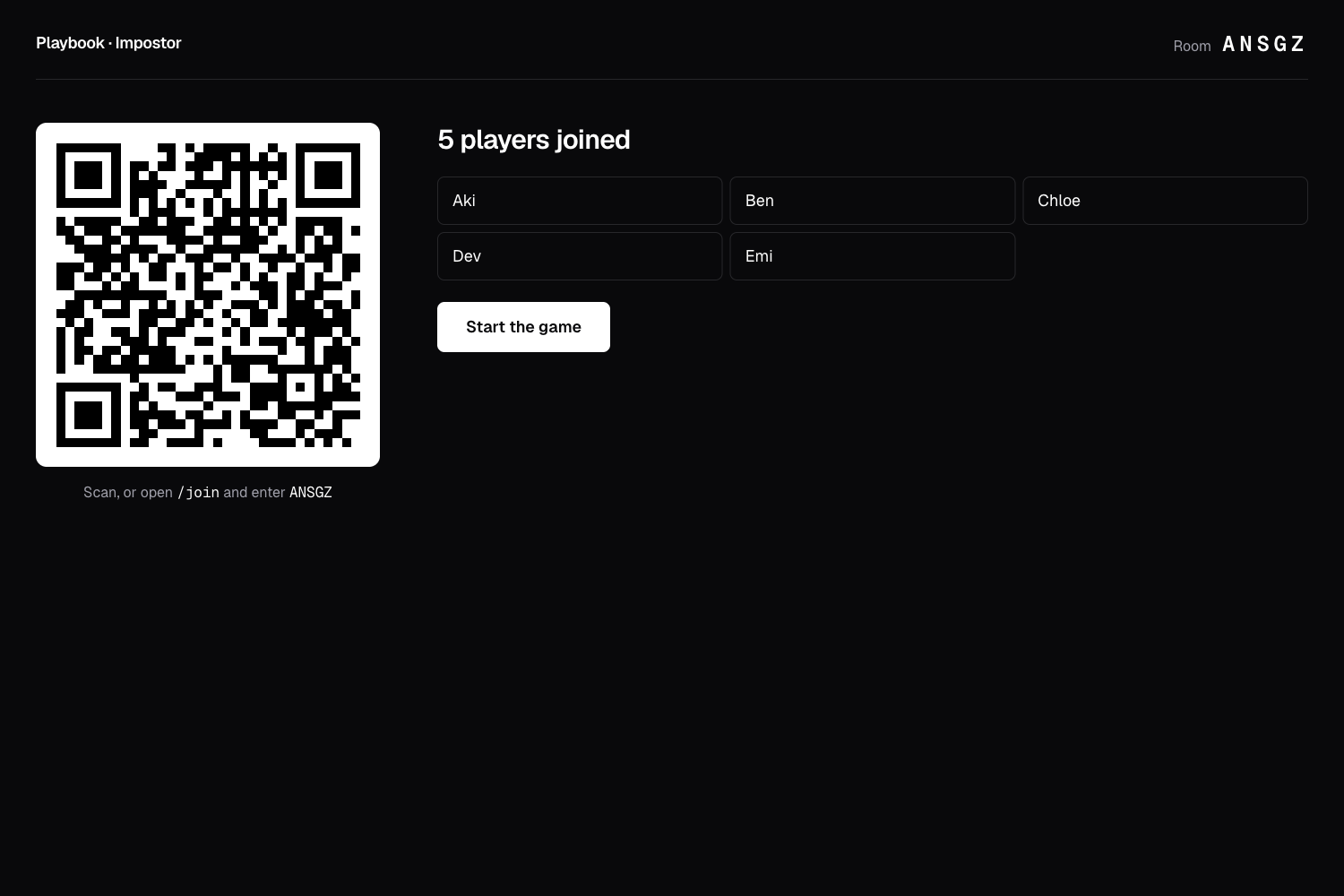
imposter lobby
-
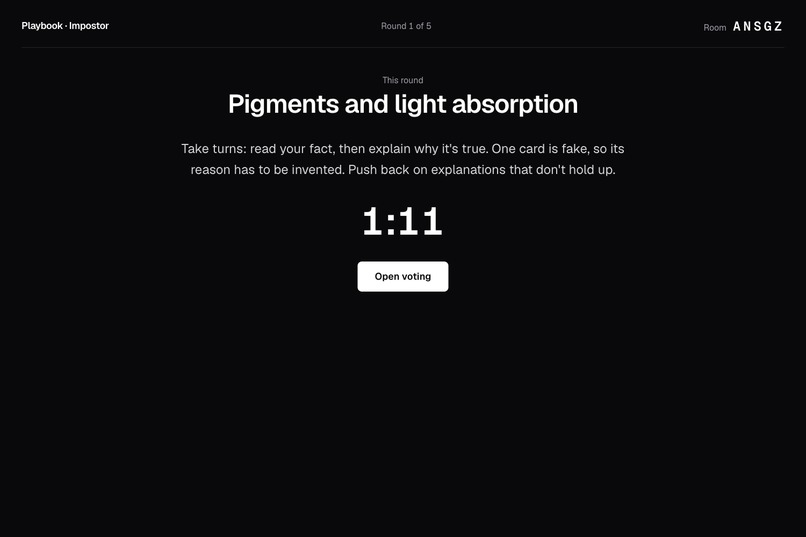
imposter game
-
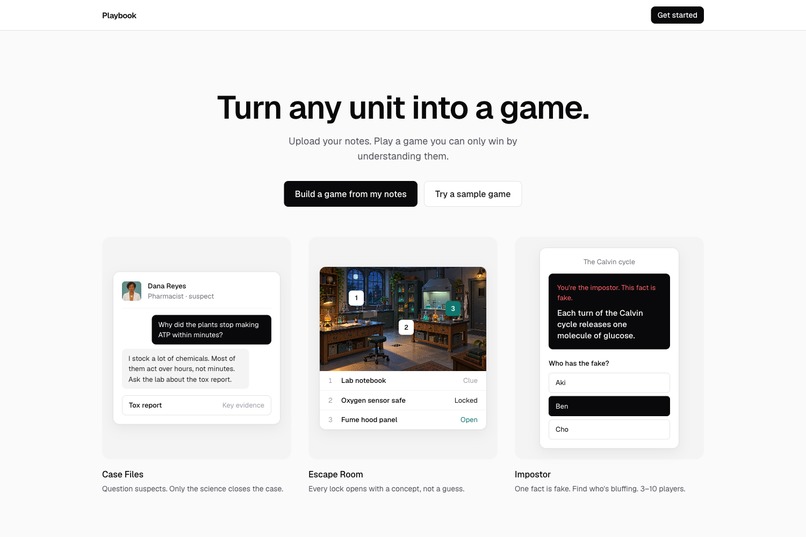
home
-
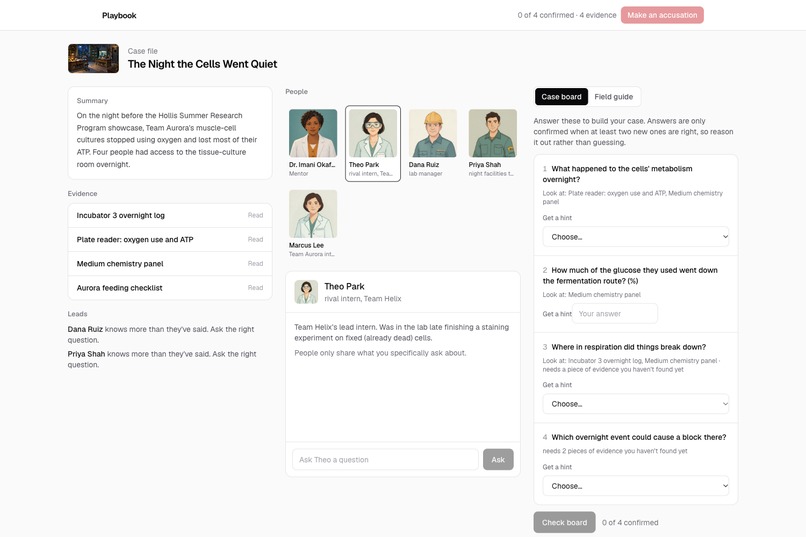
case investigation
-
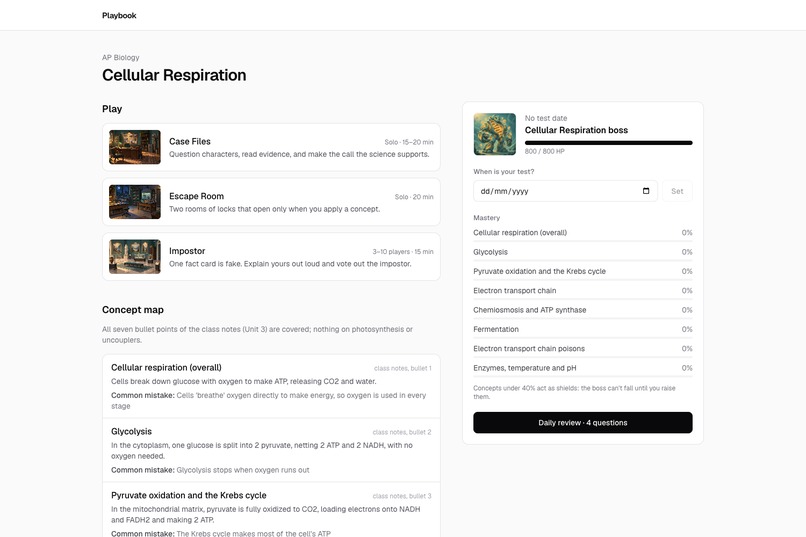
unit boss
-
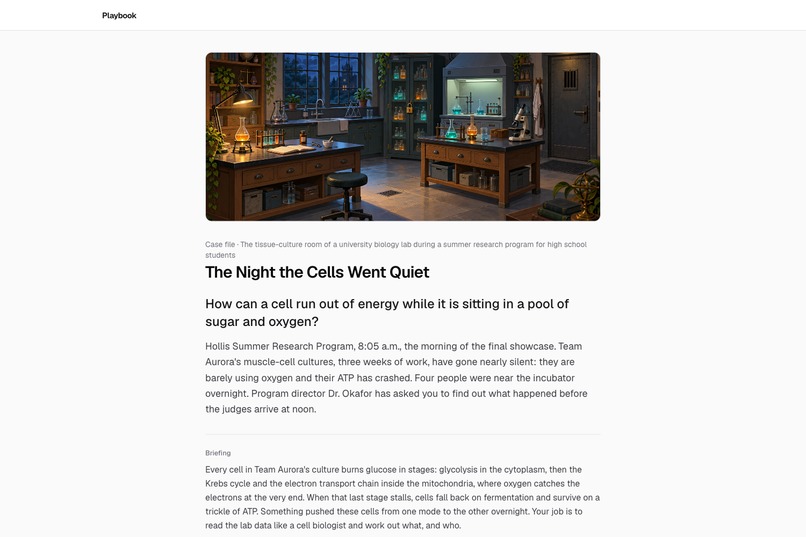
case investigation description
-
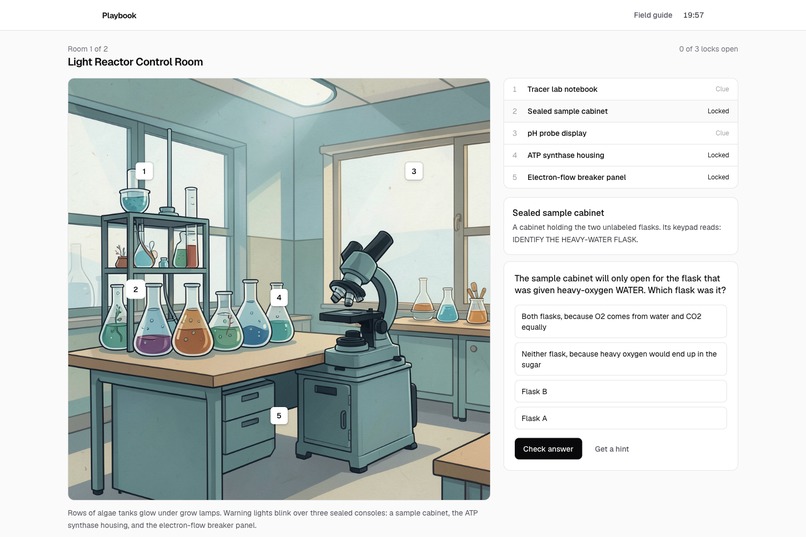
escape room
Inspiration
I play varsity soccer and take AP Biology, AP Physics C M and E & M, AP Stats, AP Psych, multivariable calculus. Between practice, college applications, and school, most of my studying is rereading notes the night before a test. The tools that are supposed to make studying fun — Blooket, Gimkit, Kahoot — mostly wrap the same multiple-choice questions in a minigame that has nothing to do with the subject. You answer a question, earn coins, then play something unrelated. Learning researchers have a name for this: chocolate-covered broccoli. Students see through it.
I wanted the opposite: a game where the concept is the mechanic. You don't answer a question to earn a turn. you catch the culprit, open the lock, or spot the liar because you applied the idea.
What it does
Playbook
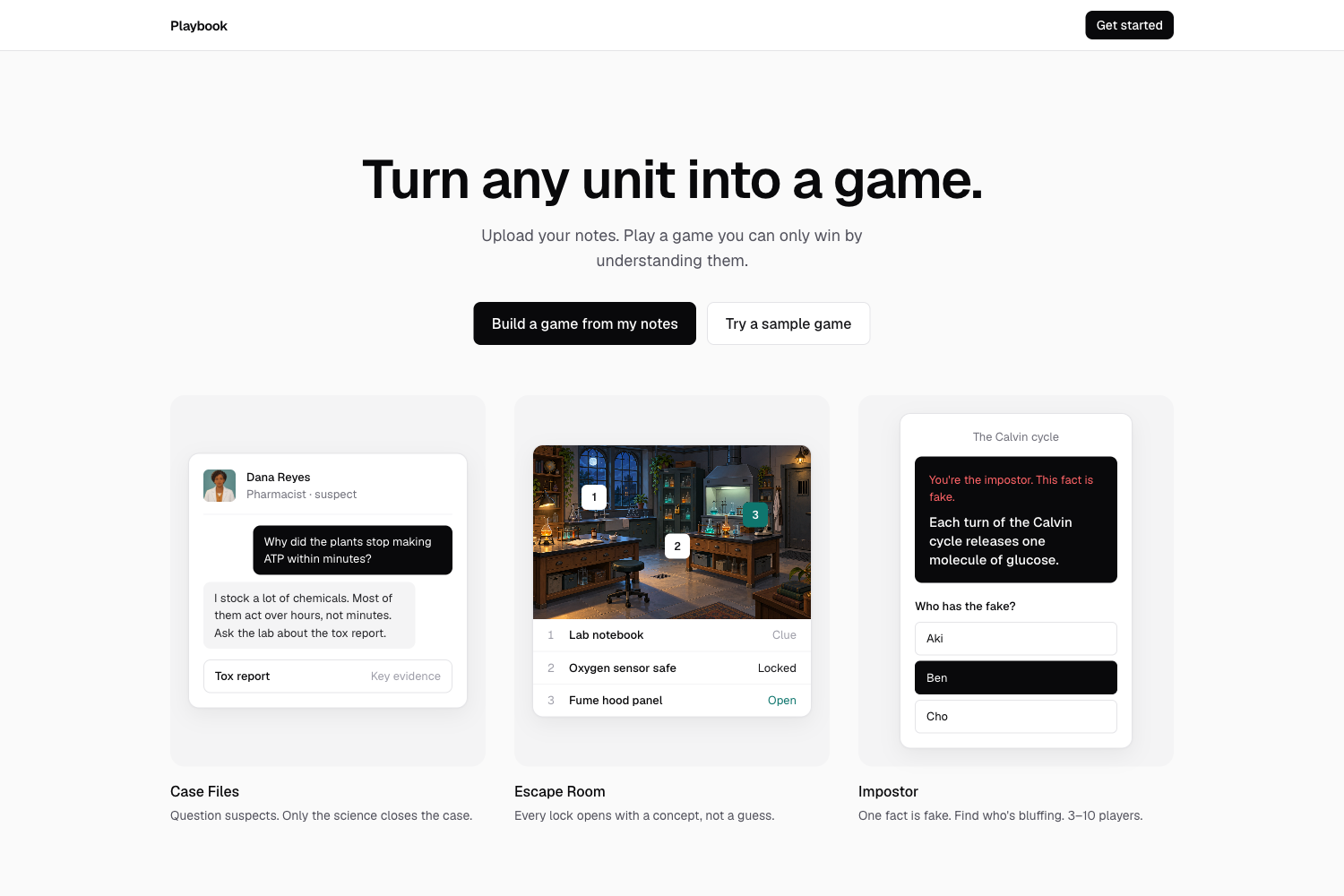
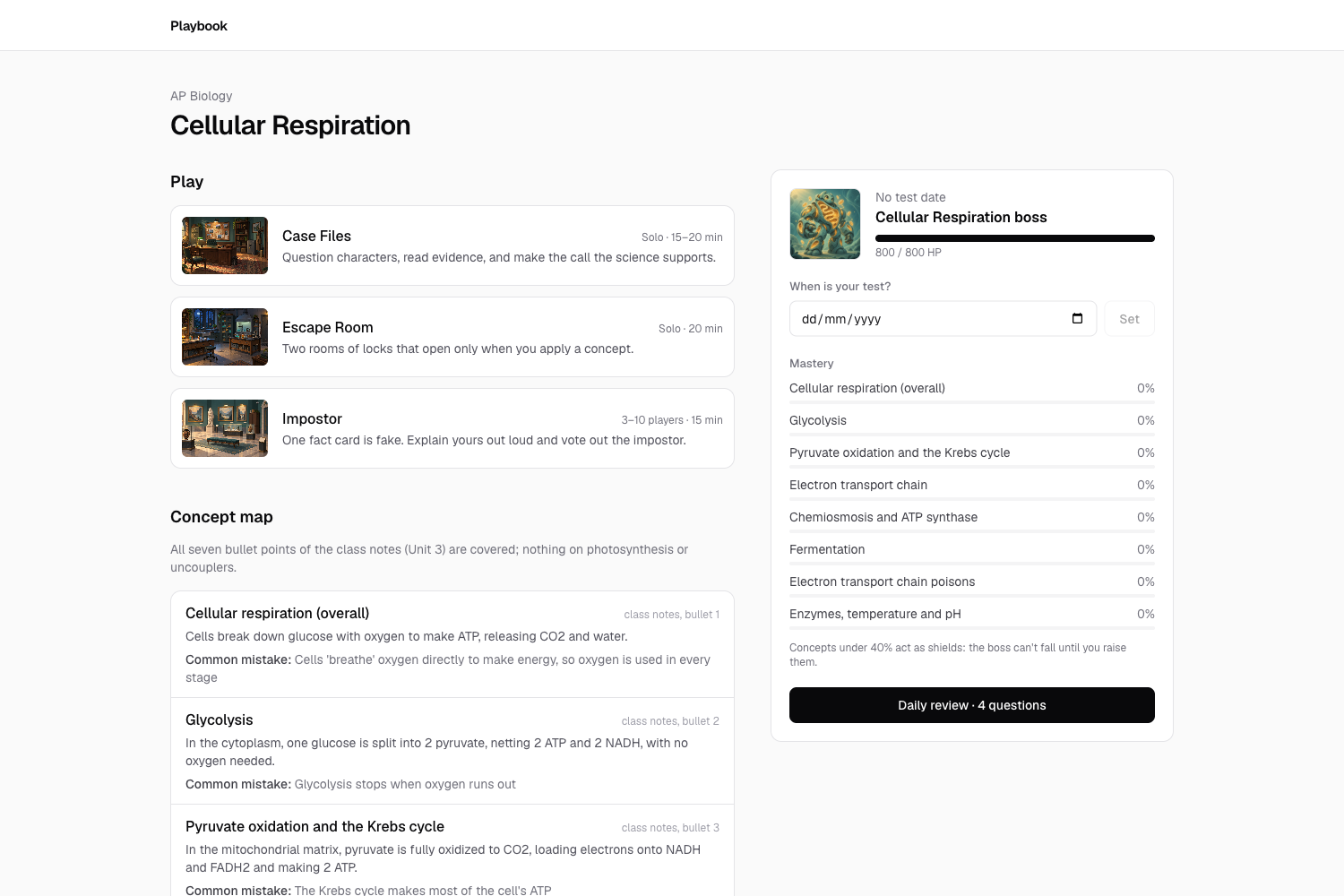
Upload your own notes, slides, or photos of a unit. Playbook builds a concept map — the key ideas, where each one shows up in your notes, and the mistakes students usually make — and then generates a game from that exact material:
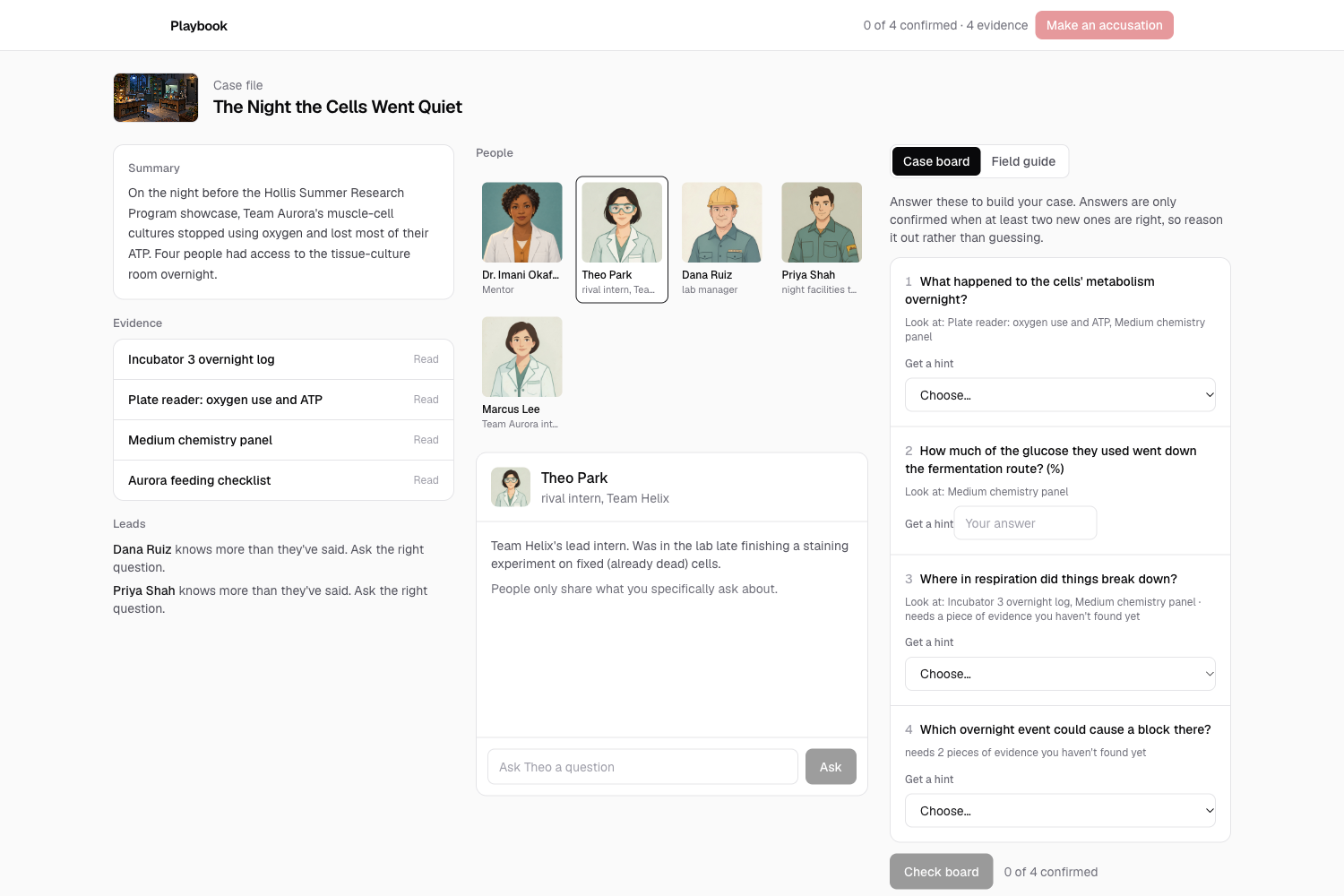
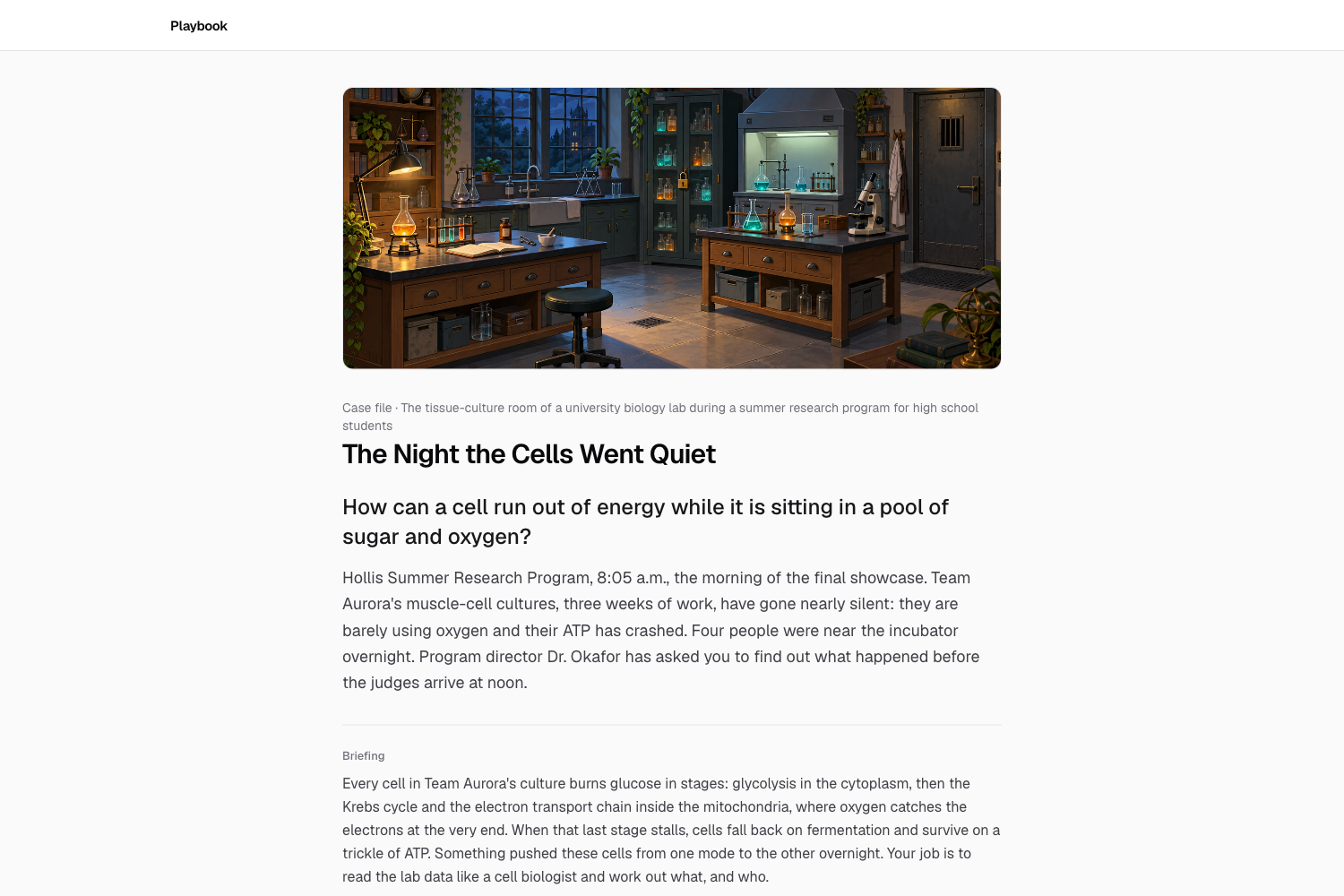
- Case Files — A detective case. Question AI characters, earn evidence by asking the right person the right thing, and fill a case board. Board answers are confirmed only two at a time (inspired by Return of the Obra Dinn), so you can't guess row by row. A mentor character teaches the science but never gives the answer.
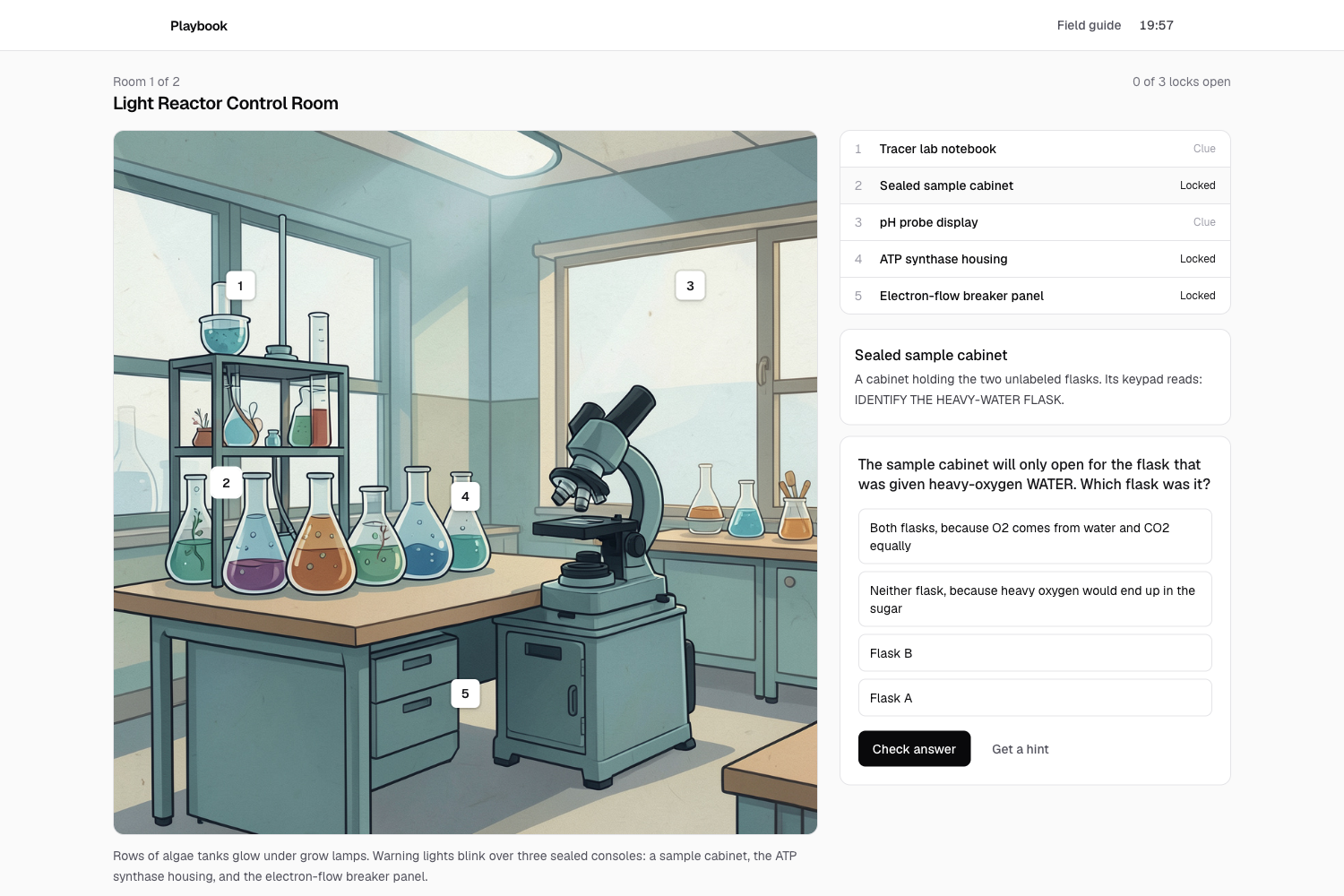
- Escape Room — Two rooms of locks that open when you compute, predict, or put a process in order. Every lock gives a fragment, and the sealed exit is a meta-puzzle that combines them.
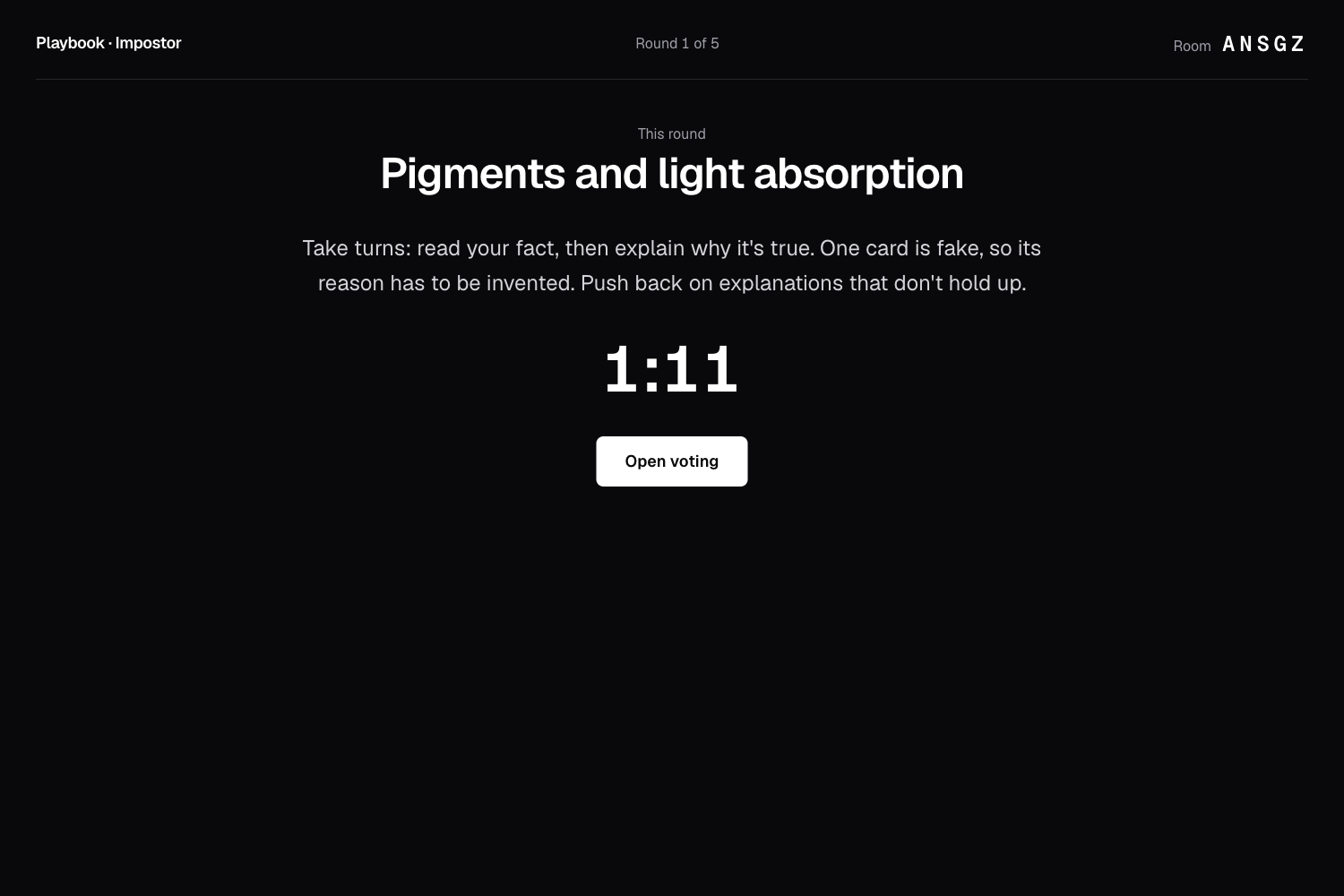
- Impostor — A party game for 3–10 players on their phones. Everyone gets a fact card; one is subtly wrong, built from a real misconception. You read your fact and explain why it's true, so the impostor has to bluff a reason. Secret vouching pairs and scoring for misdirection keep it tense.
- Boss Fight — Your test date becomes a boss. Weak concepts are its shields, correct answers deal damage, and review questions come back on a spaced schedule before test day.
Every game opens with a hook question, has a three-step hint ladder (nudge → concept → similar worked example, never the answer), and ends with a debrief that connects what you did to the textbook concept.
Try it without uploading anything: the home page has three ready-made AP Biology games. It would also help my credit usage.
How we built it
Next.js + TypeScript on Vercel, Supabase (Postgres + storage), and Render Workflows for the long-running generation jobs (a full game takes 1–3 minutes, longer than a normal serverless request).
- Claude (Anthropic API) reads the material, builds the concept map, designs each game as structured data, reviews it, and voices the characters.
- Quality gates before a student sees a game:
- Rule checks in code — every numeric answer is recomputed from its formula, every choice has feedback for each wrong option, and mode rules hold (the Three Clue Rule for mysteries, one exit meta-lock fed by every other lock, a fake fact that can't be spotted by its length).
- An AI playtester that independently re-derives every answer, tries to solve puzzles without the concept, and flags anything confusing, unfair, or "quiz in costume." Problems go back to the generator for up to two repair rounds; if a game still fails, it isn't shown.
- During play, answers are checked in code, never by AI. Answer keys, character secrets, and locked clues never reach the browser; clues are released only after a lock opens. Characters have a leak guard so they can't blurt out the solution.
- Art comes from a reusable, auto-tagged image library (hand-made with Codex plus generated images), so most games cost nothing extra to illustrate.
- 117 automated tests cover the answer checking, validation rules, game engines, and secret redaction.
Challenges we ran into
- Making generated games actually fun. My first version worked but felt like worksheets. I researched game design — intrinsic integration (Habgood & Ainsworth), the Three Clue Rule from mystery design, escape-room puzzle rules, social deduction — and rebuilt all three modes around it. Then I had AI agents playtest the prompts and found real problems (motive alone could solve a case, the last clue gave away the culprit, fake facts were longer than true ones) and fixed each with a rule.
- Keeping secrets from a chatty AI character. Suspects kept wanting to be helpful. I added a structured "does this reveal the solution?" flag plus a keyword guard, and redacted everything secret on the server.
- Limits. Large schemas exceeded the API's structured-output limits, so big games are generated as JSON and validated in code. Serverless time limits pushed generation onto Render Workflows.
- Cost and abuse. A public link can burn an AI budget, so there are per-unit caps, an hourly budget, and rate limits on chat.
Accomplishments that we're proud of
- Three complete game modes plus Boss Fight, live multiplayer on phones, and a quality pipeline that refuses to show a broken game.
- Answers are always checked deterministically, so a student is never told "correct" by a model that might be wrong.
What we learned
- The difference between a game about a subject and a game made of a subject — and how much research exists on exactly this.
- How to design with AI safely: let the model be creative, but keep correctness in code (answer keys, validation, redaction).
- Building a real full-stack product: databases, background jobs, rate limiting, deployment, and testing.
- Coding in typescript
- Effectively using AI to help boost shipment speed while maintaining my learning experience.
What's next for Playbook
- A teacher view that shows which misconceptions a class fell for during Impostor.
- Co-op Escape Room, voiced characters, and more modes (Heist, Keep It Alive, Card Battler).
- Testing with more classes and tuning difficulty to each student's mastery.
Built With
- anthropic
- next
- node.js
- react
- render
- supabase
- tailwind
- typescript
- vercel

Log in or sign up for Devpost to join the conversation.