- Inspiration
Traditional studying often feels boring, repetitive, and stressful, especially for students preparing for competitive exams like JEE, NEET, GATE, and college examinations. Students spend hours solving questions, but many struggle to stay motivated, identify their weaknesses, and track their actual improvement.
We were inspired by multiplayer games, competitive learning platforms and the idea that studying should be as exciting as gaming. Students love competing with friends, earning rewards, unlocking achievements, and climbing rankings. So why can't education offer the same excitement?
That's how Playbit was born - an AI-powered platform that transforms studying into an interactive, competitive, and enjoyable experience where students don't just study to pass exams; they play, compete, learn, and improve together.
Our goal is simple: Make learning so engaging that students enjoy practicing instead of treating it like a burden.
- What it does
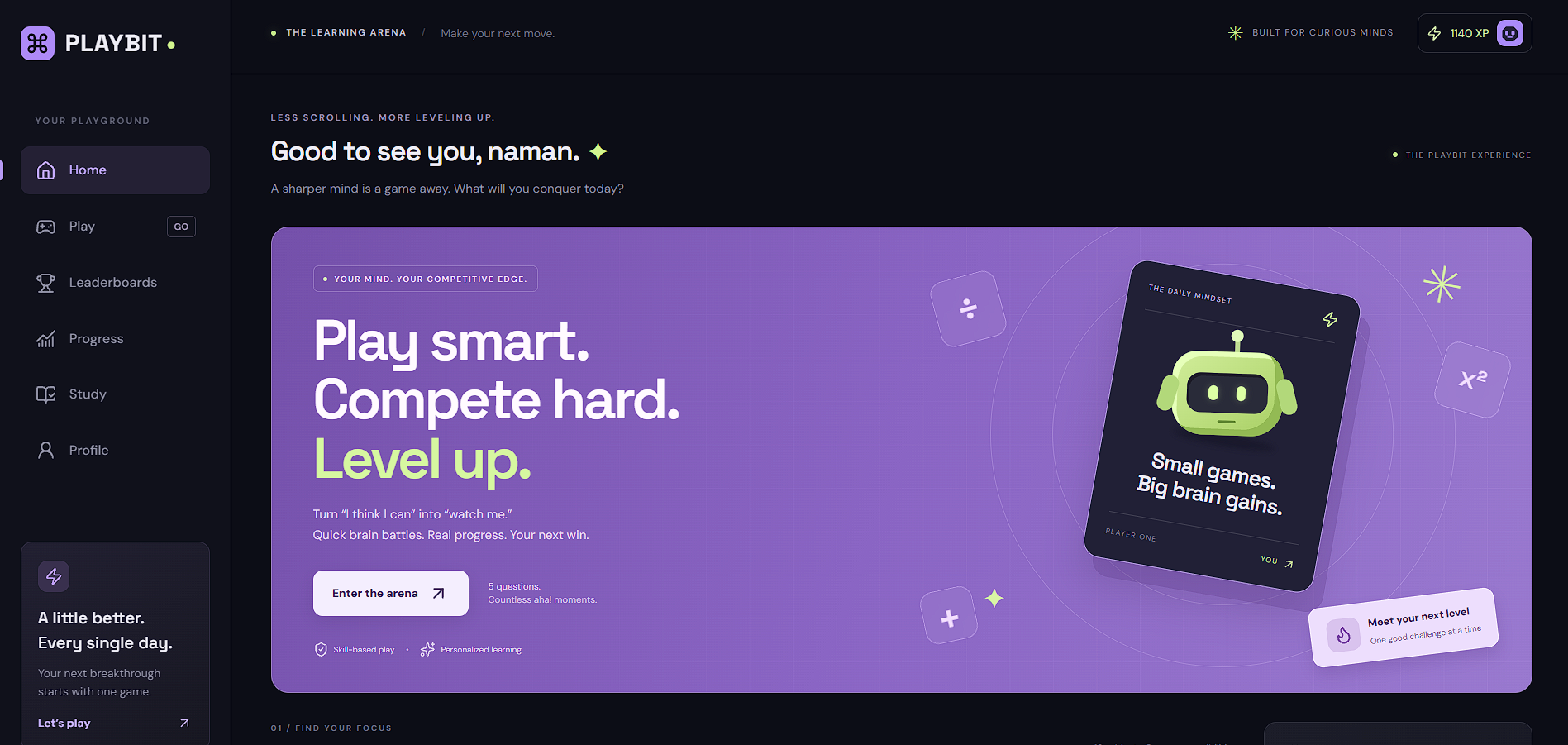
Playbit is an AI-powered, gamified learning platform that combines education, artificial intelligence, and competitive gaming into one interactive experience.
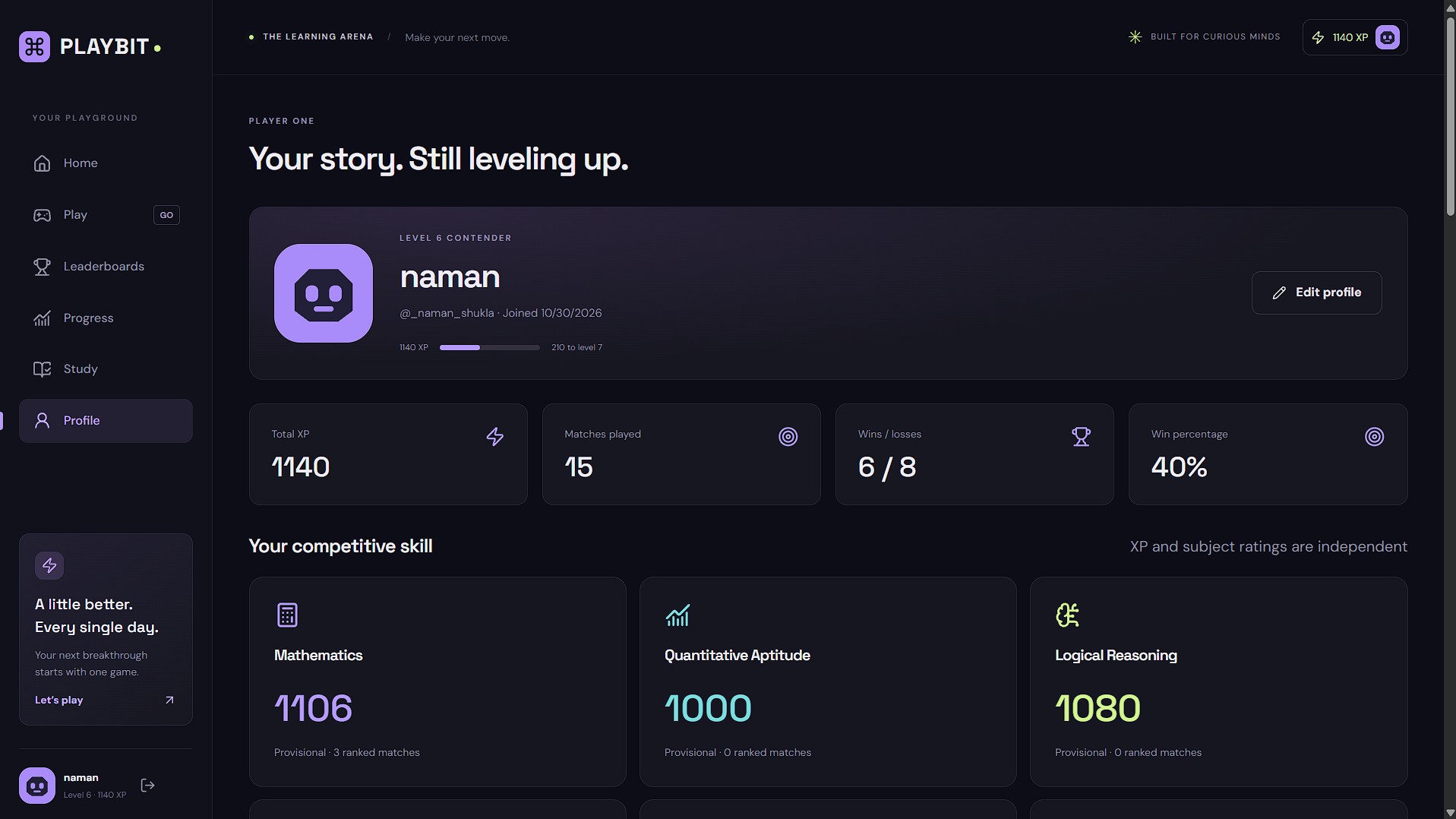
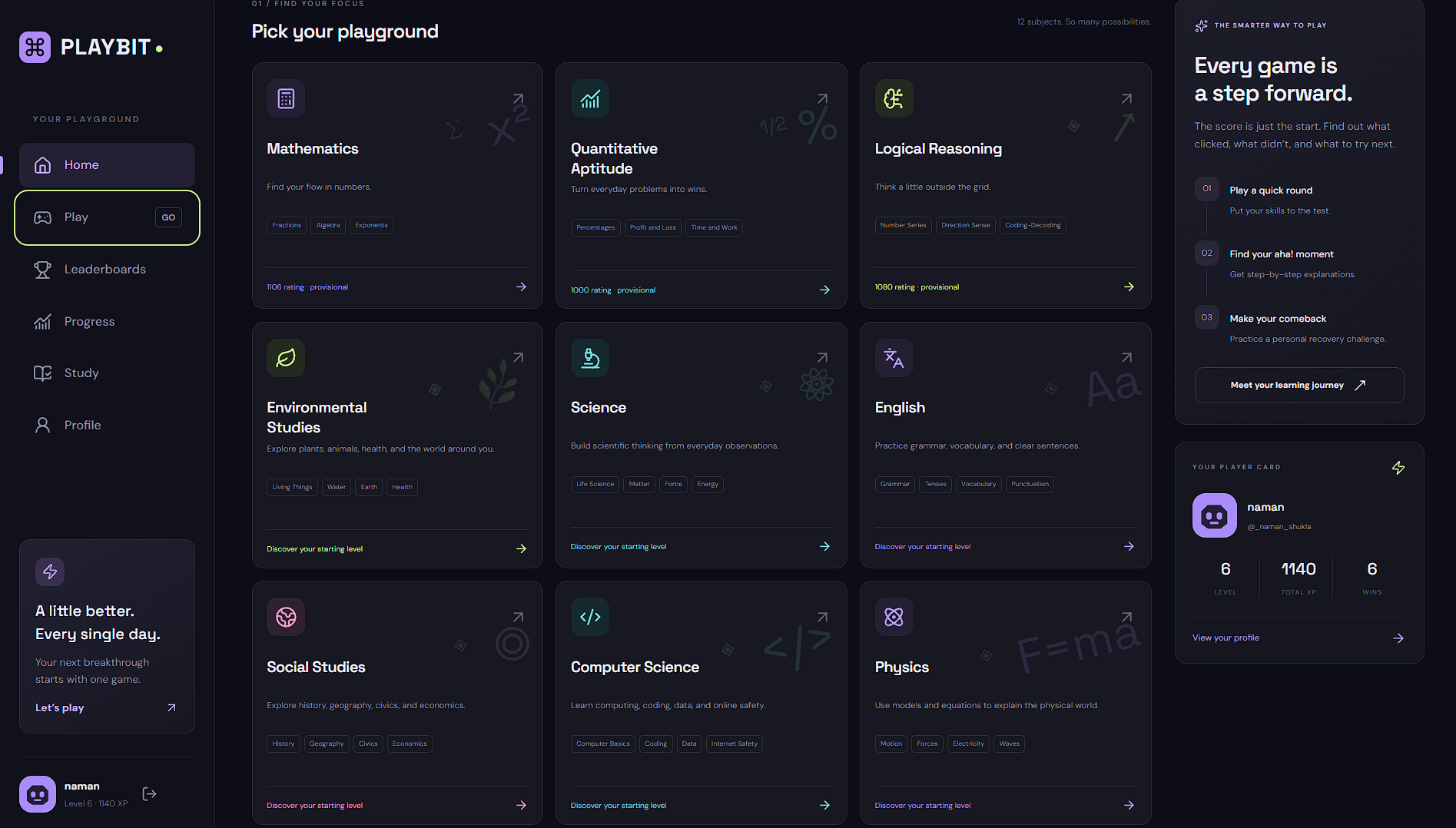
Students can create personalized profiles, select their subjects, and take an initial skill assessment to determine their knowledge level. Based on their performance, Playbit provides questions suited to their abilities, gradually increasing difficulty as they improve.
The platform supports Mathematics, Quantitative Aptitude, and Logical Reasoning, helping students strengthen problem-solving skills, speed, accuracy, and logical thinking. It is designed for students preparing for competitive examinations, campus placements, and college assessments, with opportunities to expand into exam-specific subjects for JEE, NEET, and GATE.
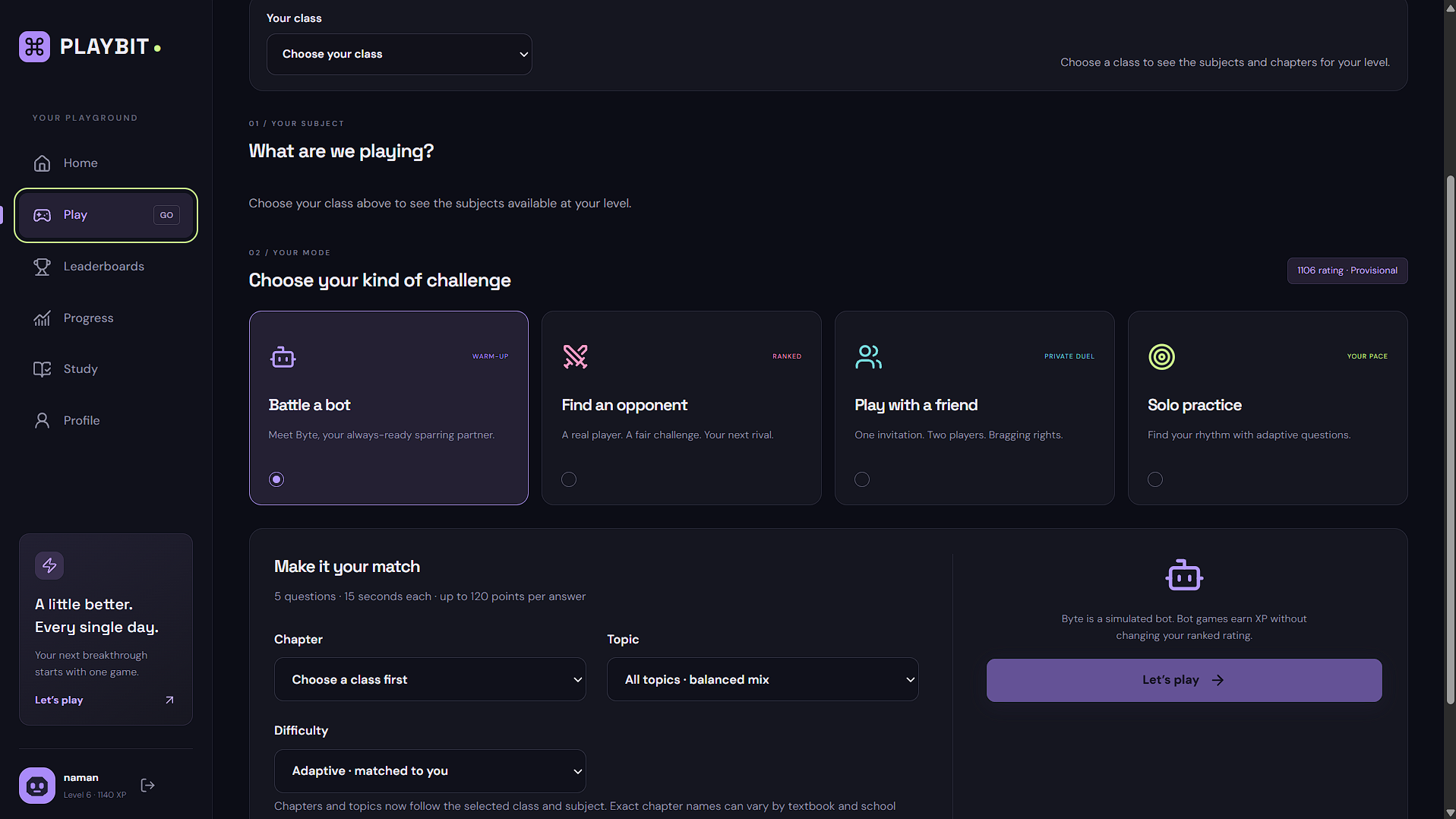
What makes Playbit exciting is its multiplayer gaming experience. Students can compete against other learners in real-time quiz battles, challenge their friends in private matches, or practice against AI-powered bots. Instead of studying alone, they experience the thrill of competition while improving their knowledge.
Playbit uses AI to generate diverse questions while minimizing repetition, making practice sessions fresh and challenging. Its adaptive difficulty system adjusts questions according to the student's skill level and performance.
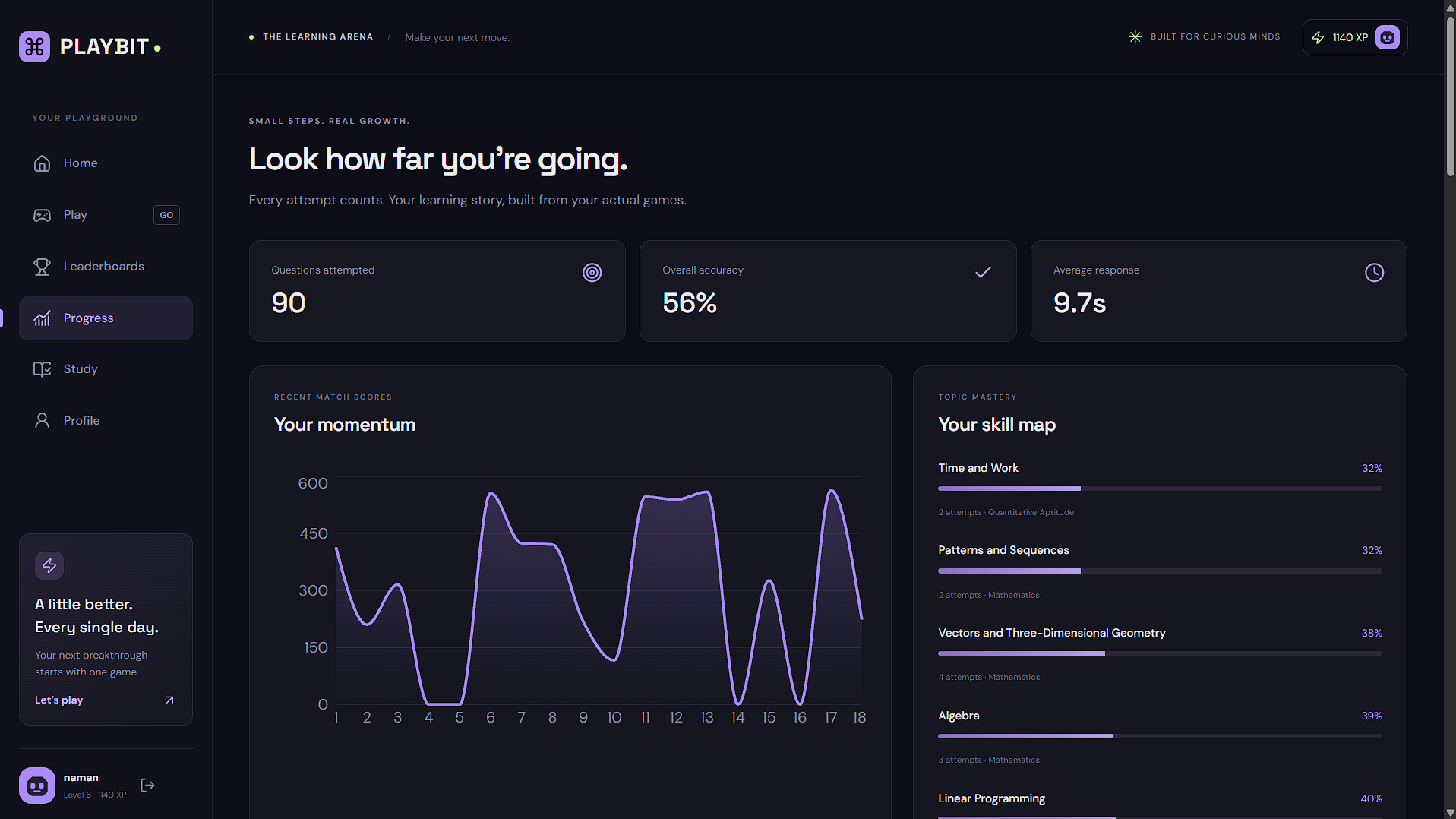
After each battle, students receive detailed performance reports showing their scores, accuracy, strengths, weaknesses, correct answers, formulas, and step-by-step explanations. This helps them understand their mistakes and identify areas requiring improvement.
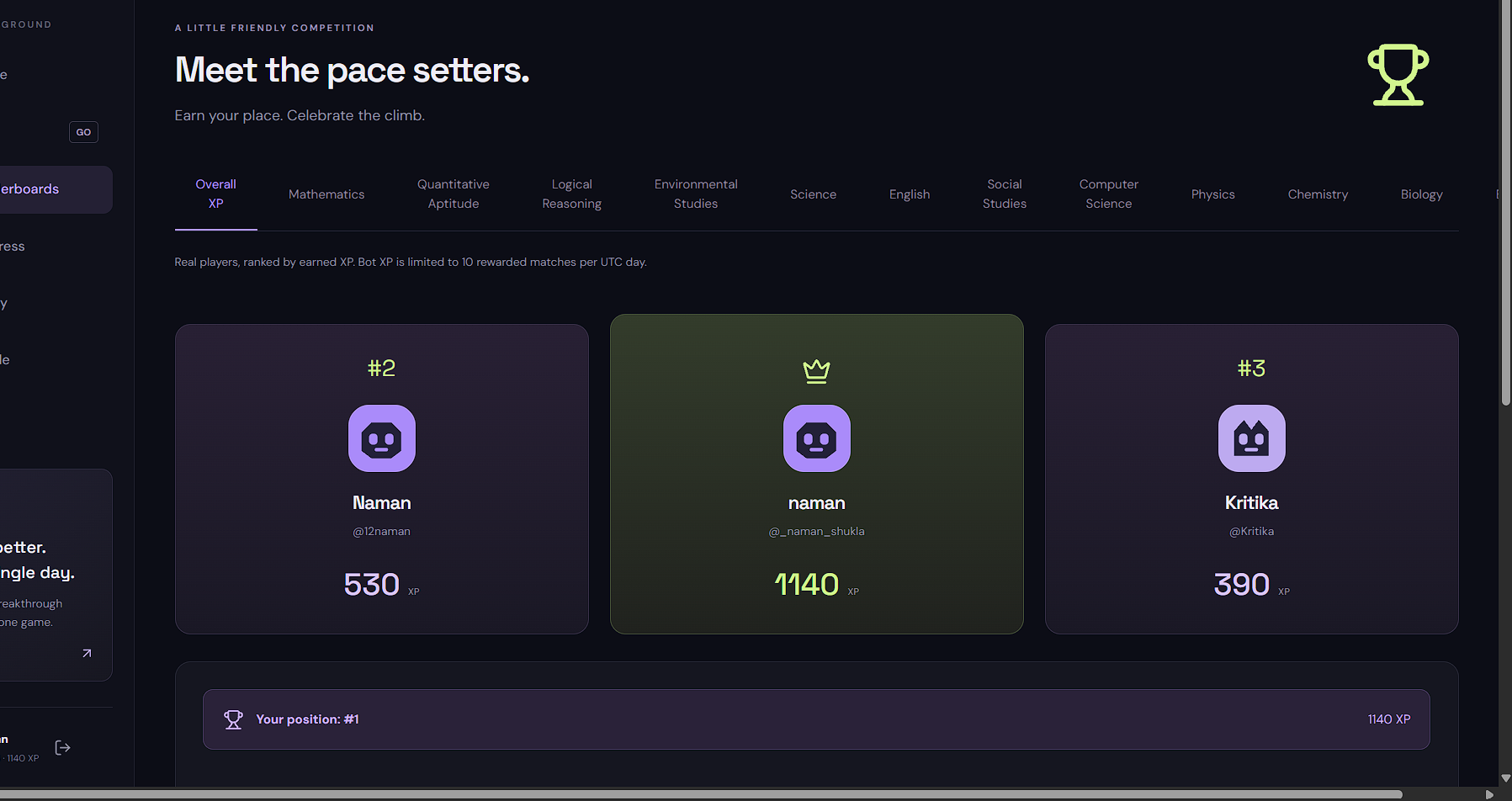
To make studying even more enjoyable, Playbit introduces experience points (XP), levels, achievements, and subject-wise and overall leaderboards. Students feel rewarded for their progress, stay motivated through friendly competition, and continuously challenge themselves to improve.
Playbit turns everyday exam preparation into an exciting learning adventure where every question improves knowledge, every competition builds confidence, and every achievement motivates students to keep learning.**
- How we built it
We designed Playbit using a modern full-stack architecture capable of supporting interactive gameplay, real-time competition, personalized learning, and AI-powered question generation.
For the frontend, we chose React, Vite, and TypeScript to create a responsive, engaging, game-inspired user interface. The design focuses on smooth navigation, interactive quizzes, player profiles, competitive dashboards, and an enjoyable learning experience.
For the backend, we planned Java with Spring Boot to manage application logic, quiz sessions, scoring, matchmaking, player progression, and communication between the frontend, database, and AI services.
We selected Supabase PostgreSQL for managing user profiles, question history, battle records, performance statistics, XP, and leaderboard data. Supabase Authentication handles user sign-in, while Supabase Realtime supports live multiplayer functionality.
For AI integration, our architecture uses Spring AI with a large language model to generate questions, produce explanations, and support personalized recommendations. We also designed deterministic question-generation methods and question fingerprinting to reduce repeated questions and improve reliability.
The adaptive learning system uses initial assessment results, question difficulty, accuracy, and performance history to guide question selection and match students with suitable competitors.
Our overall approach combines the excitement of gaming with the educational value of personalized, AI-assisted practice.
- Challenges we ran into
One of the biggest challenges was designing a platform that balances education and entertainment. We wanted Playbit to feel like an exciting multiplayer game without compromising the quality of learning or distracting students from their academic goals.
Another major challenge was reducing question repetition. Traditional quiz platforms frequently reuse the same questions, making practice predictable. Designing an AI-assisted generation system with question history and duplicate detection was important to keep learning sessions fresh.
Real-time multiplayer gameplay also presented challenges involving synchronized questions, accurate timers, fair matchmaking, live score updates, and handling players who disconnect during a battle.
Designing adaptive difficulty was another important challenge. Questions should not be so easy that students become bored or so difficult that they lose confidence. The platform needs to continuously evaluate performance and adjust practice accordingly.
We also had to consider AI-generated question accuracy, especially for mathematics and reasoning problems where incorrect answers or explanations could negatively affect learning.
Finally, building a feature-rich experience while prioritizing stable core gameplay required careful planning and feature prioritization.
- Accomplishments that we're proud of
Our biggest accomplishment is developing the concept and technical design for a platform that combines learning, gaming, AI, and healthy competition into one experience.
We are particularly proud of Playbit's personalized learning approach, where students are assessed based on their abilities rather than receiving identical questions regardless of their skill levels.
Another important achievement is designing an interconnected gameplay system that brings together multiplayer battles, AI bot practice, friend challenges, adaptive question difficulty, and progress tracking.
We are also proud of the AI-assisted question-generation strategy, which aims to reduce repetitive practice while providing students with fresh educational challenges.
The performance analysis system is another key part of our vision. Instead of simply telling students whether they won or lost, Playbit aims to explain their mistakes, highlight weak concepts, and guide them toward improvement.
Most importantly, we are proud of creating a project focused on solving a real student problem: making consistent exam preparation more enjoyable, motivating, and effective.
- What we learned
Working on Playbit taught us that effective educational technology is not just about delivering questions and answers. It is about understanding how students learn, what motivates them, and how technology can help them improve consistently.
We learned the importance of gamification in education. Features such as multiplayer competitions, XP, levels, achievements, and leaderboards can make regular practice more engaging when they are designed around meaningful learning outcomes.
We also explored how AI can support personalized education through adaptive questions, explanations, performance analysis, and targeted improvement recommendations.
Another important lesson was that AI-generated educational content needs validation. Generating questions is only one part of the process; ensuring correctness, appropriate difficulty, and minimal repetition is equally important.
We gained a deeper understanding of real-time system design, backend architecture, databases, multiplayer synchronization, and the importance of building reliable core features before expanding a product.
Above all, we learned that the best learning platforms should encourage students to develop consistency, confidence, and genuine understanding rather than focusing only on scores.
- What's next for PlayBit
Our vision is to turn Playbit into a comprehensive AI-powered learning and competitive exam preparation ecosystem.
We plan to expand beyond Mathematics, Quantitative Aptitude, and Logical Reasoning by introducing dedicated exam preparation for JEE, NEET, GATE, college examinations, and other competitive exams, including subject-specific question banks, exam patterns, and personalized learning paths.
We also aim to improve AI-powered question generation, introduce stronger question-validation methods, and build more advanced adaptive learning models that understand each student's strengths, weaknesses, and progress over time.
Future features include multiplayer tournaments, seasonal rankings, daily challenges, streak rewards, badges, team competitions, and more engaging ways for students to learn with their friends.
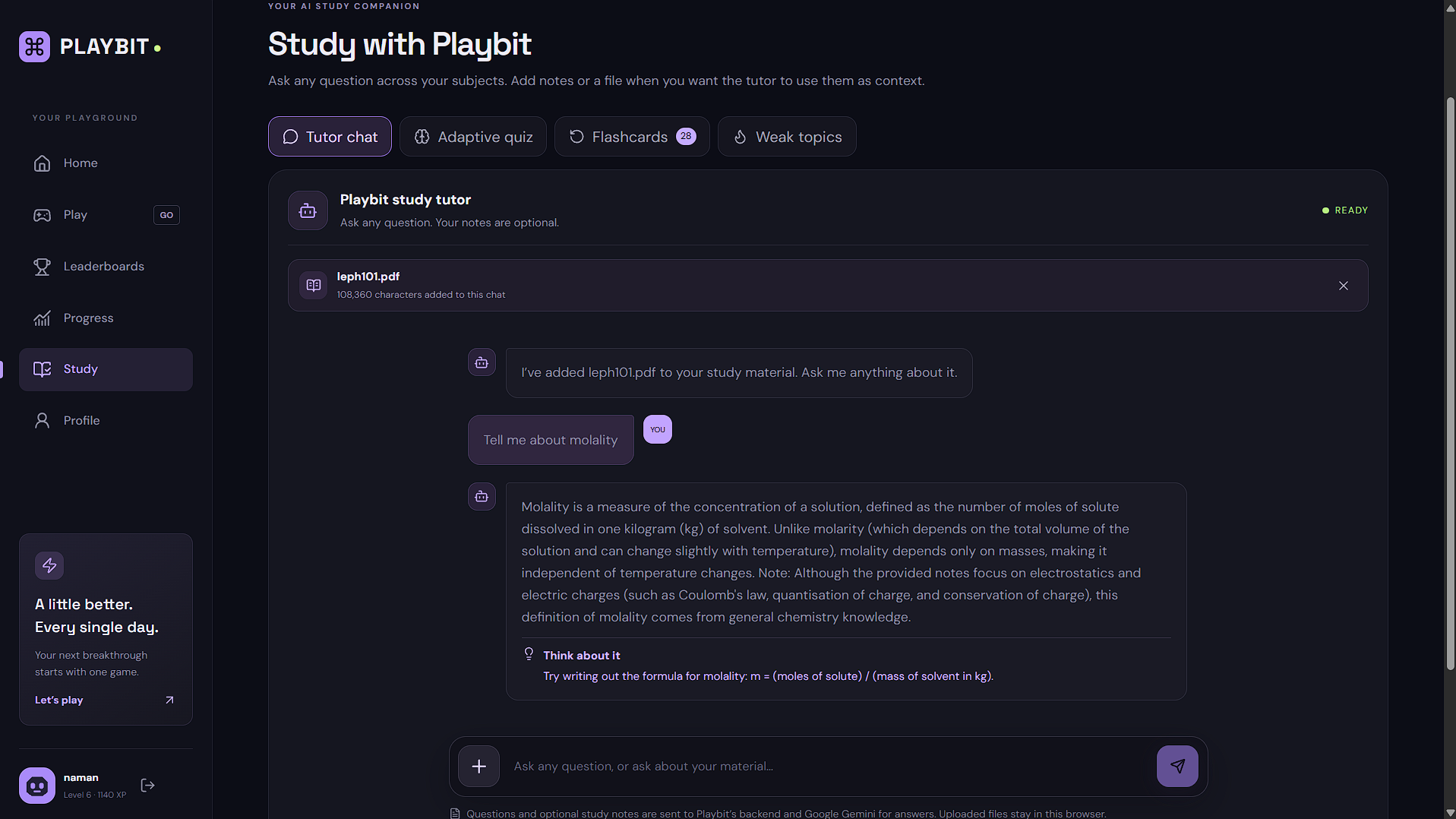
We also envision intelligent AI study assistants that explain difficult concepts, recommend revision topics, generate personalized practice sessions, and help students prepare for their upcoming examinations.
A dedicated mobile experience, improved analytics dashboards, collaborative learning communities, and structured exam preparation roadmaps are also part of our long-term vision.
Ultimately, we want Playbit to become a platform where millions of students can prepare for their exams while experiencing the excitement of gaming, the motivation of competition, and the benefits of personalized AI-powered education.**
Playbit — Play. Learn. Compete. Improve. Repeat.
Built With
- java
- react
- restapi
- springboot
- supabase
- typescript
- vite
- websockets

