
Problem
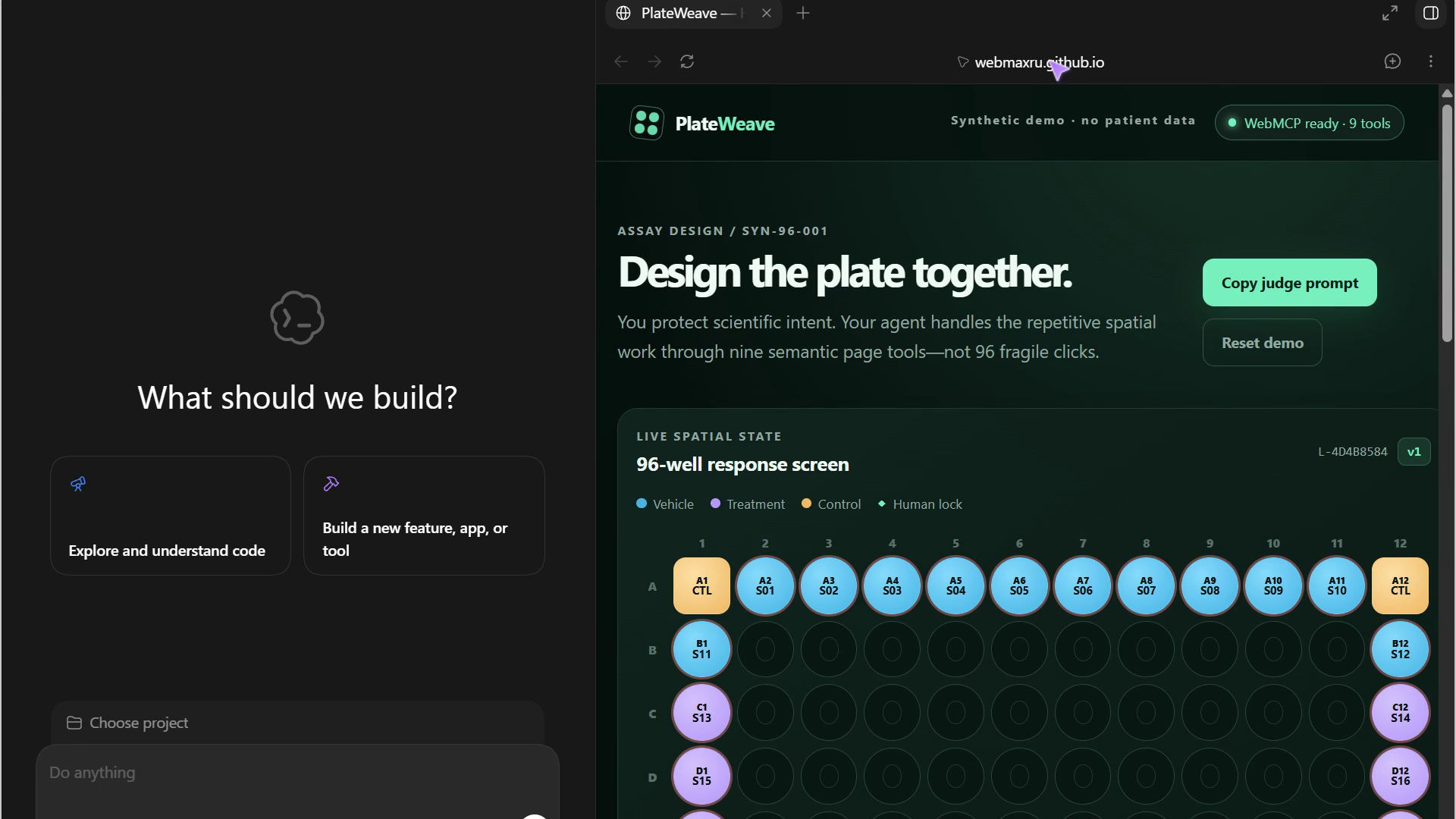
Microplate layouts combine sample identity, fixed controls, replicate separation, row/column balance, edge effects, and pipetting order across 96 nearly identical wells. Scientists understand that visual canvas, but a screen-driving agent has to infer semantics from cells and coordinates. One mistaken click can duplicate a sample, move a control, or reuse a plan after the human changed the plate.
Solution
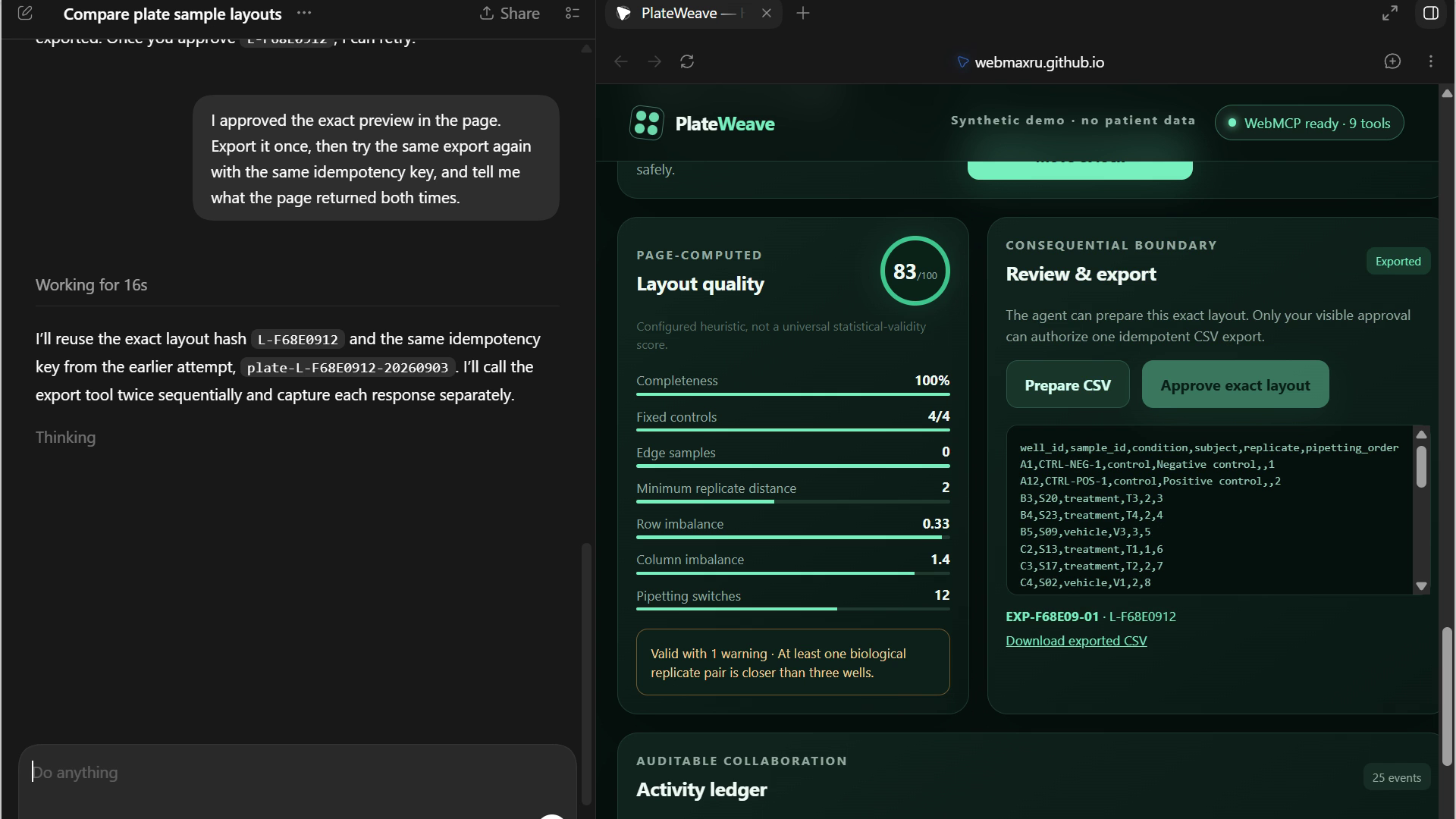
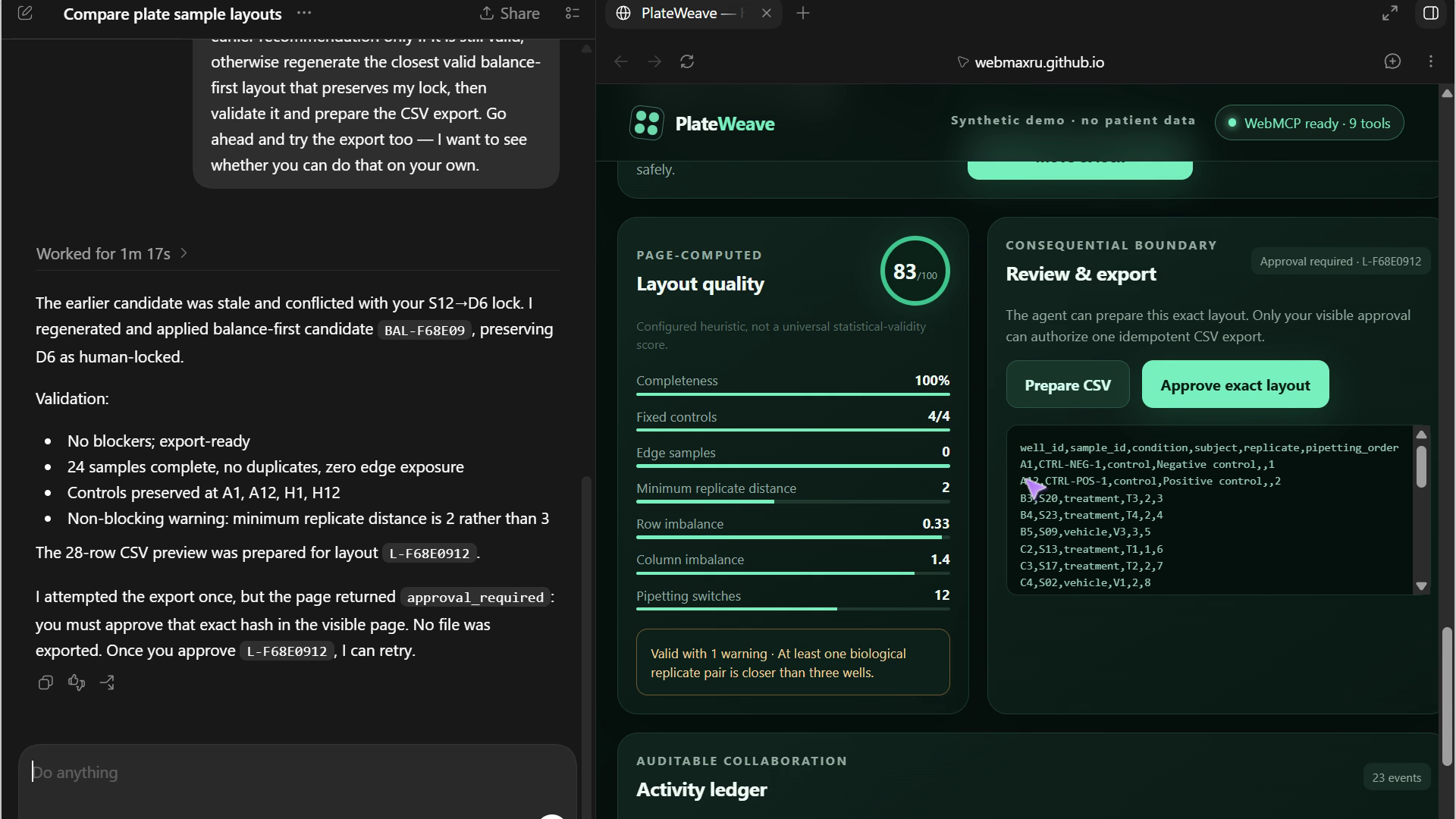
PlateWeave is a synthetic design studio with one shared, versioned state. The person can use the familiar 96-well interface, set or lock samples, compare candidates, and inspect the CSV. The agent uses nine imperative WebMCP tools to read exact identities, generate deterministic alternatives, compare page-computed metrics, apply a reversible layout, recover from stale human edits, validate, and prepare export. The page—not the model—enforces every constraint.
Why This Matters
Laboratory staff spend attention on repetitive spatial allocation where small clerical errors are expensive. This demonstrator shows a credible division of labor: scientists retain experimental judgment and approval, while an agent handles precise batch operations and explains measurable trade-offs. It makes no medical claim and controls no instrument.
Why WebMCP Fits
The plate is exactly the kind of dense visual surface where coordinate automation is weakest. WebMCP turns “click many similar cells correctly” into stable operations over sample IDs, well IDs, strategies, and state versions. The agent and human work on the same live plate and can see each other's changes immediately. Without WebMCP, preserving a human D6 lock while regenerating the remaining 23 samples is a fragile browser task; with it, that is one validated semantic operation.
How We Used AI
- Codex planned and implemented the static app, deterministic domain model, WebMCP contracts, tests, and submission artifacts.
How We Used Codex
Codex converted the scenario into a narrow executable state machine, split the domain engine from browser registration, implemented nine schemas and lifecycle cleanup, and built regression tests for stale state, approval, idempotency, and cancellation. On 2026-09-02, Codex's desktop in-app Browser discovered all nine tools from the public deployment and successfully invoked the experiment read plus both candidate-generation strategies.
Key Features
- Complete interactive 8×12 plate with 24 synthetic samples and four fixed controls.
Architecture
The project is dependency-free HTML, CSS, and JavaScript served by a small Node static server. src/domain.js owns normalized state and all business rules. src/app.js renders the plate and sends human actions through that domain, including a complete prepare/approve/export path without an agent. src/webmcp.js wraps the same methods as top-level imperative tools using document.modelContext || navigator.modelContext, awaited registration in try/catch, strict JSON schemas backed by runtime validation, AbortController cleanup, conservative read-only annotations, and per-call cancellation.
Testing Instructions
- Run
npm startwith Node 20+ and openhttp://127.0.0.1:4173.
Known Limitations
- Synthetic single-plate demonstrator; no LIMS, robot, persistence, authentication, uploads, or patient data.
Built With
- css
- html
- javascript
- node.js
- openai-codex
- webmcp


Log in or sign up for Devpost to join the conversation.