-
Design idea
Inspiration
Food waste is a well known problem, but what stood out to me was how little visibility commercial kitchens actually have into what is being wasted. While restaurants and institutions often track total food costs or disposal weight, they rarely know which specific foods are wasted, when waste occurs or whether it was avoidable. I realised that most food waste reduction efforts fail not because people don’t care, but because decisions are made without accurate feedback. This inspired me to design a system that could make food waste visible at the exact moment it happens, without relying on manual logging or staff behavioural change.
What it does
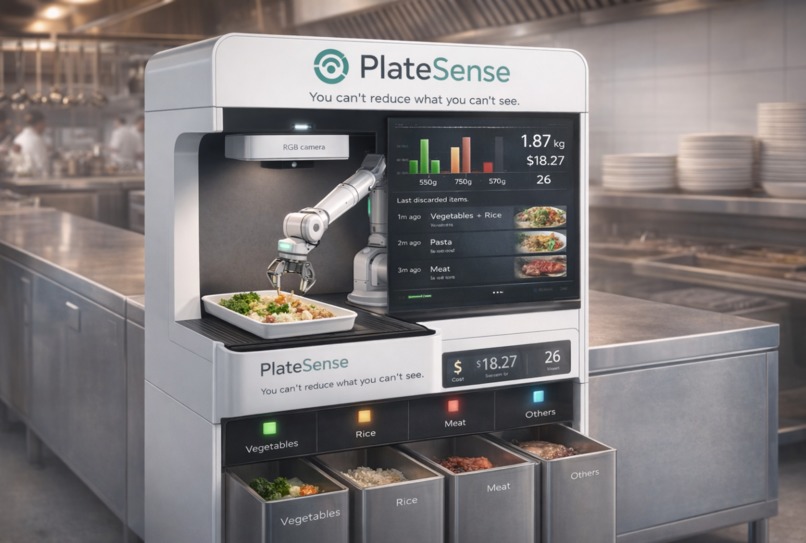
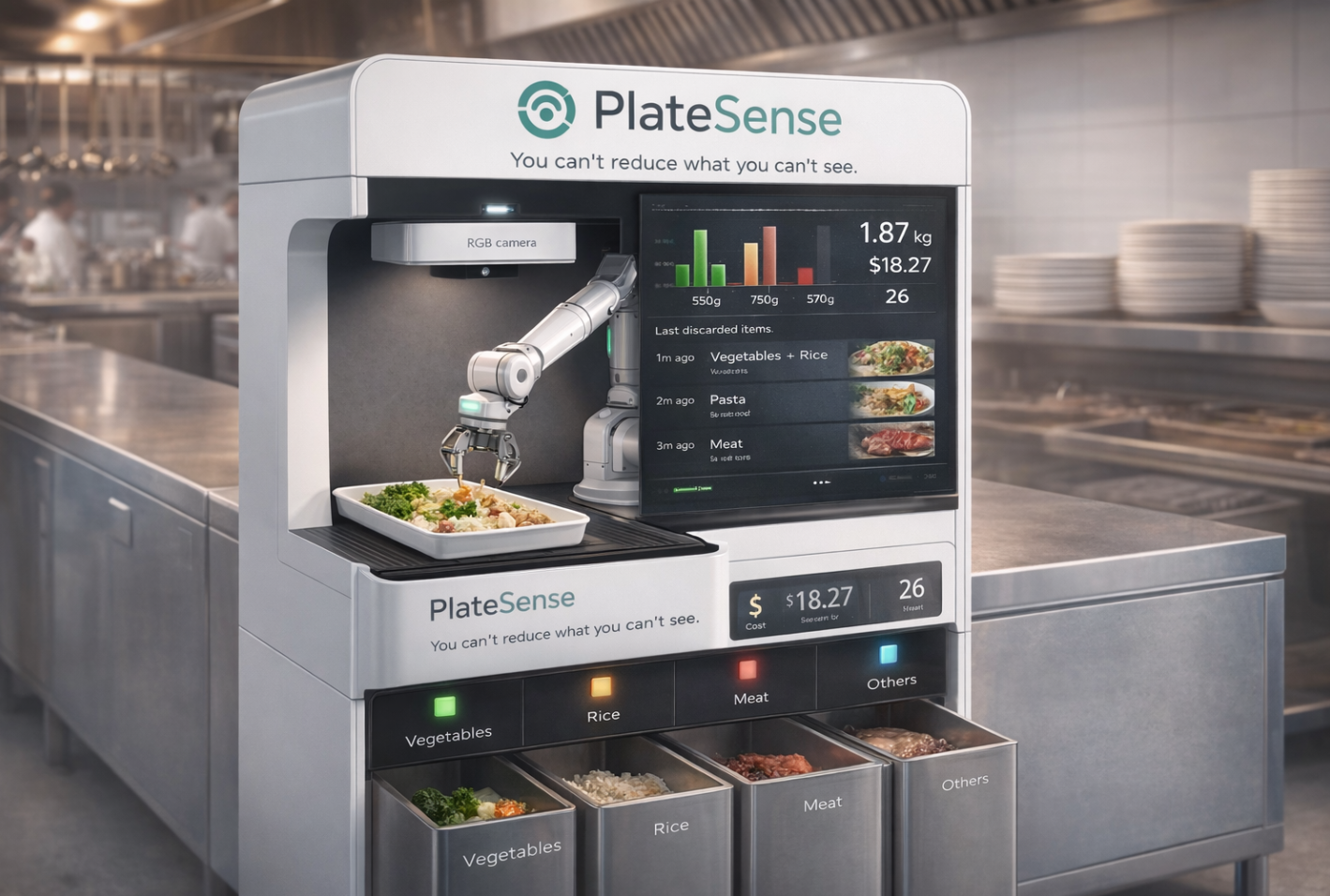
PlateSense is an autonomous food waste sensing and sorting system designed for commercial kitchens. Installed at the point of disposal, it uses computer vision, weight sensing and robotic actuation to automatically identify, classify and quantify food waste in real time. The system distinguishes between different food categories, records when and how much waste is generated, and aggregates this data into an analytics dashboard. By turning physical waste into structured, actionable data, PlateSense enables kitchens to understand the root causes of waste and make informed decisions to reduce it.
How we built it
I designed it as a cyber-physical system combining hardware, perceptions and analytics. On the hardware side, the system includes a camera for visual input, weight sensors for measuring quantities, and a robotic mechanism to physically sort waste into categories. On the software side, I implemented computer vision models to classify food types and fused this with sensor data to improve accuracy. A control logic pipeline handles detection, classification, and actuation, while a backend analytics layer aggregates the data and presents insights through a dashboard. The system was designed with scalability and automation in mind, prioritizing reliability in a fast paced kitchen environment.
Challenges we ran into
One major challenge was designing a system that could operate accurately in a messy unstructured environment where food waste is mixed, irregular and unpredictable. Lighting variation, overlapping food items and contamination from non-food objects posed difficulties for visual classification.
Accomplishments that we're proud of
I am proud of developing a concept that meaningfully integrates robotics with sustainability. I was able to build a solution that addresses the root cause of food waste rather than its symptoms.
What we learned
I learnt that many sustainability problems are fundamentally systems problems rather than behavioral ones. I gained a deeper understanding of how robotics can be used not just to perform tasks, but to create reliable feedback loops between the physical and digital world.
What's next for PlateSense
Next, I aim to improve the accuracy of the food classification models, expand the range of detectable food categories, and optimize the mechanical design for faster operation.
Built With
- canva

Log in or sign up for Devpost to join the conversation.