-
-
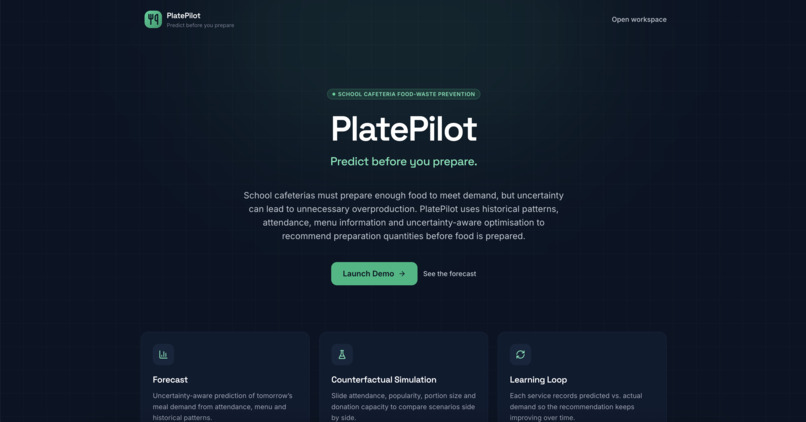
The Overview
-
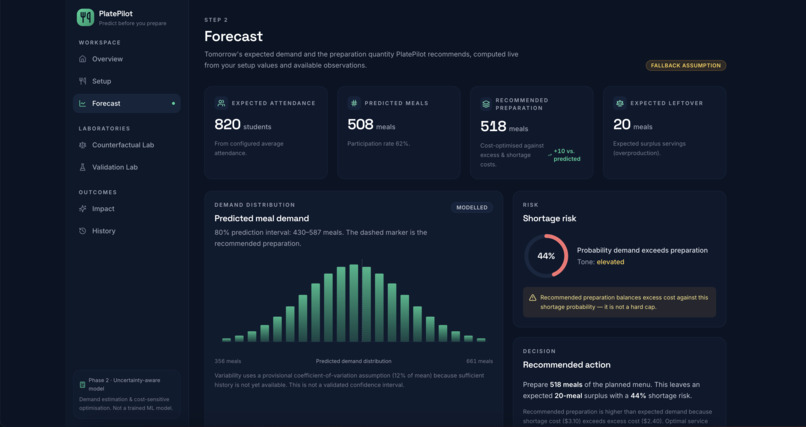
Forecast
-
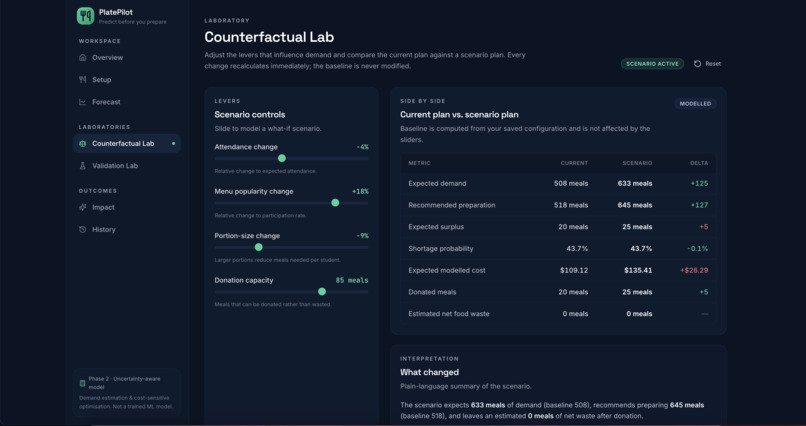
Counterfactual Lab
-
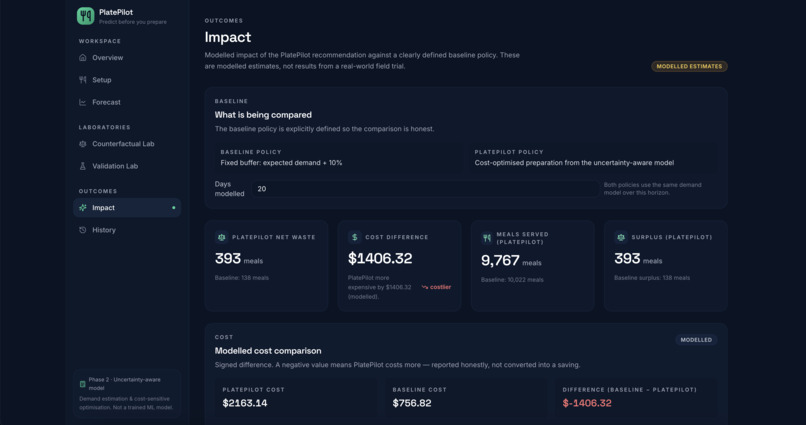
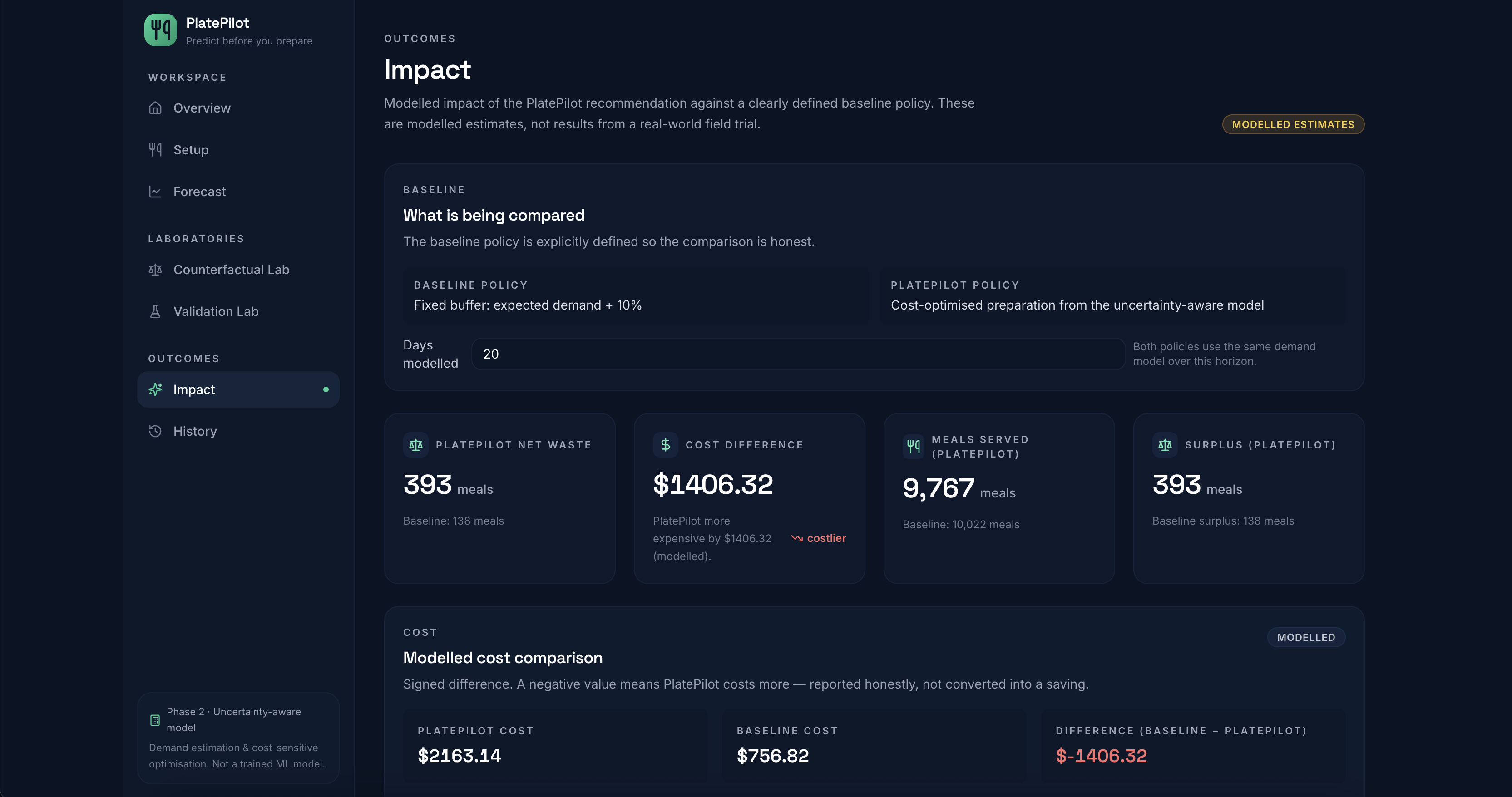
Impact Analysis
-
Validation Lab
-
History
The Problem
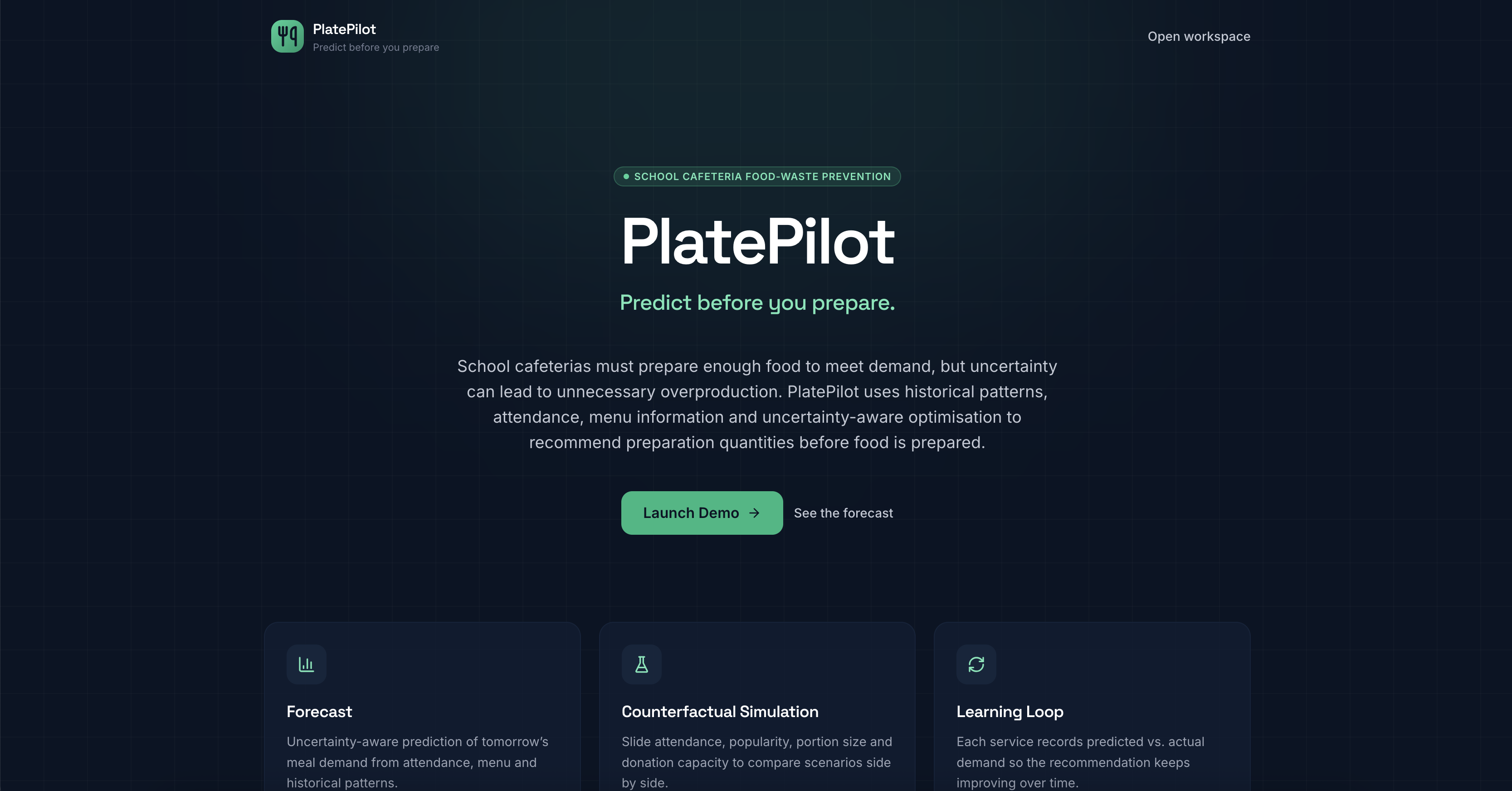
School cafeterias must prepare enough food to meet student demand without consistently producing more than students consume. Preparing too little risks unmet demand, while preparing too much can lead to avoidable food waste and unnecessary costs.
Many approaches focus on measuring waste after a meal has been served. PlatePilot focuses on the decision that happens before preparation begins.
Our Solution
PlatePilot is a functional prototype that estimates cafeteria meal demand and recommends a preparation quantity based on expected demand, uncertainty, and the relative costs of food surplus and shortages.
Its central question is simple:
How much food should a cafeteria prepare tomorrow, given that demand is uncertain?
How It Works
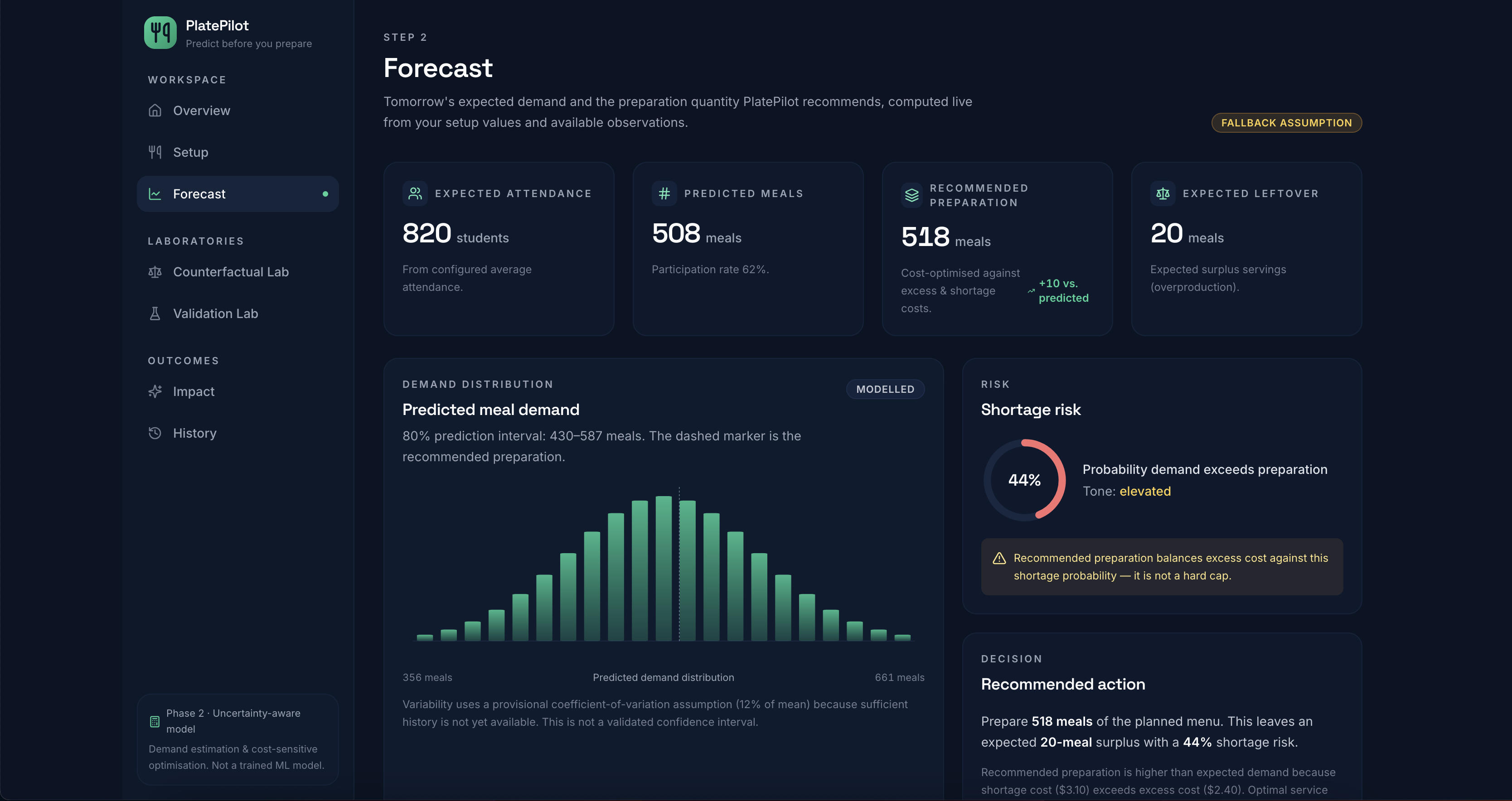
1. Forecast demand. Users enter attendance, participation, menu, and cost assumptions. Eligible historical observations can refine the demand estimate when sufficient data is available.
2. Optimise preparation. A cost-sensitive optimisation model balances expected excess-food costs against shortage costs instead of simply preparing the average predicted demand.
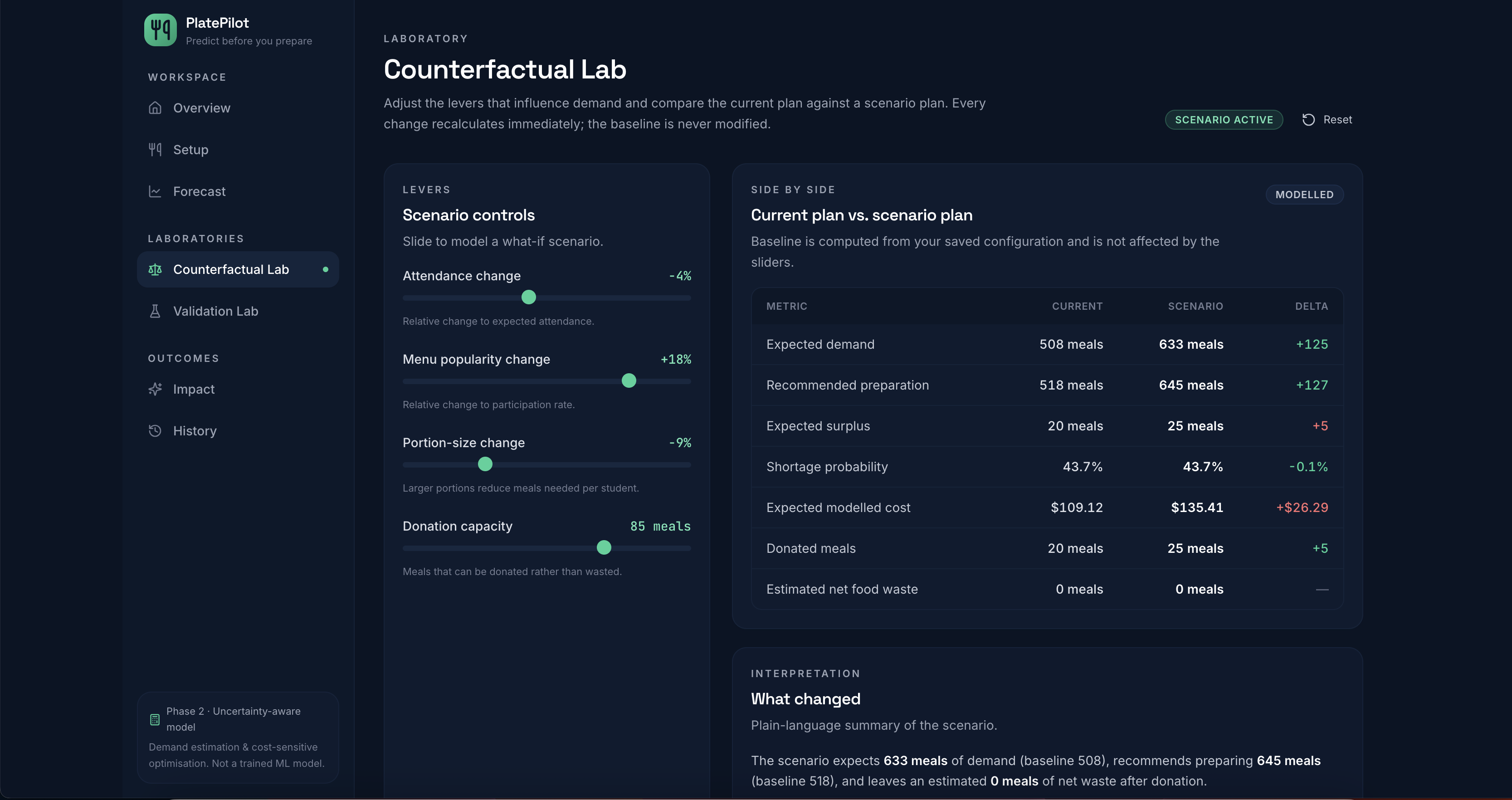
3. Explore alternative scenarios. The Counterfactual Lab lets users change attendance, menu popularity, portion size, and donation capacity to examine how preparation recommendations and projected outcomes change.
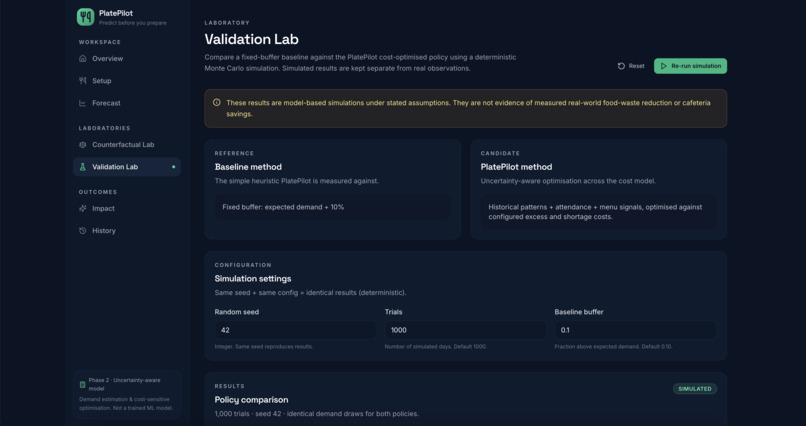
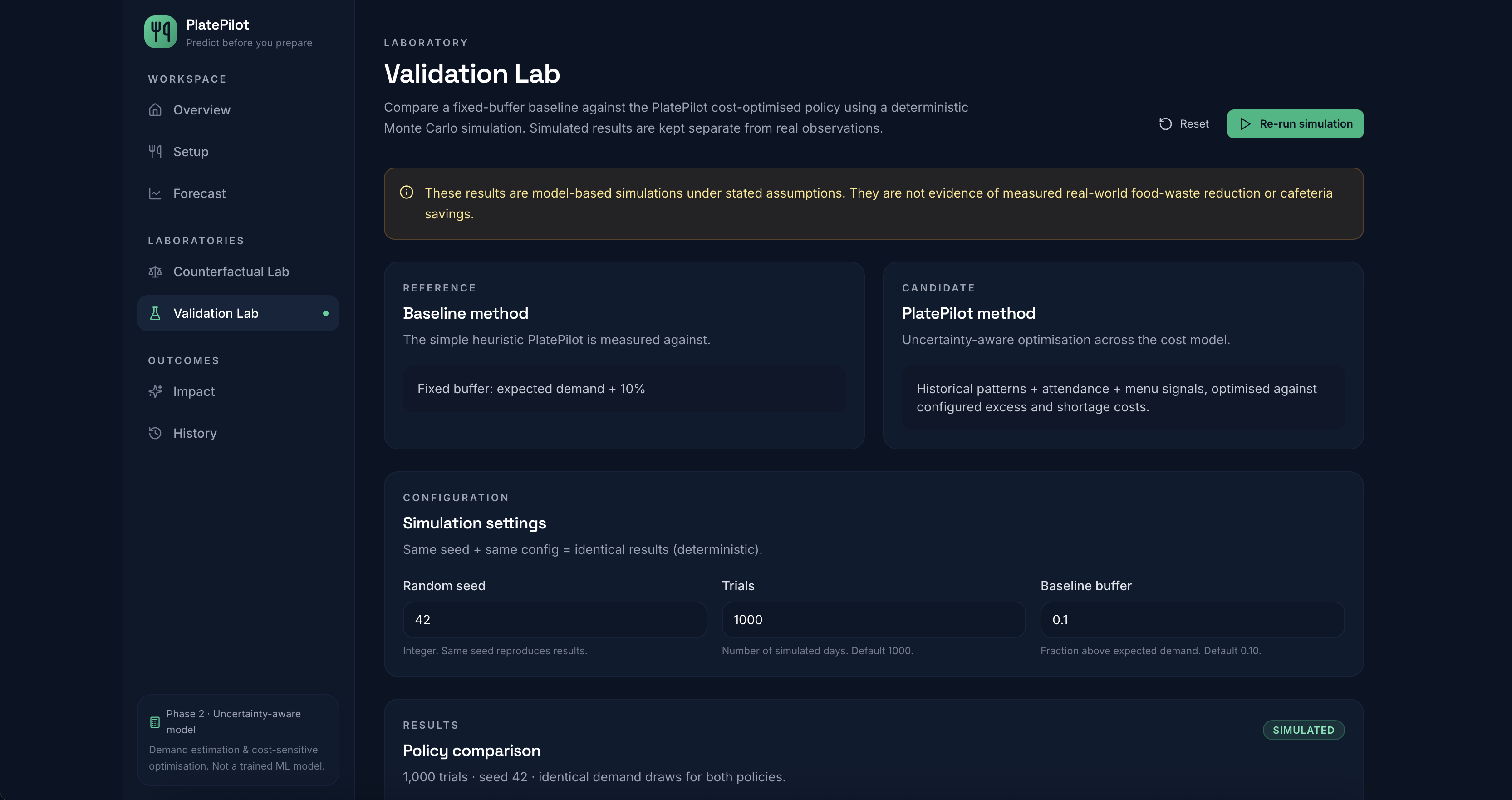
4. Evaluate under uncertainty. The Validation Lab runs deterministic, seeded Monte Carlo simulations and compares the optimised policy with a fixed-buffer baseline under consistent simulated demand conditions.
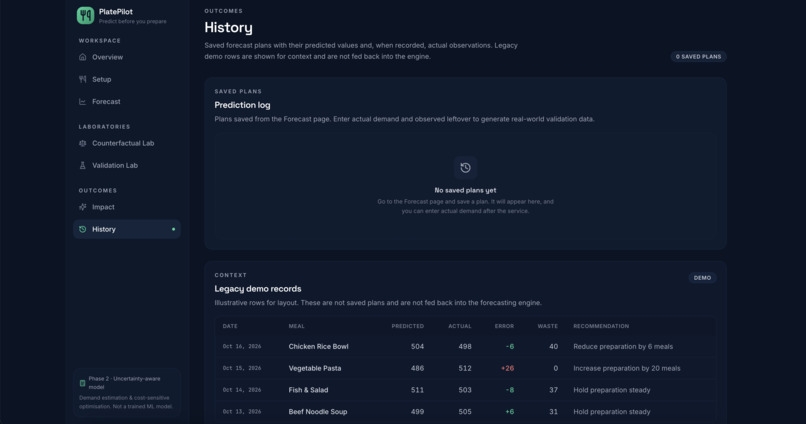
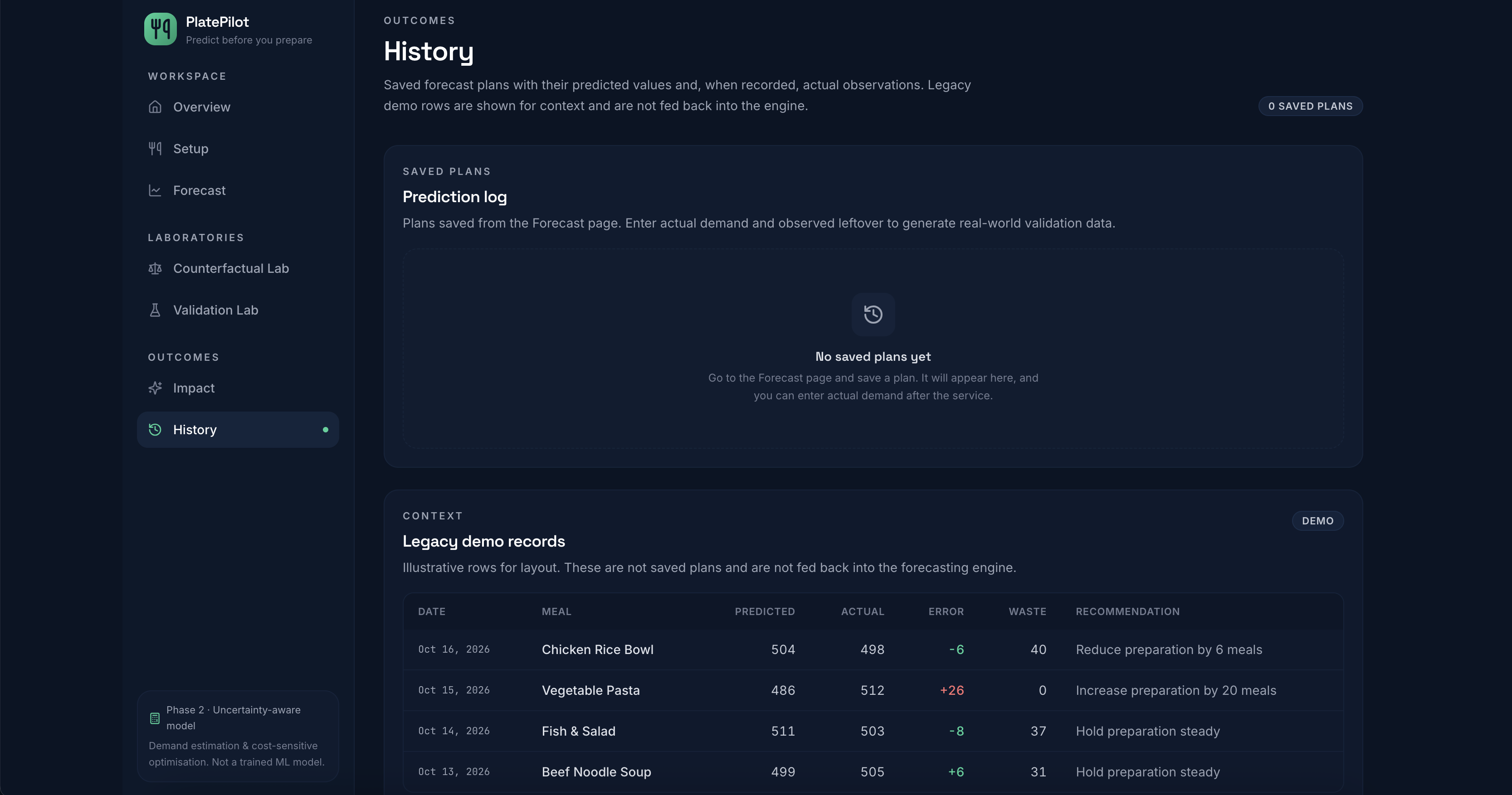
5. Learn from actual outcomes. Saved plans can be linked to observed demand and leftovers. The system distinguishes measured observations from predictions and synthetic simulation results.
What Makes PlatePilot Different?
PlatePilot is designed as a decision-support system rather than a retrospective waste dashboard. It combines demand estimation, uncertainty-aware preparation recommendations, cost-sensitive optimisation, counterfactual scenarios, and reproducible policy simulation in one workflow.
The model is inspectable and testable. Its output responds to the inputs and cost assumptions rather than relying on static dashboard figures.
Technology
- React, TypeScript, and Vite
- A modular, deterministic forecasting and optimisation engine
- Statistical helpers for demand uncertainty
- A seeded Monte Carlo simulation engine
- Shared application state and versioned localStorage persistence
- Automated tests covering optimisation, statistical edge cases, counterfactuals, simulation, persistence-related behaviour, and impact calculations
The current project has 47 passing automated model tests, with typecheck, lint, and production build reported as passing.
Evidence and Limitations
The Validation Lab generates controlled simulations, not measurements from a deployed cafeteria. Its results demonstrate how the policies behave under the model's assumptions; they do not establish real-world reductions in waste or cost.
Environmental benefits are shown only when the relevant conversion factors are configured. Actual impact would need to be evaluated with real cafeteria data over time.
PlatePilot is a prototype intended to demonstrate how better demand estimation and explicit cost trade-offs could support more informed food-preparation decisions.
Built With
- css3
- data
- html5
- javascript
- localstorage
- monte-carlo-simulation
- optimization
- react
- statistical-modeling
- typescript
- visualization
- vite

Log in or sign up for Devpost to join the conversation.