Inspiration
I started with a simple question: how much food does a school canteen actually throw away, and why?
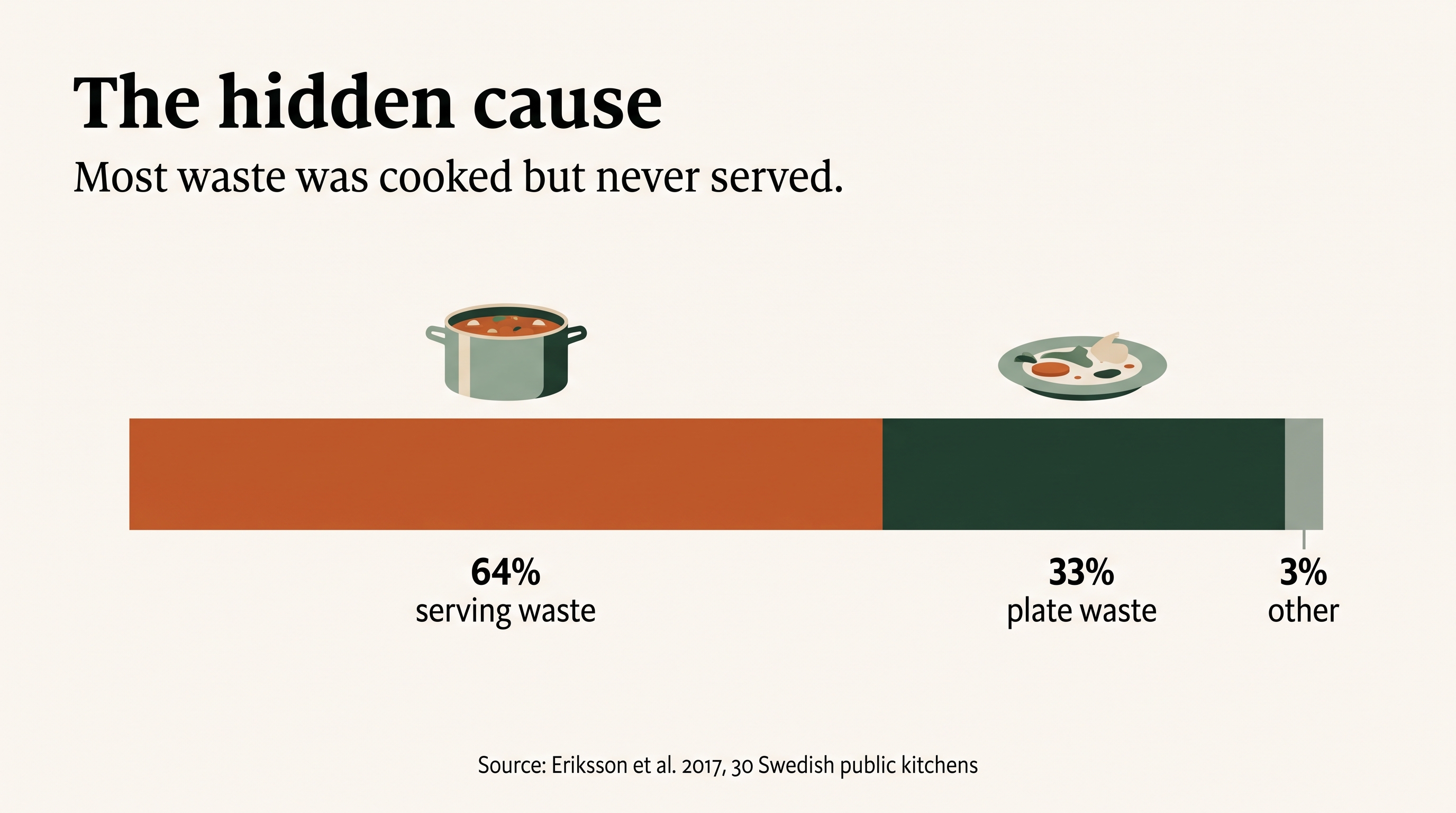
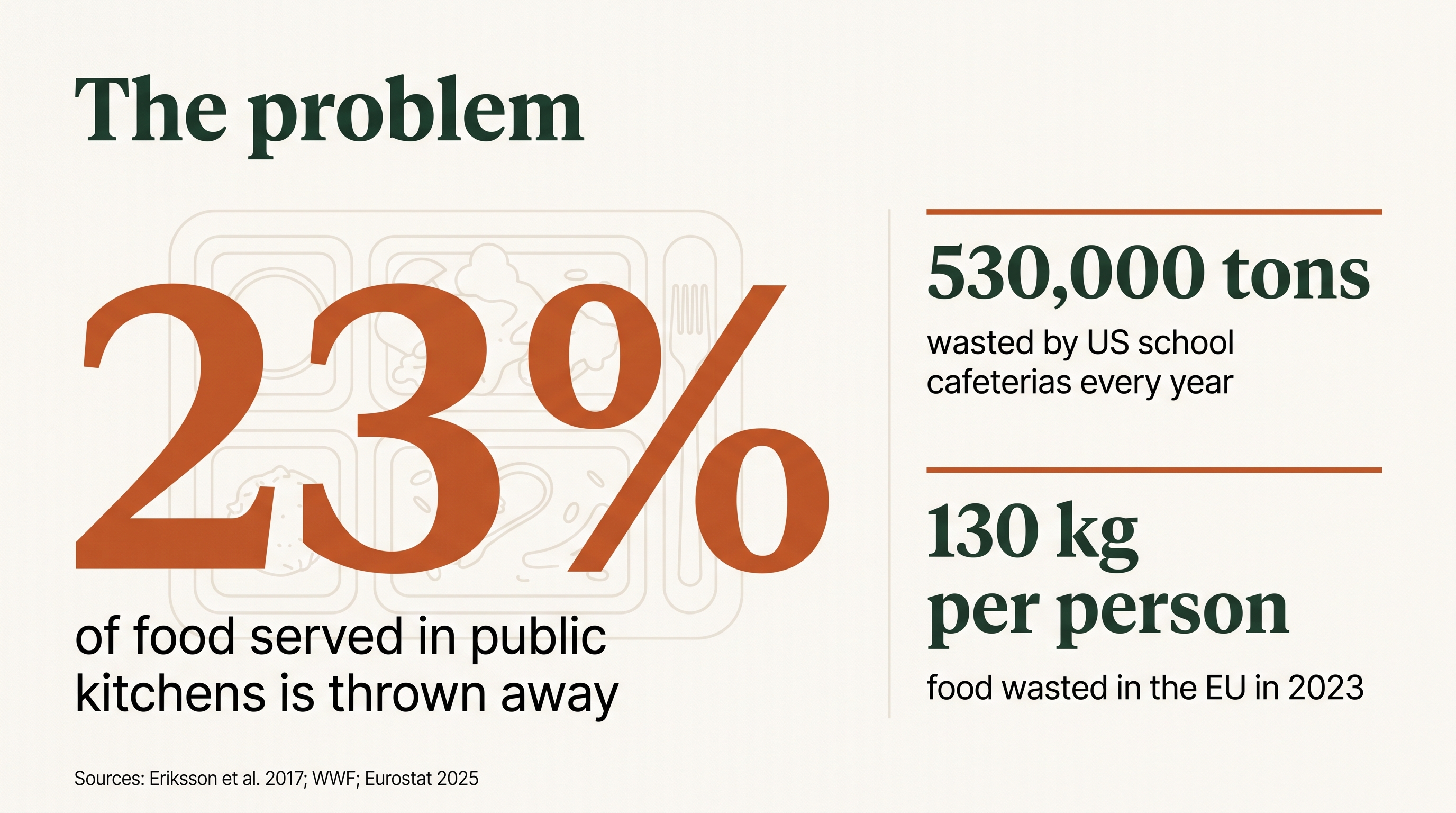
I expected the answer to be "students are picky eaters." The research told a different story. In a study of 30 Swedish public kitchens, 23% of the food served was wasted, and 64% of that waste was never on a plate at all. It was cooked but never served, because kitchens have to guess every day how many students will show up.
That changed how I saw the problem. Posters asking students to "finish your plate" target the smaller part of the waste. The bigger part is an information problem, and information problems are cheap to solve.
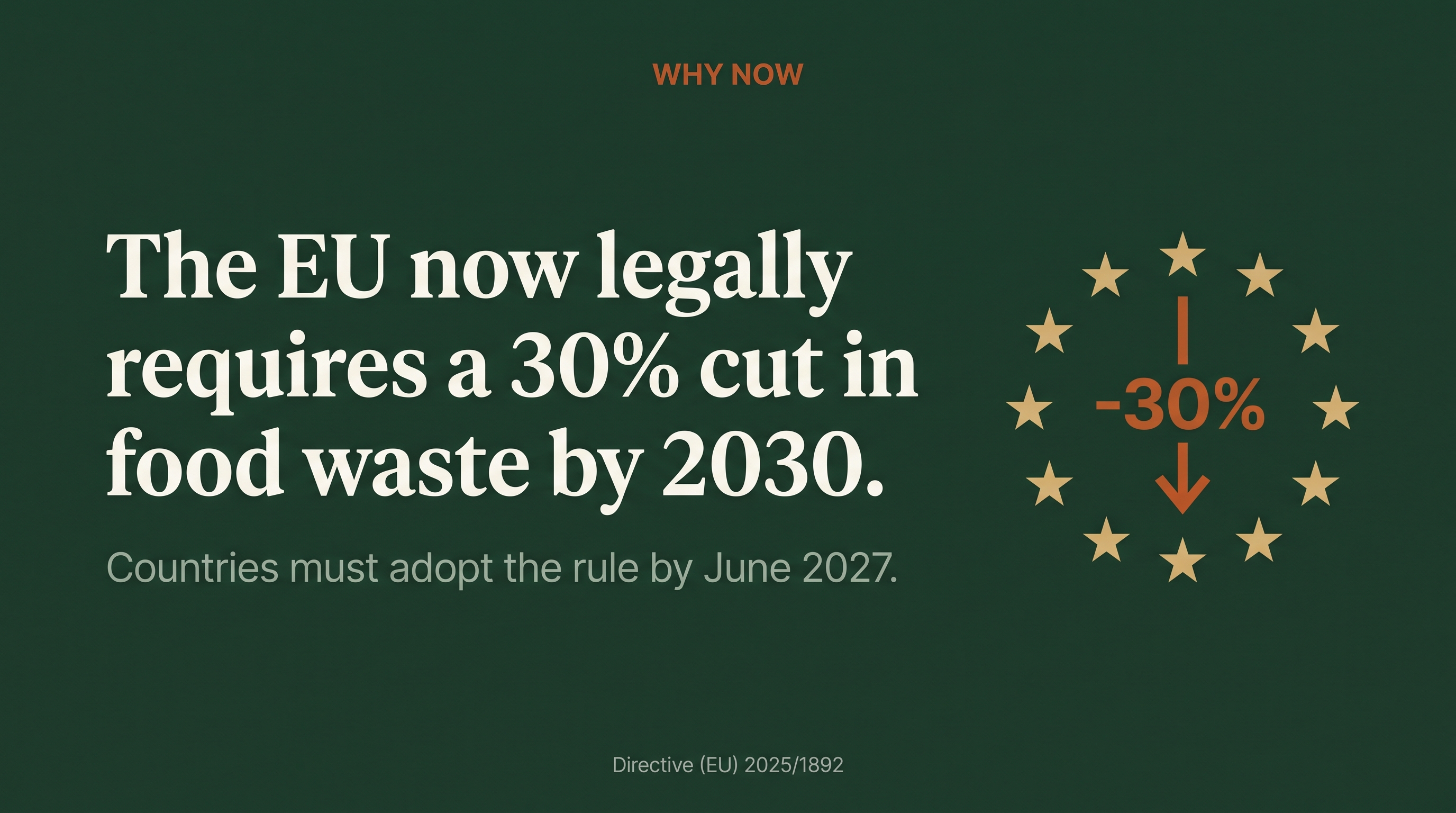
The timing also matters. Directive (EU) 2025/1892 now legally requires EU countries to cut food waste in food services and households by 30% per person by 2030, and countries must adopt it by June 2027. Schools will soon need simple, measurable tools, and today most of them have none.
What it does
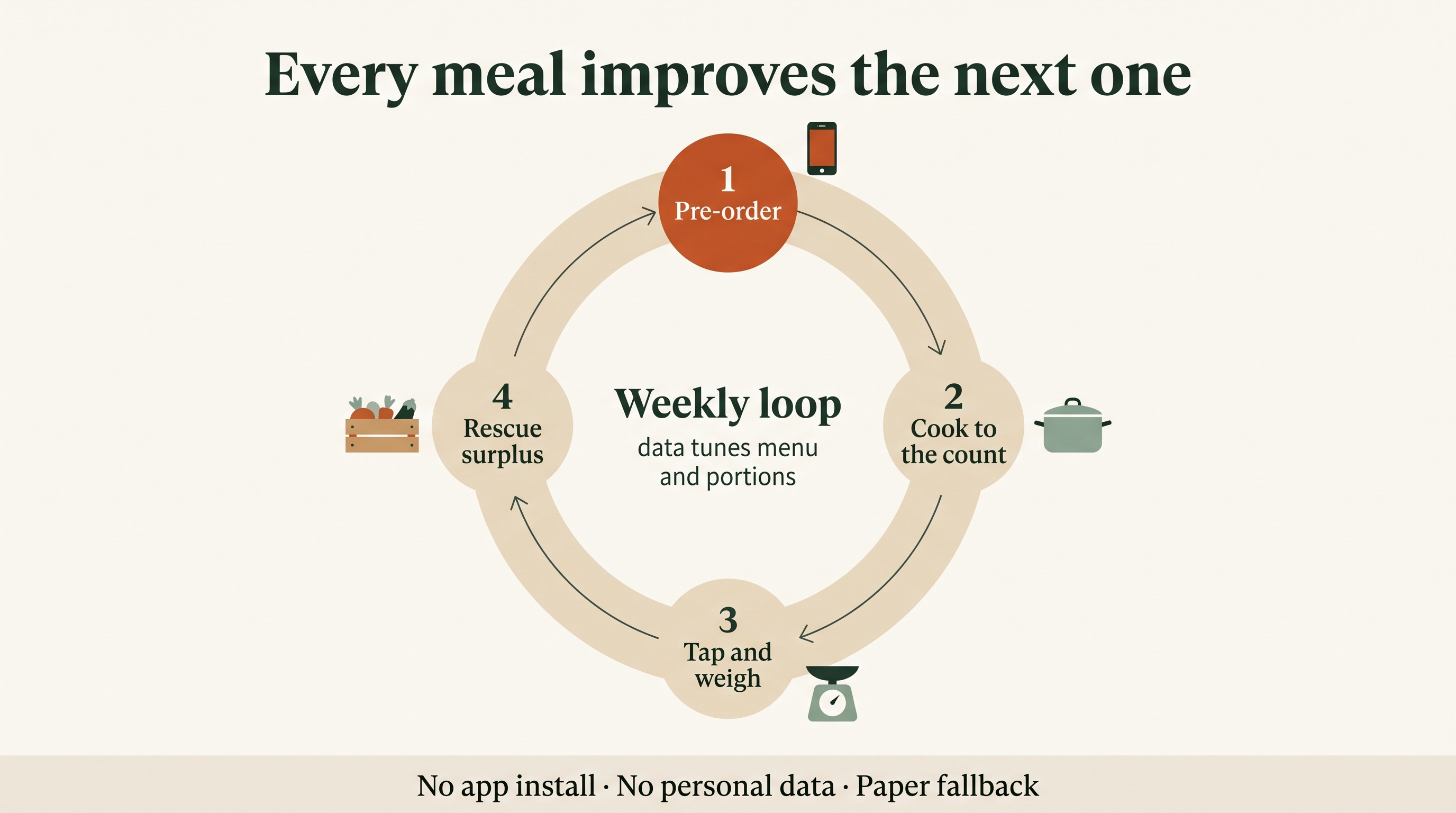
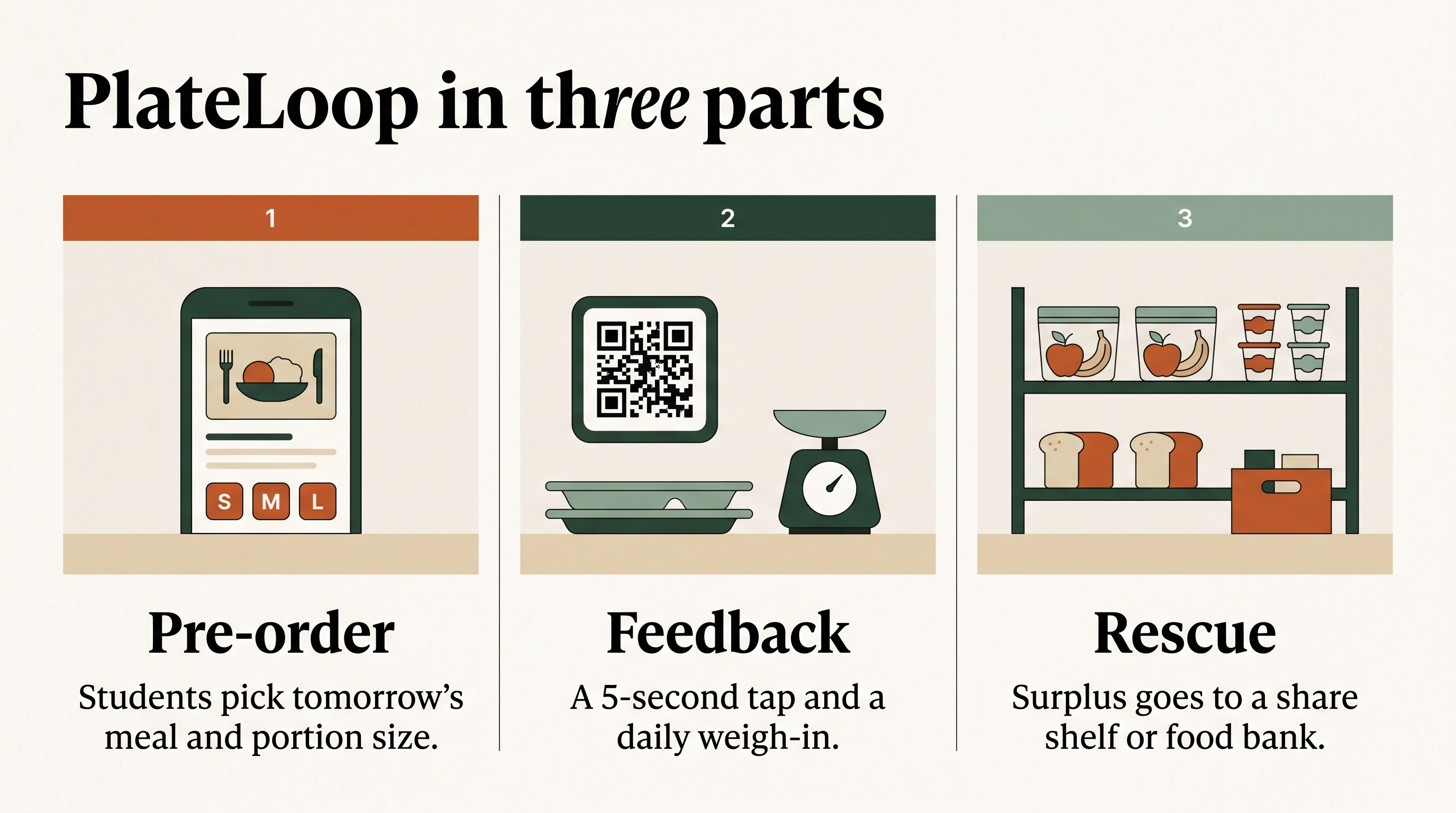
PlateLoop is a low-cost system that helps school canteens cook what actually gets eaten and share what is left. It has three parts that feed into each other:
- Pre-order. Students pick tomorrow's meal and portion size (S / M / L) by 18:00 the day before. The kitchen gets a real headcount instead of a guess.
- Feedback. At the tray return, students tap a QR code: too much, just right, or didn't like it. Staff weigh the leftovers once a day.
- Rescue. Sealed, untouched surplus goes to a share shelf or a partner food bank instead of the bin.
Every week, the data shows which dishes come back uneaten and which portions are too big, so the menu and default portions adjust. That is the loop.
Design principles:
- No app to install: a mobile web app plus QR codes
- No personal data: only a class code
- Under 5 minutes of extra work per day for kitchen staff
- A paper fallback for schools where phones are not allowed
How I built it
This is an Ideathon project, so the "build" was research, system design and planning.
1. Research. I collected data from Eurostat, EU law, peer-reviewed studies on school catering in Sweden and Latvia, WWF's Food Waste Warriors program in the US, and the Bulgarian Food Bank. I separated waste into serving waste (cooked, never served) and plate waste (left by students), because they have different causes and need different fixes.
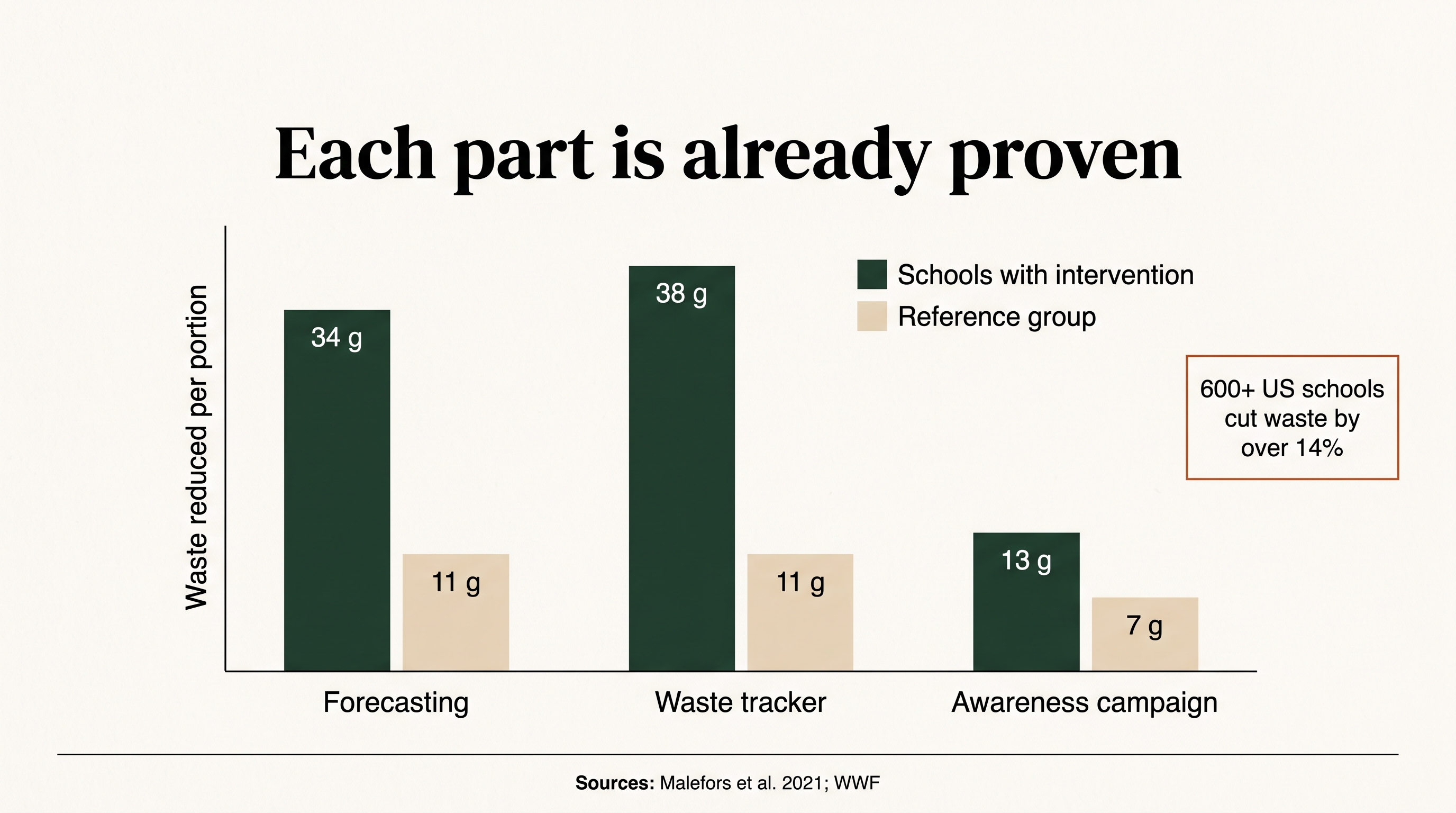
2. Evidence mapping. I matched each part of PlateLoop to a tested intervention. In a Swedish school trial, a guest forecasting tool cut serving waste by 34 g per portion and a waste tracker by 38 g, while an awareness campaign cut plate waste by 13 g. PlateLoop combines these into one loop.
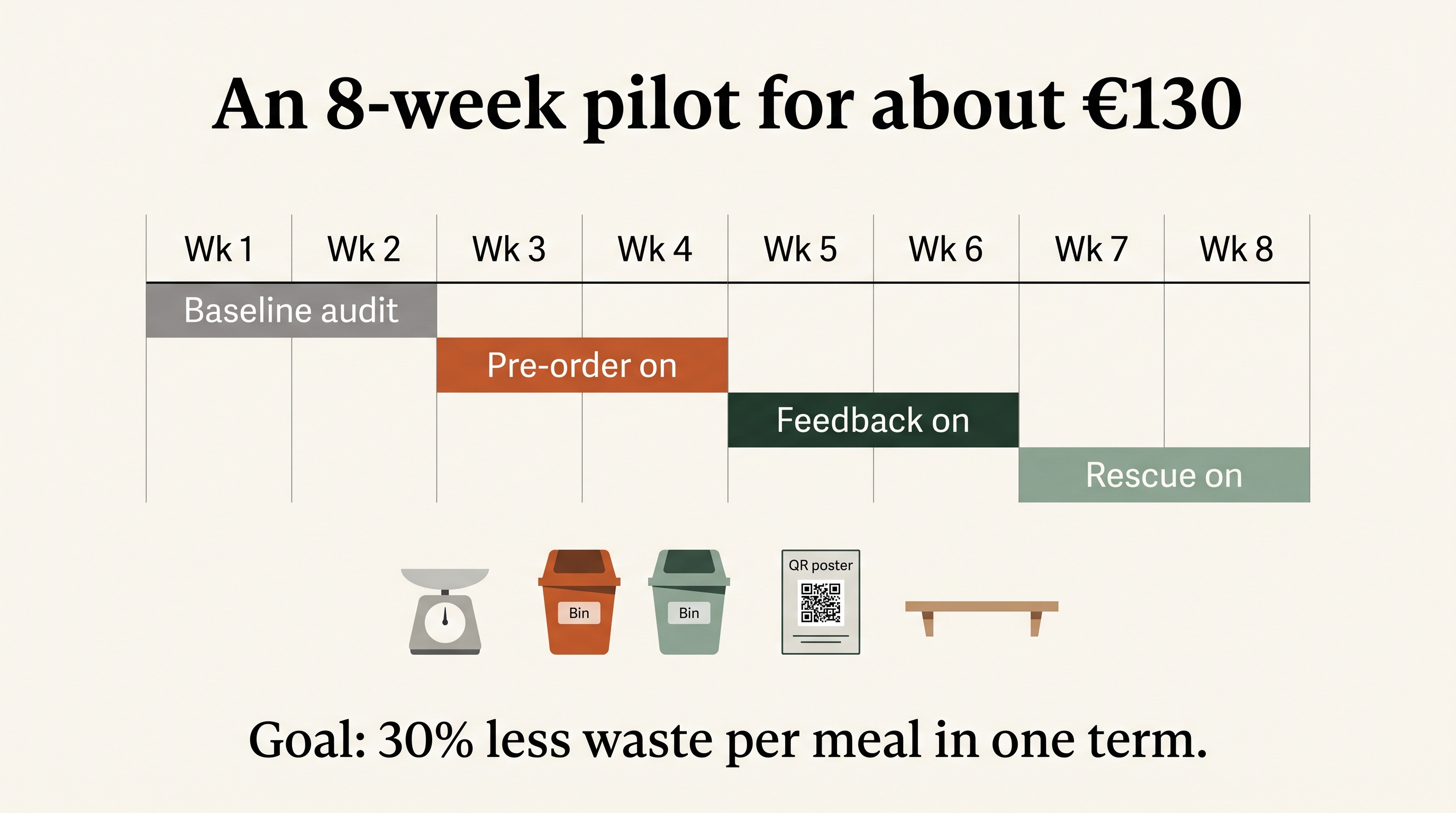
3. Pilot design. I planned an 8-week pilot at one high school in Veliko Tarnovo, Bulgaria. The first two weeks measure a baseline. Then each part switches on one at a time, so the results show which part actually works.
| Weeks | Phase | What we measure |
|---|---|---|
| 1–2 | Baseline audit | Grams wasted per meal, by type |
| 3–4 | Pre-order on | Serving waste, pre-order uptake |
| 5–6 | Feedback on | Plate waste, feedback taps per day |
| 7–8 | Rescue on | Kilograms redistributed |
4. Impact model. To estimate impact, I used meals per day (M), school days per year (D), waste per meal (W) and the target reduction (R):
$$ \text{Food saved} = M \times D \times W \times R $$
For one school serving 400 meals a day:
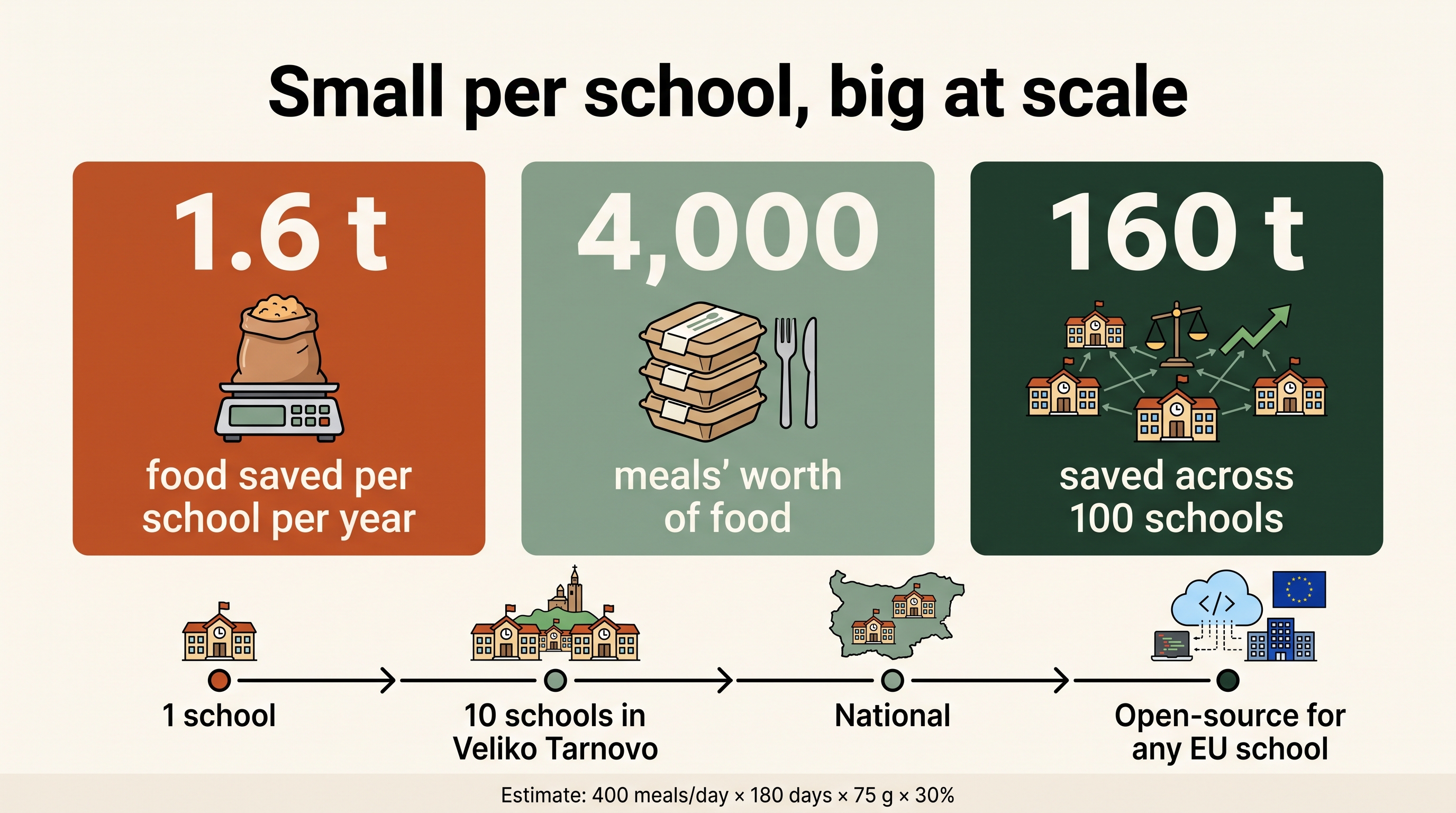
$$ 400 \times 180 \times 0.075\ \text{kg} \times 0.30 \approx 1{,}620\ \text{kg per year} $$
That is about 4,000 meals' worth of food per school per year, or about 160 tonnes across 100 schools. The 400 meals per day is an assumption that the baseline audit will replace with a real number.
5. Budget and roadmap. The pilot kit costs about €130: a kitchen scale, two labelled bins, QR posters and a share shelf. The roadmap grows from 1 school, to 10 schools in my city, to national use, and finally a free open-source toolkit for any EU school. Each phase starts only after the previous one passes a clear gate.
Challenges I ran into
- Separating strong evidence from weak evidence. A widely cited 2013 study on pre-ordering school lunch turned out to be retracted. I chose not to rely on it and built the case for pre-ordering on forecasting trials instead. The goal is an accurate headcount, not changing what students choose.
- Designing for real schools, not ideal ones. Many schools restrict phones, and kitchen staff are already busy. That is why PlateLoop has a paper fallback and adds under 5 minutes of work a day.
- Food safety. Donating cooked food has legal limits. The pilot starts with sealed and untouched items only, and cooked-food donation will be added only after checking the rules with the national food safety agency.
- Keeping the effect alive. A study in Latvian schools found that waste dropped at first but the effect faded without reinforcement. The weekly loop and class leaderboard exist to solve exactly that.
Accomplishments that I'm proud of
- Finding the insight that shaped the whole design: the kitchen's guess, not students' plates, is the biggest source of waste.
- Building a plan that a real school could start next month, for the price of a kitchen scale and some posters.
- Connecting a local, student-scale idea to a new EU-wide legal requirement.
What I learned
- Sustainability problems are often data problems. You cannot reduce what you do not measure.
- One-time campaigns fade. Systems with feedback loops keep working.
- Good research means checking sources, not just collecting them. Finding a retracted study taught me to verify before citing.
- A feasible plan needs clear metrics, a realistic budget and honest assumptions, not just a good idea.
What's next for PlateLoop
- Run the baseline audit at my school to replace the assumptions with real numbers.
- Build a working MVP of the pre-order and feedback web app.
- Run the 8-week pilot and publish the results openly.
- Expand to 10 schools in Veliko Tarnovo with support from the municipality.
- Release PlateLoop as a free, open-source toolkit for any school in the EU.
Full proposal with all sources: see the attached PDF. https://drive.google.com/drive/folders/1DAIpxJX942fYuBTbbd1d13gzQ5sFw_uJ?usp=drive_link
Built With
- powerpoint
- pptx


Log in or sign up for Devpost to join the conversation.