Inspiration
In a 2017 podcast episode of NPR’s Planet Money, the idea of a Free Food Market was brought up: it was a market where food banks would receive fake money based on how many people they feed to bid for items from Feeding America. This change in the way Feeding America distributes their food to different food pantries all over the country sprouted from a common issue food banks faced: not getting enough of food that they needed. For example, Susannah Morgan ran a food bank in Alaska and would rarely get large donations from Feeding America due to high transportation costs, although she had her own solution to that, and when she did get a big donation, it was a truckload of 5-gallon buckets of pickles because it is well-preserved. On the other hand, a food bank in Idaho gets tons of potatoes from Feeding America, when there were already more than enough potatoes supplied by local farmers. We decided that instead of having this fake food bank economy, which brings along doubts of whether the smaller food banks with less monetary support would benefit from the program compared to existing larger and wealthier food pantries, we would set up a cost-free solution to this problem: a platform for food banks to trade surplus inventory for food items that they truly want that another food bank has in surplus.
What it does
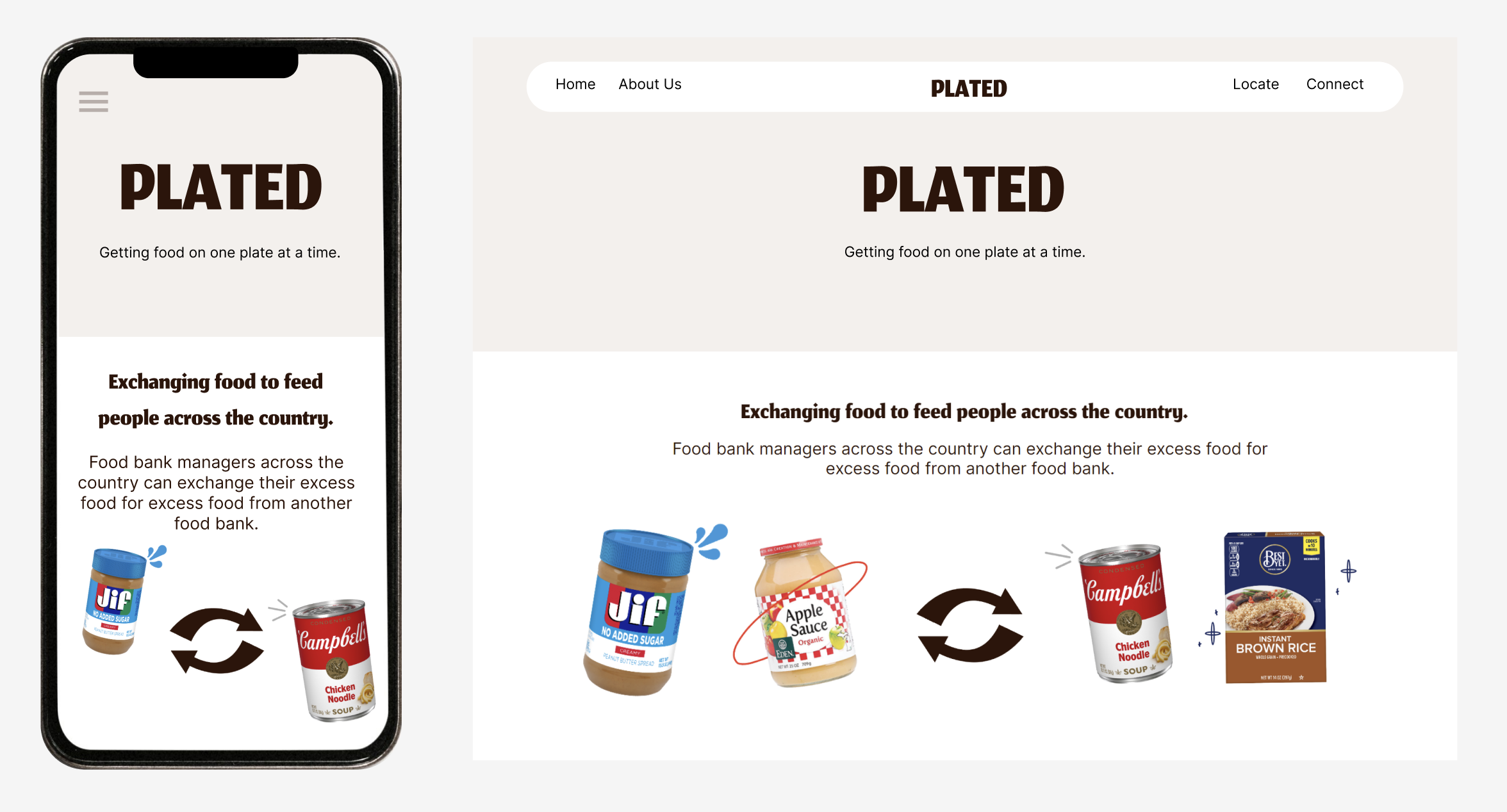
Our website allows food bank managers to input information about their food distribution organization (name, address, and contact information) as well as the food they have in surplus they would like to trade and the food they want to obtain through trading. Then, food managers can browse (on our Locate page) what foods other food banks have listed as surplus items, gaining insight about the quantity in excess, the expiration date, and any other pertinent information to see if there is anything that matches their needs. They can also explore by location through interacting with the map at the bottom of the Locate page, showing the locations of listed food banks and the food they have in excess. They can then reach out to the other food banks and propose a trade offer, allowing food banks to mutually benefit from the transaction without incurring any additional costs to secure the foods required to allow food banks to serve well-balanced meals to their communities.
How we built it
We used Python to build the algorithms required for the input form to build and access the database built through SQLite and employed Flask to map the form submit function to a template output of the form contents. HTML and CSS was used for the front-end development of the individual webpages, implementing interactive features like the carousel and routing the pages within the website. We included Javascript when connecting the Google Maps Static Maps via Google Cloud API.
Challenges we ran into
Coming into this hackathon, our team had some experience in front-end development, but no experience in backend development. Introducing Figma to some team members, we began brainstorming ideas on Figma and got a working template utilizing HTML and CSS. However, we wanted to implement a form on our website and store the data. As our team had not worked with SQLite before, it was a challenge in learning how to create our database for collecting and storing the information inputted by the different food banks. Once we had our form inputting three variables into our database, we tried to expand to take in all twelve form submission sections. But, we ran into server errors and initially failed to embed the form into our HTML page. After some research and aid from mentors, we learned that we had to clear the database since our initial database was built on three parameters. After successfully compiling and running our code, we were able to embed the form and output our database into another page to display to our users.
Accomplishments that we're proud of
Before this hackathon, we all had things that we wanted to learn how to implement. We successfully learned how to implement a Google Cloud API to incorporate Google Maps. We also tackled backend development and created a database to structure our website on. We learned how to utilize Flask and SQLite to create a model that is able to handle variable inputs and many parameters. We discovered the use of a unique identification for each input, the helpfulness of a repository to view all the information, and the management of a database, from clearing it to managing ram and memory. Overall, we are proud of the challenges we overcame and new concepts we tackled to implement our website.
What we learned
We learned how to utilize Figma as a brainstorming platform to develop our website’s pages. To tackle the backend development, we learned how to utilize SQLite to build a database to intake, hold, and retrieve our website’s user data. We also learned how to incorporate Google Cloud APIs to include their static map ability.
What's next for Plated
Going forward, we would like to implement a log-in page to allow food banks to update their inventory surplus items and the items that they are searching for on the website as their circumstances change. Additionally, we would like to implement a verification system to authenticate the user’s food bank and their surplus claims. We would also like to improve our current Locate page, incorporating new carousel slides as new entries are inputted to the system. As our number of users increases, we would like to introduce a search function with advanced filters to allow for quick navigation to the food items a user is looking for. In addition, we look towards implementing a trade request system within the website to allow for ease of communication between food banks, eliminating the hassle of external communication through phone or email. As an initiative, we would like to expand our network system beyond the Southern California region, allowing for a larger variety of the food items listed on the website and for more people to be able to access healthy, balanced meals through their local food distribution centers.
Built With
- css
- figma
- flask
- google-cloud
- google-docs
- google-drawings
- google-maps
- html
- javascript
- notability
- python
- sqlite

Log in or sign up for Devpost to join the conversation.