Inspiration
Gold nanoparticle assemblies can show strong geometry-dependent optical responses, but it is difficult for students and early-stage researchers to move quickly from an intuitive geometry—such as a dimer or trimer—to a reproducible spectrum calculation.
I wanted a lightweight local tool for exploring those conditions before moving to higher-fidelity numerical methods. The goal is not to replace rigorous methods such as BEM, DDA, FDTD, or TDDFT. Instead, it helps users inspect particle layouts, vary gaps and wavelengths, and make the model assumptions visible.
What it does
Plasmonic Coupling Simulator is a local, offline-capable web application for assemblies of 1 to 20 Au nanospheres.
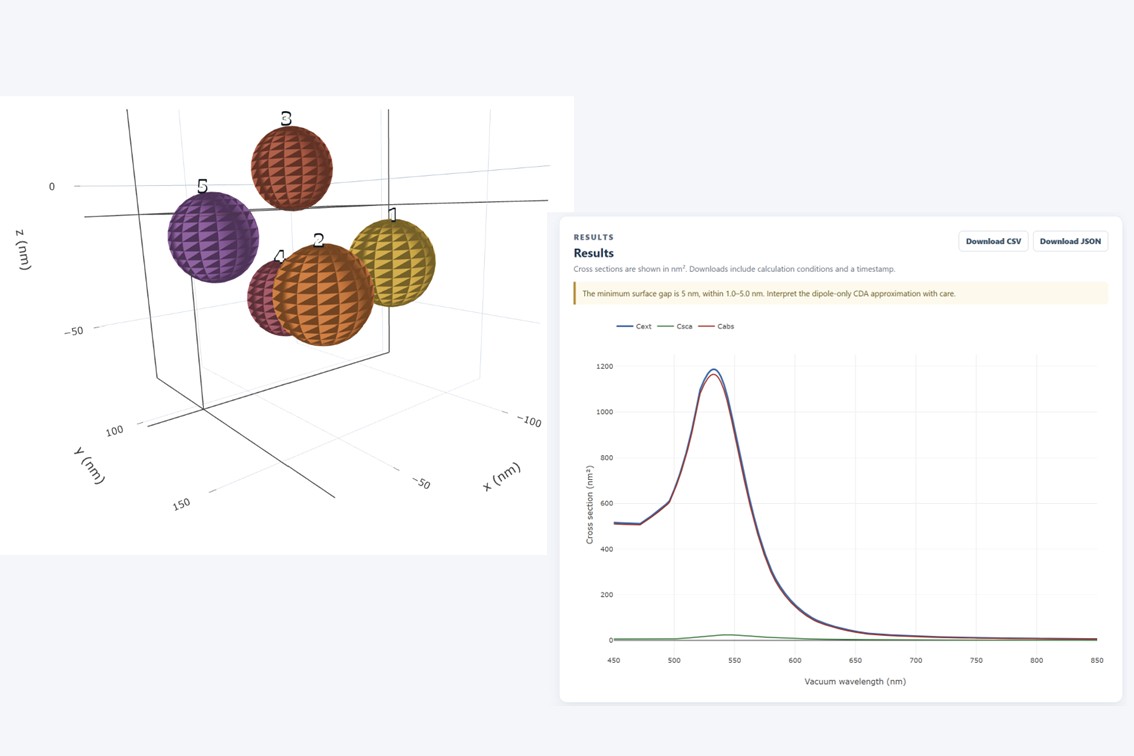
Users can start from editable dimer, equilateral-trimer, or constrained random-cluster presets, inspect the geometry in a real-diameter 3D preview, and calculate extinction, scattering, and absorption spectra. Results can be downloaded as CSV or JSON together with calculation conditions, timestamps, warnings, and QCM provenance metadata.
The interface starts in English and can switch to Japanese without changing the calculation state.
How it works
The application uses complete Mie calculations as a single-particle reference and a retarded Coupled Dipole Approximation for multi-particle assemblies. For surface gaps from 0.5 to 1.0 nm, it automatically selects a limited Quantum Corrected Model path.
The QCM tunnel parameter table is explicitly presented as a provisional manual digitization of Esteban et al. (2012), Fig. 2d, with estimated reading uncertainty. The application blocks gaps below 0.5 nm, distinguishes QCM status from the classical CDA warning range, and records model limitations in the result.
The stack is Python, FastAPI, JavaScript, Plotly.js, Server-Sent Events, and browser-side CSV/JSON export. The app binds only to localhost and works offline after setup.
Challenges and lessons
The most important challenges were not only numerical. Browser testing revealed that high-precision preset coordinates could fail after insertion into numeric form controls, and that fixed-pixel 3D markers made it difficult to understand real particle size while zooming.
These findings led to safe display-time coordinate rounding with gap validation, and to a real-diameter mesh-based 3D preview in nanometre data coordinates. A final audit also found an ambiguity between QCM status and the 1–5 nm classical-CDA warning, which was resolved through structured warning codes, translated UI messages, boundary tests, and synchronized documentation.
How GPT-5.6 and Codex were used
This project was built through iterative human review, GPT-5.6 analysis, and Codex implementation.
GPT-5.6 was used to analyze requirements, interpret browser-test findings and audit results, identify cross-cutting consistency risks, and help formulate implementation plans. Codex implemented approved changes, ran tests and lint checks, maintained documentation, and reported verification results.
Human review remained responsible for scientific scope, physical-model limits, product decisions, and final acceptance. AI-generated output was not treated as evidence for physics, experimental values, or literature claims.
What is next
Future work includes stronger automated browser-based UI testing, optional size-dependent damping with literature-supported parameters, broader material support, and comparison workflows against higher-fidelity electromagnetic solvers.
Built With
- events
- fastapi
- gpt-5.6
- javascript
- plotly.js
- pydantic
- pytest
- python
- ruff
- server-sent

Log in or sign up for Devpost to join the conversation.