Plasma Studio: A Living Artwork That Adapts
The Philosophy: There Is No Final Artwork
Not a painting. Not a drawing application. Not a visualizer.
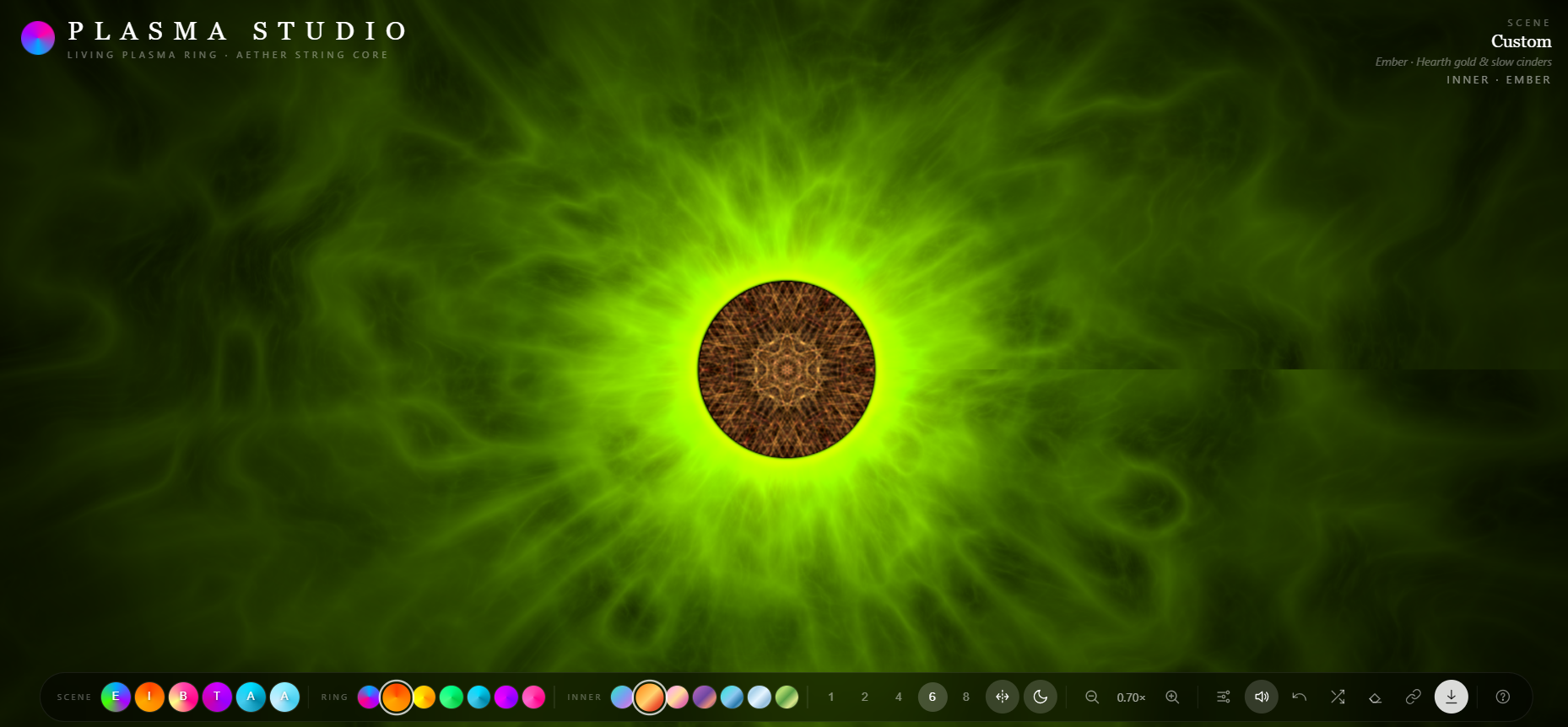
When we set out to build Plasma Studio, we wanted to challenge the very definition of digital creativity. Traditional art software replicates physical mediums—giving users digital brushes to mimic oil on canvas. We wanted to build a digital ecosystem that could only exist in the medium of computation: a living, breathing artwork that collaborates dynamically with its observer.
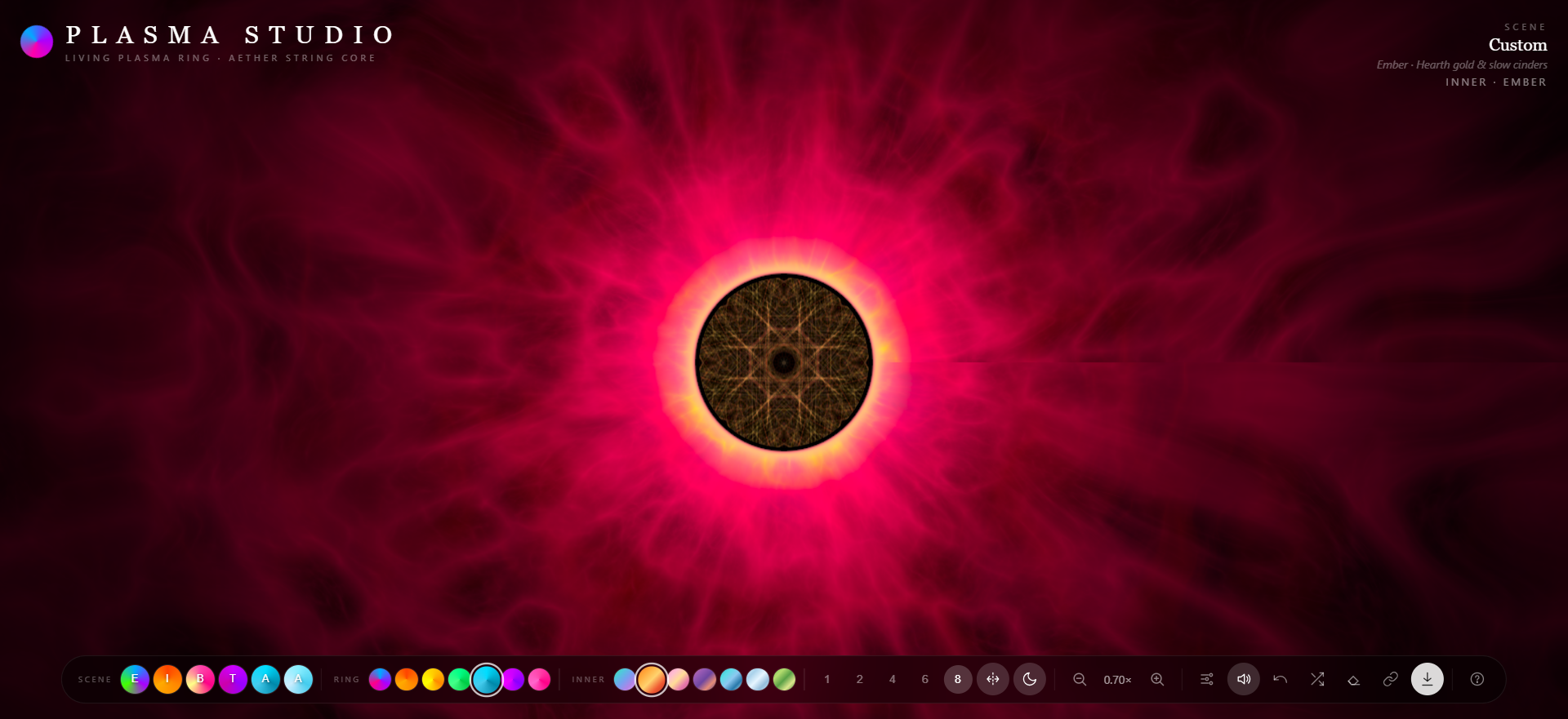
In Plasma Studio, there is no final artwork. Every click reveals another possibility. Every reshuffle uncovers another world. Every interaction becomes part of the artwork itself.
Inspiration: Sight Meets Sound
Our core inspiration was the concept of synesthesia—the union of senses. We wanted to create an ecosystem where mathematics is the brush, motion is the driver, and sight and sound evolve together as a unified experience.
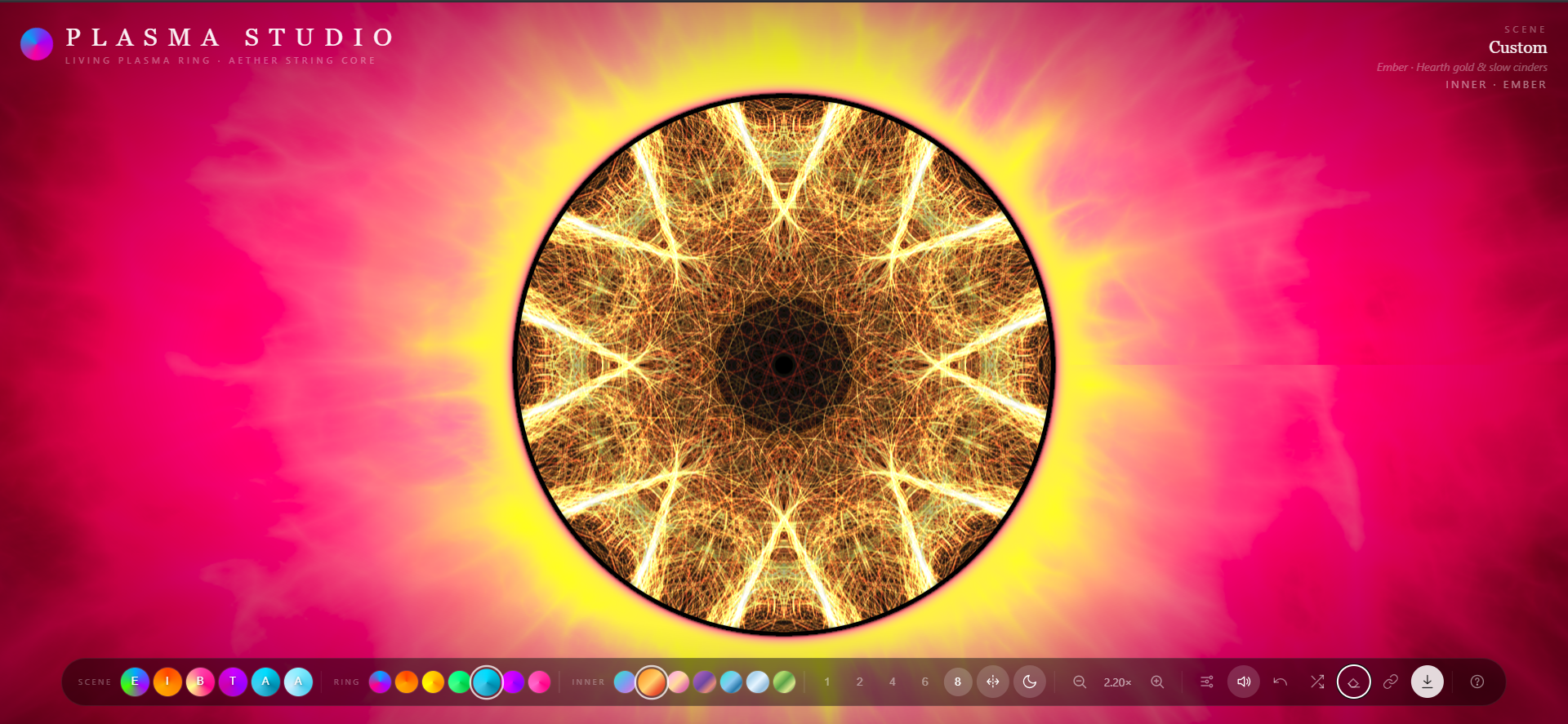
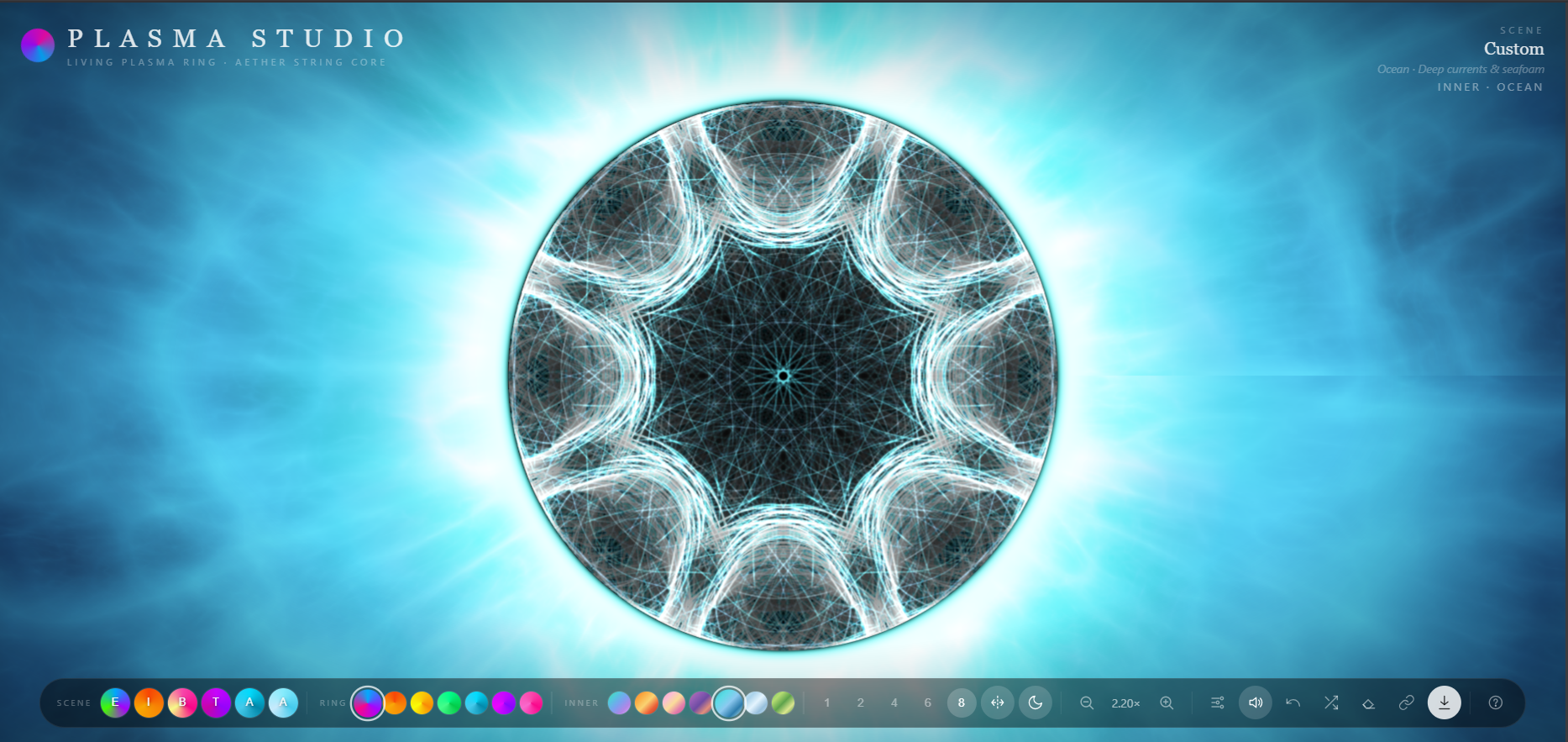
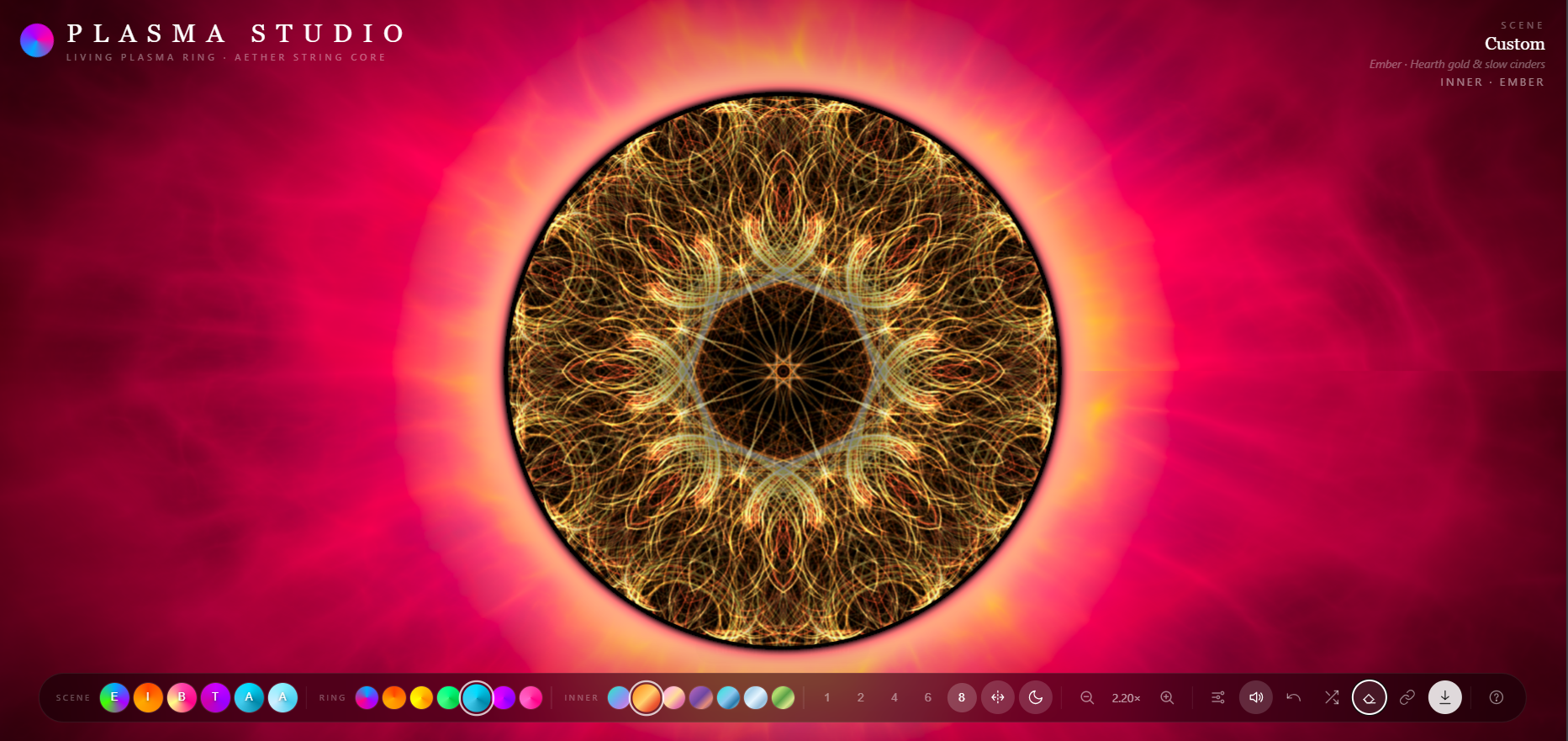
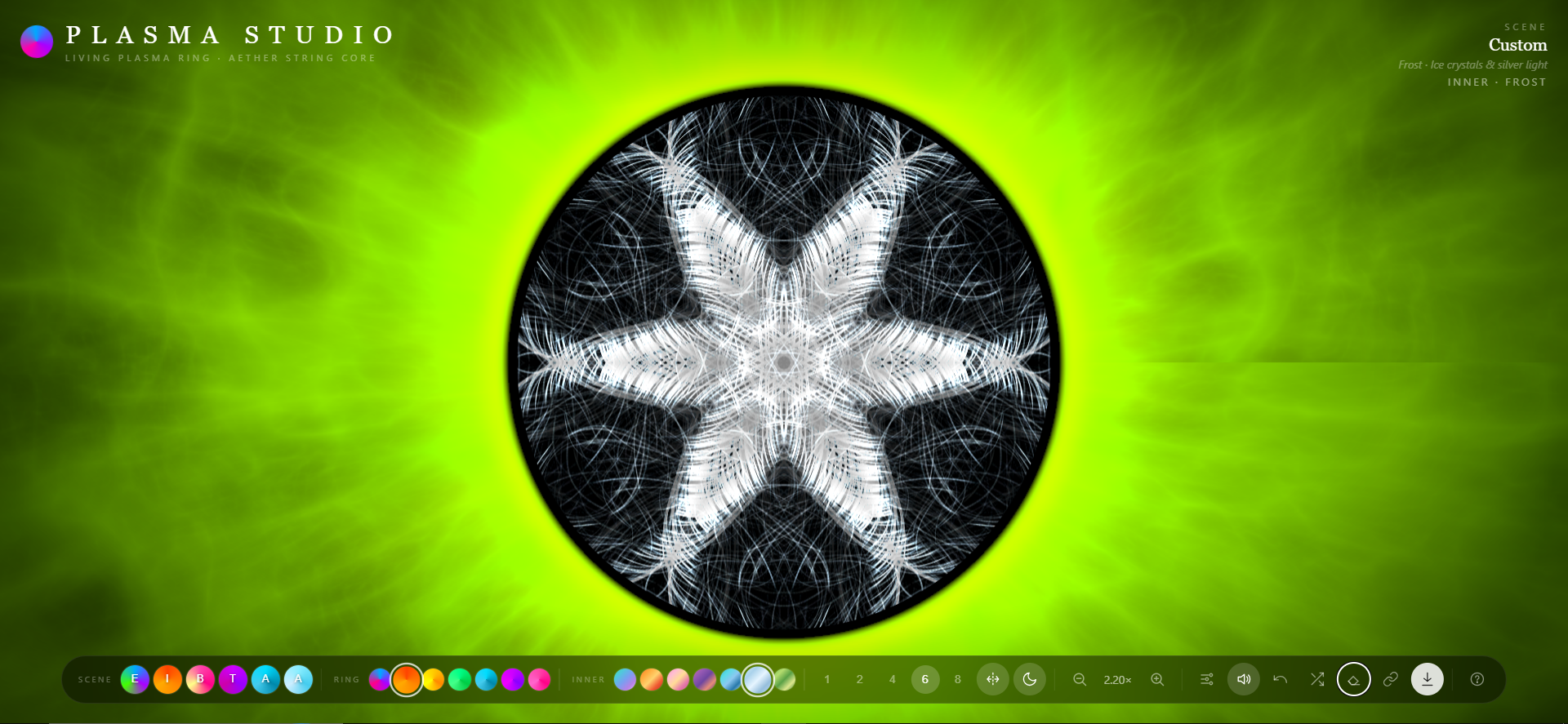
We drew visual inspiration from the organic patterns of the universe: the boreal auroras, the golden embers of slow cinders, and the deep currents of the ocean abyss. By combining real-time GPU-rendered shaders with CPU vector flow-fields and procedural audio synthesis, Plasma Studio lets users explore an enormous creative universe containing over ( 9.4 \times 10^{18} ) unique configurations and ( \sim 10^{37} ) reproducible procedural worlds.
How We Built It: The Computational Orchestra
Plasma Studio is built entirely from scratch with raw, vanilla web technologies—no frameworks, no external libraries, and no pre-rendered assets. Three core engines work in harmony:
1. The WebGL Plasma Ring (The Void)
A custom fragment shader renders the breathing plasma ring and defines the boundaries of the central black void. We use multi-octave Fractional Brownian Motion (fBm) to generate organic gas textures directly on the GPU. The distance from the center of the void is calculated as: $$ r = \sqrt{(x - x_c)^2 + (y - y_c)^2} $$ A smooth transition ramp acts as a mathematical boundary, preventing visual artifacts where the WebGL ring meets the central particle core.
2. The AETHER Flow-Field Core (The Brush)
Inside the black void, a CPU particle simulation navigates a vector flow-field. Particle headings are determined in real-time by three-dimensional Perlin noise: $$ \theta = \Phi(x, y, t) \cdot 3\pi \cdot \text{curl} $$ These particles trace glowing string-art paths, which are drawn to a 2D Canvas with instanced calculations to handle up to 8-fold radial symmetry and mirror projections dynamically.
3. The Web Audio Synthesizer (The Voice)
When a user moves inside the void or clicks to trigger a "bloom" of light, the application dynamically synthesizes audio. The vertical pointer coordinate maps directly to musical pitches: $$ f = f_0 \cdot 2^{\frac{\Delta \text{midi}}{12}} $$ These notes are dynamically snapped to atmospheric scale arrays (Major Pentatonic, Minor Pentatonic, Whole Tone, Lydian). Concurrently, a low-frequency oscillator (LFO) maps the plasma's current hue and brightness to a soft, breathing background drone hum.
Challenges We Faced: Conquering the Sandbox
Building complex graphics and audio engines in a single, standalone HTML document presented unique hurdles:
- Navigating the Autoplay Sandbox: Modern browsers block the Web Audio API until a synchronous user interaction occurs. We had to build a custom overlay wrapper that securely triggers and resumes the
AudioContextimmediately upon the user's first physical click on the canvas, seamlessly unlocking the visual-audio drone hum. - The High-DPI Display Gap: On Retina and 4K displays, the browser's pixel ratio mismatches the WebGL layout dimensions. We had to implement dynamic scaling buffers to ensure the canvas export module (
drawImage) aligned the high-resolution CPU particle drawings perfectly over the GPU plasma layer. - CPU Math Calculations: Simulating up to 2,600 active particles with 8-fold radial symmetry and mirror projections simultaneously on the CPU requires intense mathematical execution. We had to highly optimize our coordinate arrays and path drawing functions to keep the simulation smooth and responsive on consumer laptops.
What We Learned: The Power of the Raw Web
This project taught us the elegance of writing raw, unadorned code. In a web ecosystem dominated by heavy frameworks and massive libraries, we discovered that vanilla JavaScript, raw WebGL, and the native Web Audio API are incredibly fast, lightweight, and capable of creating stunning, premium art. We learned how to pool objects to avoid garbage collection spikes and how to write mathematical formulas to mimic the physics of the real world.
Built With
- canvas-2d
- css3
- generation
- glsl
- html5
- javascript
- perlin-noise
- procedural
- web-audio-api
- webgl


Log in or sign up for Devpost to join the conversation.