-
-
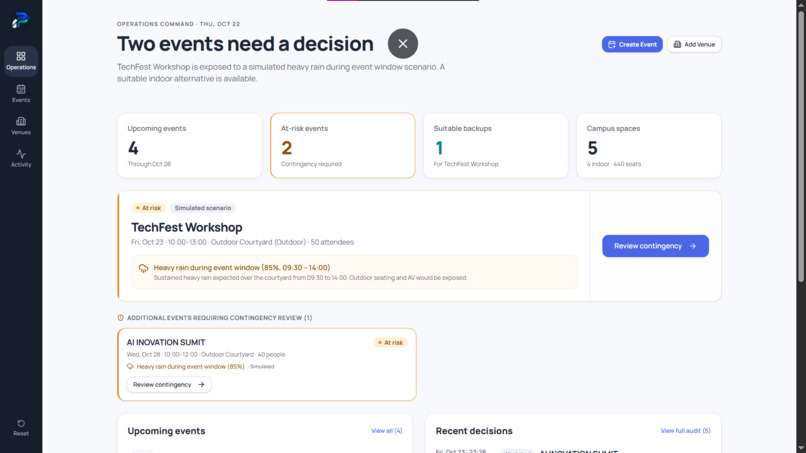
Meet Planzo — an AI-powered event recovery platform that identifies disruptions and helps organizers make informed decisions.
-
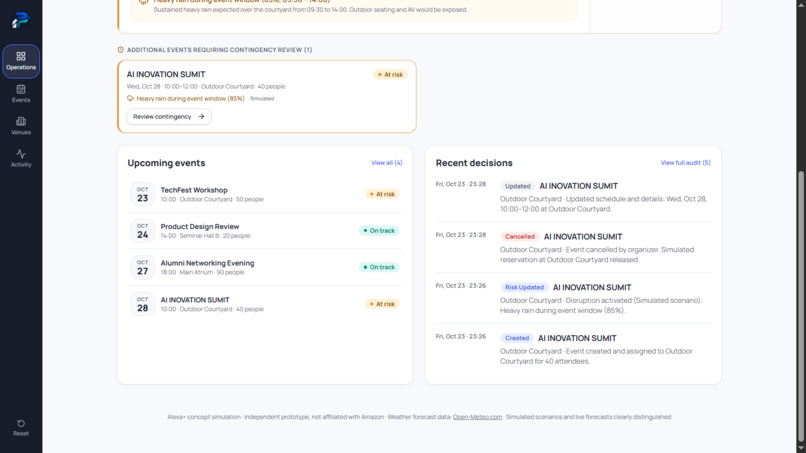
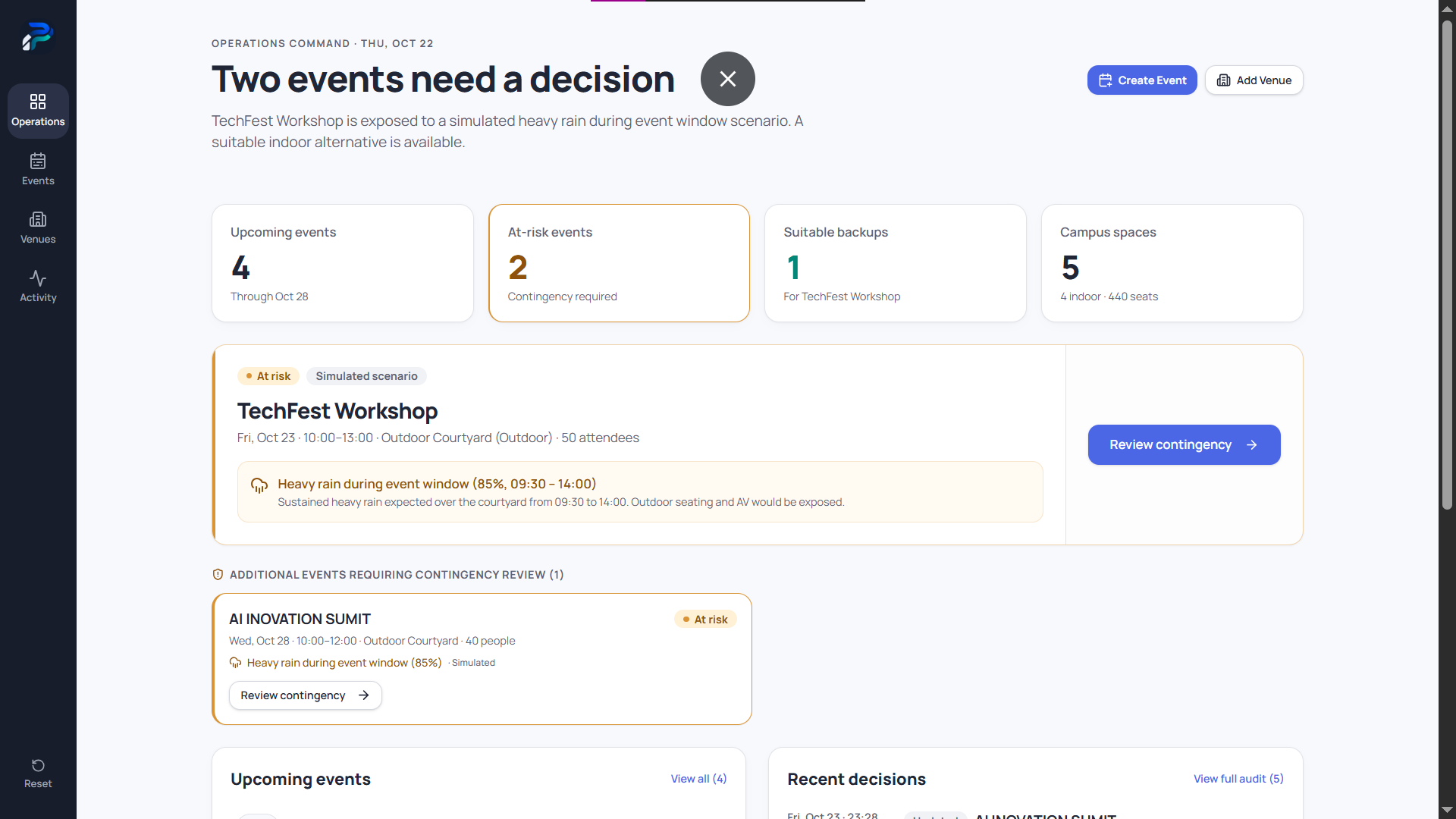
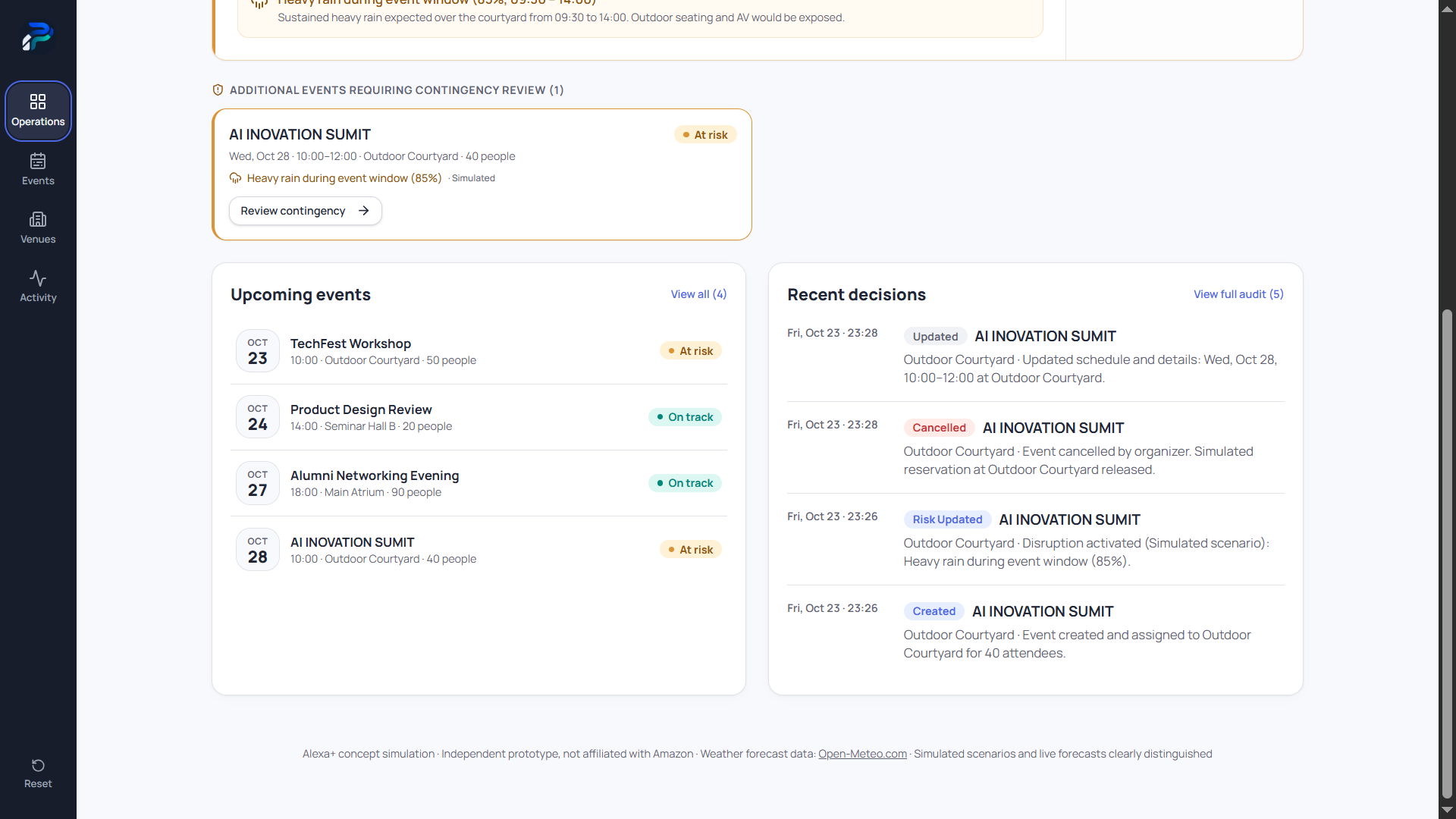
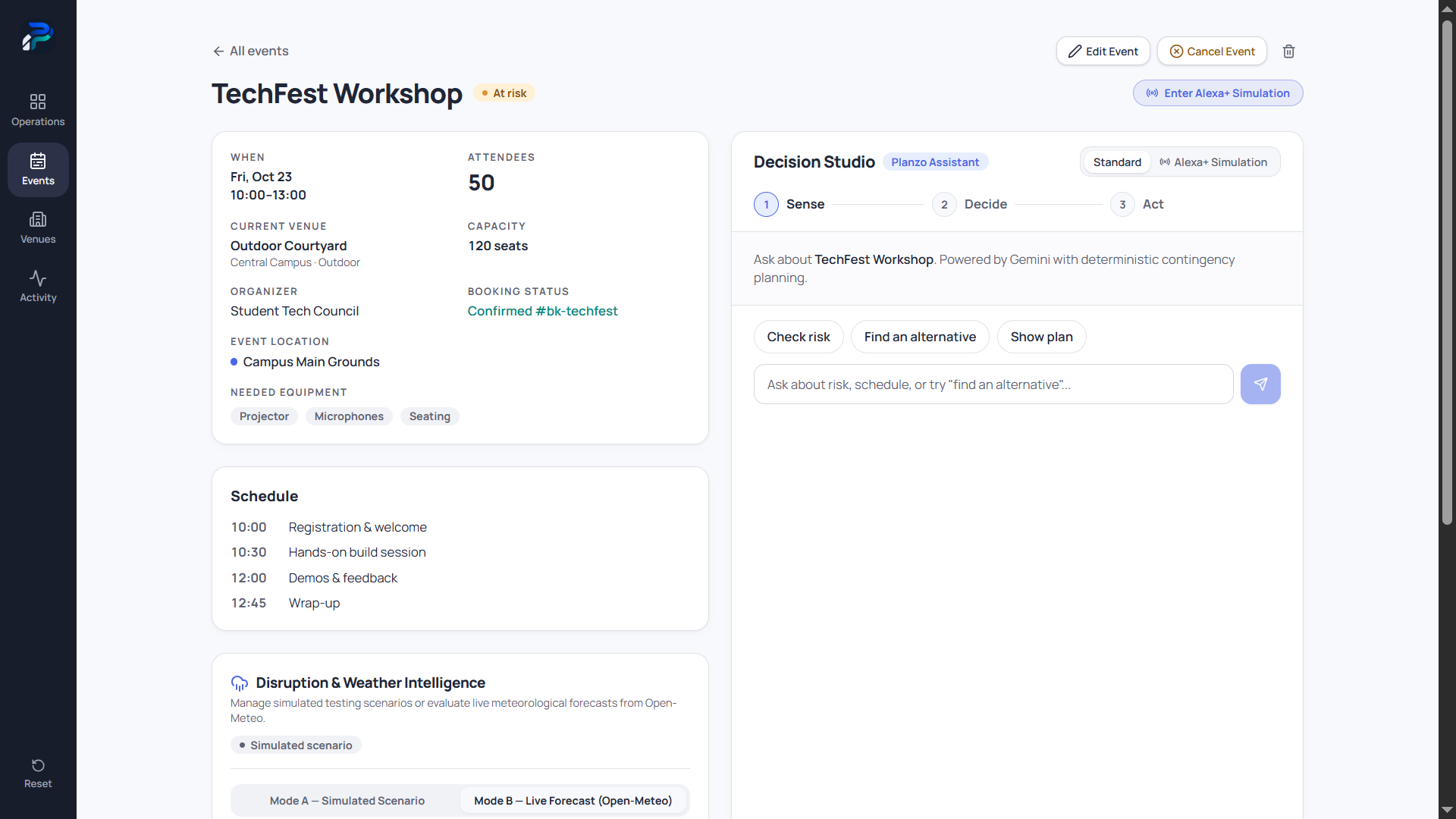
Planzo monitors multiple events, highlights active disruptions, and brings contingency decisions into one central dashboard.
-
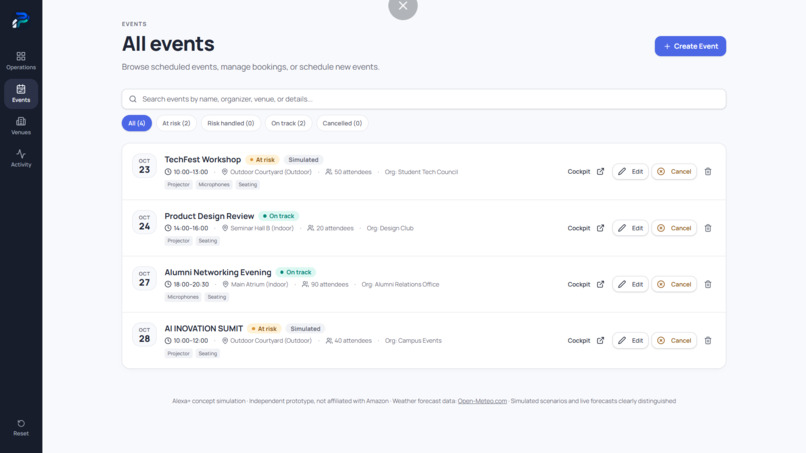
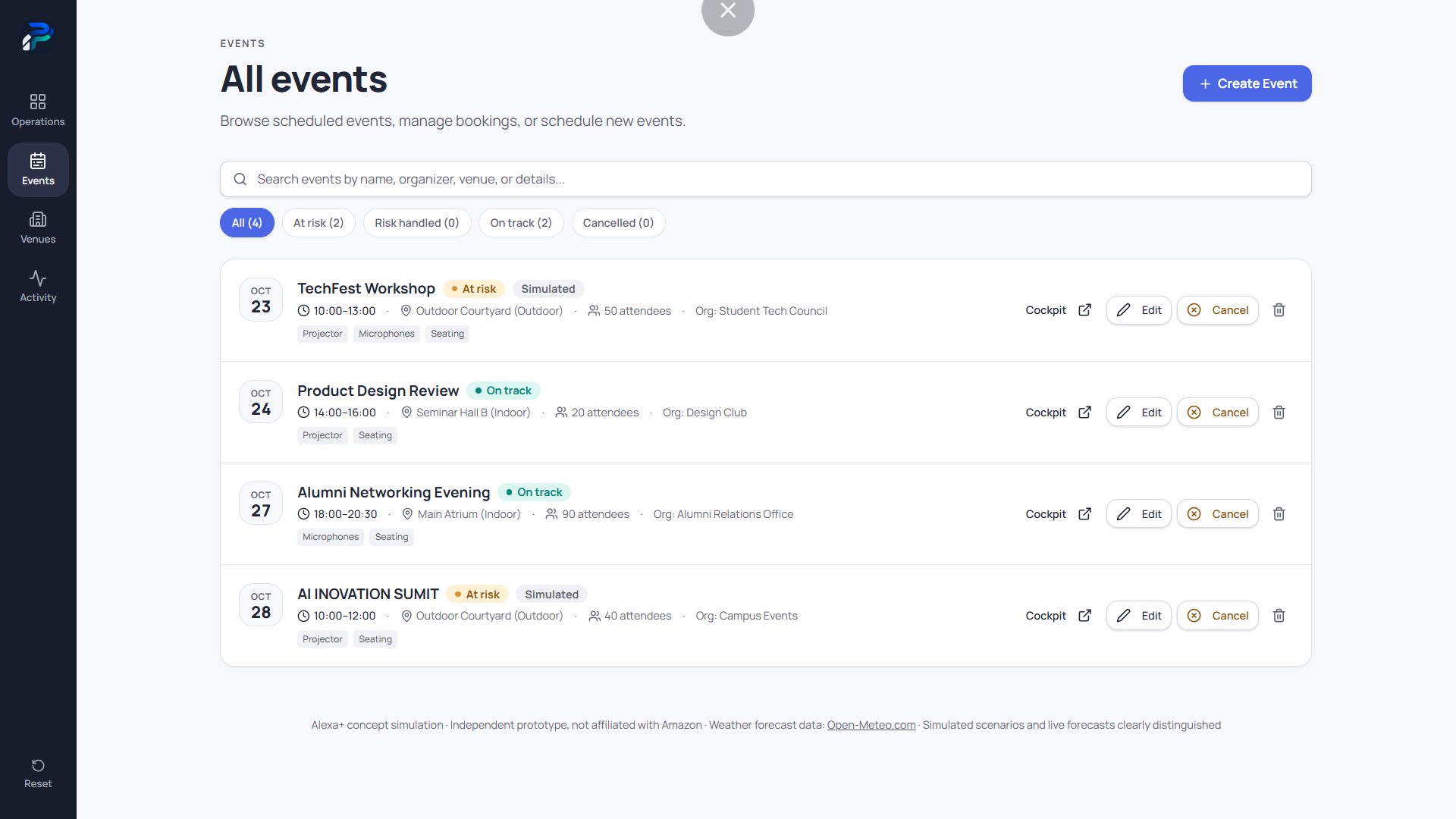
Create, edit, cancel, and manage custom events with attendee counts, equipment requirements, and scheduling validation.
-
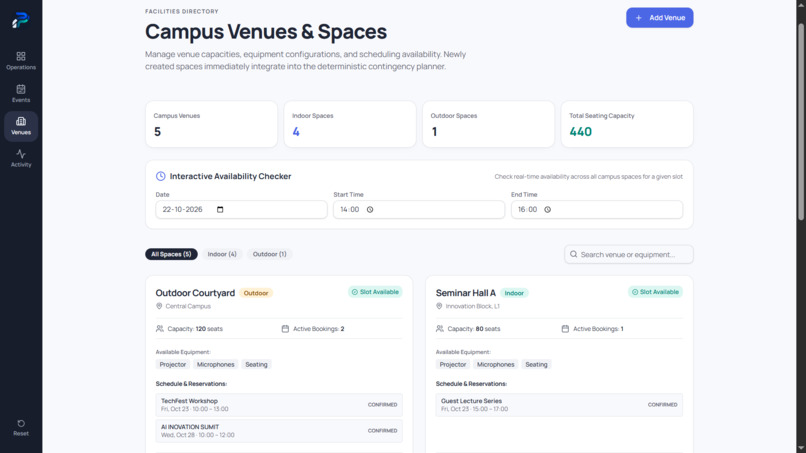
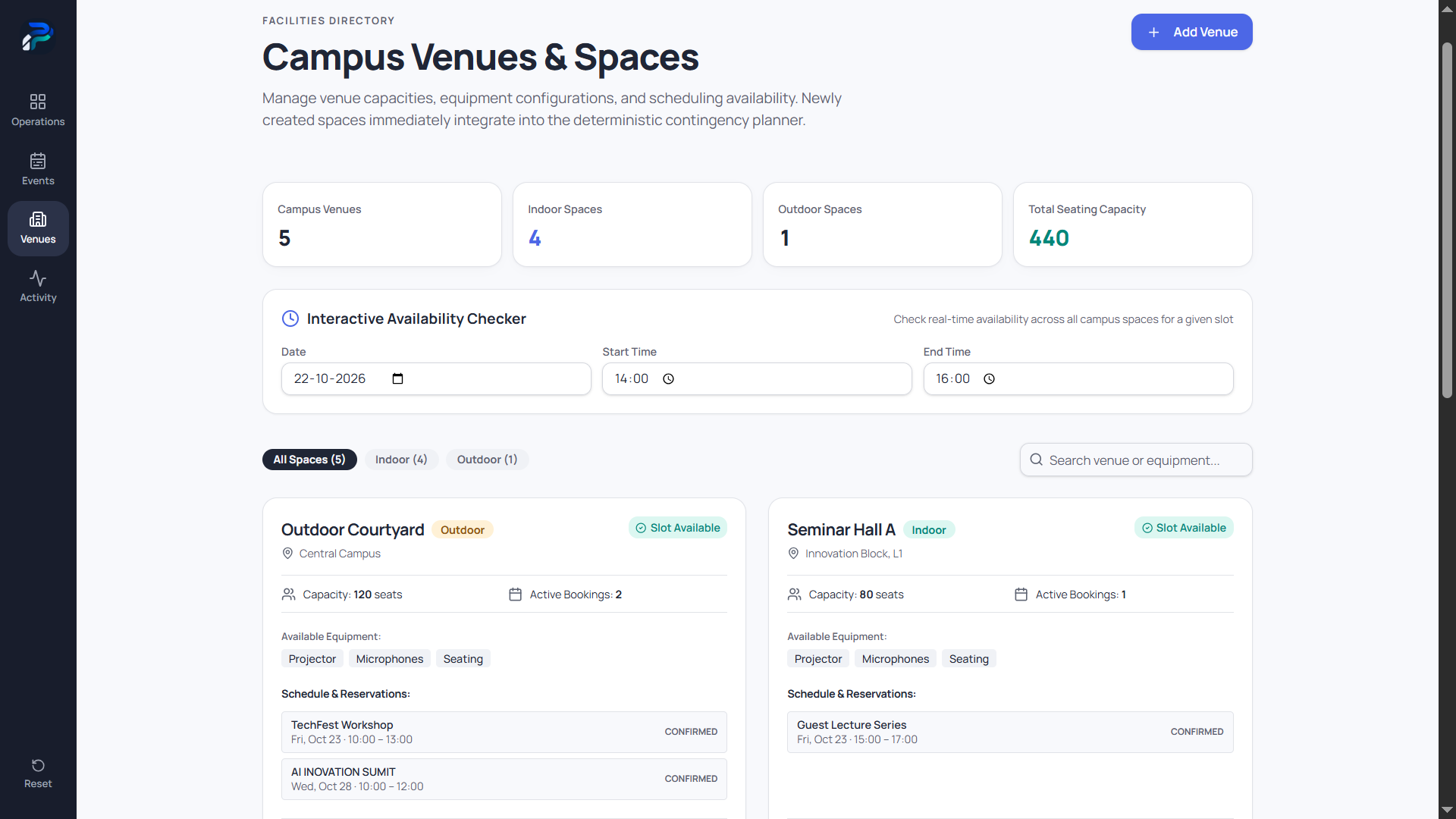
Manage campus venues, seating capacities, equipment, reservations, and availability to prevent scheduling conflicts.
-
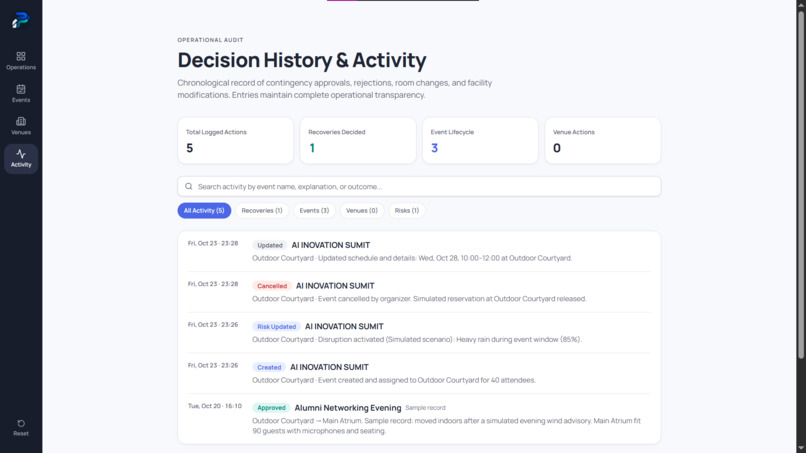
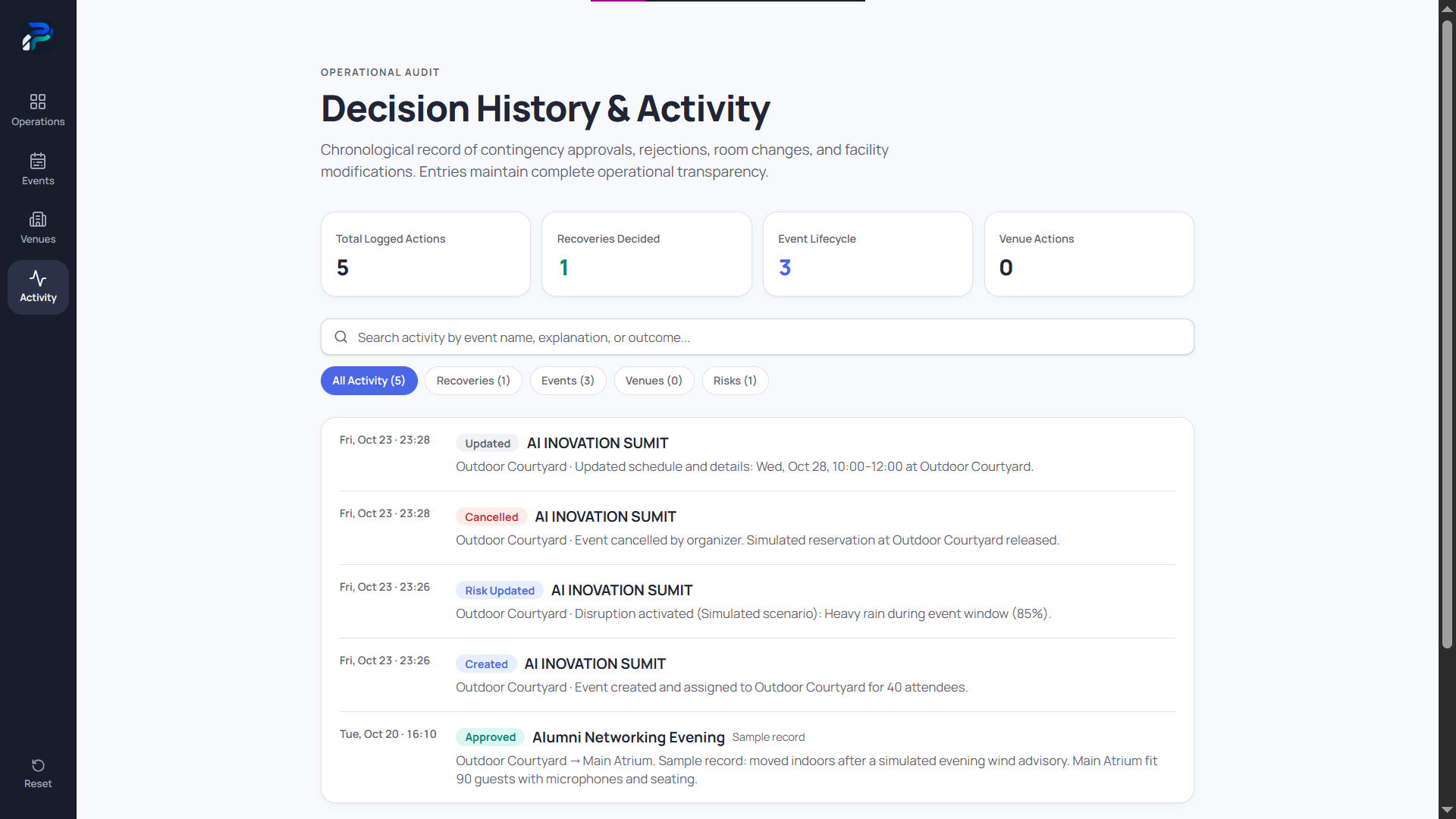
Every important event action is recorded in a browser-local activity history, making decisions easy to review and trace.
-
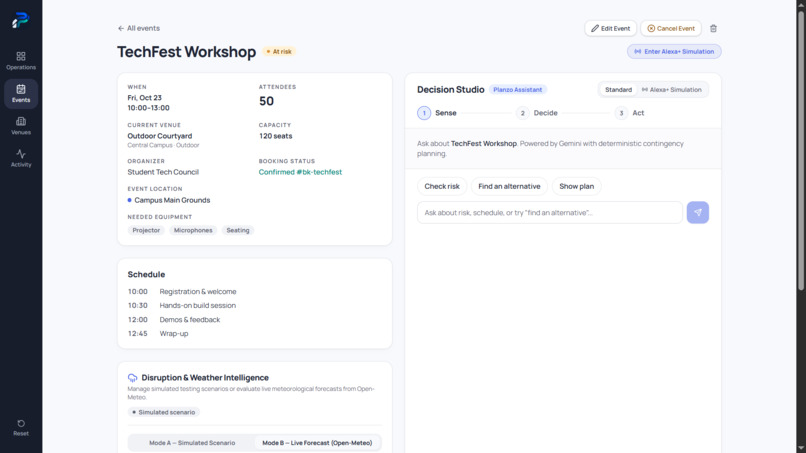
TechFest Workshop has 50 attendees and an outdoor venue. A simulated heavy-rain disruption triggers contingency planning.
-
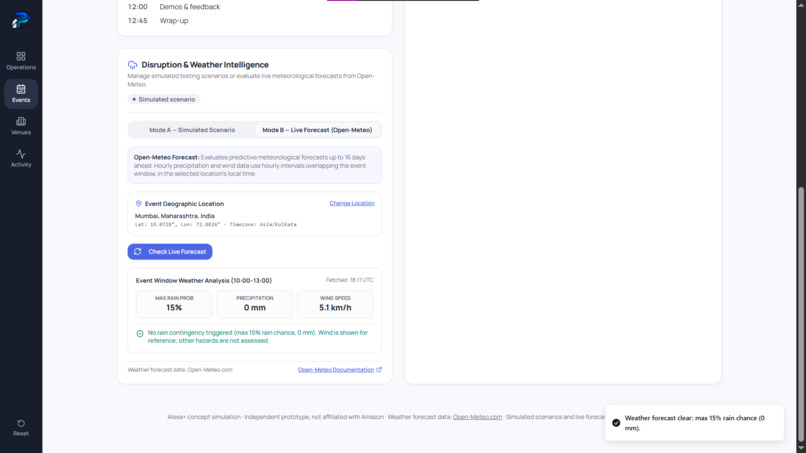
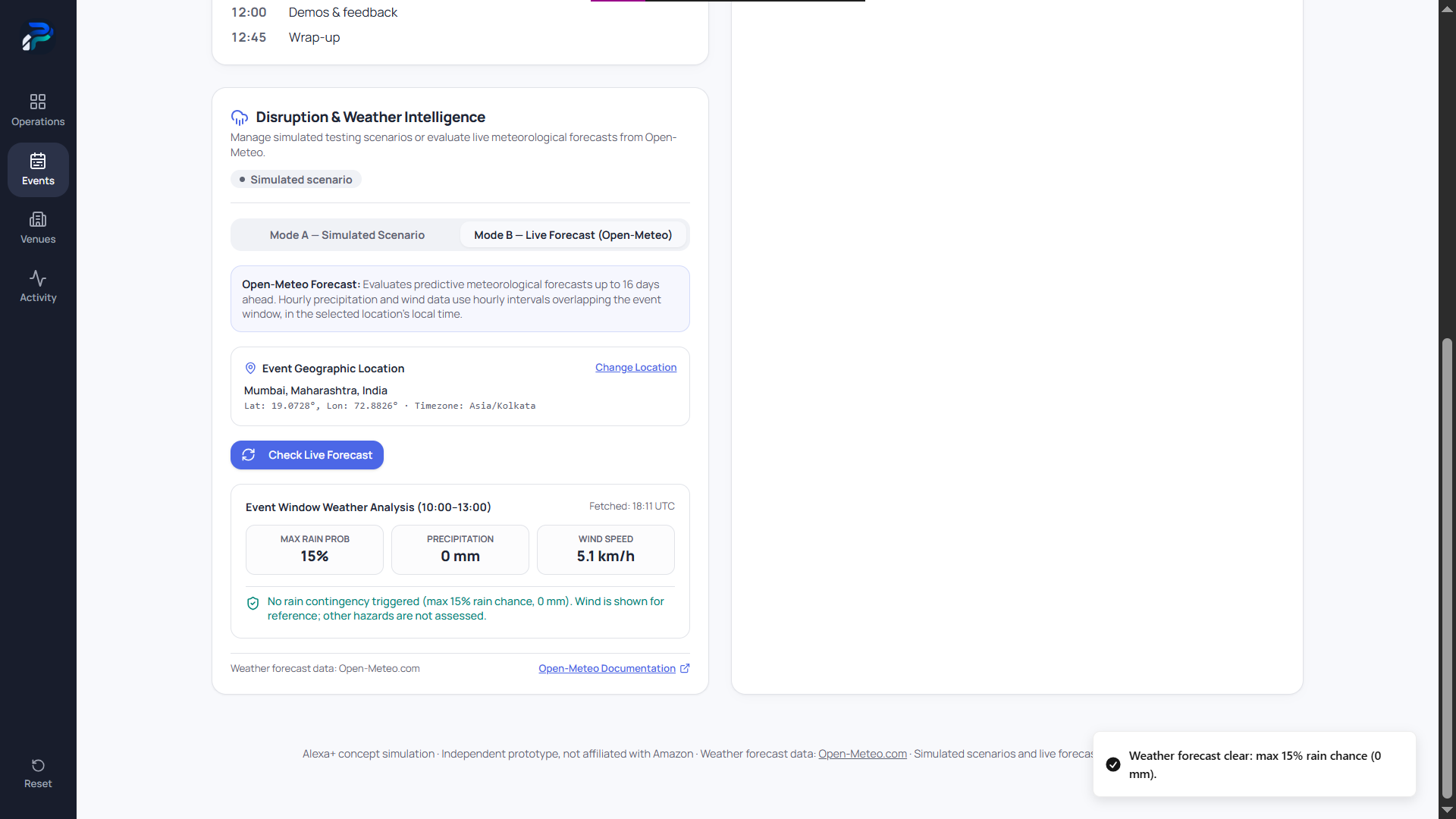
Planzo integrates Open-Meteo forecasts to evaluate real weather conditions, clearly distinguishing live data from simulated risks.
-
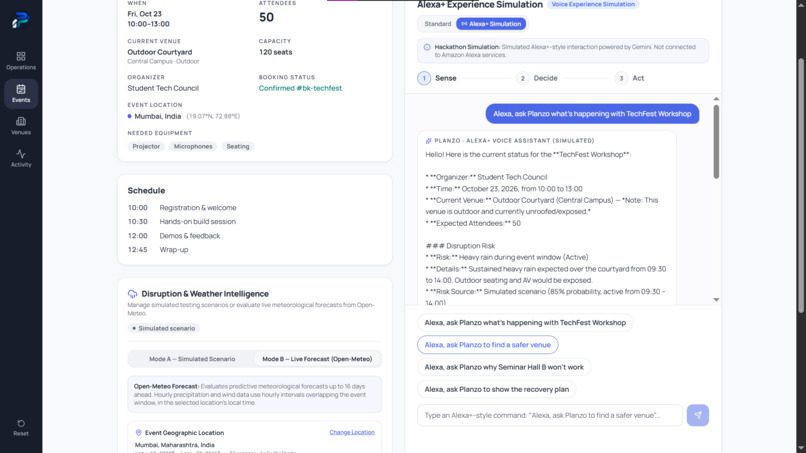
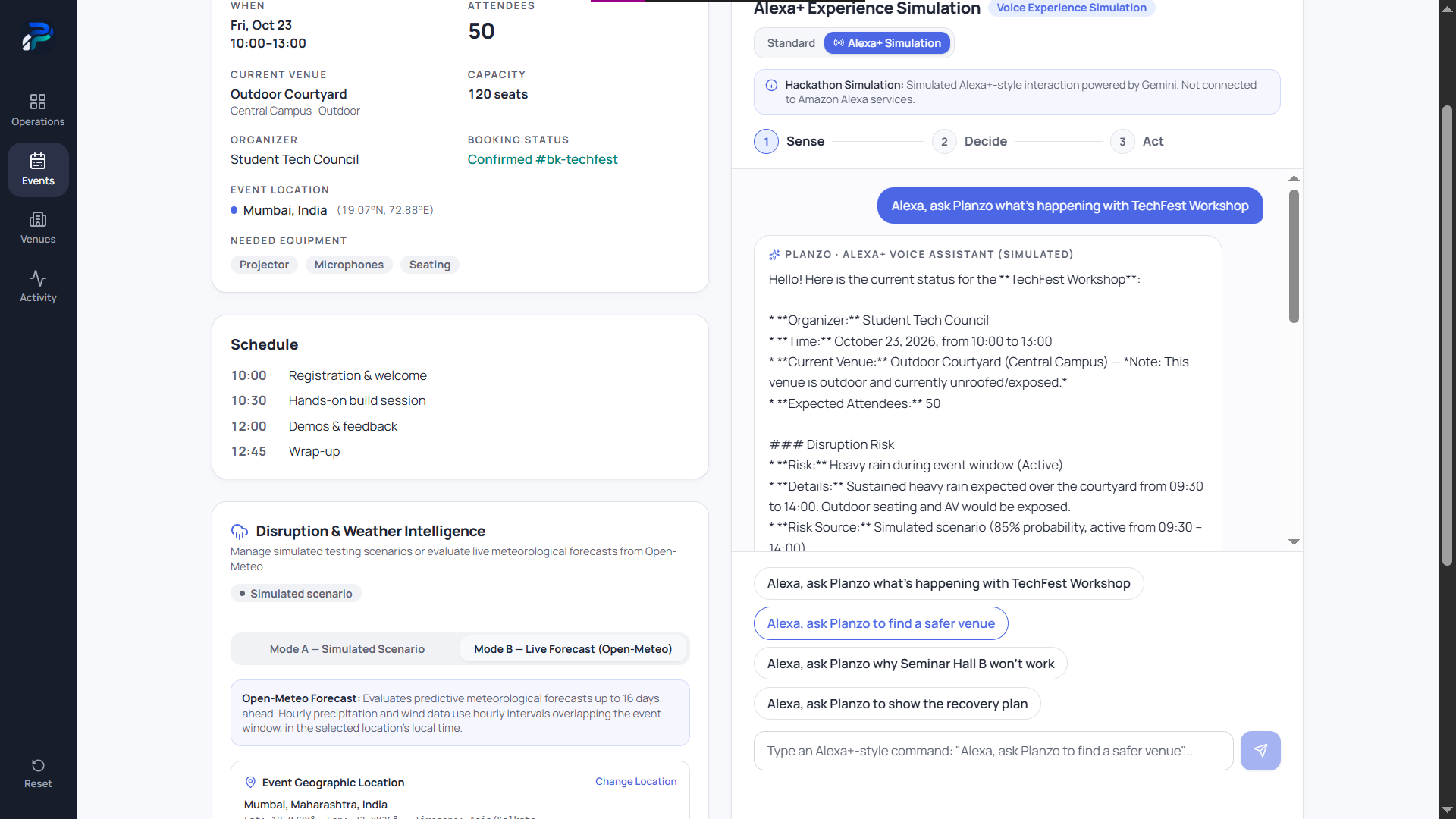
An Alexa+-inspired conversational simulation lets organizers ask natural-language questions and explore recovery options using Gemini.
-
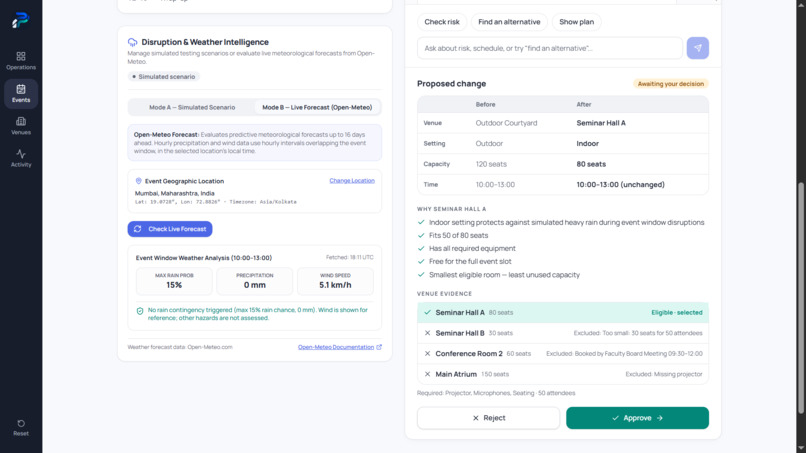
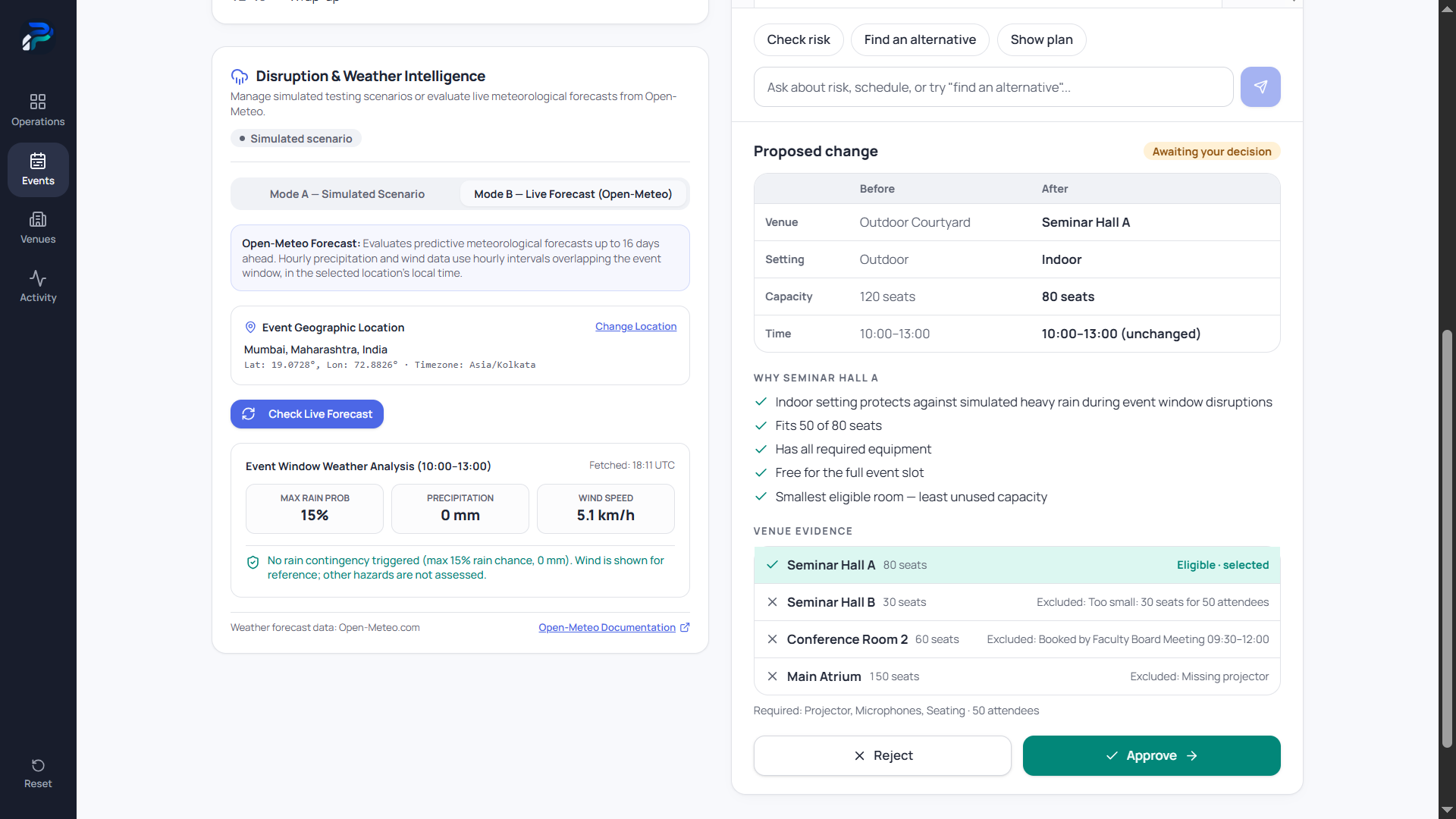
Planzo recommends Seminar Hall A after validating capacity, equipment, indoor safety, and booking availability — while explaining venues.
-
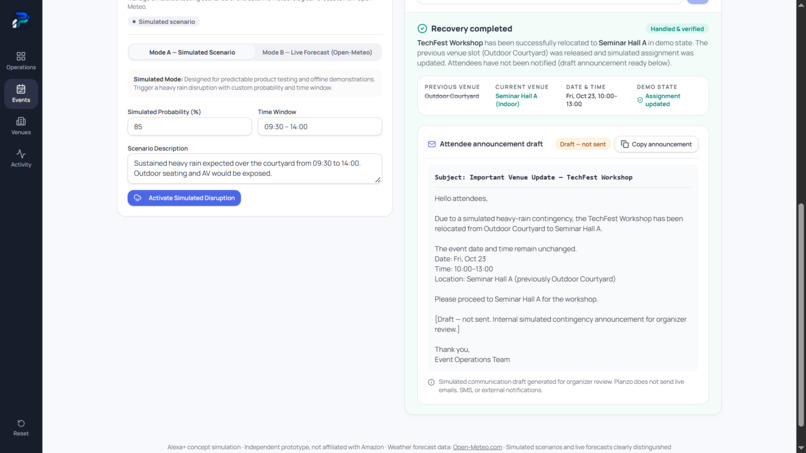
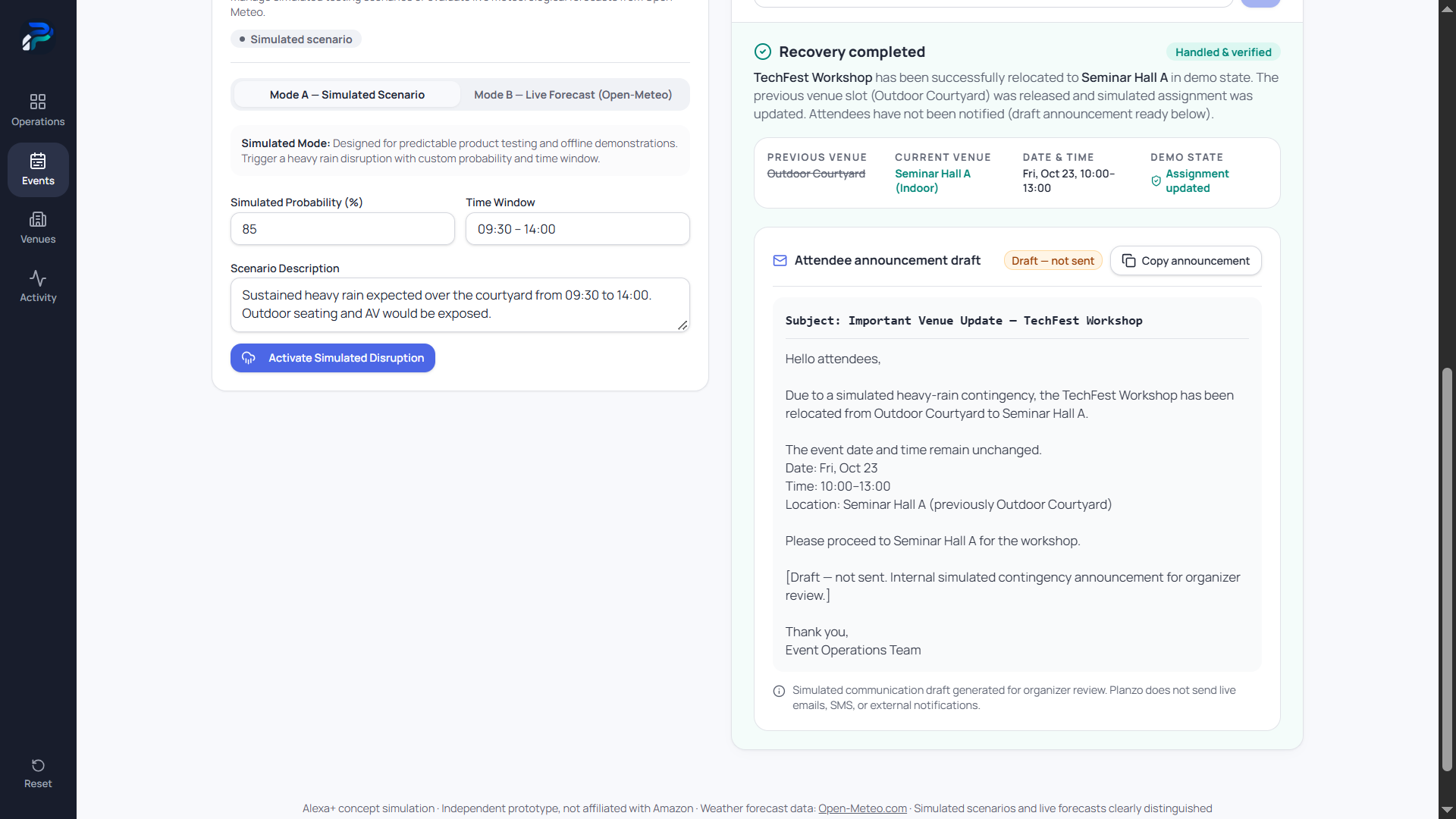
After explicit organizer approval, Planzo updates the simulated venue booking and prepares an attendee announcement draft for review.
-
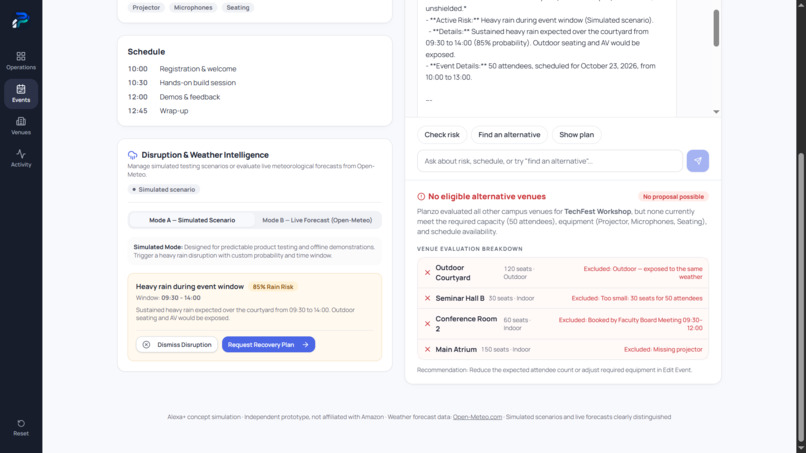
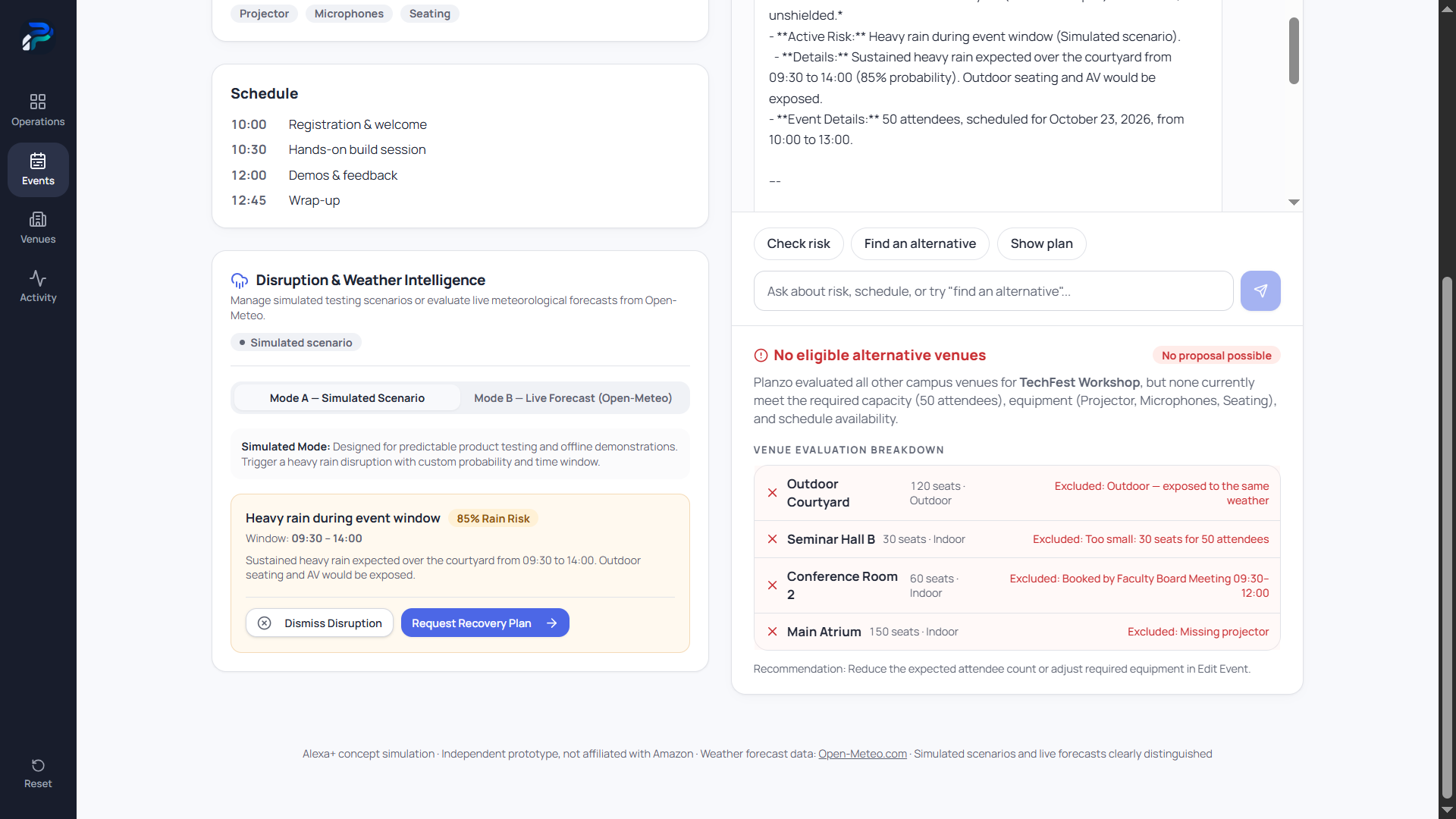
When no alternative satisfies every operational constraint, It rejects unsafe proposals and explains exactly why each venue is unsuitable.
Inspiration
Imagine organizing a major workshop with 50 attendees, only to discover that heavy rain could disrupt your outdoor venue. Suddenly, you need to find another space, verify seating capacity, check equipment, avoid scheduling conflicts, and inform attendees.
What should be a simple contingency decision becomes a stressful coordination problem.
We built Planzo to turn that uncertainty into a structured, explainable recovery process.
Our goal was to explore how conversational AI, real weather data, and deterministic planning could work together to help event organizers make safer, faster, and more informed decisions.
What it does
Planzo is an AI-assisted event contingency and recovery platform.
Organizers can create events, manage venues, check booking availability, assess weather-related disruptions, and evaluate alternative arrangements.
Its core experience follows three stages:
- Sense — Understand the disruption
Planzo supports on-demand weather forecasts through Open-Meteo, alongside configurable simulated scenarios. Organizers can review weather-related risks affecting scheduled outdoor events.
- Decide — Find a feasible recovery plan
Planzo evaluates alternative venues using actual operational constraints:
- Attendee capacity
- Required equipment
- Indoor or outdoor suitability
- Existing reservations
- Event schedules and overlapping bookings
Google Gemini helps explain the situation conversationally, while a deterministic planning engine validates which alternatives are genuinely eligible.
- Act — Recover with human approval
Planzo presents a proposed relocation and its supporting evidence. The organizer must explicitly approve or reject the change.
After approval, Planzo updates its browser-local event and booking state, records the decision, and generates an attendee announcement draft for review.
The announcement is not automatically sent.
Alexa+-inspired simulated experience
Planzo includes an Alexa+-style conversational simulation where organizers can type natural-language commands such as:
Alexa, ask Planzo to find a safer venue.
The assistant explains weather risks, evaluates alternatives, and helps the organizer understand recovery options.
This is an independent browser-based simulation, not a production integration with Alexa hardware. Optional speech output allows supported browsers to read assistant responses aloud.
How we built it
We developed Planzo using:
- React, TypeScript, TanStack Start and Tailwind CSS for the frontend.
- Python, FastAPI and Pydantic for backend APIs and validated data handling.
- Google Gemini for contextual conversational assistance and streamed responses.
- Open-Meteo for geographic location search and on-demand hourly weather forecasts.
- A deterministic TypeScript planning engine for venue suitability, scheduling constraints and recovery proposals.
- Browser localStorage for prototype event data, venue assignments and activity history.
A key architectural decision was to separate AI-generated explanations from operational decisions. Gemini provides conversational intelligence, but the planning engine validates eligible venues, and the organizer retains final authorization.
Challenges we faced
One major challenge was preventing the assistant from confidently suggesting venues that were too small, lacked required equipment, or were already booked.
We addressed this by evaluating venue constraints deterministically rather than relying on unconstrained AI recommendations.
Another challenge was maintaining consistency when organizers created or edited events, changed venue availability, approved relocations, or reset demonstration data.
Integrating real weather forecasts also required careful handling of geographic coordinates, hourly timestamps, forecast availability, network failures, and the distinction between simulated and real weather data.
Finally, we wanted the Alexa+-style experience to remain conversational without allowing voice-style commands to bypass explicit human authorization.
Accomplishments we're proud of
- Built an end-to-end event contingency and recovery workflow.
- Implemented event and venue management with booking conflict checks.
- Integrated on-demand Open-Meteo forecasts.
- Created explainable, constraint-validated venue recommendations.
- Connected Gemini-powered conversations to current event context.
- Preserved human approval for operational changes.
- Added recovery history and attendee announcement drafts.
- Developed a browser-based Alexa+-inspired simulated experience.
- Tested both predefined demonstration scenarios and newly created events.
What we learned
We learned that useful AI products require more than compelling model responses.
AI should explain decisions, structured systems should validate them, and humans should remain in control of consequential actions.
We also learned the importance of testing complete user journeys rather than relying entirely on passing unit tests.
What's next for Planzo
Our longer-term vision includes authenticated multi-organizer workspaces, shared persistent databases, automated weather monitoring, calendar integrations, and optional attendee notification services.
Planzo currently demonstrates these contingency workflows through a working browser-based prototype with local state persistence.
Planzo — When plans change, intelligence takes over.
Built With
- ai
- fastapi
- google-gemini
- javascript
- open-meteo
- pydantic
- python
- react
- tailwind-css
- tanstack-start
- typescript
- vite

