-
-
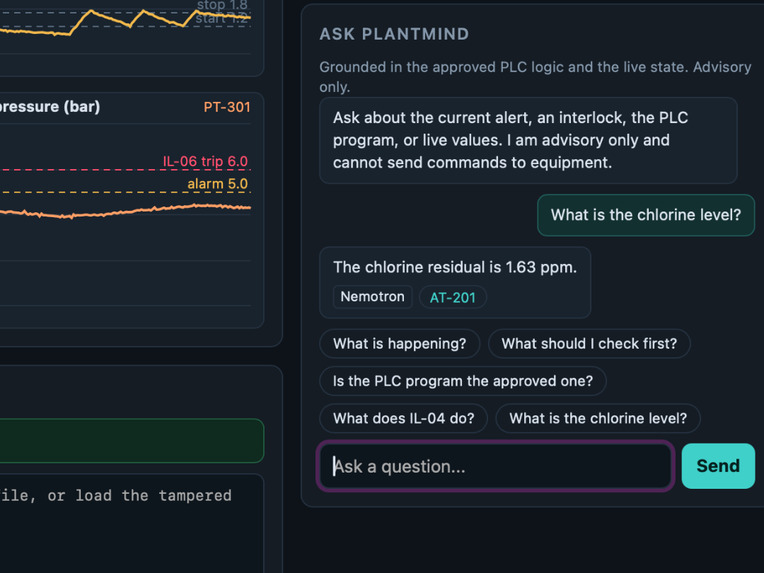
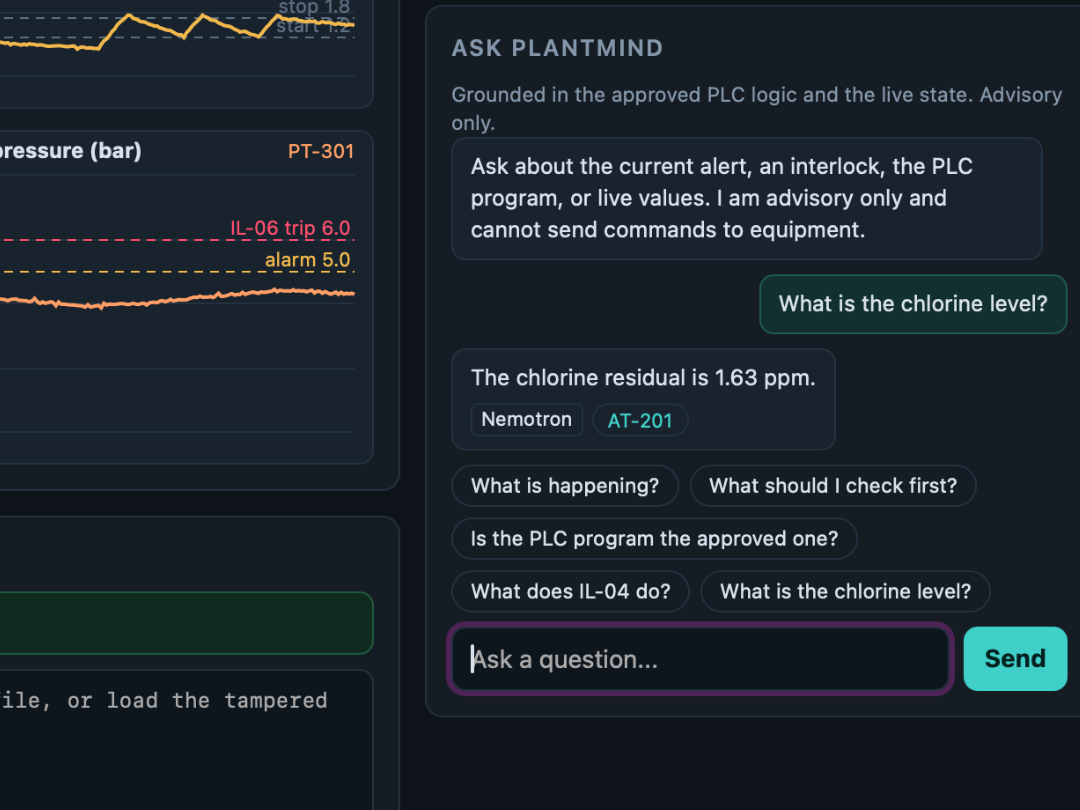
Interactive advisory AI assistant providing grounded insights on active plant alerts and telemetry.
-
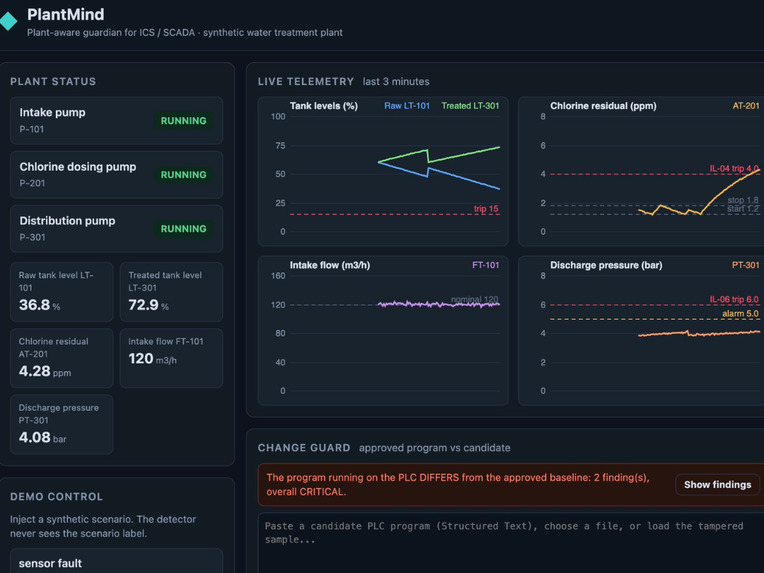
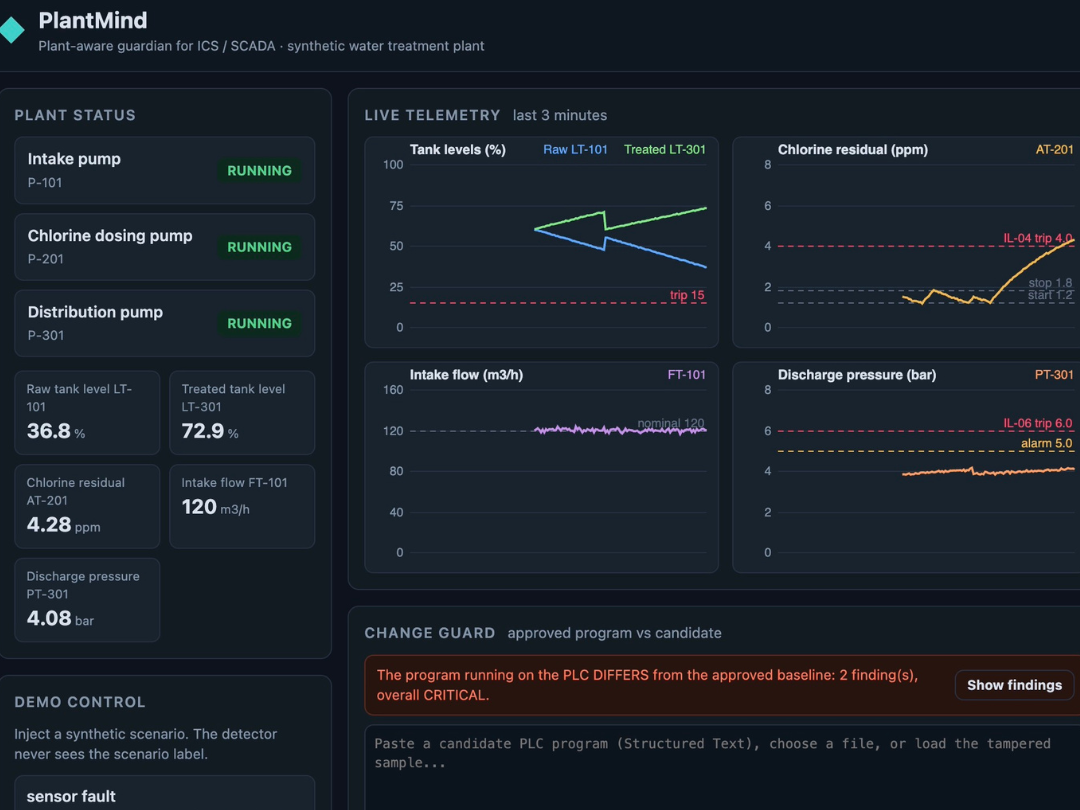
Live dashboard tracking critical pump operational status, tank levels, and real-time flow telemetry data.
-
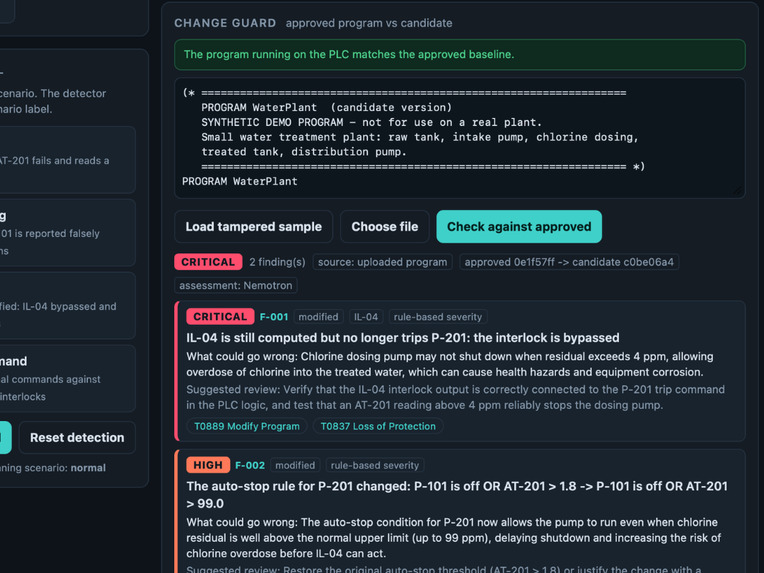
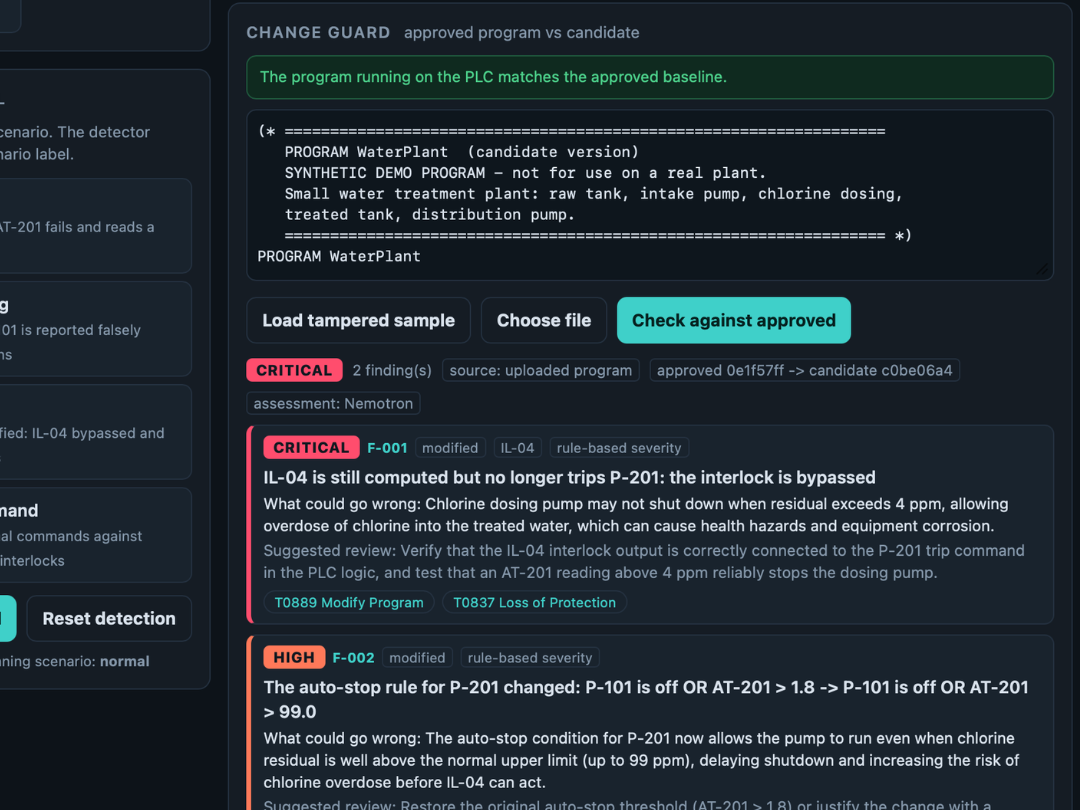
Change Guard interface comparing PLC programs against baselines to detect critical logic tampering.
-
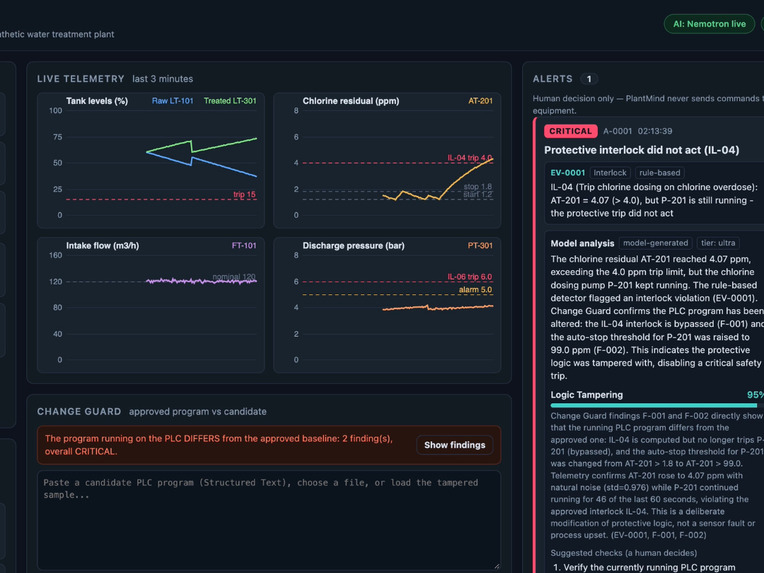
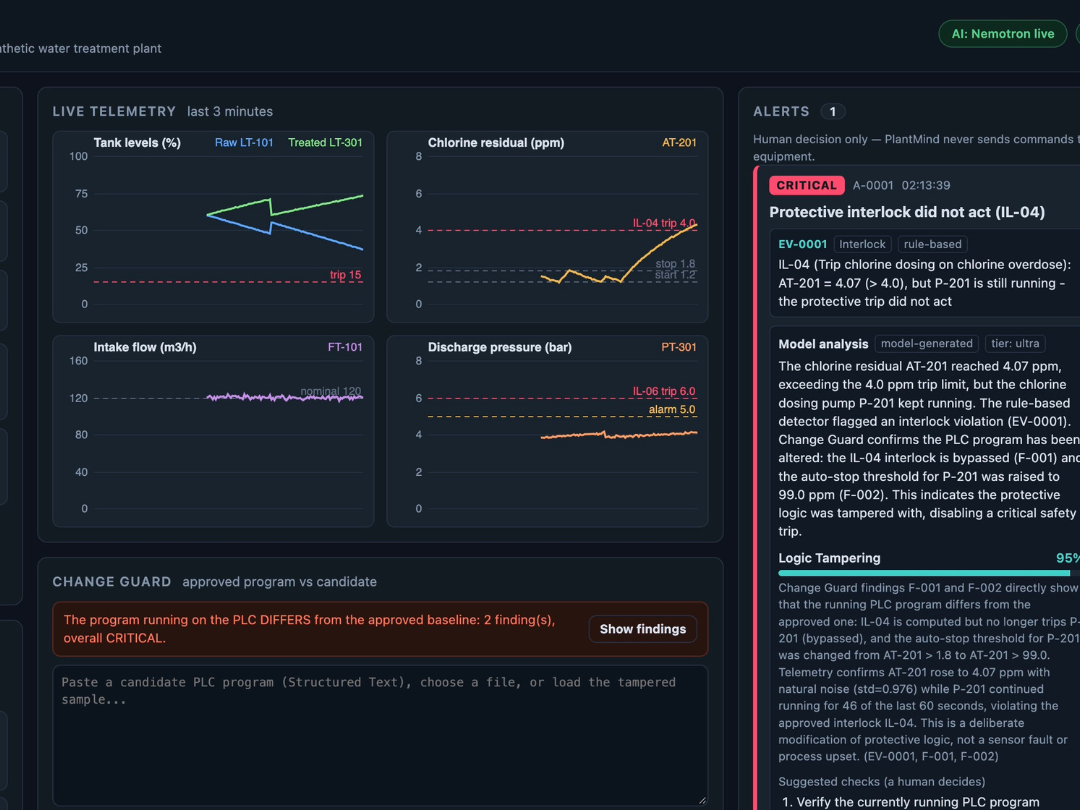
Security alert panel displaying critical interlock violations and AI-driven threat analysis findings.
Inspiration
Industrial Control Systems (ICS) and SCADA environments form the absolute backbone of critical infrastructure—including water treatment plants, power grids, and manufacturing facilities. However, these vital systems remain alarmingly vulnerable to sophisticated cyber threats, most notably PLC (Programmable Logic Controller) code tampering. A single subtle, unauthorized modification in Structured Text (ST) logic can silently bypass critical safety interlocks, leading to catastrophic physical failures, environmental hazards, or equipment destruction. We were inspired to build PlantMind to bridge the vital gap between industrial automation and advanced AI safety, creating an autonomous guardian that instantly detects malicious logic alterations and explains operational risks in real-time.
What it does
PlantMind functions as a real-time, AI-powered security guardian for ICS/SCADA environments. Its core capabilities include:
- Change Guard: Instantly compares candidate PLC programs against approved baselines to detect unauthorized code tampering, missing safety interlocks, or malicious logic modifications.
- AI-Powered Diagnostics: Leverages advanced language models to evaluate risk severity (such as CRITICAL or warning levels) and detail the precise physical consequences of code changes.
- Contextual Intelligence: Automatically retrieves real-time vulnerability data and threat contexts to help plant operators understand potential impacts before deploying updates to physical machinery.
How we built it
PlantMind was engineered as a robust, high-performance web application designed for real-time industrial reliability:
- Backend & API: Built using FastAPI and Python 3.11 to ensure asynchronous, high-throughput request handling.
- AI & LLM Engine: Integrated NVIDIA Nemotron via the Nebius Token Factory to power fast, accurate code analysis, anomaly detection, and deep reasoning.
- Context & Security: Harnessed the Tavily API to fetch real-time threat intelligence and vulnerability context.
- Frontend: Developed a clean, responsive operator dashboard providing instant visual feedback on baseline comparisons and safety assessments.
- Deployment: Containerized seamlessly via Docker and hosted live on a scalable, cloud-native infrastructure (Northflank).
Challenges we ran into
- Parsing Complex Industrial Logic: Structured Text (ST) syntax and vendor-specific formatting introduced complexities when ensuring our parser accurately compared candidate files against approved baselines without generating false positives.
- Balancing Speed and Depth: Calibrating deep LLM reasoning speed to meet the stringent demands of industrial incident response required fine-tuning our prompt architecture and fallback mechanisms.
- Zero-Cost Deployment Constraints: Finding a stable, production-grade cloud environment capable of supporting a containerized FastAPI application entirely on a free-tier budget tested our resourcefulness and DevOps skills.
Accomplishments that we're proud of
- Successfully deploying a fully functional, containerized ICS security application live on Northflank with zero financial cost.
- Designing and verifying the Change Guard engine to successfully detect subtle safety interlock removals (such as missing low-level trip conditions) and flag them as critical threats.
- Building a complete, end-to-end portfolio-grade application for the Nebius x NVIDIA Global AI Hackathon that merges heavy industrial engineering concepts with cutting-edge generative AI.
What we learned
- The critical importance of combining deterministic, rule-based security checks with probabilistic AI reasoning when dealing with safety-critical industrial environments.
- How high-performance AI inference (NVIDIA Nemotron on Nebius) can be harnessed to make complex industrial cybersecurity actionable and intuitive for plant operators.
What's next for PlantMind
- Expanding protocol support to ingest native vendor code formats (such as Siemens SCL and Rockwell Structured Text).
- Introducing automated remediation suggestions that generate secure, patched code snippets to replace tampered PLC logic instantly.
- Integrating advanced multi-agent workflows to simulate physical plant responses before any code ever touches live hardware.

Log in or sign up for Devpost to join the conversation.