-
-
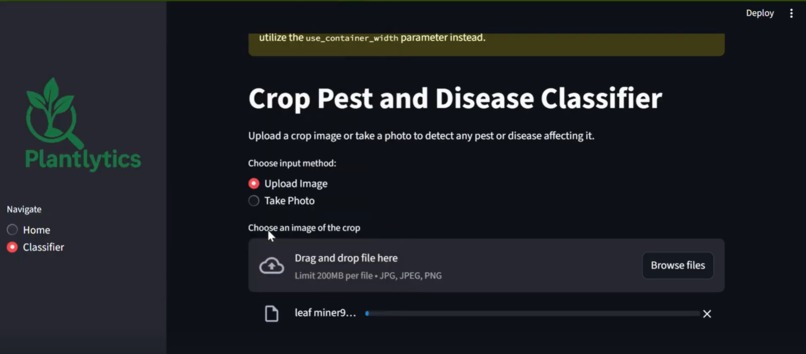
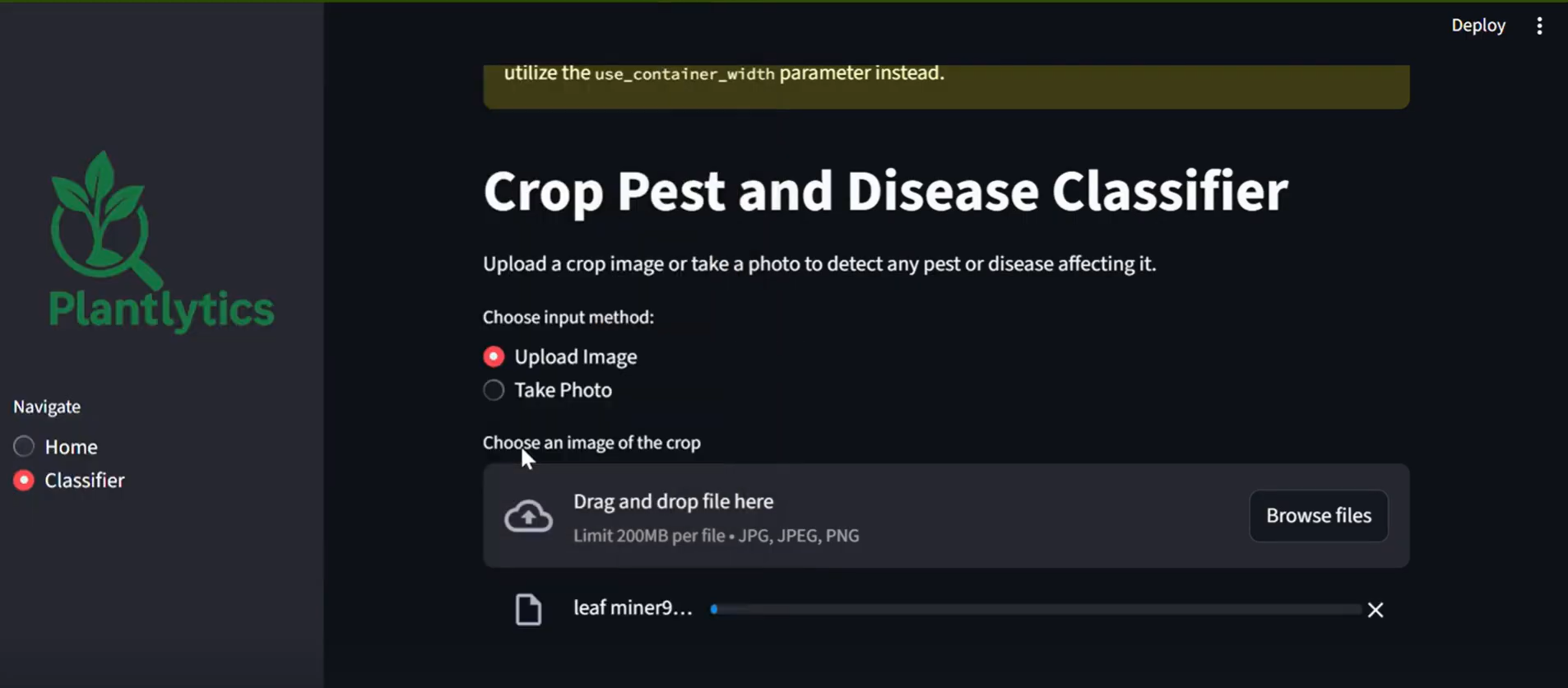
The User Interface of our app
Inspiration Plantlytics was born from a simple but powerful vision, What if every farmer could carry an expert agronomist in their pocket? What if a simple photo could prevent crop failure and transform livelihoods? We were inspired to democratize plant disease detection, making expert-level agricultural diagnostics accessible to every farmer, regardless of their location or economic status. Our mission is to empower farmers with AI-driven insights that can save crops, increase yields, and build food security across Ghana.
What it does Plantlytics is an AI-powered system designed for early detection of pests and diseases in Ghanaian crops such as tomato, maize, cassava, and cashew. It uses deep learning (EfficientNetB0) to identify plant health issues from leaf images, helping farmers, researchers, and agricultural workers detect and respond to issues quickly, thereby reducing crop losses and improving productivity.
How we built it
Challenges we ran into Handling a large dataset on limited hardware was a major challenge. We overcame memory issues with batch processing and chunk loading. We also dealt with class imbalance using weighted losses and stratified sampling. Overfitting was tackled using dropout, regularization, and data augmentation. To prevent unstable training, we used a very low learning rate with the Adam optimizer.
Accomplishments that we're proud of We achieved 63% test accuracy despite limited resources and a complex dataset. Our pipeline is optimized for low memory usage and can scale to other crops. We're proud of fine-tuning a robust model and building a system that can benefit real-world agriculture.
What we learned We learned how critical preprocessing and augmentation are for model performance. Transfer learning requires careful tuning, especially with low learning rates. Efficient data handling is key when working with large datasets on limited hardware. We also deepened our understanding of regularization and training stability
What's next for Plantlytics We plan to improve the model accuracy and train it to be adaptable to other crops while also considering how to deploy it offline so it is accessible to a wider range of farmers.
Built With
- efficientnetb0
- keras
- python
- seaborn
- tensorflow

Log in or sign up for Devpost to join the conversation.