-
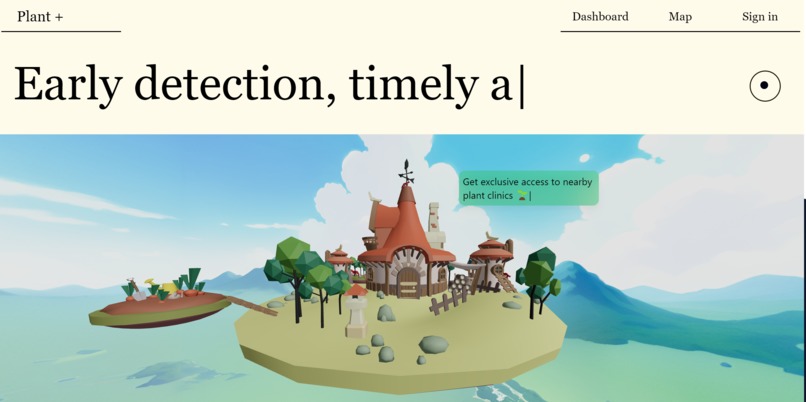
Our landing page

Inspiration:
PlantGuardian was inspired by the urgent need for sustainable farming and the empowerment of farmers through technology. We aimed to leverage AI to help farmers identify plant diseases and pests early and provide them with actionable insights.
What it does:
PlantGuardian uses image recognition and machine learning to detect plant diseases, alert farmers about pest infestations, suggest recipes based on vegetable photos, and visualize disease trends on a map for preventive measures.
How we built it:
PlantGuardian presents a bifurcated frontend system designed to cater to two main functionalities: disease diagnosis and recipe suggestions. Users interact with two distinct React-based frontends – one dedicated to identifying plant diseases and the other to providing recipes based on vegetable inputs.
The disease diagnosis frontend communicates with a Microsoft .NET backend, which processes the data and interacts with a centralized database to store and retrieve relevant information. This database is crucial for maintaining a repository of plant disease information and user queries, which enables efficient data management and retrieval.
On the other hand, the recipe suggestion frontend interfaces with a Flask-based AI backend. This backend is specifically designed to handle AI and machine learning operations, such as image recognition and analysis, which are essential for identifying vegetables from user-uploaded images and suggesting appropriate recipes.
The AI backend utilizes a specialized AI model to perform the complex computations required for image recognition and pattern detection. This model is likely trained on a dataset of vegetable images and is capable of discerning various vegetable types to match them with recipes.
This architecture not only allows for a modular approach to handling different functionalities of the app but also ensures that each component is optimized for its specific task – whether it be data handling and processing in the .NET backend or the AI-driven operations in the Flask backend.
Challenges we ran into:
One major challenge was ensuring accurate disease detection under varied lighting and photo quality conditions. Integrating different tech stacks smoothly and optimizing the app's performance were also complex tasks.
Accomplishments that we're proud of:
We are proud of developing a functional prototype that can accurately identify multiple plant diseases and pests. The real-time alert system and the map visualization stand out as key features that can make a significant impact.
What we learned:
The project deepened our understanding of machine learning applications in real-world scenarios and honed our skills in full-stack development. We also learned the importance of interdisciplinary collaboration and agile methodology.
What's next for PlantGuardian:
The next steps include expanding our database for plant diseases, improving the app's UI/UX, and scaling the solution to serve farmers globally. We also plan to integrate more personalized recommendations for pest control and plant care.

Log in or sign up for Devpost to join the conversation.