-
-
-
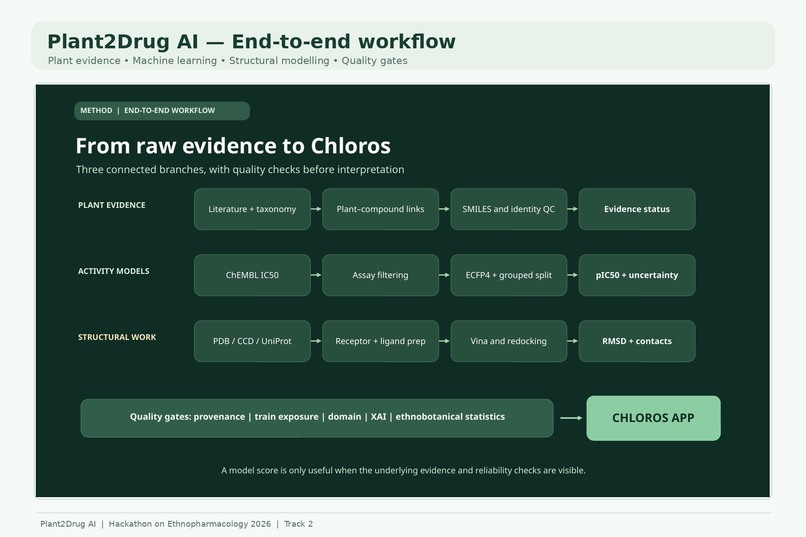
Workflow of project
-
-
We are a multidisciplinary team consisting of a chemist, two bioinformaticians, and a biotechnologist. We were inspired by the challenge of bridging traditional plant knowledge with modern computational drug discovery.
Natural products offer enormous chemical diversity, yet identifying promising bioactive compounds remains time-consuming and complex. Ethnobotanical knowledge, chemical structures, and biological activity data are often scattered across disconnected databases.
We wanted to bring these pieces together into a transparent, automated, and scientifically grounded workflow.
Our guiding principle became simple: a promising molecule or a single AI prediction is never enough without reliable evidence, chemical context, and validation.
What it does
Plant2Drug AI is an evidence-based computational screening pipeline that connects traditional plant knowledge with molecular modeling, machine learning, and explainable artificial intelligence.
Our primary structural target is human acetylcholinesterase (AChE), an enzyme relevant to Alzheimer's disease research.
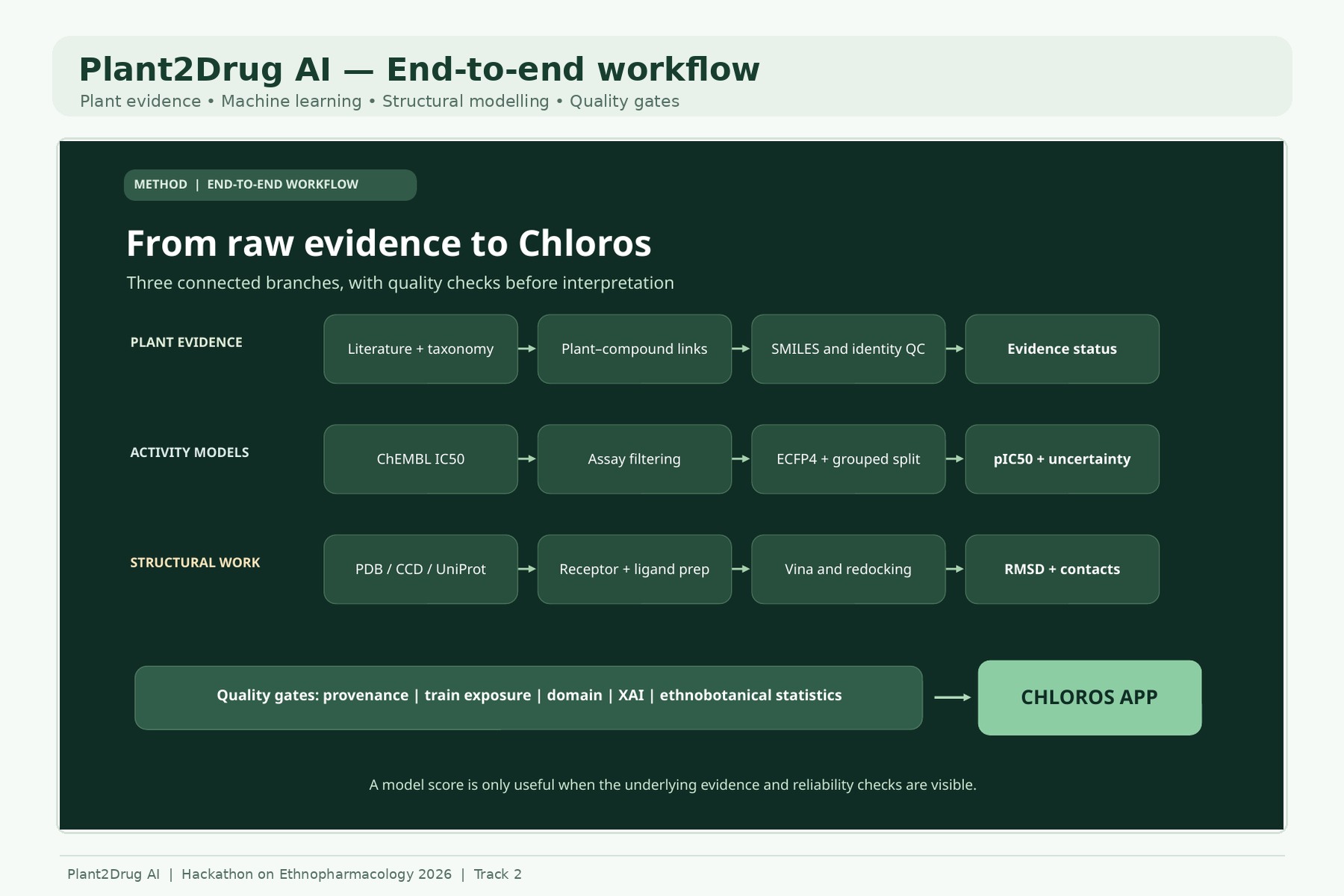
The platform combines three major components:
- Plant evidence: Curated plant–compound relationships supported by scientific literature and database records.
- Machine learning: Prediction of biological activity using experimental IC50 measurements, molecular fingerprints, and physicochemical descriptors.
- Molecular docking: Investigation of potential protein–ligand binding poses using AutoDock Vina.
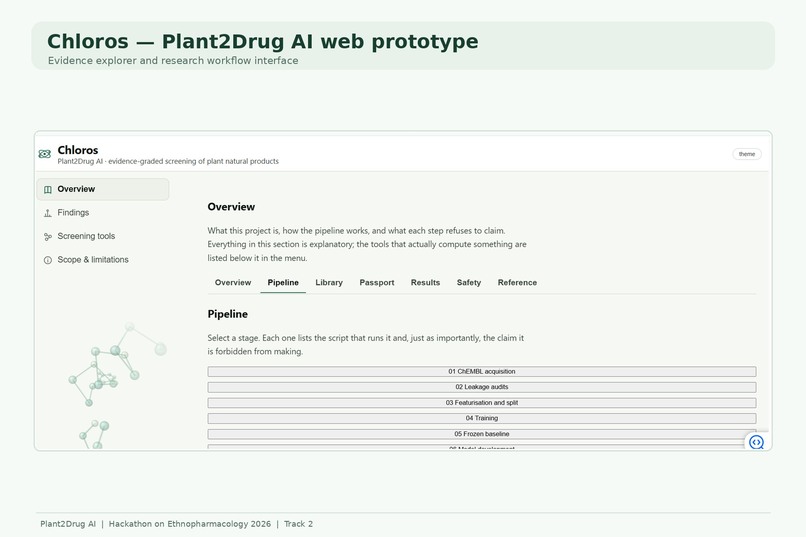
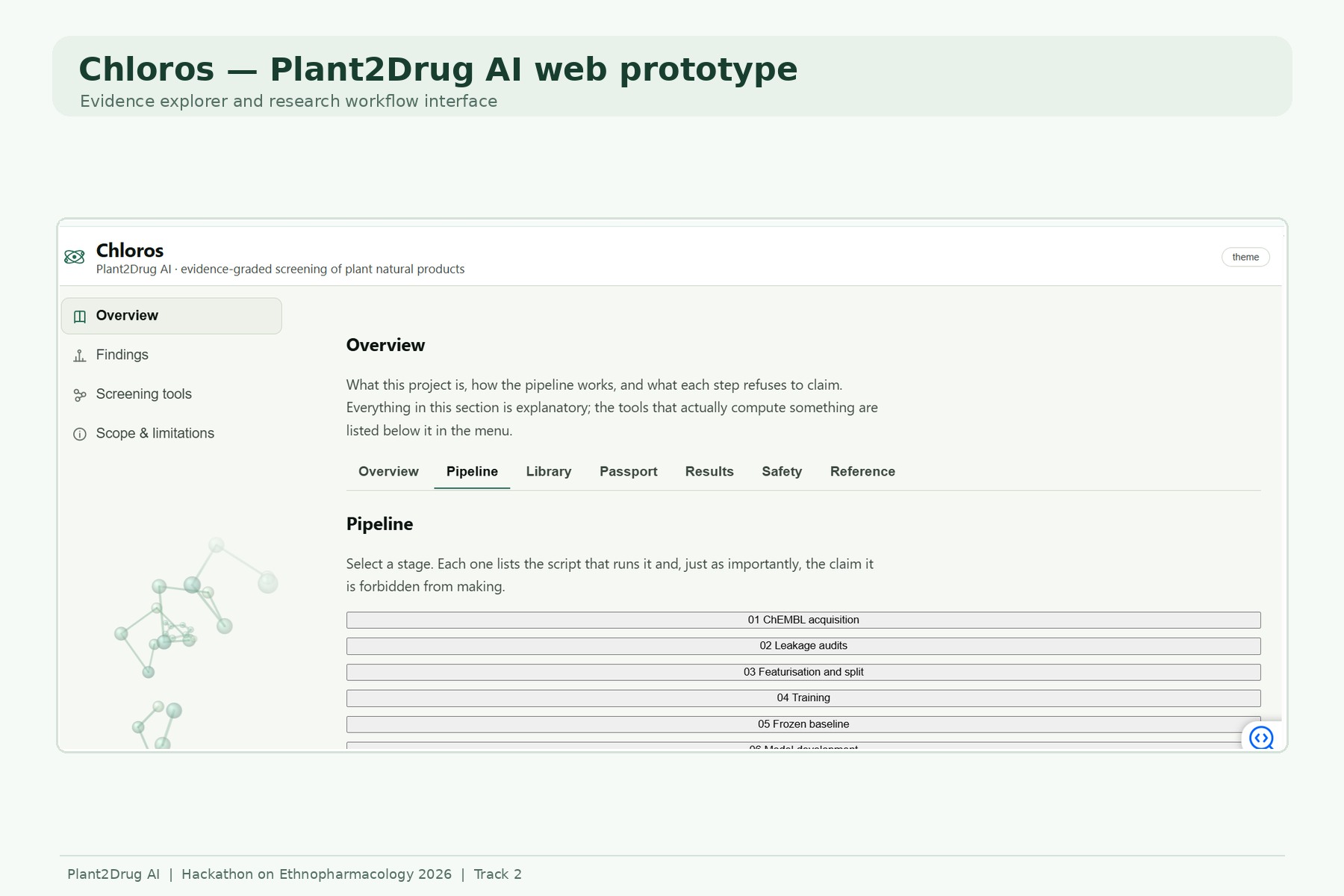
These components are integrated into Chloros, our browser-based research prototype, which brings together data provenance, screening tools, model explanations, and uncertainty information.
Rather than presenting predictions as established biological facts, the platform makes their scientific limitations visible.
How we built it
We developed Plant2Drug AI through a connected computational workflow.
First, we integrated complementary information from ChEMBL, RCSB PDB, UniProt, LOTUS, COCONUT, GBIF, Wikidata, and other scientific resources. We reviewed plant–compound associations and their supporting evidence, creating a demonstration library containing 21 plant species, 24 distinct molecular structures, and 32 reviewed plant–compound links.
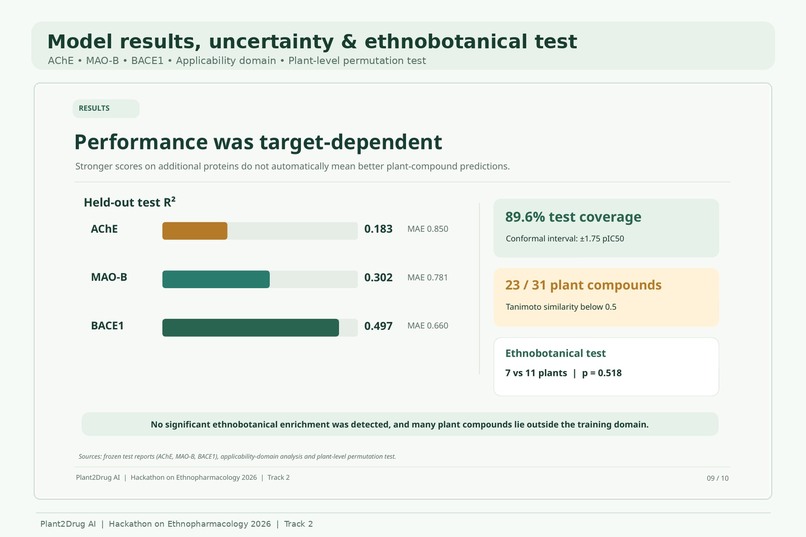
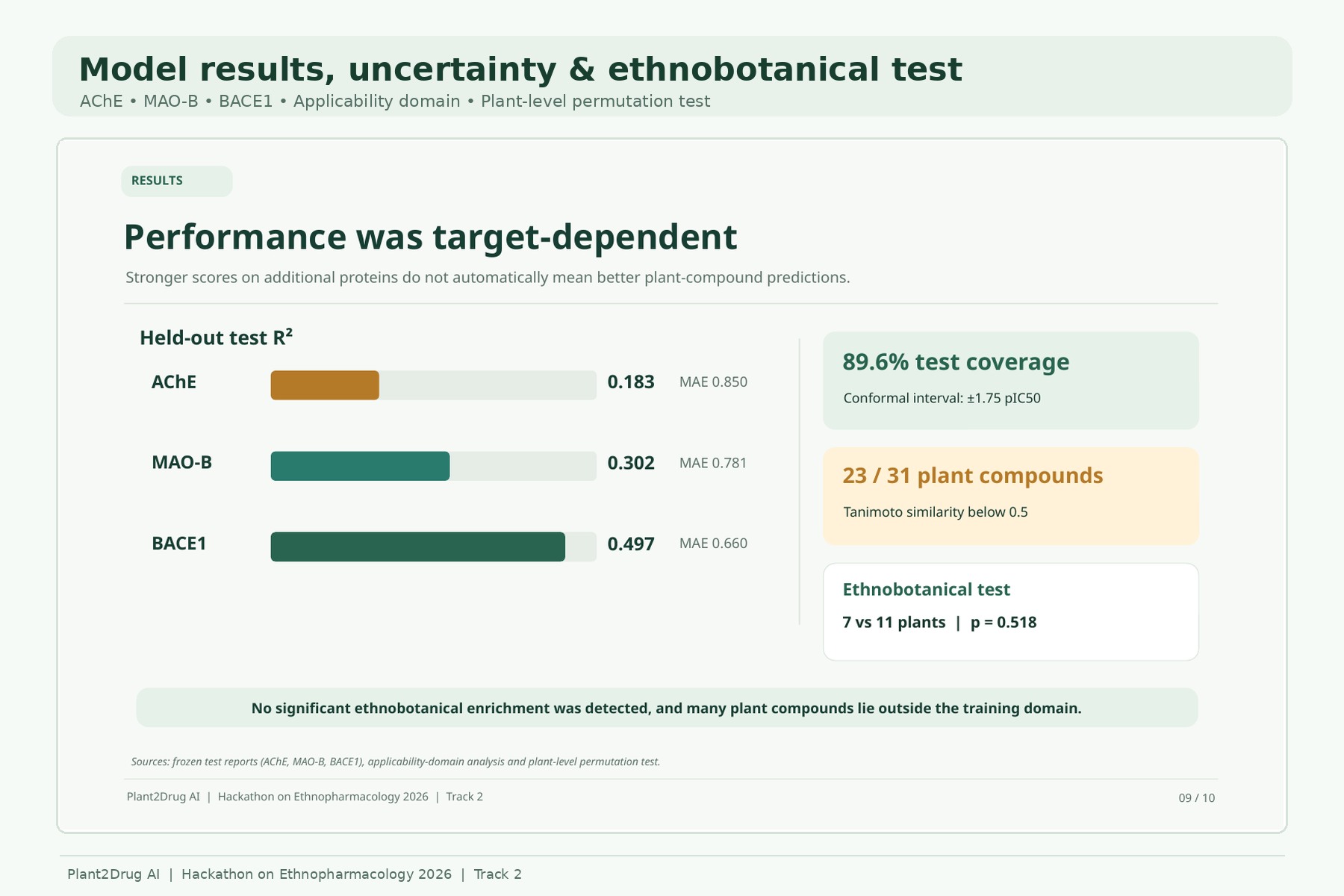
For machine learning, we collected experimental activity measurements from ChEMBL and trained HistGradientBoosting regression models using Morgan ECFP4 fingerprints and physicochemical descriptors. Chemical clustering was used to reduce potential information leakage between training and test sets.
For structural analysis, we prepared human AChE crystal structures (PDB IDs: 4EY6 and 4EY7), processed protein and ligand structures, and performed molecular docking using AutoDock Vina.
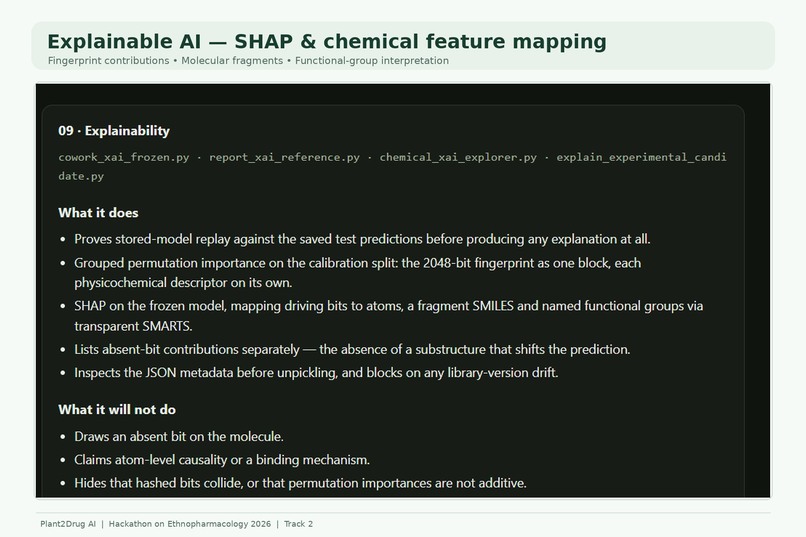
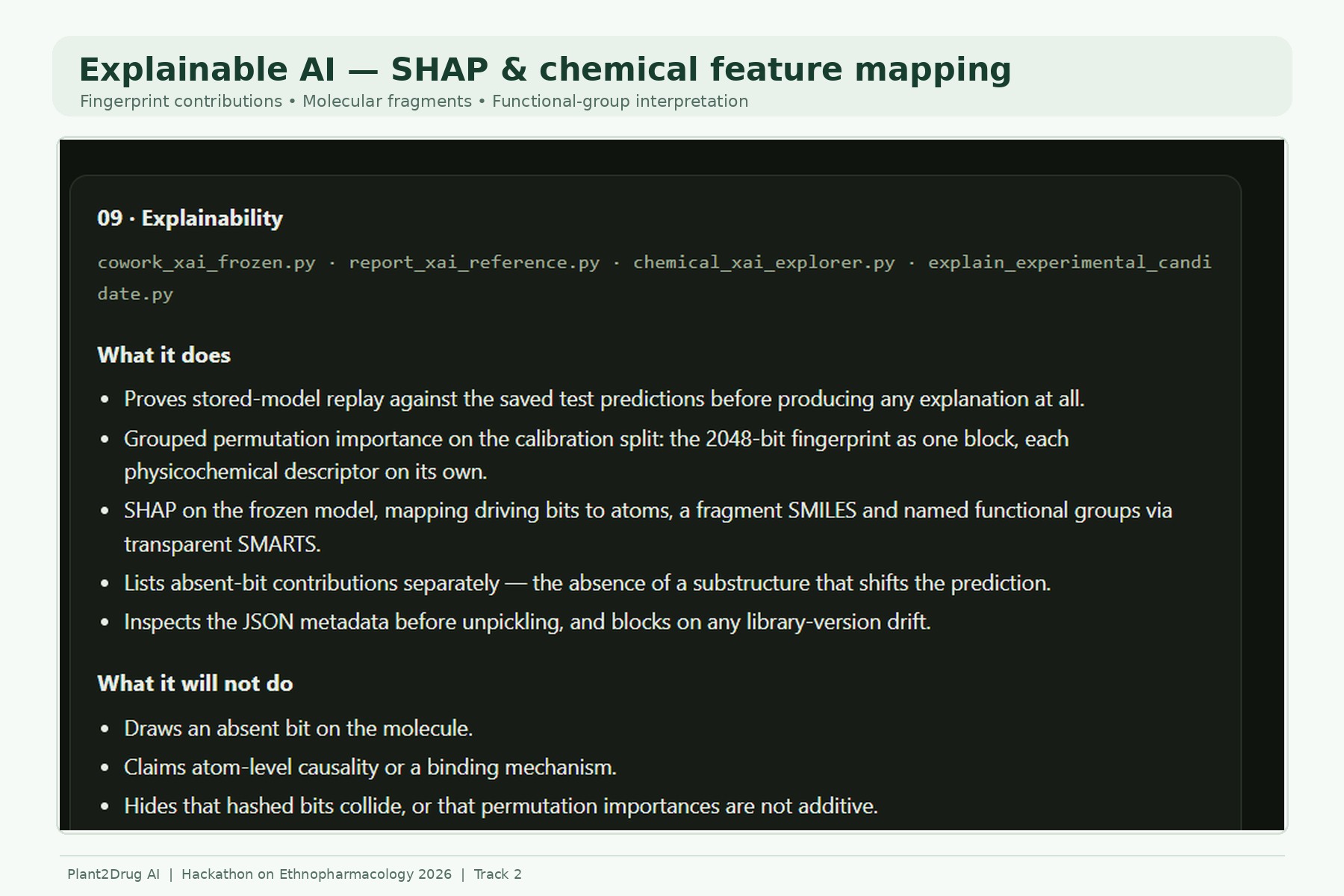
Finally, we connected the analysis through a FastAPI/Uvicorn backend and an interactive HTML/JavaScript frontend, incorporating explainable AI methods such as SHAP and uncertainty estimation.
Challenges we ran into
One major challenge was data fragmentation. Plant names, compound identities, and experimental activity records do not always match across scientific databases. Establishing reliable relationships required careful data cleaning and literature review.
Another challenge was ensuring that molecular docking results were scientifically meaningful. Although self-redocking successfully reproduced reference ligand poses, cross-docking revealed limitations associated with receptor flexibility.
Machine-learning generalization was also challenging. Many natural products differed substantially from the compounds used during model training, highlighting limitations in the models' applicability domains.
Additionally, our initial ethnobotanical statistical analysis did not demonstrate significant enrichment, reinforcing the importance of interpreting computational results cautiously.
These challenges shaped our decision to prioritize scientific transparency over overconfident predictions.
Accomplishments
Our greatest achievement was integrating plant evidence, experimental bioactivity modeling, molecular docking, and explainable AI into a unified research workflow.
We successfully reproduced experimental ligand poses during AChE self-redocking, achieving RMSD values of 0.77 Å and 1.01 Å, while openly reporting less successful validation cases.
We also developed Chloros, a working research prototype that brings together scientific evidence, prediction tools, model interpretation, and uncertainty information in an accessible interface.
Most importantly, we created a system designed not only to generate predictions, but also to help researchers evaluate how trustworthy those predictions may be.
What we learned
This project taught us that computational predictions must always be interpreted within their scientific context.
A high machine-learning score does not automatically indicate biological activity, and a favorable docking pose does not prove that a compound will be therapeutically effective.
We also learned how essential data provenance, applicability-domain analysis, experimental validation, and explainable AI are when evaluating natural products.
Above all, Plant2Drug AI reinforced our central principle:
One score is never enough. Evidence, chemistry, uncertainty, and validation must accompany every prediction.
Our next steps focus on strengthening the scientific reliability and practical capabilities of Plant2Drug AI.
We plan to expand and further validate our plant–compound evidence library, incorporate additional natural-product datasets, and extend molecular docking benchmarks to more protein targets.
An important future direction is the integration of molecular dynamics (MD) simulations. By studying the time-dependent behavior of selected protein–ligand complexes, we aim to investigate their structural stability, conformational changes, and key molecular interactions under dynamic conditions. This would complement our current docking approach, which primarily evaluates static binding poses, and provide an additional layer of computational validation for promising compounds.
We also aim to validate live prediction and SHAP workflows end-to-end and evaluate promising candidates through independent experimental bioassays.
Our long-term vision is to develop Plant2Drug AI into a more comprehensive, transparent, and reproducible platform supporting evidence-based natural-product research and early-stage drug discovery.
Built With
- admet
- artificial-intelligence
- autodock-vina
- bioinformatics
- chembl
- cheminformatics
- drug-discovery
- ethnopharmacology
- explainable-ai
- fastapi
- javascript
- jupyter-notebooks
- machine-learning
- molecular-docking
- molecular-fingerprints
- natural-products
- pic50-prediction
- protein-preparation
- pubchem
- python
- rcsb-pdb
- rdkit
- shap
- uniprot


