-
-
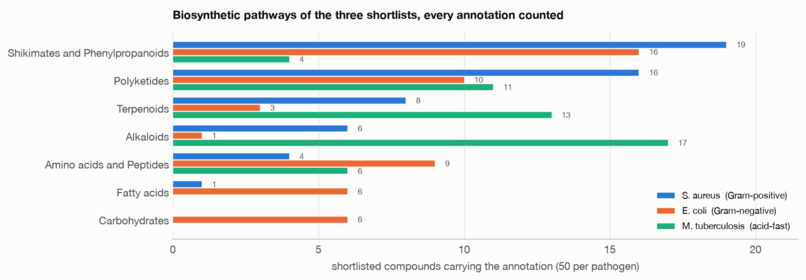
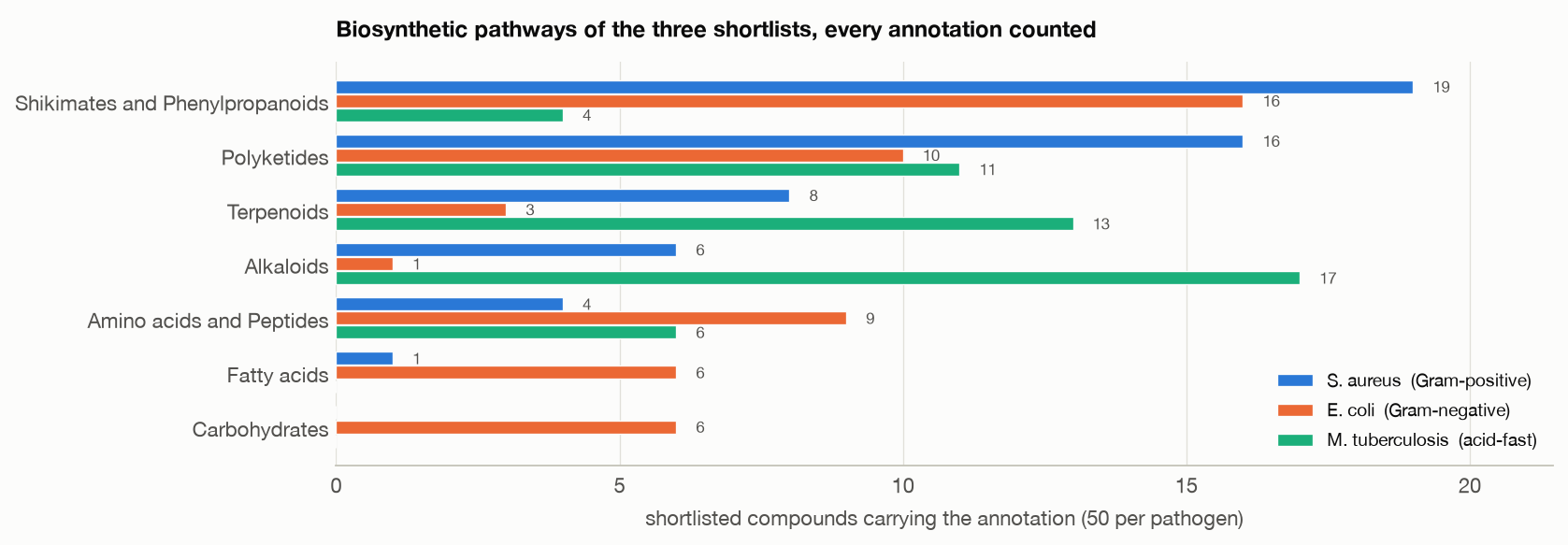
Biosynthetic pathways per shortlist. Alkaloids and terpenoids dominate acid-fast M. tuberculosis, 30 of 50. A hypothesis, not a finding.
-
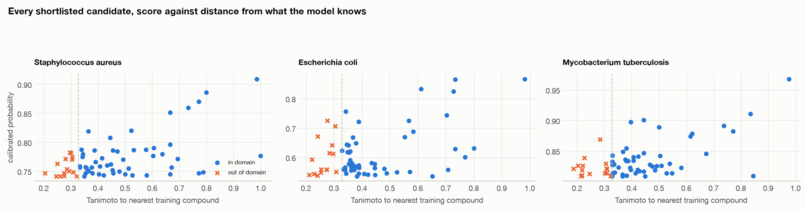
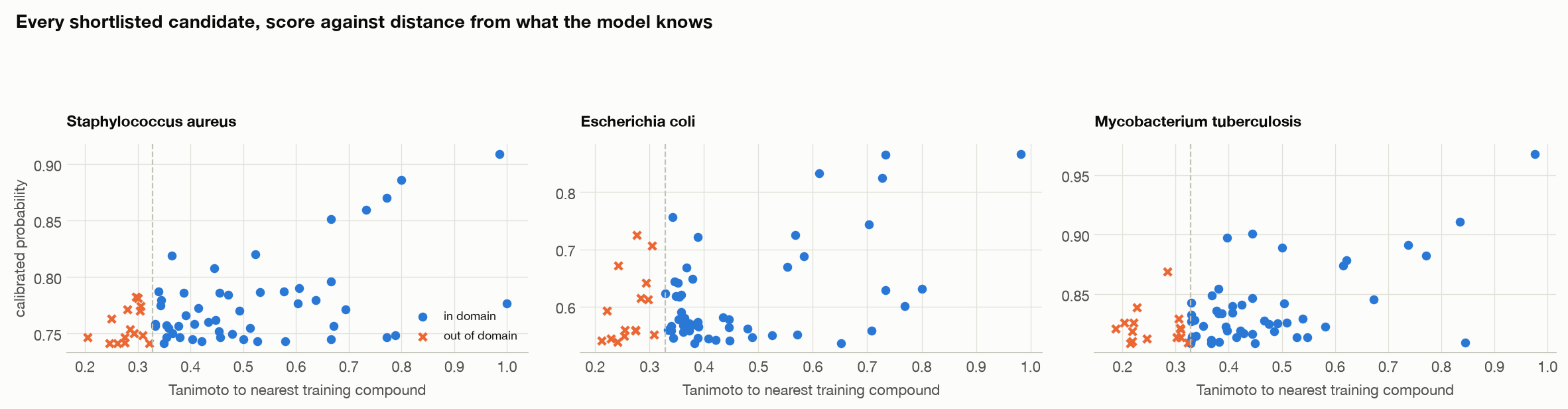
Every candidate: calibrated probability against distance from training. The 0.328 cutoff is the 25th percentile of the plant holdout.
-
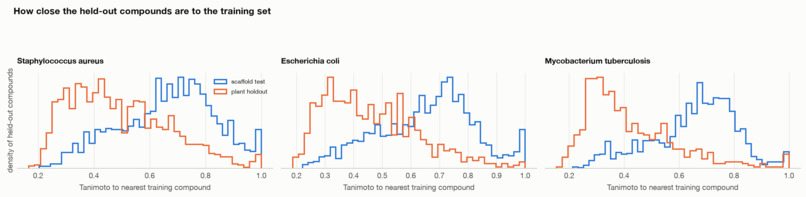
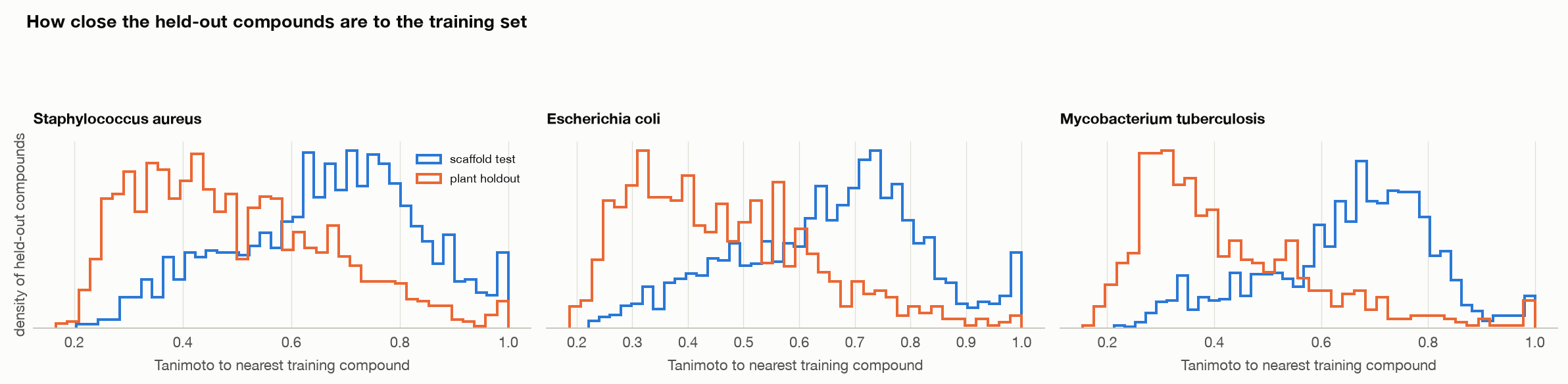
Distance to the nearest training compound. Only 3.4% of plant compounds have a near-twin, against 13.5% of the scaffold test set.
Inspiration
Track 2 asks: among hundreds of thousands of plant compounds, which deserve a closer look? We took it literally.
Published antibacterial measurements are overwhelmingly not about plants. Of the 58,191 compounds with a published MIC against S. aureus, only 1,424 come from a plant. A model trained on that and pointed at plant chemistry is extrapolating, and most virtual-screening demos never measure how far. So we answer a narrower, testable question: when you hold every plant-derived compound out of training entirely, how well does the model still rank them?
What it does
Three pathogens, one model each, chosen for three different cell envelopes so that cross-reading between them means something: S. aureus (Gram-positive, 58,191 labelled compounds), E. coli (Gram-negative, 43,099) and M. tuberculosis (acid-fast, 22,907). Each returns a ranked shortlist of 50 plant compounds carrying the source plant, the literature reference, and the Tanimoto distance to the nearest training compound.
The evaluation ladder, same model read three ways:
| validation | scaffold-held-out | plant holdout | |
|---|---|---|---|
| S. aureus | 0.880 | 0.863 | 0.719 |
| E. coli | 0.882 | 0.903 | 0.682 |
| M. tuberculosis | 0.846 | 0.815 | 0.629 |
The ladder is not monotonic, since E. coli scores higher on the scaffold test than on validation, so our claim is narrower than it looks: the plant holdout is the hardest reading for every pathogen, and it is the only one that measures what a plant screen actually asks for. That is the number we report.
For a lab, that is 57.0% precision in the top 10% of the S. aureus ranking against a 25.3% base rate, and 5.03x enrichment in the top 5% for E. coli. Not a cure: a shorter queue for the bench.
How we built it
ChEMBL for the activity labels, LOTUS for the plant-to-compound edge, GBIF to check which organisms are plants. Morgan fingerprints and physicochemical descriptors, XGBoost tuned with Optuna, and cluster-level splits: we cluster on chemical similarity and split the clusters, so no compound and no close analogue can land on both sides.
Every predicted probability is published beside its distance to training. The applicability-domain cutoff, 0.328, is the 25th percentile of the plant holdout, the most distant set on which performance was actually measured, not a number chosen because it looked good. Candidates past it go into a separate tier that says in its own words that its scores are not evidence of activity.
Challenges we ran into
The project we planned could not be trained. We set out to build per-protein models. Then we measured the download: 99.6% of the ChEMBL MIC rows in our pull, across nine bacteria, are measured against the whole organism, and only 35 single-protein targets carry any MIC at all. There was nothing there to train on. We changed the project to fit the data rather than the other way around, so the model predicts growth inhibition and says nothing about mechanism.
Our headline hypothesis did not replicate. We expected holding out whole plant families to be harder than holding out chemical scaffolds. Measured four separate times, the direction is usually negative and the magnitude never settles: S. aureus -0.073 (paired sd 0.067), E. coli +0.004 (sd 0.139, the effect vanishes), M. tuberculosis -0.097 (sd 0.158). The repeat-to-repeat spread is wider than the effect, so it goes in as an honest negative, not as our contribution.
Accomplishments that we're proud of
The shortlist reports what is wrong with it. Our own distance column caught the worst problem: the top-ranked candidate on all three plates is a near-copy of a training compound (Tanimoto 0.986 / 0.982 / 0.976). The exact phenomenon this project set out to measure turned up inside its own deliverable, and we published it rather than quietly reranking. 12 / 8 / 3 of the 50 candidates per plate carry no source plant and no reference. Per-compound SHAP values came out numerically impossible for a probability output, so that column is withheld until we find the cause.
One thing we did not expect: the biosynthetic pathways of the shortlisted compounds track each pathogen's cell envelope, with alkaloids and terpenoids dominating the acid-fast M. tuberculosis list (30 of 50). The model was never given any cell-wall information. We report it as a hypothesis worth testing, not a finding, since it partly reflects which compounds LOTUS has annotated.
What we learned
That the split is the experiment. A scaffold holdout looked rigorous and still flattered the model by roughly 0.15 AUROC against the question we actually care about. Only 3.4% of plant compounds have a near-twin in training, against 13.5% of the scaffold test set, and that distance is the whole problem.
What's next for Plant Shortlist
Not a fourth pathogen. Ten of these compounds on a real plate, with the measured hit rate published next to the predicted one, including if it is worse.
Required disclosures
Not a medical or clinical claim. Everything here is a model prediction over published measurements and traditional-use records. Nothing has been near a laboratory. No dose, preparation or use is implied or recommended. Output is stated as predicted or traditional-use claims, is not evidence of efficacy, and is not medical advice.
Use of AI tools. Claude (Anthropic) was used throughout as a pair programmer and writing assistant: scaffolding the notebooks and the shared pipeline modules, building the web app, drafting documentation, and reviewing decisions. Every modelling and curation decision, every number reported, and the final text are ours; we checked the outputs and are responsible for their accuracy, originality and licensing. Several claims were corrected against the run ledger during review.
What existed before the hackathon. Nothing in the repository. It was created on 2 November 2026 and everything was built during the event. The project design draws on prior unpublished work by one of us on antimicrobial-peptide screening pipelines; no code, data or text from that work is in the repository.
Data licences. ChEMBL CC BY-SA 3.0, LOTUS CC0, GBIF backbone CC BY-NC 4.0. NPASS was evaluated and dropped: its MIC table is a copy of ChEMBL and it publishes no licence, so we cite ChEMBL directly.
Responsible use. The plant records come from published literature and traditional knowledge sits behind many of them. Anything built on this carries the Nagoya Protocol and Local Contexts as a condition of using the data, not as a footnote.
Built With
- chembl
- lotus
- matplotlib
- next.js
- numpy
- optuna
- pandas
- python
- rdkit
- react
- scikit-learn
- shap
- tailwindcss
- typescript
- vercel
- xgboost
