Inspiration
One of the important sectors of the Indian Economy is Agriculture. Employment for almost 50% of the country's workforce is provided by the Indian agriculture sector. India is known to be the world's largest producer of pulses, rice, wheat, spices, and spice products. Farmers' economic growth depends on the quality of the products that they produce, which relies on the plant's growth and the yield they get. Therefore, in the field of agriculture, the detection of disease in plants plays an instrumental role. Plants are highly prone to diseases that affect the growth of the plant which in turn affects the ecology of the farmer. In order to detect a plant disease at the very initial stage, the use of an automatic disease detection technique is advantageous. The symptoms of plant diseases are conspicuous in different parts of a plant such as leaves, etc. Manual detection of plant disease using leaf images is a tedious job. Hence, it is required to develop computational methods that will make the process of disease detection and classification using leaf images automatic.
What it does
Plant disease identification in the visual way is a more laborious task and at the same time accurate and can be done only in limited areas. Whereas if an automatic detection technique is used it will take less effort, less time, and be more accurate.
The main objective of this system is to identify the disease in the leaves and notify the farmers so that they can give the corresponding pesticides to those leaves. It decreases the nearby leaves' infected in a short period. Using image processing we can easily spot the infected area in the leaves.
How we built it
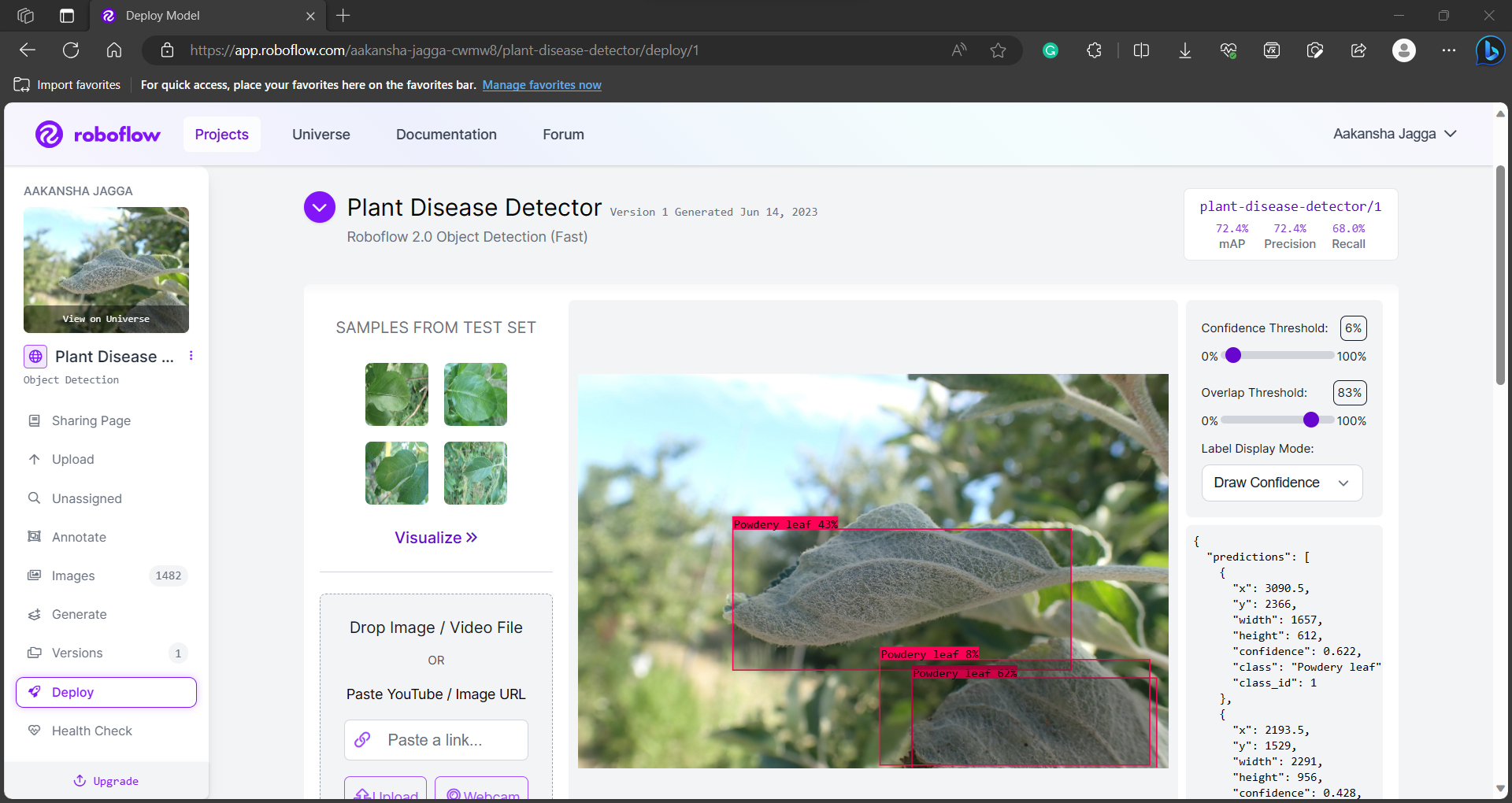
Numerous approaches have been proposed over the years. A considerable number of crops are being destroyed due to the lack of knowledge of identifying various ailments amongst plants. This project provides accurate and quick decisions about the illness. The Project deals detection of diseases that affect the plant and the area affected using the Convolutional neural network (CNN) Model. The convolutional neural network model is developed to perform plant disease detection and diagnosis using simple leaf images of healthy and diseased plants, through deep learning methodologies. So that appropriate fertilizers can be used to prevent further damage to plants from pathogenic viruses.
Challenges we ran into
Gathering accurate and relevant data stands as the cornerstone of this project, and it is a challenge that requires our utmost attention. Furthermore, the model's testing and training demand precision in predictions, which presents yet another significant challenge. Thus, we must perform extensive testing to achieve improved accuracy.
Accomplishments that we're proud of
Based on the data gathered, the prototype of the model has demonstrated exceptional accuracy and precision values. This translates to more reliable and precise predictions, which can ultimately have a positive impact on individuals and communities alike. The potential benefits of this technology are vast and far-reaching, ranging from improved decision-making processes to increased efficiency and productivity in various industries.
What we learned
Through our studies, we have discovered the immense value of image classification in various industries. Specifically, we have found that this skill is particularly beneficial for farmers who require quick and accurate identification of crops and other elements in their fields. By gathering relevant data sets and utilizing advanced modeling techniques, we have been able to create a highly effective tool that can assist farmers in their day-to-day operations. This model has the potential to save countless hours of manual labor and provide farmers with invaluable insights into their operations.
What's next for Plant Disease Detector
We firmly believe that the current project can significantly benefit farmers and the overall economy. With its speedy, cost-effective, and efficient approach, it offers a promising solution. As we move forward, we plan to showcase the results in multiple languages, eliminating any language barriers and making it more widely available. We are committed to ensuring that this project reaches its full potential and positively impacts the agricultural industry.


Log in or sign up for Devpost to join the conversation.