Inspiration
One of the important sectors of the Indian Economy is Agriculture. Employment for almost 50% of the country's workforce is provided by the Indian agriculture sector. India is known to be the world's largest producer of pulses, rice, wheat, spices, and spice products. Farmers' economic growth depends on the quality of the products that they produce, which relies on the plant's growth and the yield they get. Therefore, in the field of agriculture, the detection of disease in plants plays an instrumental role.
What it does
Plants are highly prone to diseases that affect the growth of the plant which in turn affects the ecology of the farmer. In order to detect a plant disease at the very initial stage, the use of an automatic disease detection technique is advantageous. The symptoms of plant diseases are conspicuous in different parts of a plant such as leaves, etc. Manual detection of plant disease using leaf images is a tedious job. Hence, it is required to develop computational methods that will make the process of disease detection and classification using leaf images automatic.
How we built it
Plant disease identification in the visual way is a more laborious task and at the same time accurate and can be done only in limited areas. Whereas if an automatic detection technique is used it will take less effort, less time, and be more accurate. The main objective of this system is to identify the disease in the leaves and notify the farmers so that they can give the corresponding pesticides to those leaves. It decreases the nearby leaves' infected in a short period. Using image processing we can easily spot the infected area in the leaves.
Challenges we ran into
One of the biggest challenges in this project is collecting and testing data for the model. Data is the foundation of this project, and obtaining relevant and accurate datasets is crucial for achieving better accuracy and predictions. It's equally important to use the correct data for both testing and training the model, as this greatly impacts the accuracy of the predictions.
Accomplishments that we're proud of
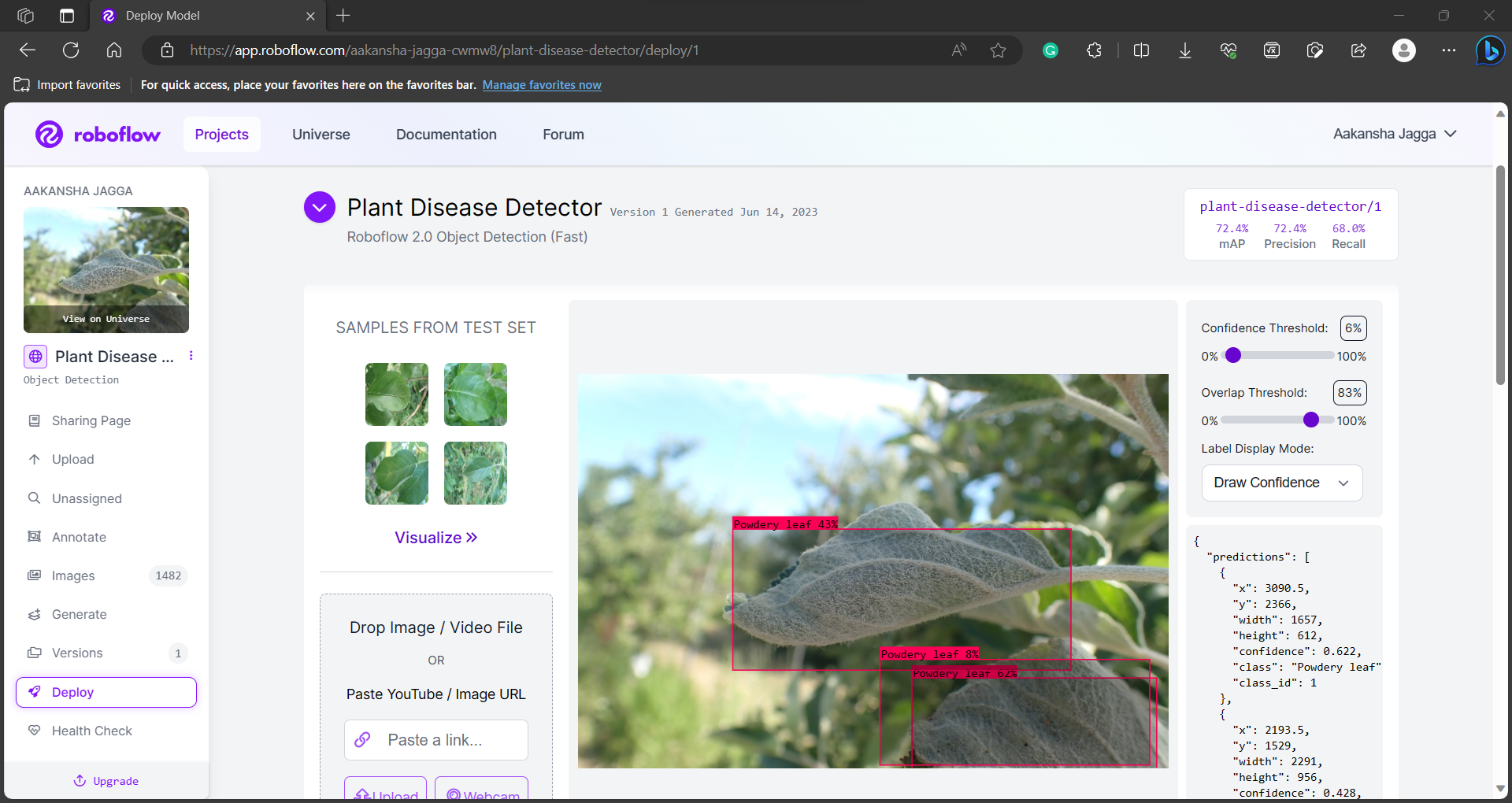
The prototype produces accurate results with high precision and recall values, making it a valuable tool for predicting outcomes.
What we learned
Through machine learning, we can classify images and sort them accordingly. Additionally, we can utilize this classification to make predictions about other images. By using a high-quality dataset and conducting thorough training and testing, a machine learning model can produce reliable results.
What's next for Plant Disease Detector
We could incorporate various features to assist farmers. Language can be a significant obstacle, but we can overcome it by displaying results in local languages. We can create an app for this purpose, which would enhance its usability. This project presents promising opportunities in the agricultural industry and has the potential to bring about a revolution.
Built With
- ai
- machine-learning
- plant

Log in or sign up for Devpost to join the conversation.