



Planix AI — The Learning Operating System
💡 Inspiration
We are not lacking information.
We are drowning in it.
Students save courses they never finish.
Professionals bookmark tutorials they never execute.
AI tools answer questions instantly — yet real growth remains inconsistent.
The problem is not knowledge access.
The problem is lack of structured execution.
Most learning journeys fail because people don't know:
- where to start
- what to learn next
- how to structure progress
- how to stay consistent
Modern AI tools respond to prompts, but they rarely design learning progression.
Planix AI was built to change that.
Instead of simply answering questions, it acts as an AI-powered learning architect, transforming goals into structured execution systems.
Growth should be engineered — not improvised.
🎯 What it does
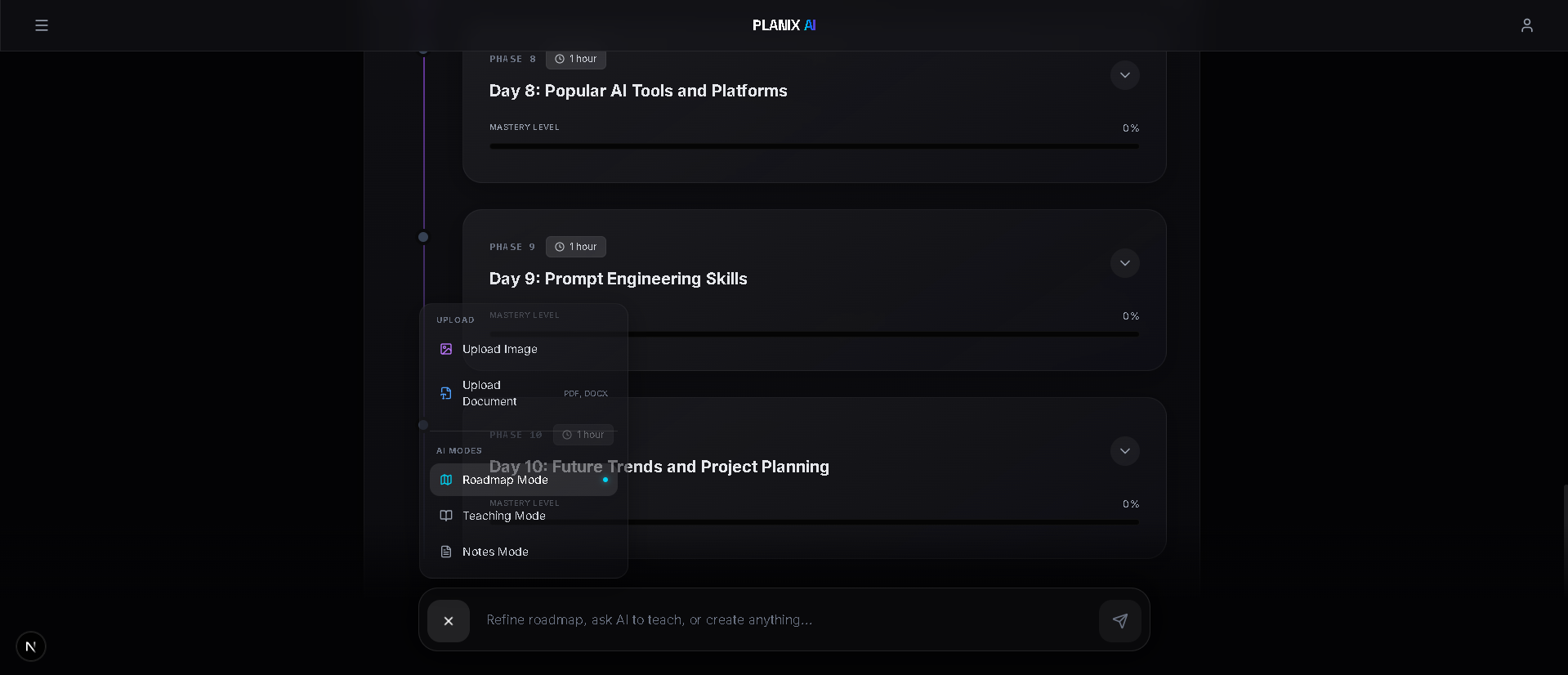
Planix AI converts a learning goal into a structured roadmap.
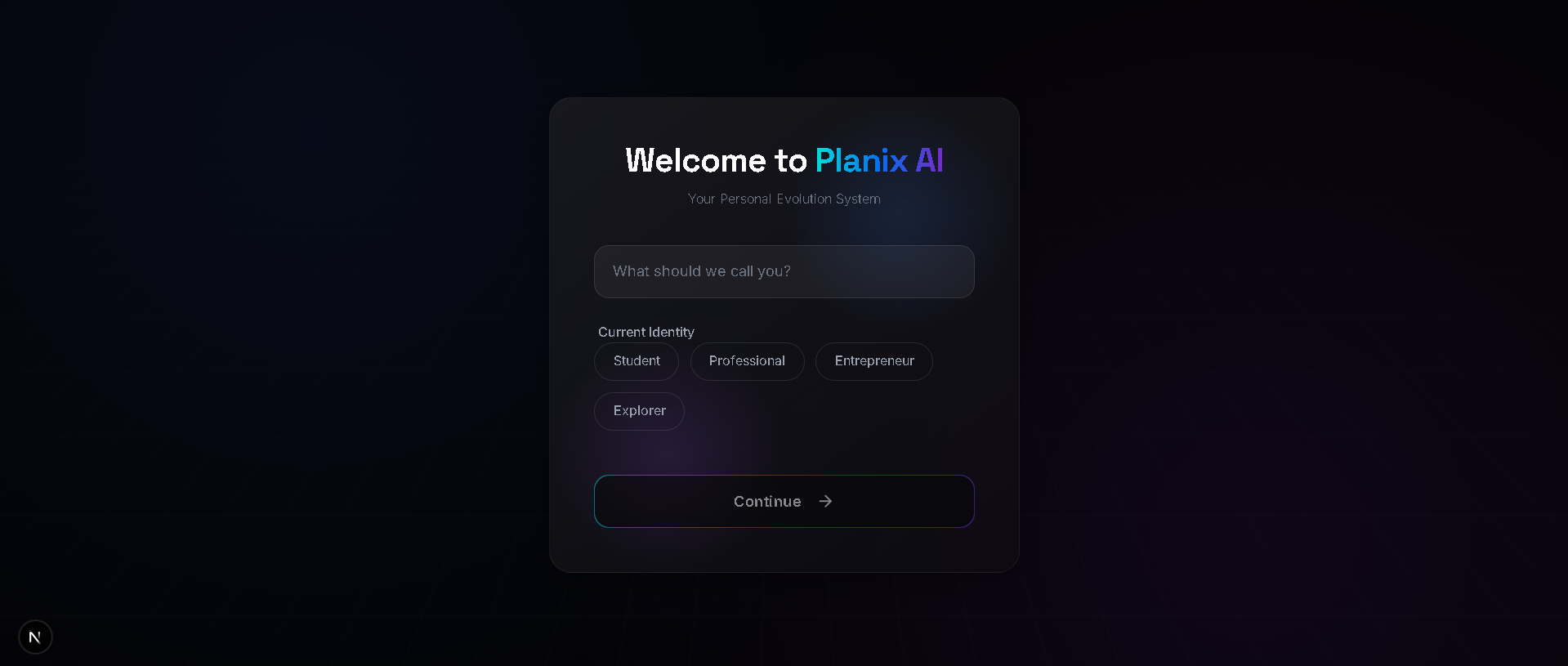
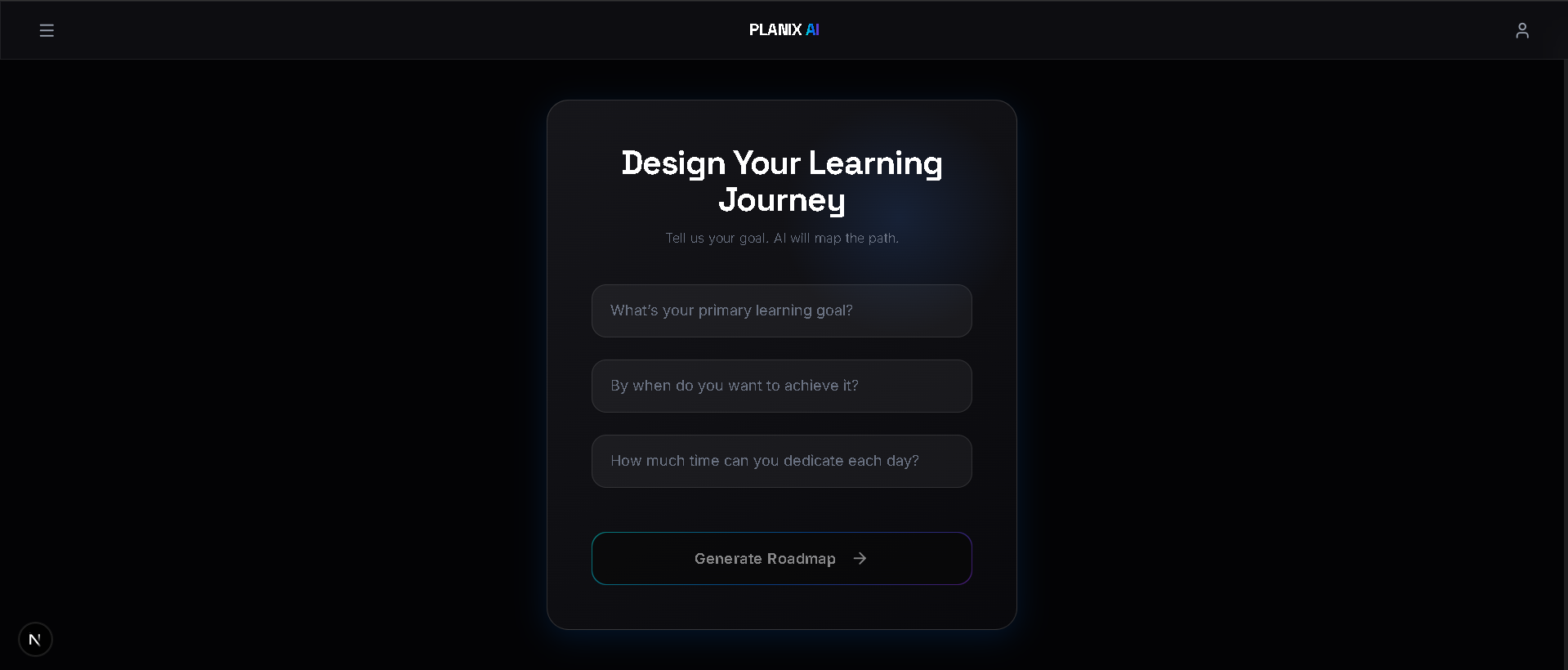
A user defines:
- what they want to learn
- how many days they want to study
- how many hours they can dedicate daily
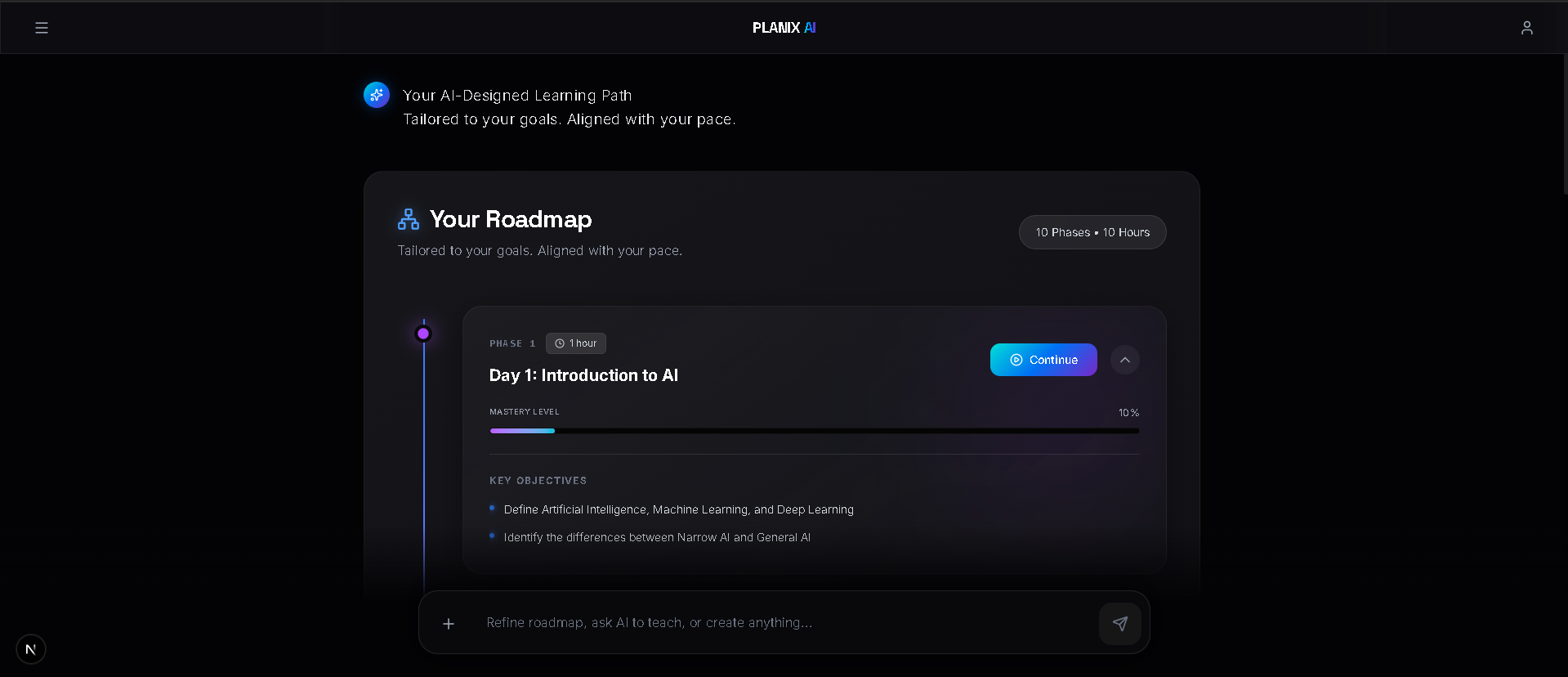
Planix AI then generates a phase-based learning architecture including:
- logically sequenced phases
- time-calibrated milestones
- structured competency progression
- estimated effort per task
Once a roadmap is generated, users can:
- explore roadmap phases
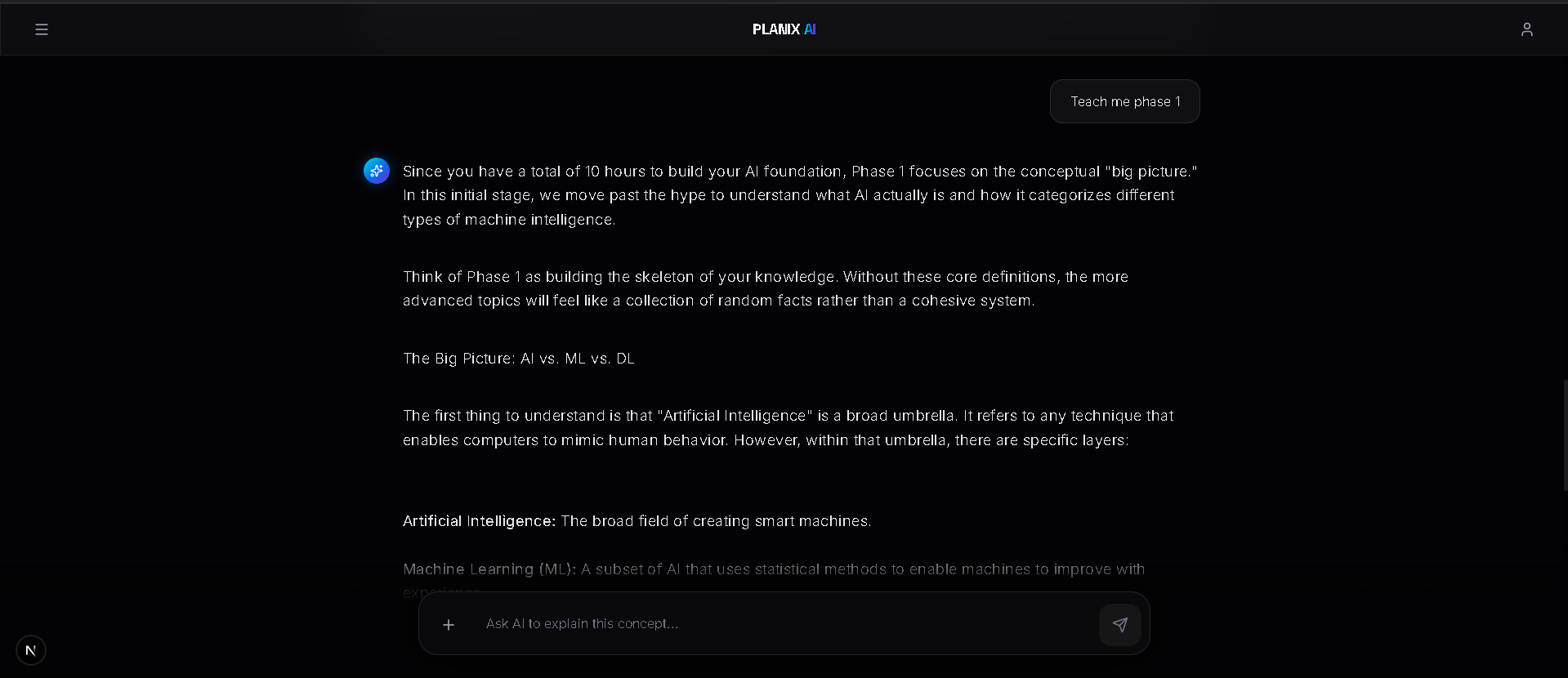
- ask AI to explain concepts
- generate structured learning notes
- refine the roadmap dynamically
Unlike traditional chat-based tools, Planix operates on roadmap context, not isolated prompts.
It designs the path before answering.
🛠 How we built it
Planix AI is built as a modern full-stack AI application.
Frontend
- Next.js 15
- TypeScript
- Tailwind CSS
- Framer Motion for UI transitions
Backend
- Next.js API routes
- Prisma ORM
- PostgreSQL (Supabase)
AI Layer
- Google Gemini API
- Structured prompt engineering
- Deterministic roadmap formatting
The AI generates structured JSON outputs which are then rendered into roadmap components inside the UI.
This architecture separates the system into:
- UI Layer
- AI Reasoning Layer
- Persistence Layer
This modular structure makes the platform scalable and extensible.
🏔 Challenges we ran into
Structured AI Output
Large language models naturally produce long text responses.
However, Planix requires structured roadmap architecture.
We solved this using strict prompt constraints and normalization logic that forces the AI to generate consistent phase and milestone structures.
Adaptive Time Calibration
Learning goals vary widely in complexity.
Balancing the user's available time with realistic roadmap planning required designing logic that dynamically adjusts milestone density.
Context-Aware AI Interaction
Standard chat systems operate on isolated prompts.
Planix needed persistent roadmap context so users could refine and explore learning paths without losing structure.
This required building roadmap-aware AI interaction layers.
🏆 Accomplishments that we're proud of
We are proud that Planix AI moves beyond the traditional chatbot paradigm.
Instead of simply generating answers, it generates structured systems for learning progression.
Key accomplishments include:
- designing an AI-powered roadmap architecture system
- building a full-stack AI learning platform
- implementing structured AI outputs instead of free text responses
- creating a user interface that visualizes learning progression clearly
Planix demonstrates how AI can move from information generation to system design.
📚 What we learned
Building Planix AI taught us that the real power of AI is unlocked when it produces structured outputs instead of raw text.
We learned how prompt engineering can transform a language model into a planning engine rather than a conversational assistant.
We also gained experience designing AI systems where the model becomes a core architectural component rather than an optional feature.
🔮 What's next for Planix AI — The Learning Operating System
Our long-term vision is to turn Planix into a complete growth infrastructure platform.
Future directions include:
- AI-powered progress analytics
- adaptive roadmap recalibration based on learning speed
- community-shared learning architectures
- collaborative learning systems
- skill verification and feedback loops
- mobile platform support
The goal is a world where no learner ever asks:
“Where do I start?”
Instead, AI responds:
“Here is your structured system.”
Built With
- framermotion
- googlegeminiapi
- next.js
- postgresql
- prisma
- react
- supabase
- tailwindcss
- typescript
- vercel

Log in or sign up for Devpost to join the conversation.