-
-
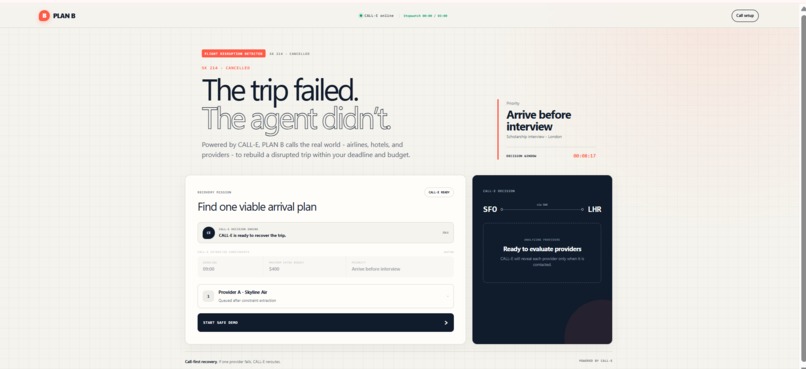
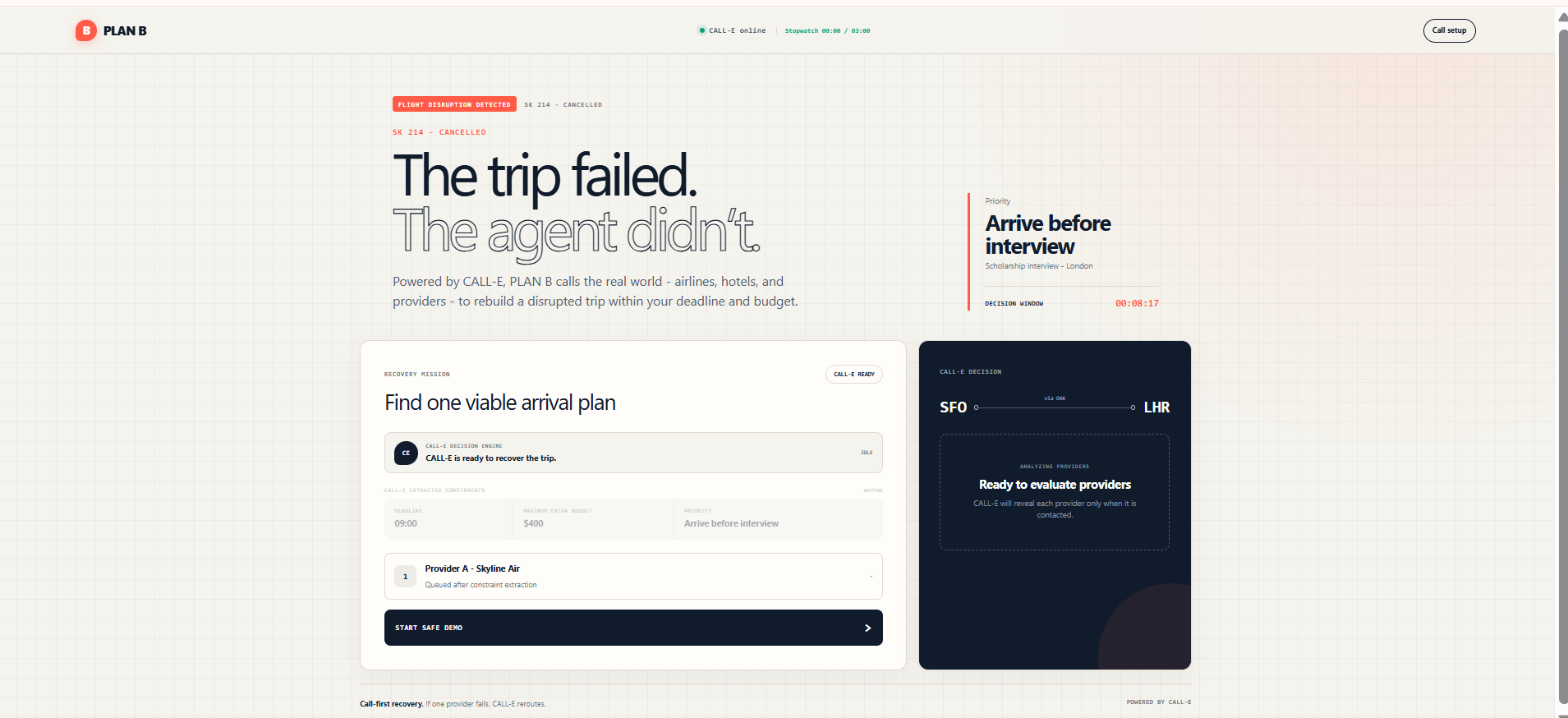
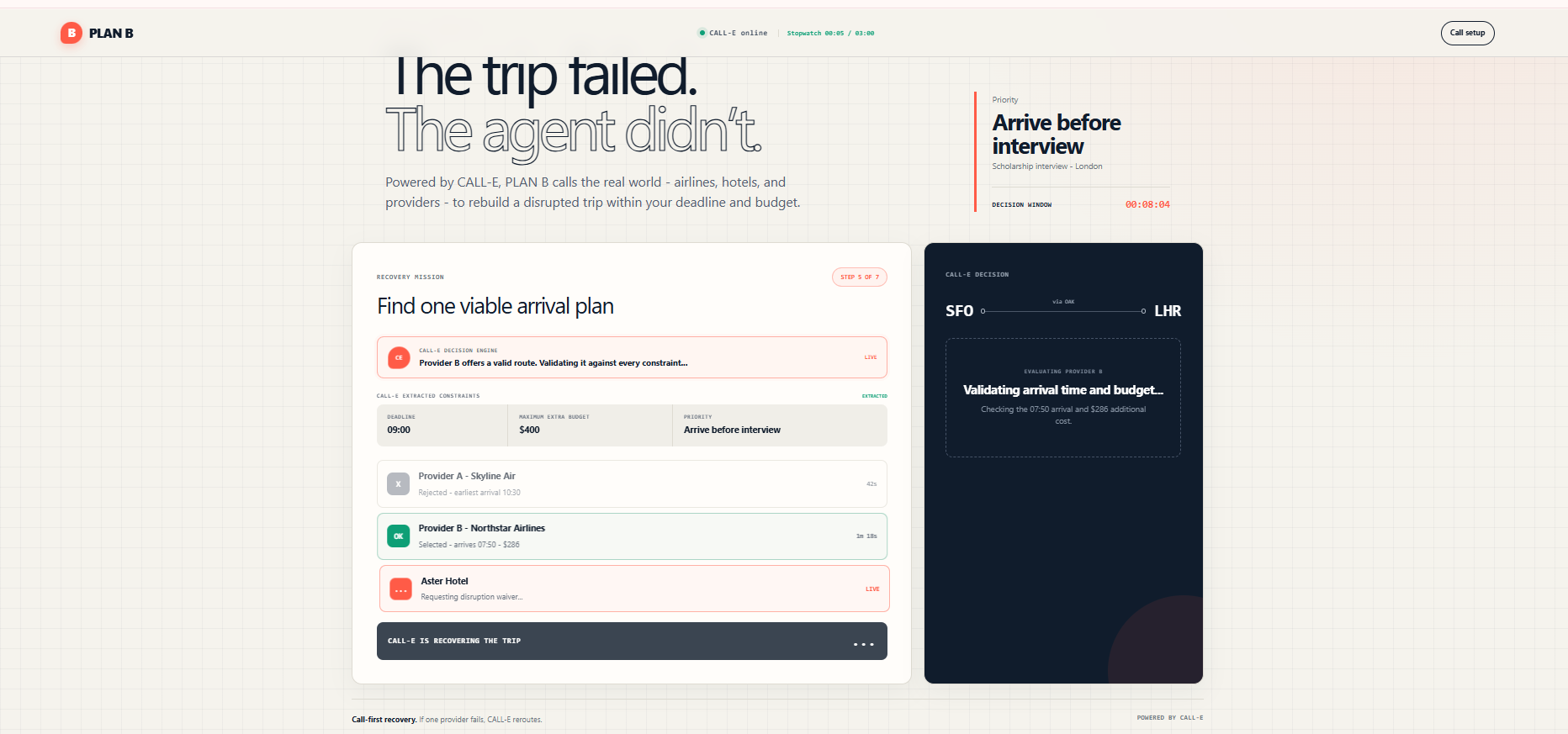
PLAN B detects the cancelled flight and extracts the traveler's deadline, budget, and priority.
-
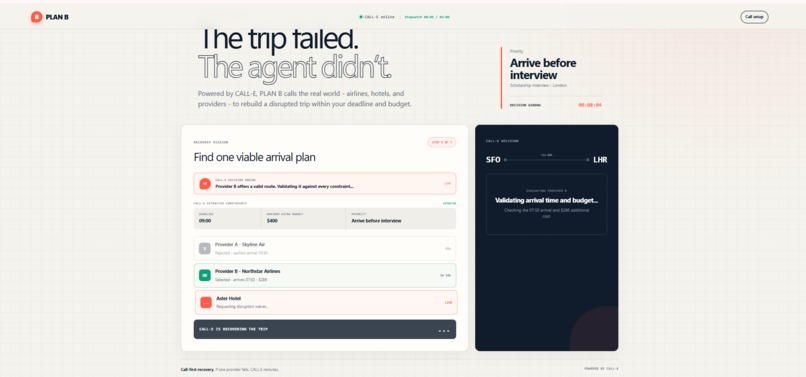
CALL-E rejects Provider A, switches to Provider B, and validates the route against the deadline and budget.
-
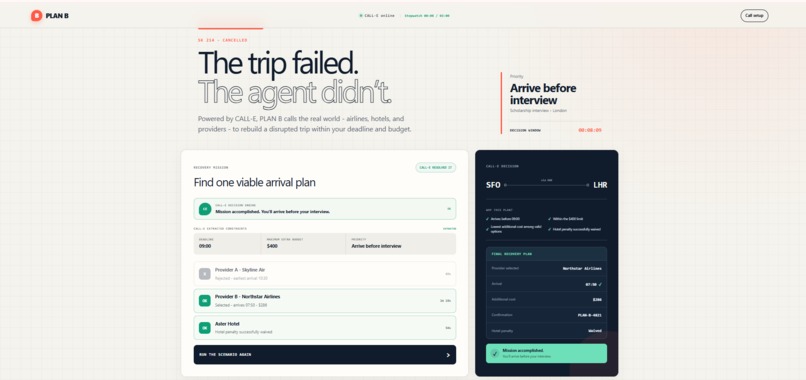
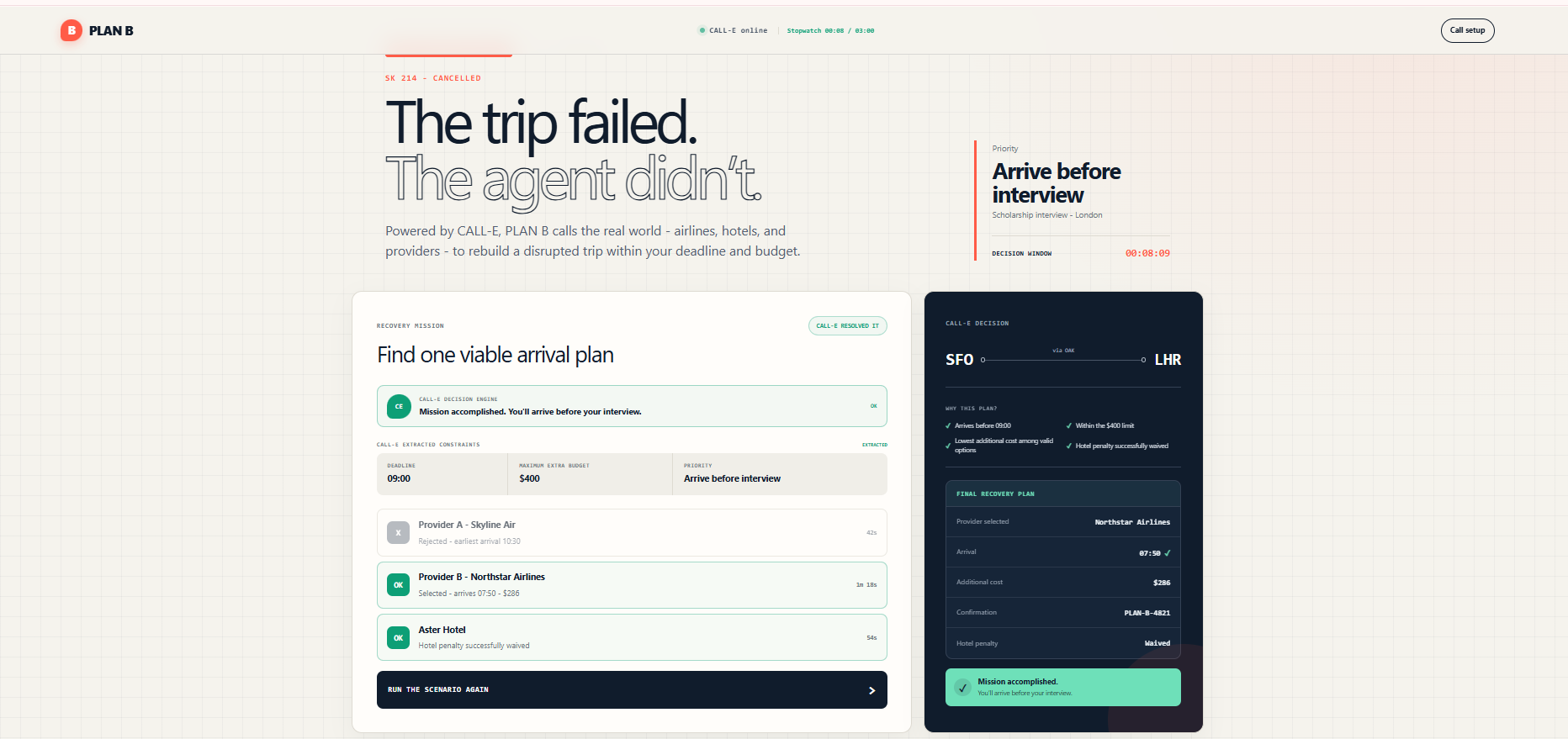
PLAN B reveals the final plan: provider, 07:50 arrival, $286 cost, confirmation number, and waived hotel penalty.
Inspiration
What it does
How we built it
Challenges we ran into## Inspiration
A cancelled flight can trigger a chain of stressful tasks: finding another route, comparing arrival times, staying within budget, contacting providers, and protecting hotel reservations. Most travel tools only display options and leave the traveler to make every call.
PLAN B explores a different approach: an AI agent that can call the real world, evaluate responses, and complete a recovery mission.
What it does
PLAN B is an autonomous travel recovery agent powered by CALL-E.
When a disruption is detected, the agent:
- Extracts the traveler’s constraints, including the arrival deadline, maximum additional budget, and trip priority.
- Contacts Provider A and requests a valid recovery option.
- Rejects the option if it violates a constraint.
- Automatically switches to Provider B.
- Evaluates the new option against the deadline and budget.
- Explains "Why this plan?" before revealing the result.
- Returns a structured Final Recovery Plan containing the provider, arrival time, additional cost, and confirmation number.
In the Safe Demo scenario, the traveler must arrive before a scholarship interview at 09:00 with a maximum additional budget of $400. Provider A offers an arrival at 10:30, so the agent rejects it. Provider B then returns a valid 07:50 arrival for $286.
How CALL-E powers PLAN B
CALL-E is the core action layer of the project, not a secondary feature.
In Live Mode, PLAN B uses CALL-E to place provider calls, conduct conversations, adapt to provider responses, and return structured results using fields such as:
provider_nameviablearrival_timeextra_costdecision_reasonconfirmation_reference
The application validates the returned result against the traveler's deadline and budget. A recovery plan is displayed only when the required fields are present and all constraints are satisfied.
Every value shown in the Live Mode Final Recovery Plan comes directly from CALL-E's structured response after the phone call completes.
Because our current public deployment is intended for reliable judging, it runs a deterministic Safe Demo scenario. The application also includes an access-controlled Live Mode wired to the CALL-E Developer API and structured-result schema. We successfully validated the outbound calling pipeline using CALL-E's official testing hotline.
How we built it
The interface was built with Next.js, React, TypeScript, and Tailwind CSS. The backend integrates the CALL-E SDK and Developer API using a structured JSON schema for reliable call results.
The project includes two modes:
- Safe Demo: A deterministic, offline-friendly scenario for reliable judging.
- Live CALL-E Mode: An access-controlled mode powered by CALL-E that uses structured results from completed phone calls.
Live Mode is protected to prevent unauthorized API usage while preserving a reliable public demonstration.
Challenges we ran into
The biggest challenge was making the agent's reasoning visible. A loading screen was not enough—we wanted users and judges to understand why one provider was rejected and another was selected.
We solved this by presenting every decision as a staged sequence:
- Provider A rejected because it missed the deadline.
- Provider B contacted automatically.
- The returned option evaluated against every constraint.
- The reasoning shown before revealing the final recovery plan.
We also separated Safe Demo behavior from Live Mode so that simulated data is never confused with structured CALL-E results.
Accomplishments that we're proud of
- Built an end-to-end travel recovery workflow with CALL-E integration and a deterministic Safe Demo.
- Successfully validated the CALL-E outbound calling pipeline using the official CALL-E testing hotline.
- Connected structured call results directly to the interface.
- Made every recovery decision visible and explainable.
- Added deadline, budget, and structured-result validation.
- Designed the complete demonstration to finish in under 90 seconds.
What we learned
Voice agents become valuable when they do more than speak. The important question is not whether an agent can make a call, but whether it can successfully complete a real-world task.
We learned that trustworthy AI agents require clear constraints, structured outputs, transparent reasoning, and reliable fallback behavior.
What's next for PLAN B
The next version will expand the recovery workflow to include hotels, ground transportation, and additional travel providers. Future work also includes parallel provider calls, airline disruption feeds, user approval before purchases, and automatic delivery of the confirmed recovery itinerary.
Our long-term vision is for PLAN B to become a general-purpose recovery agent capable of coordinating multiple phone calls and decisions whenever real-world disruptions occur.
Accomplishments that we're proud of
What we learned
What's next for PLAN B: Autonomous Travel Recovery
Built With
- call-e
- call-e-developer-api
- call-e-sdk
- json
- next.js
- node.js
- react
- tailwind-css
- typescript

Log in or sign up for Devpost to join the conversation.