-
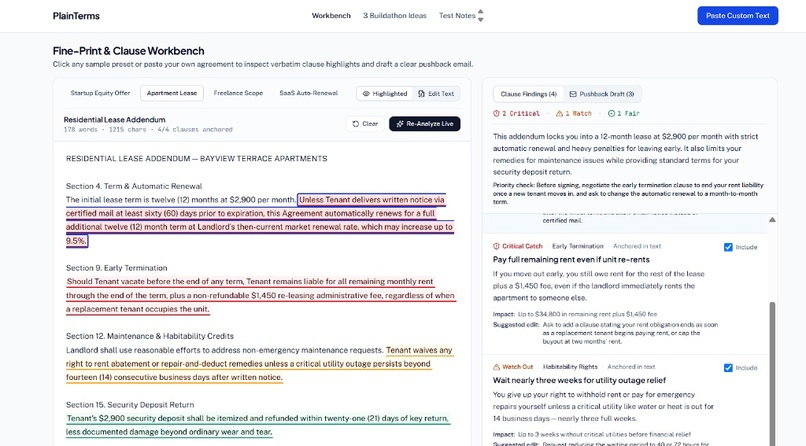
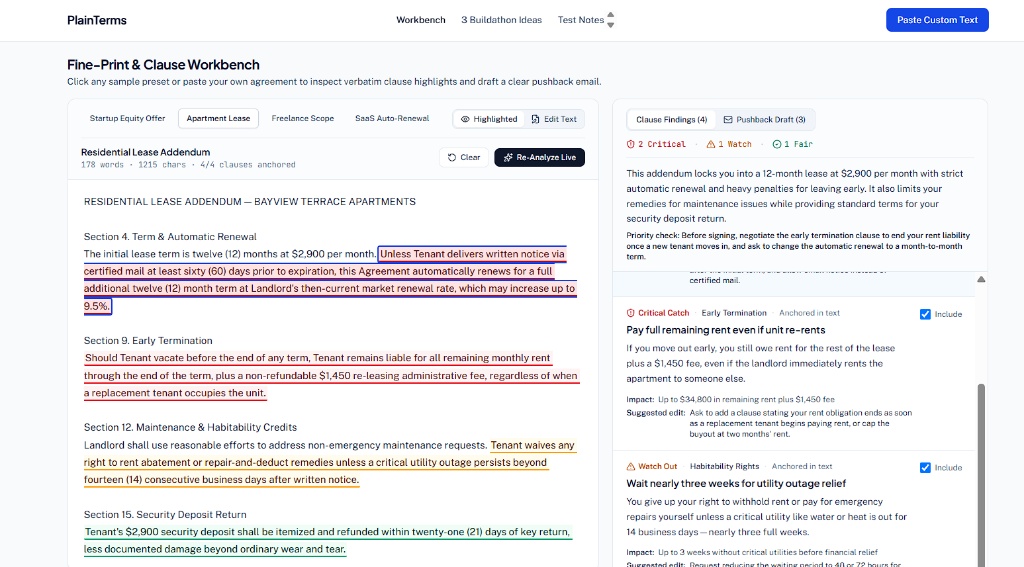
Split-pane fine-print workbench highlighting risky clauses directly inside the source agreement alongside risk-rated findings.
-
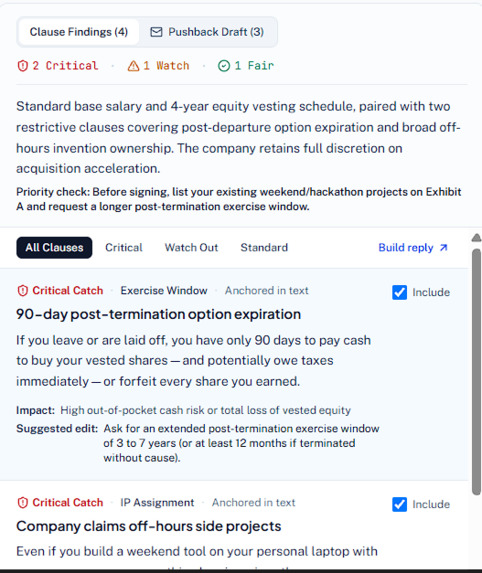
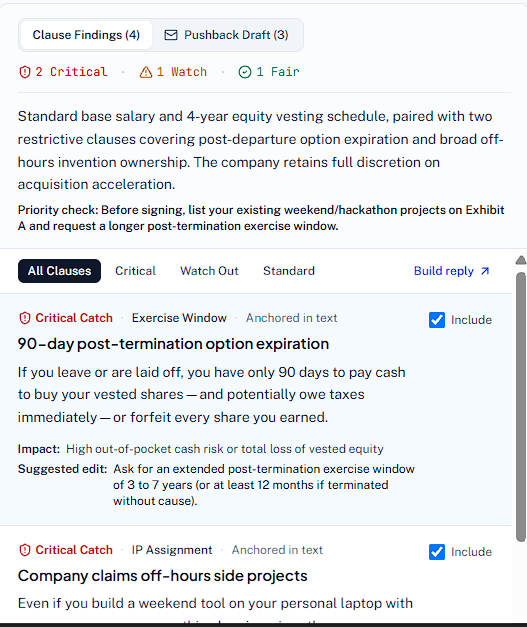
Risk-rated clause cards (Critical Catch, Watch Out, Standard Term) anchored in text with impact notes and suggested edits.
-
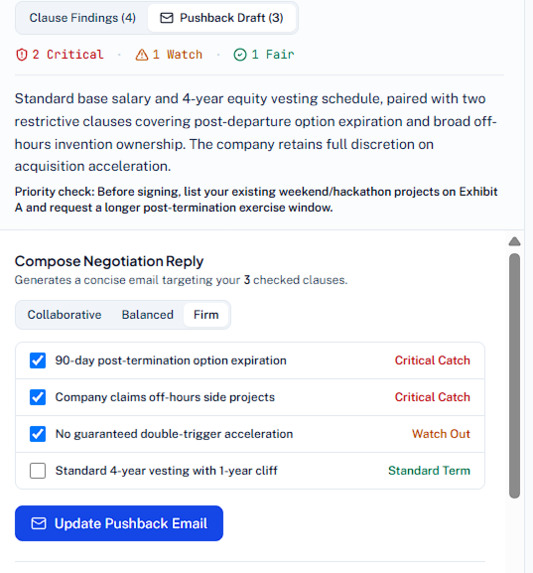
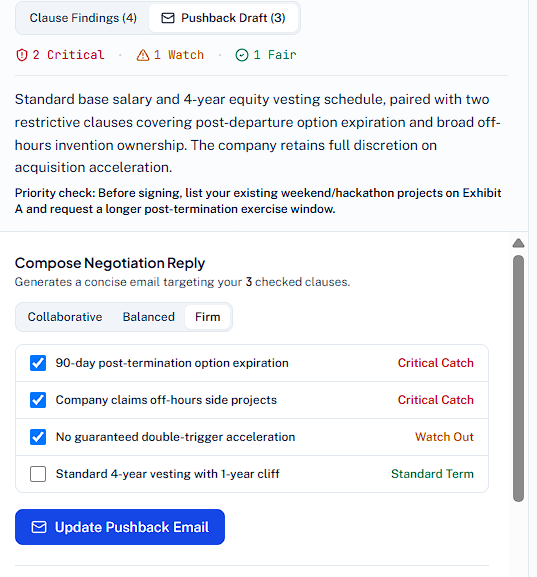
Compose Negotiation Reply view letting users pick specific clauses and switch between Collaborative, Balanced, and Firm tones.
-
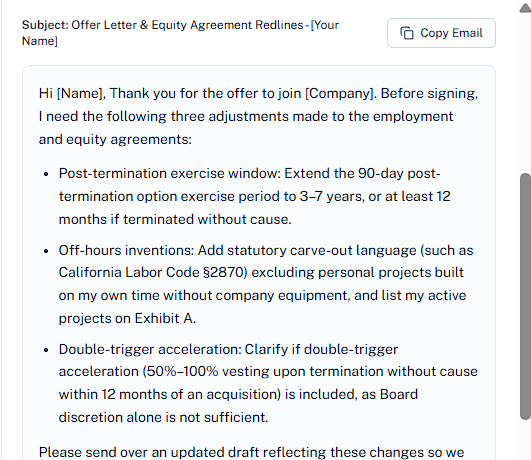
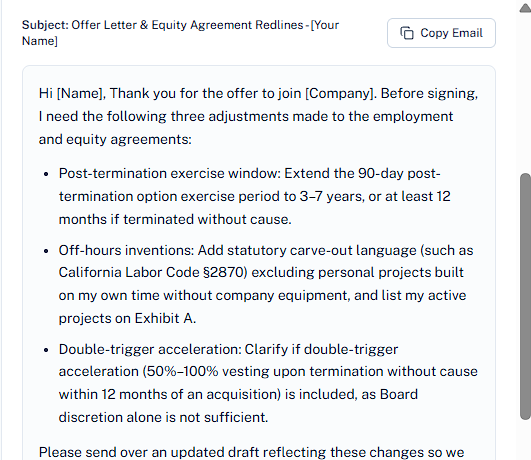
Bulleted pushback email draft tailored to selected clauses with one-click copy and a synced summary of negotiation asks.
-
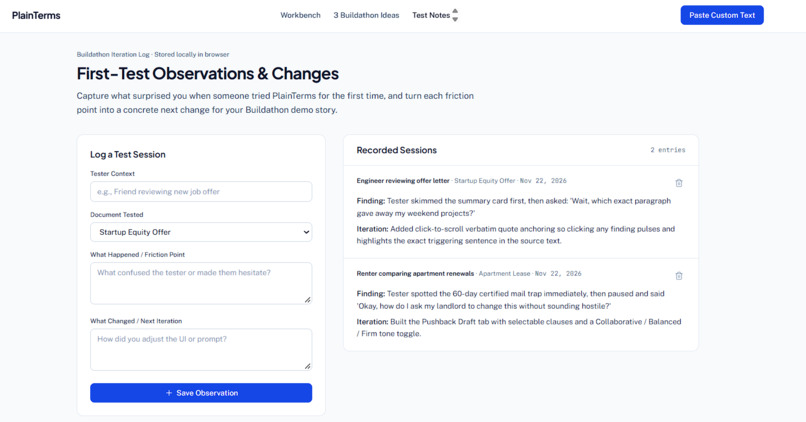
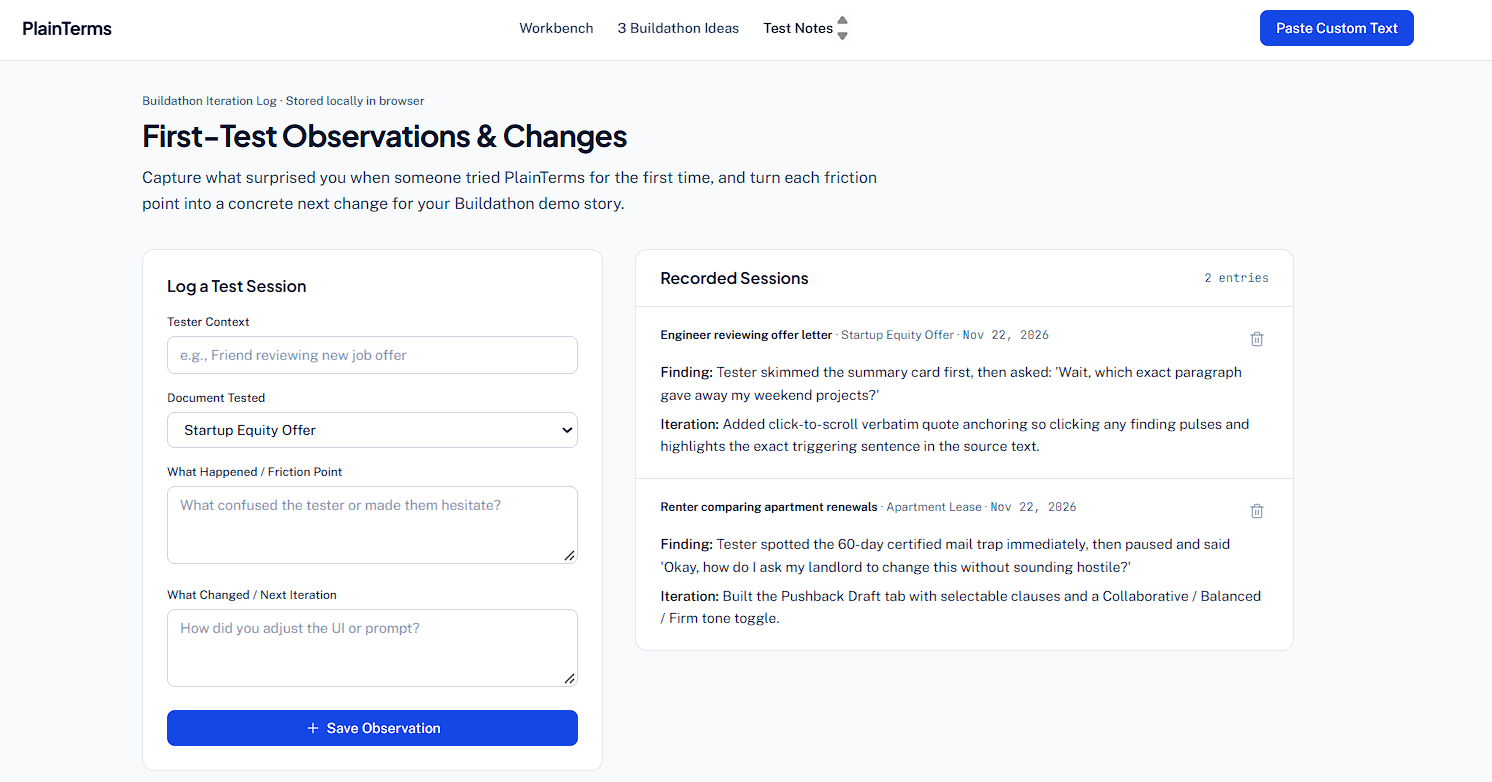
Built-in Test Notes view for logging real tester friction points and product iterations across demo runs.
Inspiration
Dense leases, SaaS subscription terms, and equity offer letters bury high-stakes trade-offs inside legalistic prose. Generic AI chat summaries often leave readers wondering which exact sentence triggered a warning—or leave them stuck staring at a blank screen when trying to push back politely. We built PlainTerms for the Silicon Valley Buildathon to turn raw fine print into an interactive workbench where every risk is anchored to verbatim source text and paired with a ready-to-send negotiation draft.
What It Does
- Split-Pane Fine-Print Workbench: Start from sample presets or paste custom agreement text to inspect plain-English summaries, priority negotiation checks, and risk-rated clause cards (
Critical Catch,Watch Out,Standard Term). - Verbatim Quote Anchoring: Grounds findings in exact source quotes with visual highlighting so users can trace warnings directly back to the contract.
- Selective Pushback Email Composer: Filter findings, check or uncheck specific clauses, switch between Collaborative, Balanced, and Firm tones, review a synced list of negotiation asks, and copy the resulting email in one click.
- Dark Mode & Test Notes: Includes a user-controlled Light/Dark theme toggle and a local Test Notes session log to capture real tester friction and follow-up iterations.
How We Built It
We designed PlainTerms around a focused split-pane workbench using React and TypeScript, paired with a lightweight server proxy so GEMINI_API_KEY stays safely off the client. Clause analysis and pushback email generation rely on Gemini structured JSON outputs (responseSchema) so the UI receives predictable, grounded clause objects rather than freeform text blobs.
Challenges We Faced & How We Iterated
- Keeping navigation focused: Early iterations included extra concept tabs and indicator arrows in the header; we streamlined navigation down to Workbench and Test Notes so testers land straight in the live tool.
- Formatting negotiation drafts cleanly: Initial pushback emails merged multiple points into a single text block; we updated the draft layout into separate, scannable bullet points alongside a synced list of selected negotiation asks.
- Cross-clause & edge-case consistency: Testing real snippets—like SaaS auto-renewal windows paired with price-hike notices and startup equity terms (
90-daypost-termination exercise windows, Exhibit A side-project carve-outs, and change-of-control acceleration)—helped us catch timing contradictions and refine empty/unchecked clause states. - Comfortable reading modes: Adding a Light/Dark mode toggle makes reviewing long clauses and drafting replies much easier on the eyes.
What We Learned
Fast, structured feedback loops beat guessing what users need. Watching how real test runs expose subtle wording conflicts or formatting friction makes it clear where prompt constraints, schema design, and UI guardrails matter most.
Disclaimer: PlainTerms is an informational and drafting aid, not legal advice or a substitute for qualified legal counsel.
Built With
- dark-mode
- developer-tools
- express.js
- gemini
- gemini-api
- google-ai-studio
- html
- localstorage
- node.js
- react
- structured
- typescript
- ui/ux

