-
-
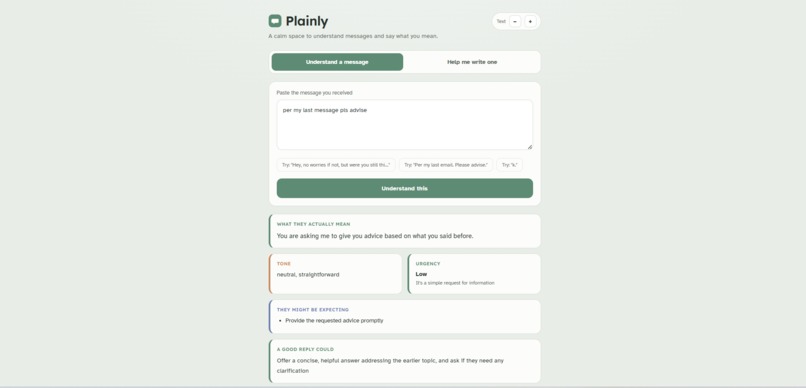
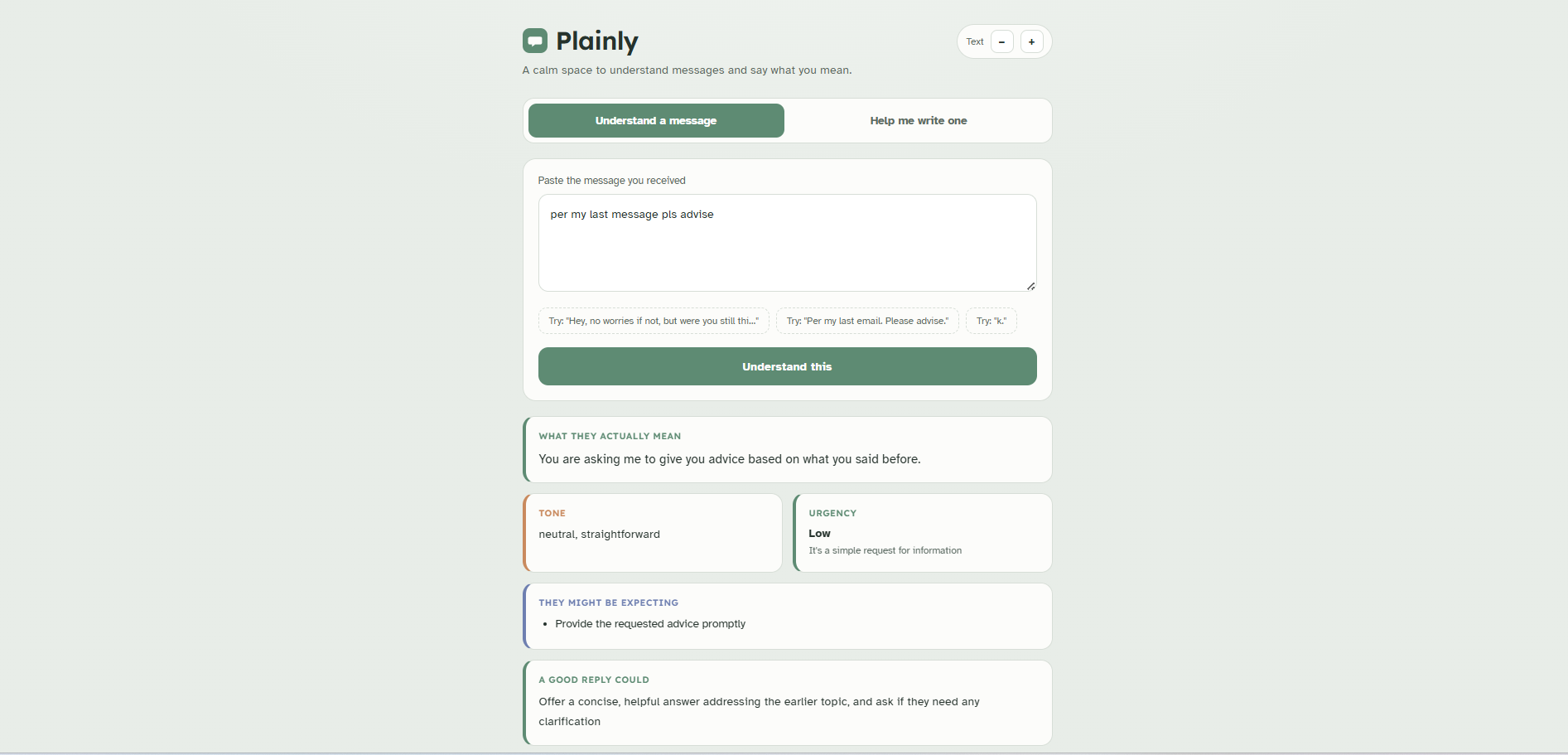
Plainly's Understand mode showing a decoded message: what it means, its tone, urgency, and the unspoken expectation — in calm,readable cards
Inspiration
Indirect language and hidden subtext are among the most-cited daily challenges for autistic and neurodivergent people. This hackathon funds the Akhil Autism Foundation — so I built for exactly that community: a tool that takes the guesswork out of everyday communication.
What it does
Plainly has two modes.
- Understand decodes a message you received into its literal meaning, tone, urgency, and the expectations the sender didn't say out loud.
- Compose turns a messy intention into a clear, appropriately-toned message — and shows what it changed, so you always stay in control of what you send.
How I built it
React (Vite) front end, a serverless proxy on Vercel that calls Groq's gpt-oss-120b in JSON mode, returning structured results the UI maps onto calm, readable cards. The API key stays server-side and never touches the browser.
The design is the accessibility
Everything is deliberately low-sensory: a muted palette, generous spacing, an adjustable text size, keyboard focus, and reduced-motion support. The typefaces are Atkinson Hyperlegible and Lexend — both built by accessibility researchers for readability. For neurodivergent users, a loud, busy interface is a barrier, not a delight, so the restraint is the feature.
Challenges
Keeping it genuinely calm instead of "just an AI wrapper" — every design choice had to earn its place. I also caught a live model deprecation mid-build and made the model swappable so it can't break.
What's next
Saved phrasings, a browser extension, and tone presets co-designed with neurodivergent users.
Built With
- groq
- javascript
- react
- vercel
- vite

Log in or sign up for Devpost to join the conversation.