Inspiration
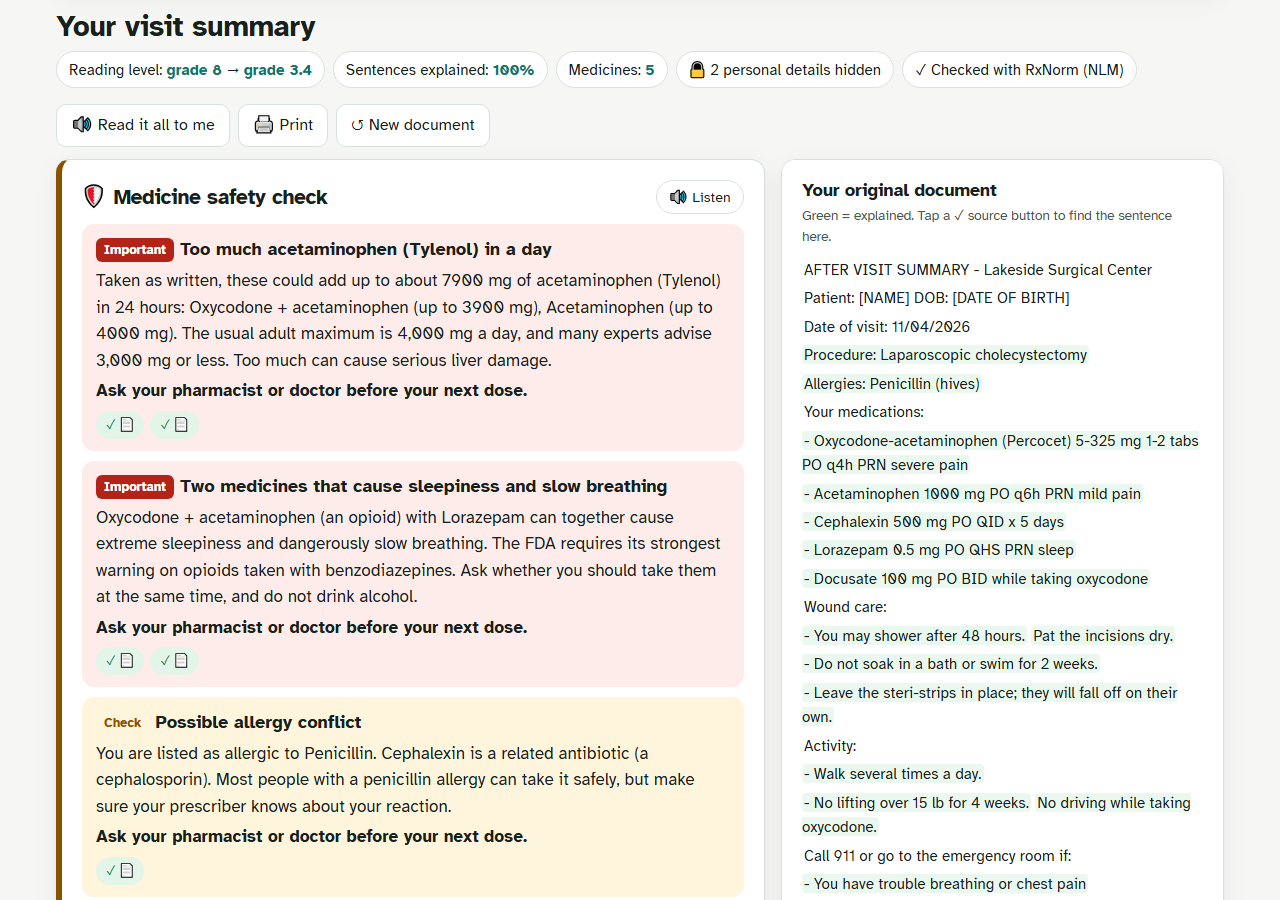
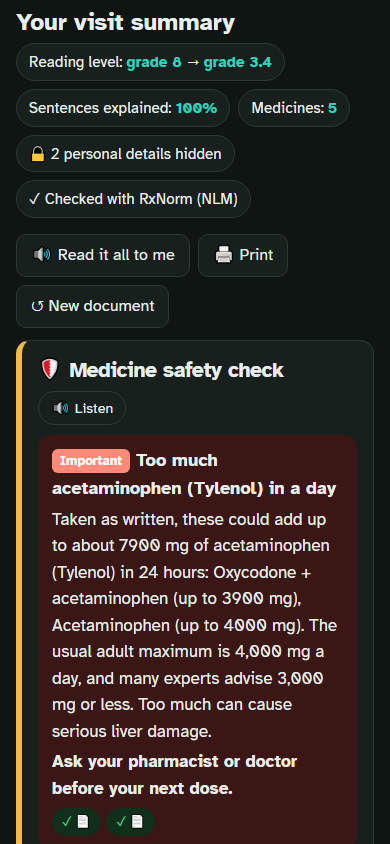
The most important health instructions people get come on paper they often can't use. Only 12% of U.S. adults have proficient health literacy. In one study, only 14 of 145 heart-failure patients understood all of their discharge instructions. More than 25 million people in the U.S. have limited English proficiency, and about half of clinicians in a 2025 survey had treated such a patient without a qualified interpreter. Worse, the paperwork itself often contains traps. A typical surgery discharge lists Percocet (which contains acetaminophen) and "Tylenol as needed". Taken as written, that is nearly 8,000 mg of acetaminophen a day, twice the maximum, and acetaminophen overdose is a leading cause of acute liver failure in the U.S. We wanted to give everyone the "pharmacist friend" that well-connected patients already have, for free.
What it does
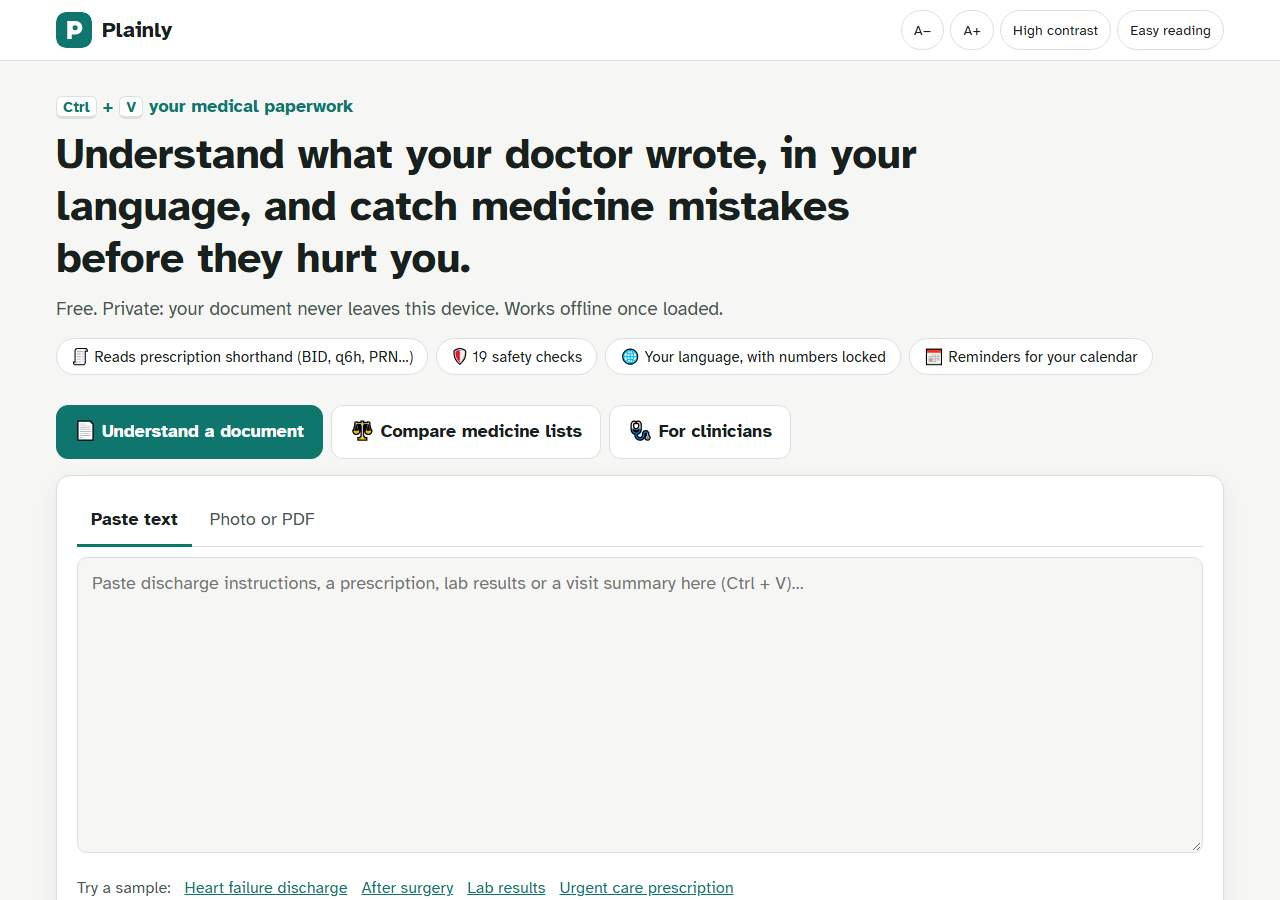
Plainly is a free, private website with three tools:
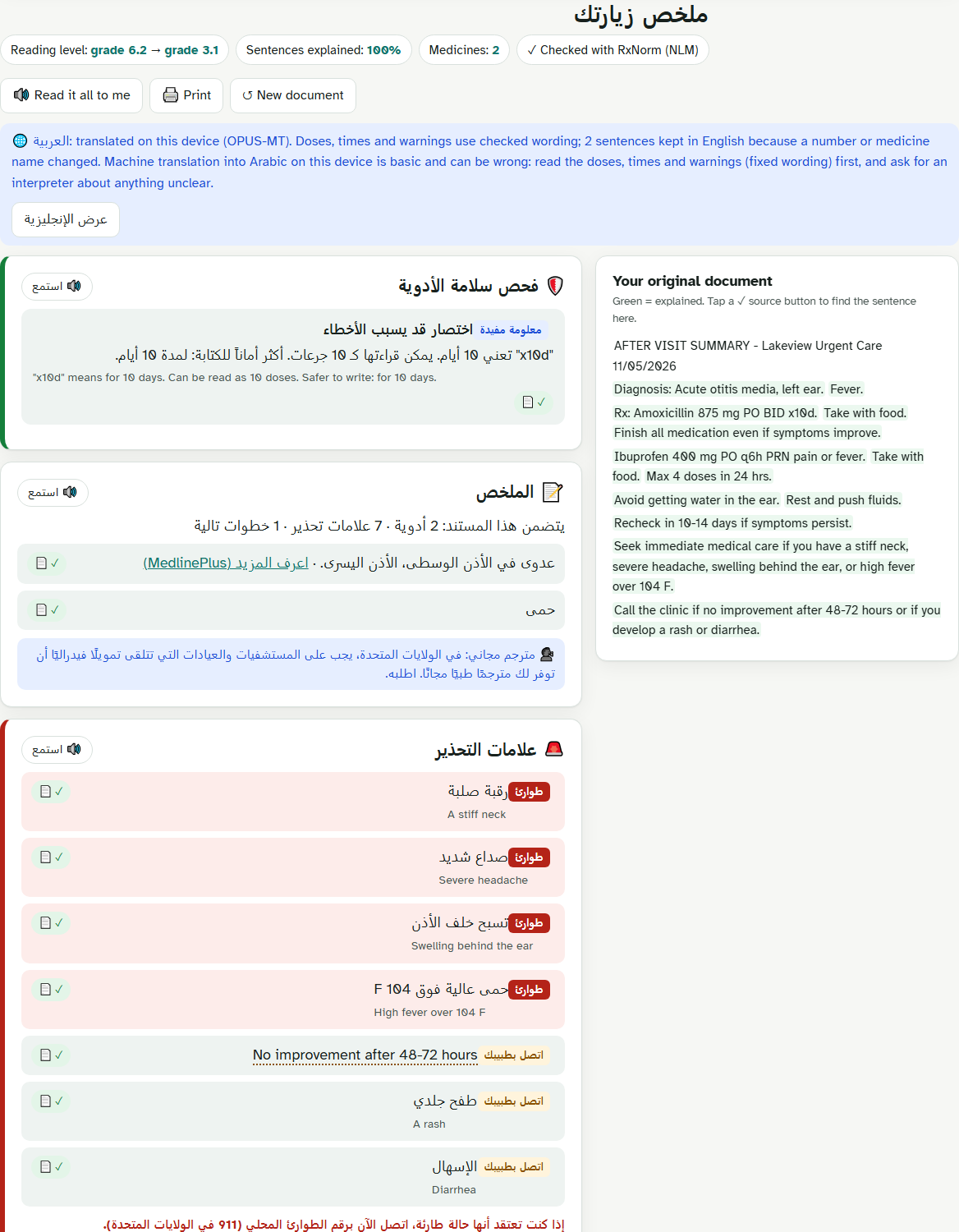
1. Understand a document. Paste, photograph, or upload a discharge note, prescription or lab report. Plainly:
- reads real hospital paperwork: START / CHANGE / STOP medicine sections, prescription shorthand like
Percocet 5-325 1-2 tabs q4h PRN, lab tables, warning-sign lists, allergies, pending tests and follow-up dates - runs 19 medicine safety checks: total acetaminophen across products, opioid + benzodiazepine (FDA boxed warning), blood thinner + NSAID, allergy conflicts, a medicine the same note says to avoid, methotrexate written as daily instead of weekly, critical lab values, error-prone abbreviations, and more
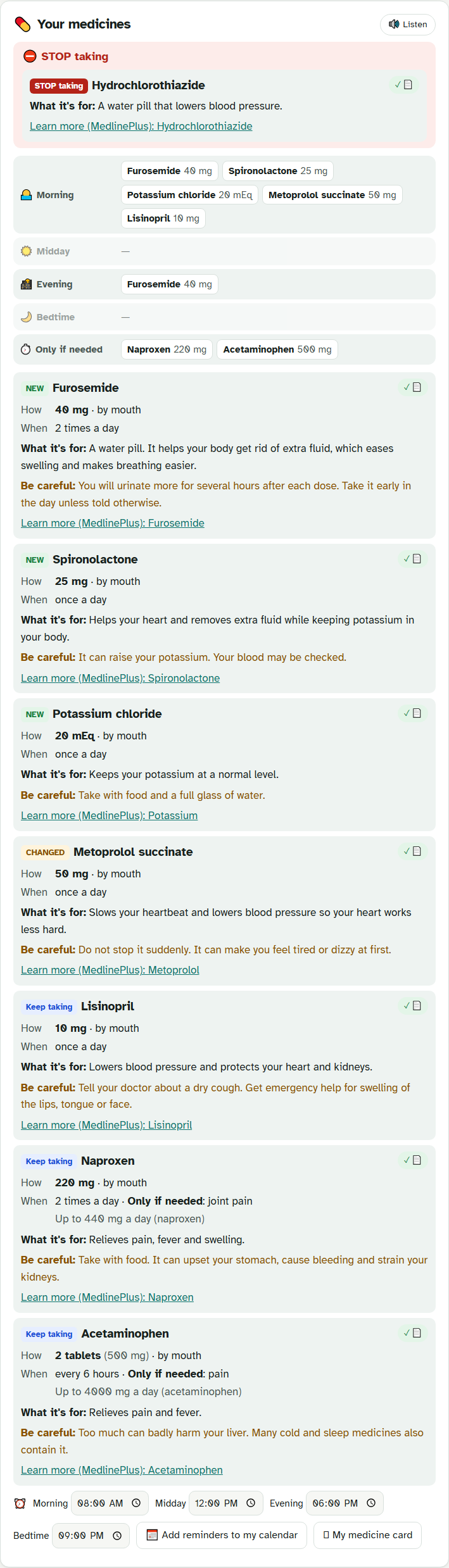
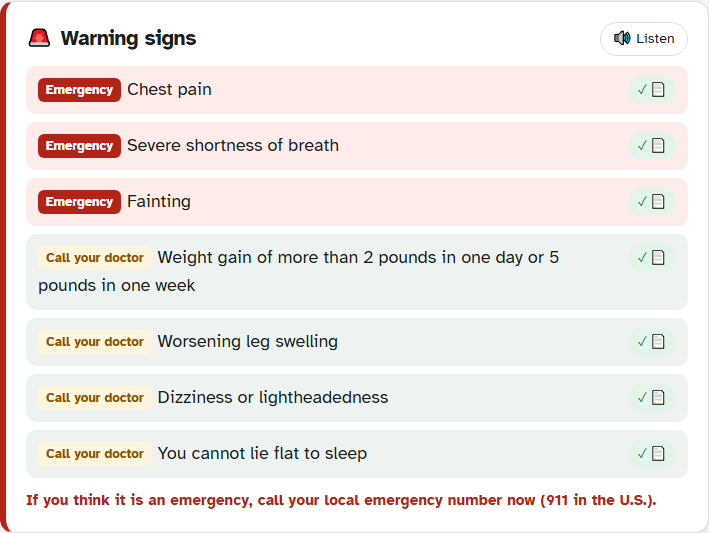
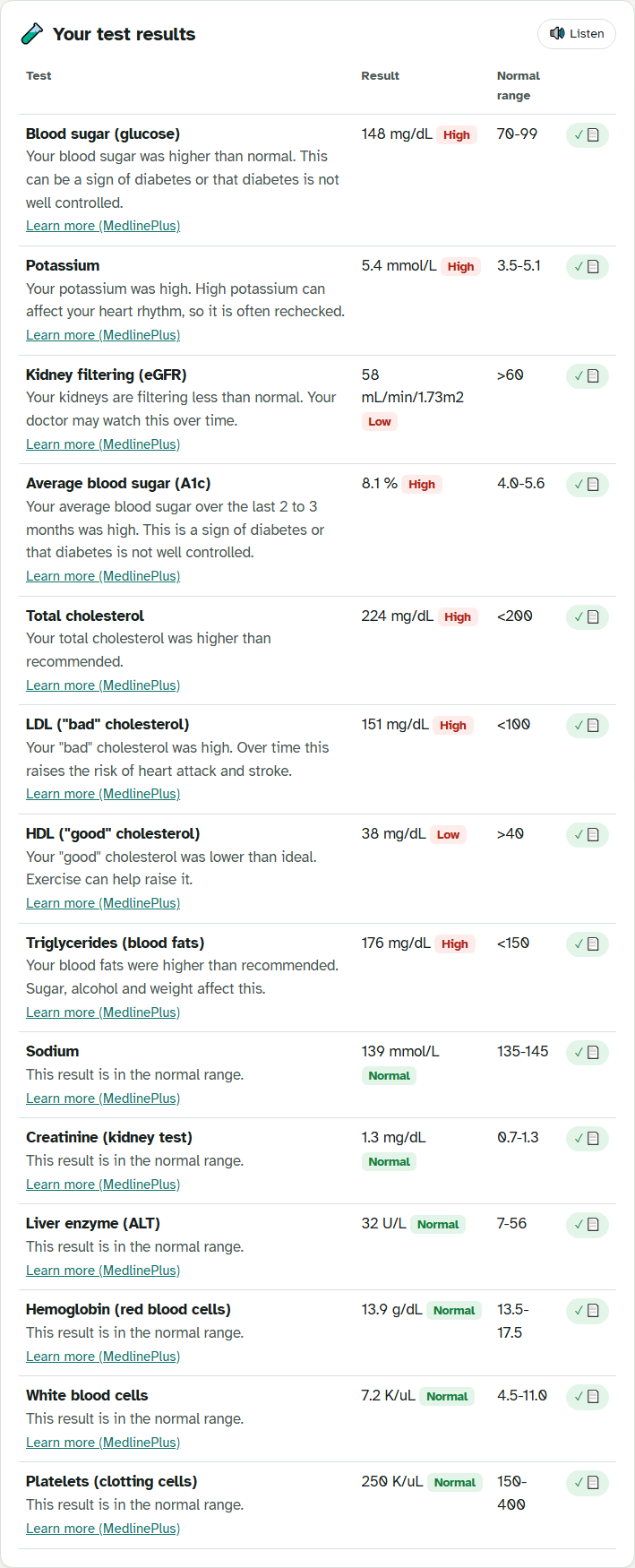
- shows warning signs (🚨 emergency vs. call your doctor), a daily medicine schedule, a red STOP taking list, lab results in plain words, next steps and a word decoder ("cholecystectomy = surgery to remove the gallbladder")
- links every point to the exact sentence in the original, shown side by side
- exports calendar reminders for every dose and appointment, prints a bilingual medicine card, and reads everything aloud
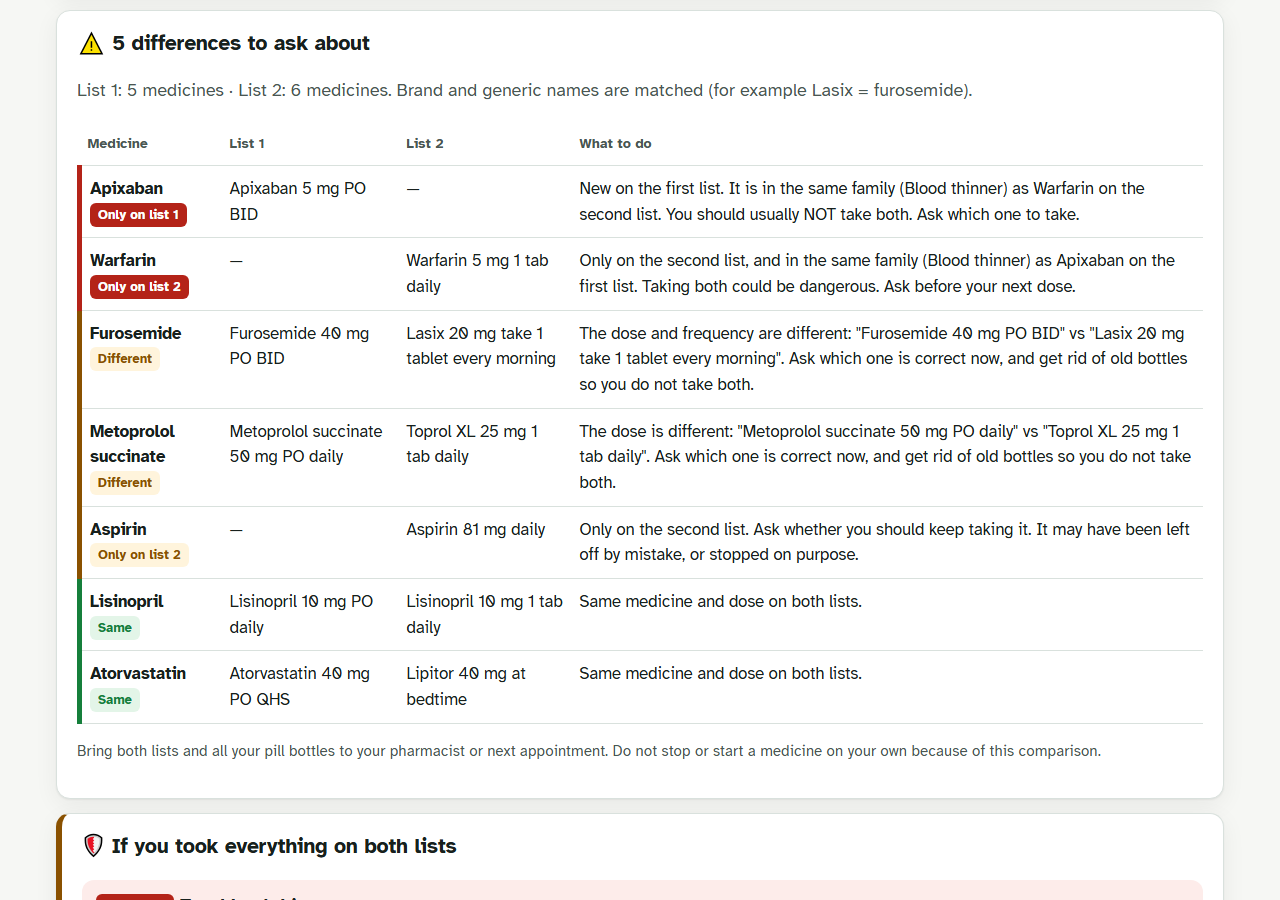
2. Compare medicine lists. Hospital list vs. pill bottles at home. It matches brand and generic names (Lasix = furosemide) and flags dose changes, missing medicines and dangerous duplicates, such as warfarin at home plus a new blood thinner from the hospital.
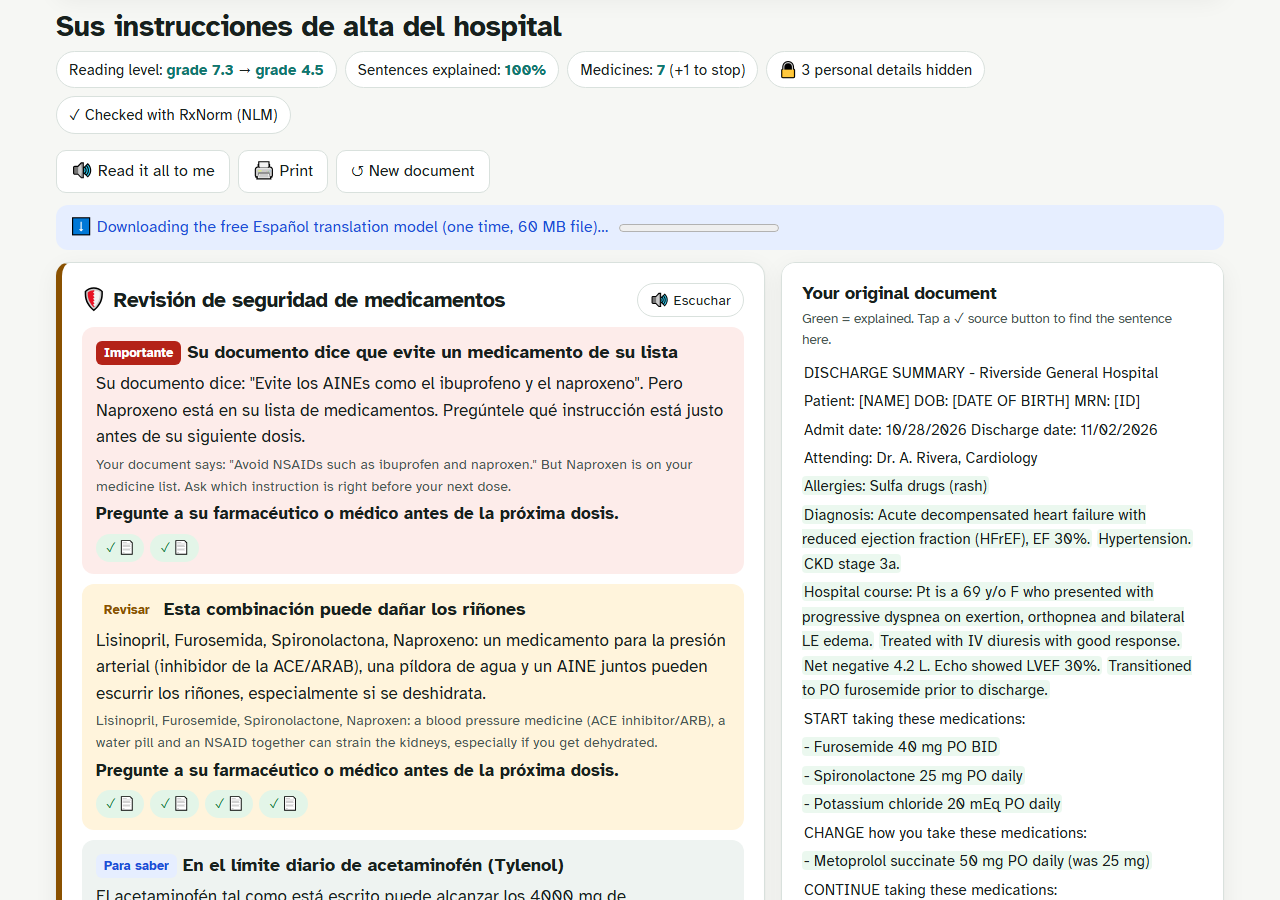
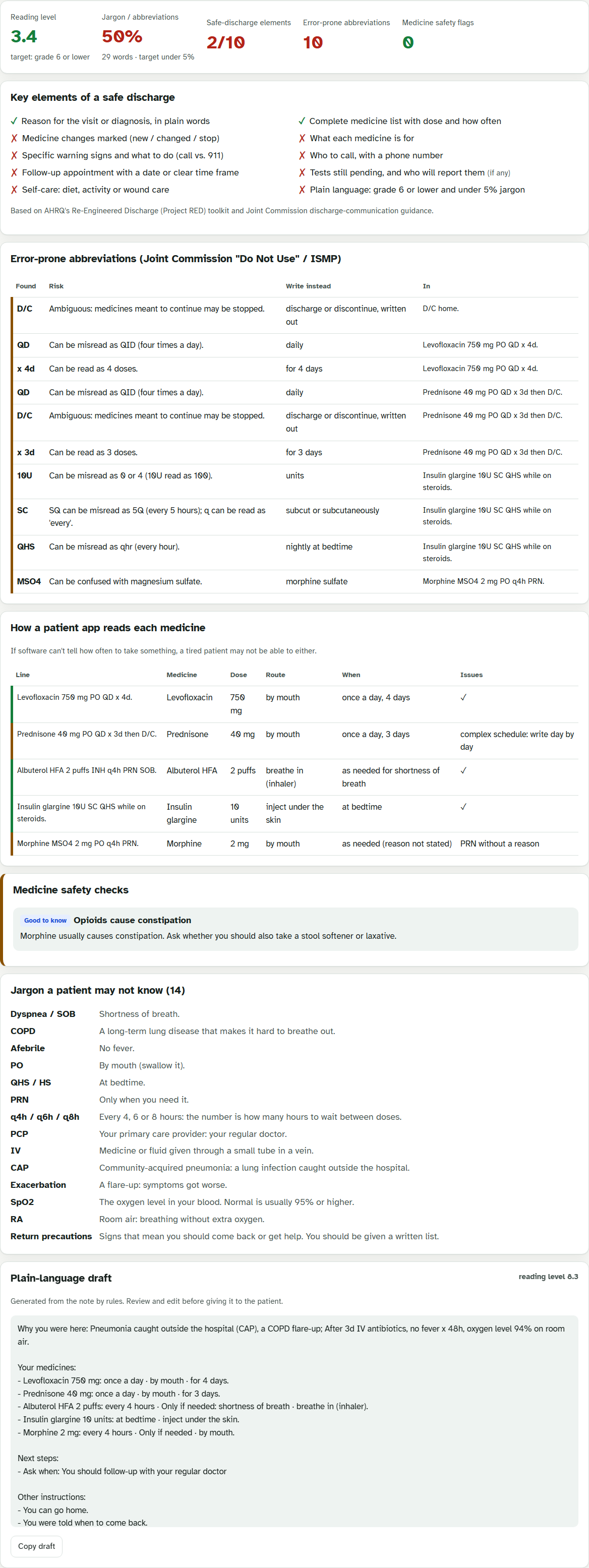
3. For clinicians. Nurses paste a draft note to see its reading level, jargon density, Joint Commission/ISMP error-prone abbreviations, a safe-discharge checklist (AHRQ Project RED) and an editable plain-language draft. This fixes the problem at the source. Languages, safely: doses, times and warnings use hand-written, fixed wording in 8 languages (English, Spanish, Chinese, Vietnamese, Arabic, Hindi, French, Russian). Everything else is translated on the device. If a translation changes a number or a medicine name, Plainly shows the English instead, and warning signs always keep the English underneath.
How we built it
- No paid AI, no server, $0. A static website (HTML, CSS, vanilla JavaScript) that works offline after the first visit (Progressive Web App). The document never leaves the device.
- Our own clinical reading engine: a prescription-shorthand parser (strength, amount, form, route, frequency, PRN reason, duration, daily maximum), parsers for sections, labs, warnings and appointments, plain-language rewriting, readability and jargon analysis, and a medical word-part decoder. It is backed by a knowledge base of 180 medicines (405 generic and brand names), 61 drug classes, 37 lab tests and 23 error-prone abbreviations.
- Free public medical data from the U.S. National Library of Medicine: RxNorm/RxClass (spelling correction, ingredients, drug class for medicines outside our list) and MedlinePlus Connect (patient-friendly pages, in Spanish where available). Only medicine names and codes are sent, never the document.
- On-device AI: Chrome's built-in Translator when available, otherwise Helsinki-NLP OPUS-MT models running in the browser with Transformers.js; Tesseract.js OCR for photos; pdf.js for PDFs; Web Speech API for read-aloud.
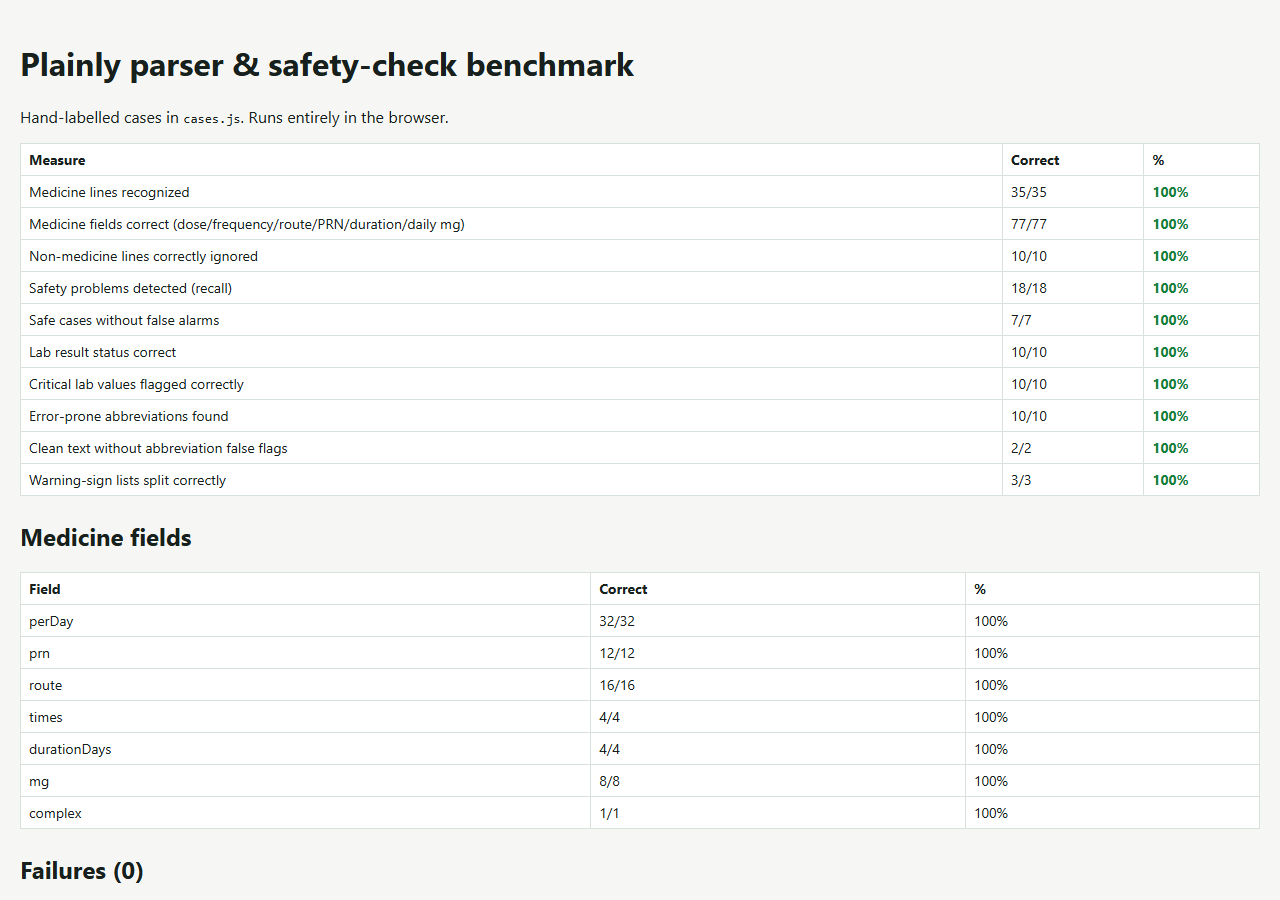
- Tested with a hand-labelled benchmark and Playwright end-to-end tests (desktop, phone, offline, right-to-left layout). ## Challenges we ran into
- Real paperwork is messy. "1-2 tabs q4-6h PRN", "10U SC QHS", several medicines on one line, bullet lists under "Call 911 if:". Our first benchmark run missed two planted safety problems because lines like "Norco 5-325 1 tab q6h" have no "mg" written. We fixed the cause and published every failure.
- Free translation models make dangerous mistakes. In testing, Arabic turned "swelling behind the ear" into "swimming behind the ear", and Vietnamese turned "acetaminophen" into "brightness". So we added a number lock and a medicine-name lock, English under every warning sign, honest per-language quality labels, and a notice of the patient's legal right to a free medical interpreter.
- Readability formulas can be fooled. An abbreviation-packed note ("s/p 3d IV abx, QD") scores as "grade 3" because the words are short. We added a jargon-density measure so the clinician tool doesn't call it easy to read. ## Accomplishments that we're proud of
- On a held-out test set run once: 100% of medicine lines recognized, 92.1% of dose details exact, and every planted safety problem caught, with no false alarms on safe medicine lists.
- It catches real, well-documented dangers (acetaminophen stacking, opioid + sedative, two blood thinners, daily methotrexate) with zero cost and zero document data leaving the device.
- It serves both sides of the problem: patients understand their papers and know what to ask, and nurses can fix notes before they reach the patient. ## What we learned Safety in health tools is mostly about what you refuse to do: never invent, never silently drop, never let a translation change a number, and always show where every sentence came from. We also learned that being honest about limits (quality labels, "ask your pharmacist", publishing our failures) builds more trust than claiming perfection. And small, transparent rules can beat a big black-box model when every dose must be exactly right. ## What's next for Plainly
- Native-speaking pharmacists and medical interpreters review the fixed wording, then we add more languages (Korean, Tagalog, Haitian Creole, Somali).
- Use Adaption's Invent-a-Dataset to generate patient-instruction translation pairs, and AutoScientist to fine-tune a small on-device model for the low-resource languages where today's free models are weakest.
- Expand the medicine list and safety checks, with a clinical pharmacist reviewing every rule.
- Pilot with a hospital: a QR code on the printed discharge summary opens Plainly pre-filled, and we measure patient understanding (teach-back) and follow-up calls.
Built With
- chrome-translator-api
- css3
- html5
- icalendar
- javascript
- medlineplus
- nlm-api
- onnx
- opus-mt
- pdf.js
- playwright
- progressive-web-app
- rxnorm
- service-worker
- tesseract.js
- transformers.js
- web-speech-api

