-
-
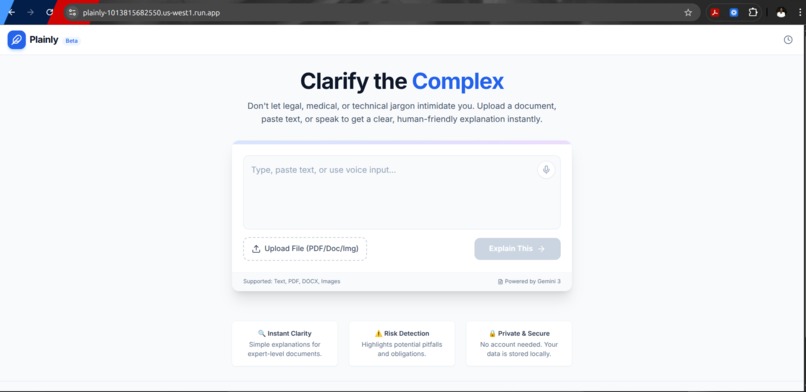
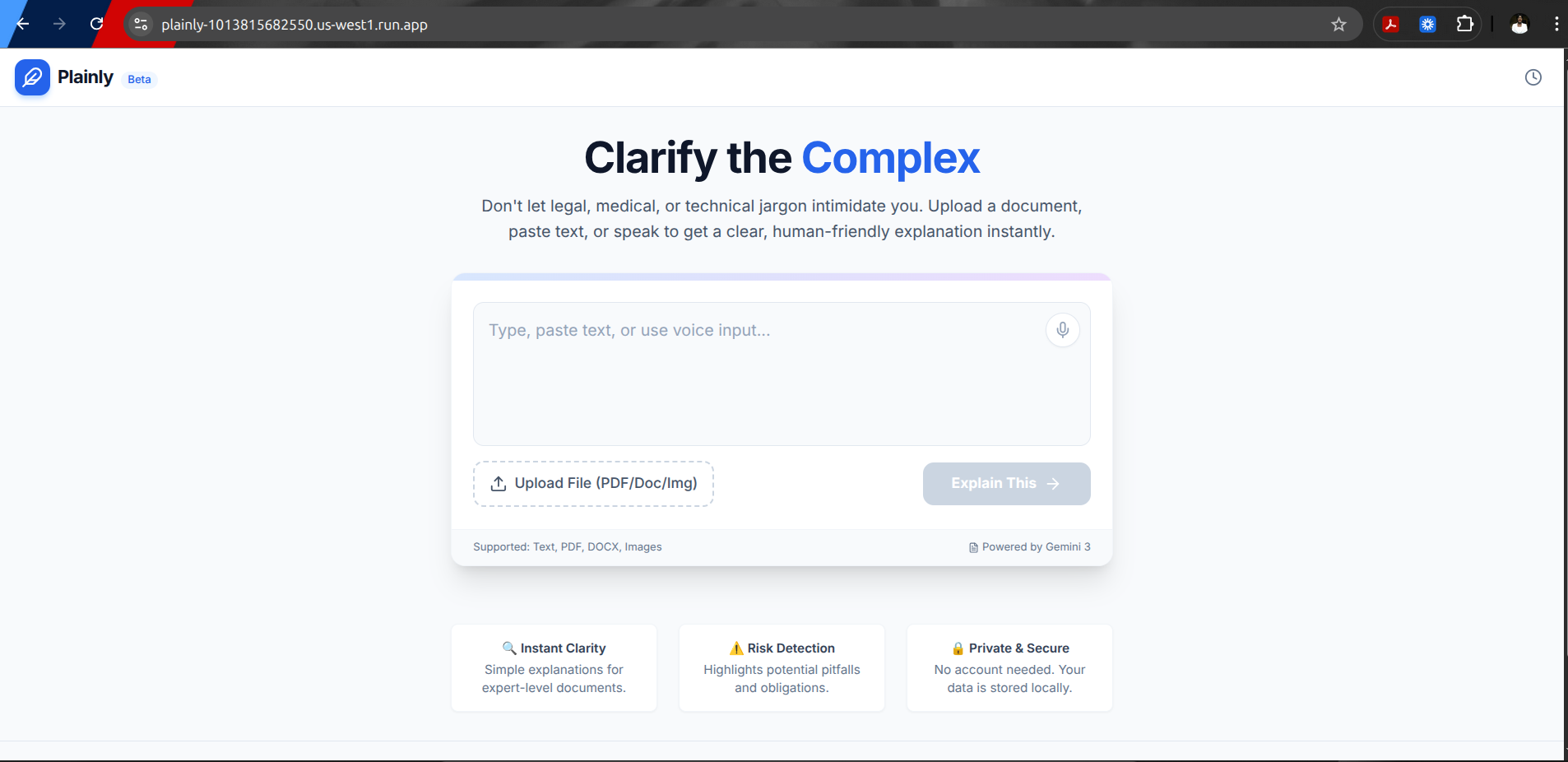
Landing page
-
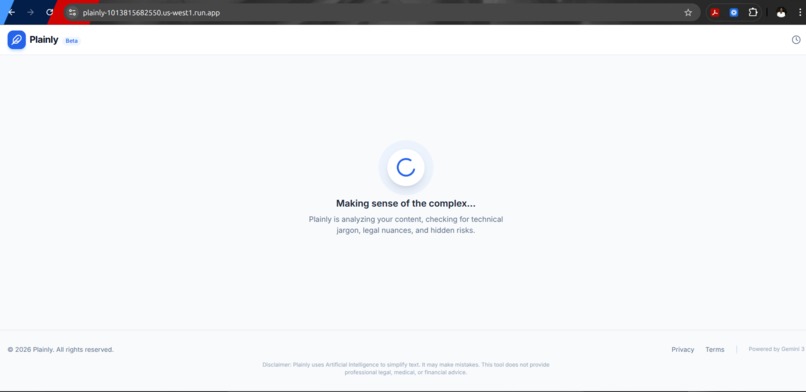
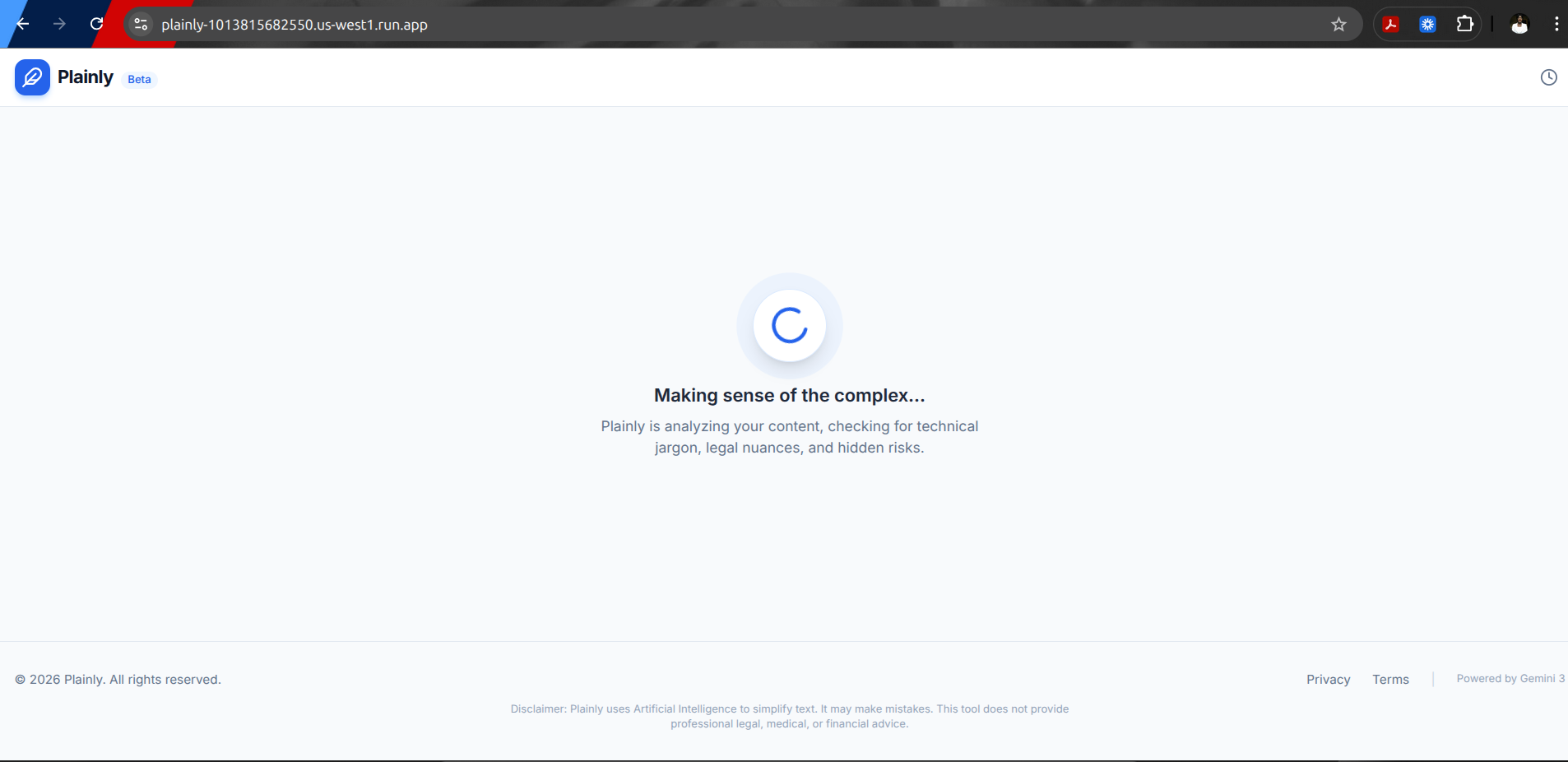
Processing document
-
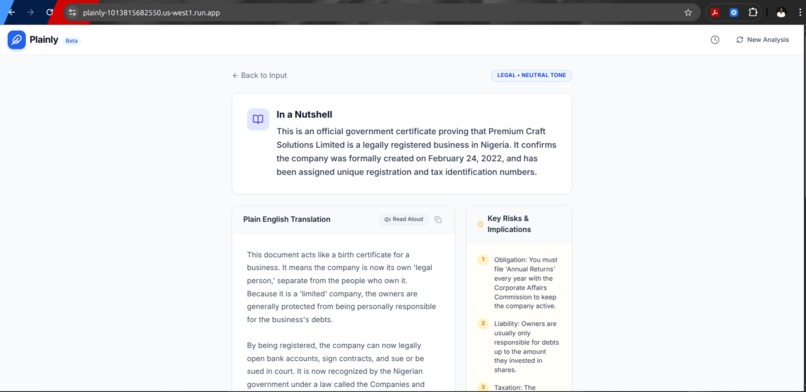
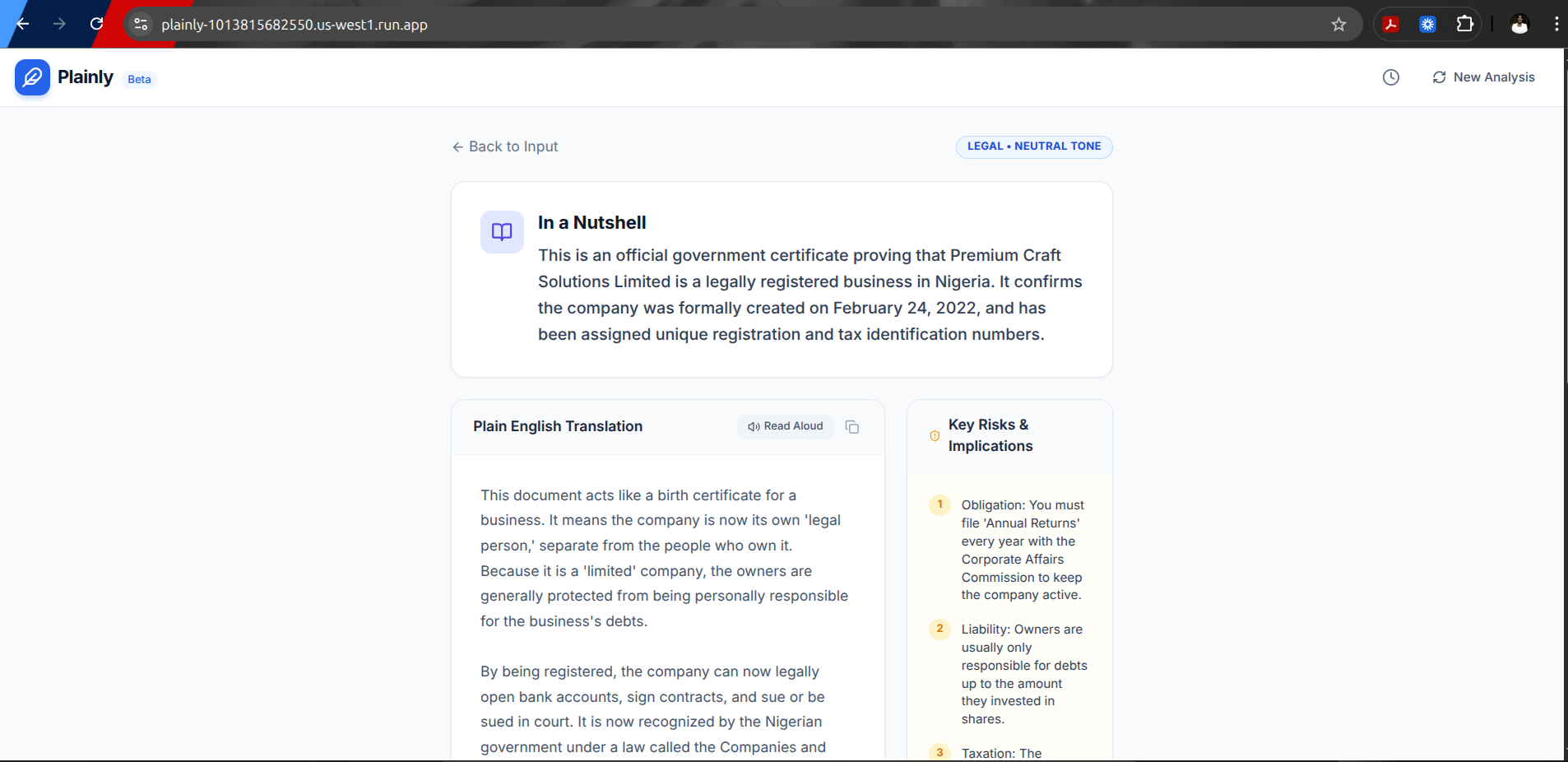
Result page
Inspiration
Plainly was inspired by a personal frustration we experience almost daily: trying to understand information that is written for experts, not for everyday people. Legal clauses, medical explanations, technical documentation, and policy texts often require specialized knowledge, yet they affect everyday decisions. We found ourselves constantly copying text into search engines and still feeling unsure about what something actually meant for us. This project was born from the belief that people should not need a law degree, medical training, or technical background to understand information that impacts their lives.
What It Does
Plainly is a simple, no-login web app that helps users understand complex information quickly and clearly. Users can paste text or upload an image or screenshot of something they don’t understand, such as a legal clause, medical note, policy excerpt, or technical explanation. The app explains the content in plain language, highlights important implications or risks, and provides a short, easy-to-digest summary. The app also features a built-in voice input and Read Aloud function which makes Plainly accessible to users with visual impairments, reading difficulties, or anyone who prefers hands-free interaction. The goal is not to replace experts, but to give users clarity and confidence when faced with intimidating information.
How we built it
Plainly is built as a lightweight, frontend-first web application using React, TypeScript, and Vite, with the Gemini 3 API integrated directly as the core reasoning engine. The app runs entirely without user accounts or a traditional backend, focusing instead on a fast and frictionless user experience. Users can paste text or upload documents, images and screenshots, which are processed and sent directly to Gemini for analysis.
At the heart of the app is the Gemini integration layer, implemented using Google’s official @google/genai SDK. The app sends structured prompts to Gemini that instruct it to identify the type of content, simplify expert-level language, highlight key implications or risks, and return a concise summary. For image inputs, Gemini’s multimodal capabilities are used to read and reason about visual content such as screenshots and document photos. The responses are validated against a defined schema to ensure consistent, readable outputs.
The user interface is intentionally minimal and built with reusable React components to keep the focus on clarity rather than complexity. Plainly is deployed as a production-ready web app on Google Cloud Run, making it globally accessible with low latency. By removing backend state, databases, and authentication, the project demonstrates how powerful AI reasoning with Gemini 3 can be delivered through a simple, accessible interface that solves a real human problem.
Challenges we ran into
One of the biggest challenges was ensuring that explanations were simple without being misleading. Expert content often contains nuance, and reducing complexity while preserving meaning required careful prompt iteration and testing with different types of inputs. Another challenge was keeping the scope intentionally small; it was tempting to add user accounts, history, or advanced features, but resisting that urge was key to maintaining a strong core experience. Finally, integrating multimodal inputs reliably while keeping the app fast and intuitive required thoughtful design decisions across both backend and frontend.
Accomplishments We’re Proud Of
Built a production-ready, publicly accessible AI app with no login or setup required.
Plainly is live and usable by anyone in seconds, demonstrating how powerful AI reasoning can be delivered through a simple, frictionless experience.Used Gemini 3 as a true multimodal reasoning engine.
The app analyzes both text and images to identify expert-level content and generate structured, plain-language explanations with clear summaries and implications.Designed and shipped voice-first accessibility features.
Plainly includes built-in speech input and read-aloud explanations, making the app usable for people with visual impairments, reading difficulties, or anyone who prefers audio-based interaction.Prioritized inclusive, human-centered design.
By supporting documents, text, image, and voice interaction, Plainly reduces cognitive load and ensures that understanding expert information is not limited by typing ability, vision, or reading comfort.Kept advanced AI invisible while maximizing usefulness.
The interface intentionally avoids unnecessary features, allowing Gemini’s reasoning to stay in the background while users focus on clarity and understanding.Solved a universal, real-world problem with a focused scope.
Plainly addresses a challenge faced globally: understanding expert language, without relying on accounts, databases, or complex workflows.Made advanced AI feel invisible and useful.
The technology stays in the background while the user experience remains simple, fast, and intuitive, which was a core design goal of the project.
What we learned
Building Plainly taught us the importance of prompt design and structured reasoning when working with large language models. Rather than treating Gemini as a chatbot, we learned how to guide it step-by-step to produce consistent, high-quality explanations. We also gained hands-on experience deploying a production-ready AI application, handling file and image inputs, and designing for clarity instead of complexity. Most importantly, we learned that impactful products don’t need to be complicated, instead, they need to solve a real human problems well.
What’s Next for Plainly
Plainly is intentionally simple today, but there are many meaningful ways it could grow while staying true to its core goal of making expert information understandable. One next step would be to add explanation depth controls, allowing users to choose how simple or detailed an explanation should be (for example, “very simple,” “standard,” or “in-depth”). This would help Plainly adapt to different learning styles and levels of familiarity.
Longer term, Plainly could be integrated directly into places where confusion happens most, such as browsers, email clients, or document viewers. A browser extension or embedded assistant could let users explain complex content in context, with a single click. Throughout these future improvements, the focus would remain on simplicity, accessibility, and keeping advanced AI reasoning invisible but genuinely useful.
Conclusion
Plainly demonstrates how advanced AI reasoning can be made accessible through a simple, human-centered interface. By focusing on clarity, empathy, and real-world usefulness, the project shows how Gemini 3 can help bridge the gap between expert knowledge and everyday understanding.

Log in or sign up for Devpost to join the conversation.