Inspiration
A letter from a school or a benefits office can decide whether someone keeps a class seat or a payment, and it is often written in a register that even fluent readers skim past. "Failure to submit documentation prior to 15 November will result in termination of the reserved seat" has the date, the task and the penalty in it, but you have to dig. For an adult learner reading in a second language, on an old phone, that is a real barrier to learning.
Learner, task and barrier
The learner is an adult signing up for a skills class, or a parent or guardian answering a school or benefits letter, often in a second language. The task is to find the deadline, the papers to send and any money owed, and act in time. The barrier is formal English that hides those three things.
What it does
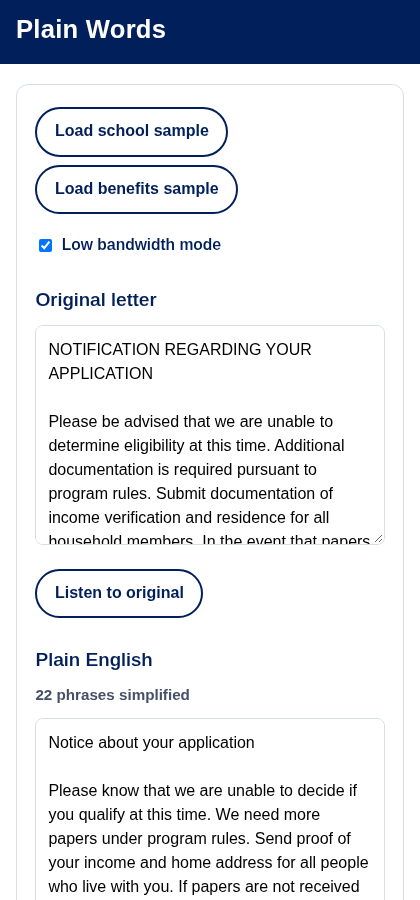
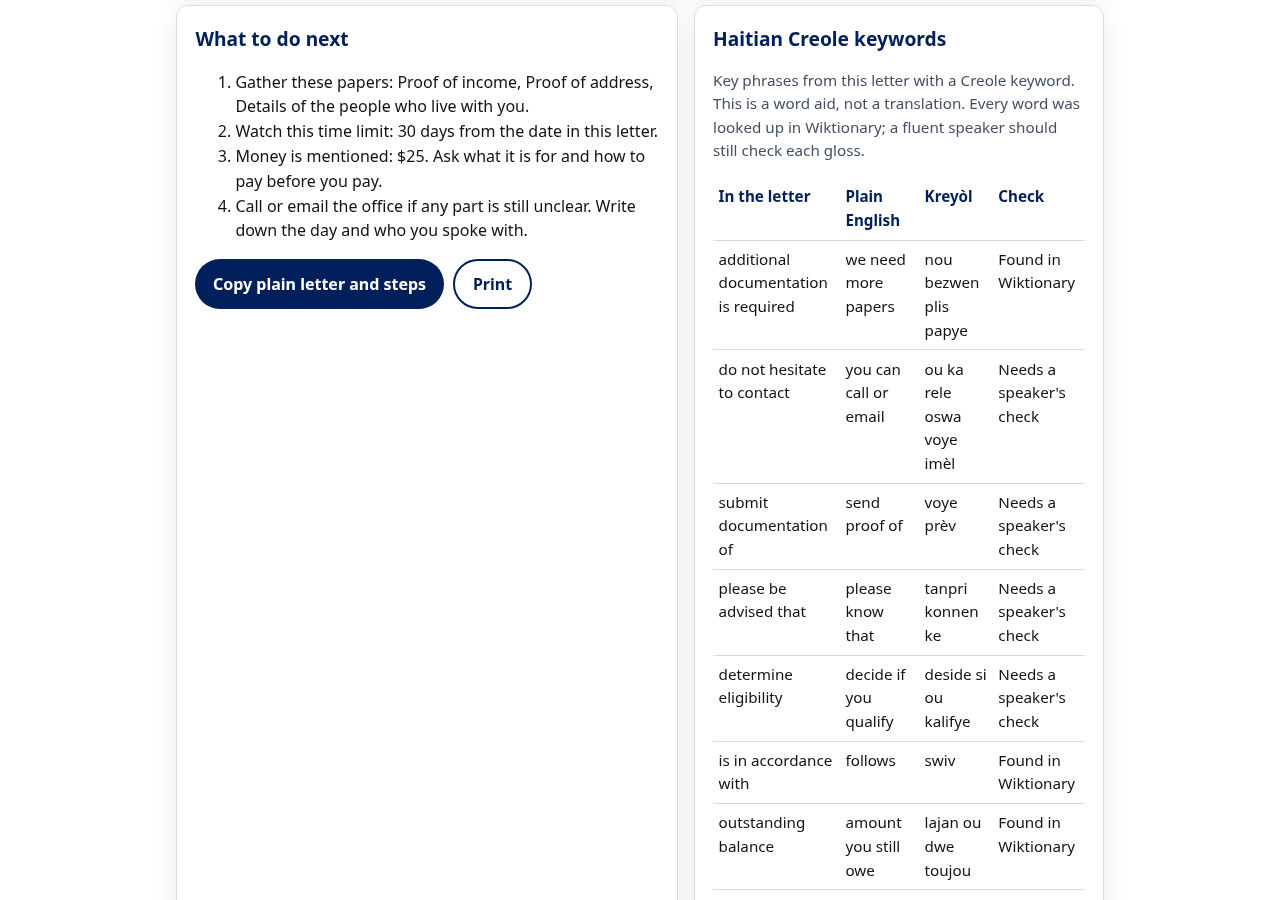
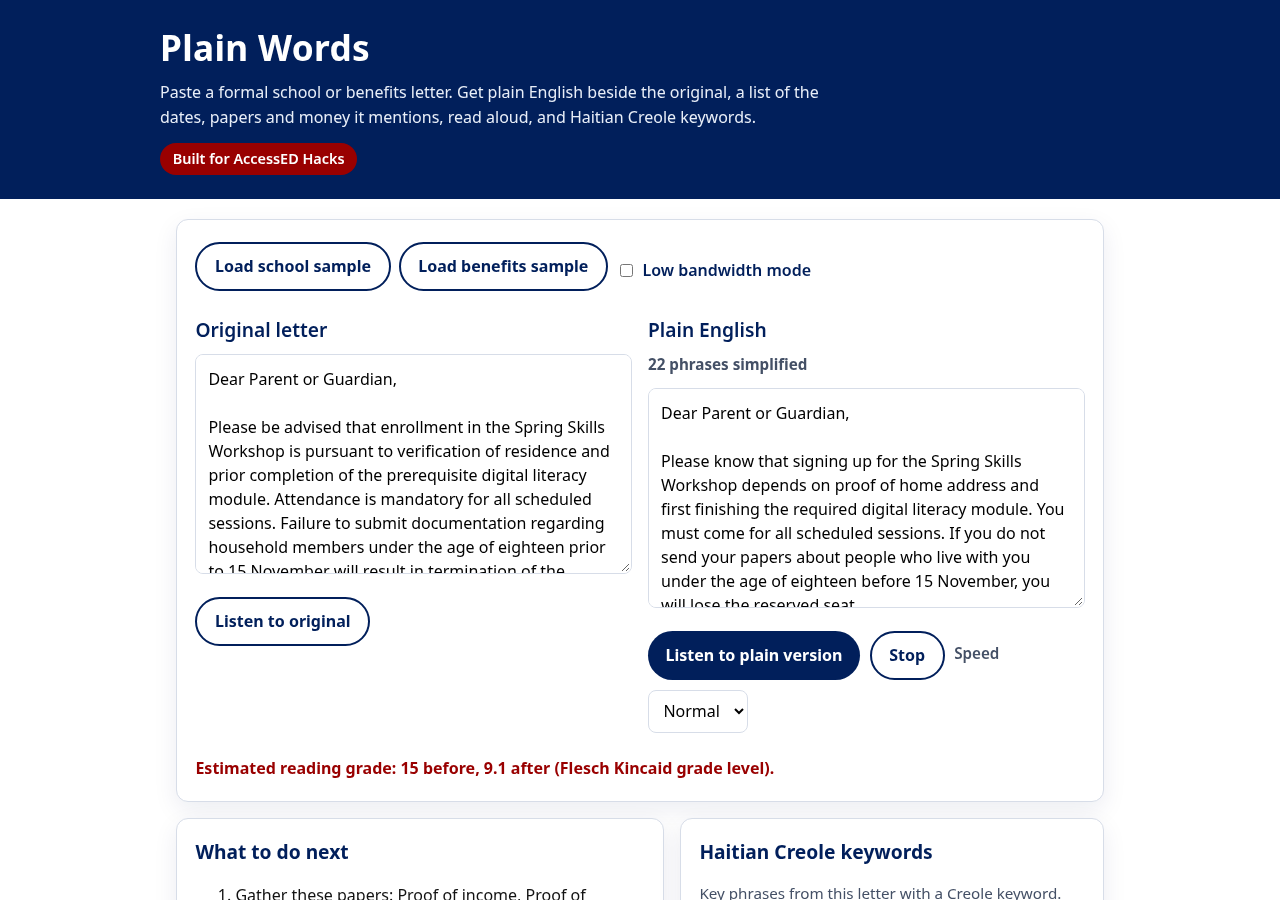
Paste a letter, or load one of the two made up samples. Plain Words shows a plain English version beside the original and keeps sentence case. It builds a What to do next list from the letter itself: the papers to gather, the dates, the time limits and the amounts of money. It shows an estimated reading grade before and after, reads either version aloud at a chosen speed, and lists Haitian Creole keywords for the phrases it changed, with a column that says whether each word was found in Wiktionary. You can copy or print the plain letter with its steps to take to the office. A low bandwidth mode drops the extra header text and styling, and the page works offline after the first visit.
How I built it
Plain HTML, CSS and JavaScript with no build step, on GitHub Pages. A JSON phrase list drives the rewrite, longest phrase first, whole words only. One small module holds the rewrite, the key fact finder, the steps and the reading grade, and both the page and the Node tests use it. A service worker caches the files for offline use. Read aloud uses the browser's built in speech. GitHub Actions runs the tests on every push.
Challenges I ran into
Swapping words is easy; keeping sentences readable is not. Early versions produced "show proof of proof of your income" and lowercase sentence starts, so I added longer phrase rules, case matching and a cleanup pass, and wrote tests that check full sentences in both samples. The Creole table was the other honest problem. I can look a word up, but that does not prove the gloss fits the letter, so the table says which words were found in Wiktionary and asks for a fluent speaker's review instead of claiming a translation.
Accomplishments that I'm proud of
On the two sample letters the estimated reading grade drops from 15 to 9.1 and from 13.4 to 6.9, and the textstat Python library gives the same picture, 13.9 to 7.9 and 13.3 to 6.8. Every control is reachable with the keyboard, the page reloads with the network off after one visit, and the whole app is about 10 KB compressed.
What I learned
The most useful output is not the rewrite. It is the short list of what to do and by when. I also learned to label uncertainty in the interface itself, so a learner can see which parts to double check.
Testing evidence
Unit tests cover both samples sentence by sentence, case handling, whole word matching, date, time limit and money detection, the steps, the reading grade and the Creole rows. Browser checks in headless Chrome covered the offline reload, the keyboard order and no console errors. The sample letters are synthetic; no real records were used.
What's next
Have a fluent Haitian Creole speaker review every gloss, add Spanish and French keywords, support more letter types such as tenancy and health notices, and test with adult learners at a community program.
Built during the event
Everything in this project was made during AccessED Hacks, between November 5 and November 14, 2026, with no earlier foundation. Third party pieces: the Flesch Kincaid formula, the browser's Web Speech API, Wiktionary lookups for the Creole words, and the textstat library for a cross check of the grades.