
Prototype link: Figma
Describe your project (Max 150 words)
It is difficult to ask for help, especially in a world full of misunderstandings and judgments about one another’s generations, causing intimidation and hesitation. Guidance helps to repair and make new connections, especially when life experiences, no matter how unique, are unexpectedly shared between different generations.
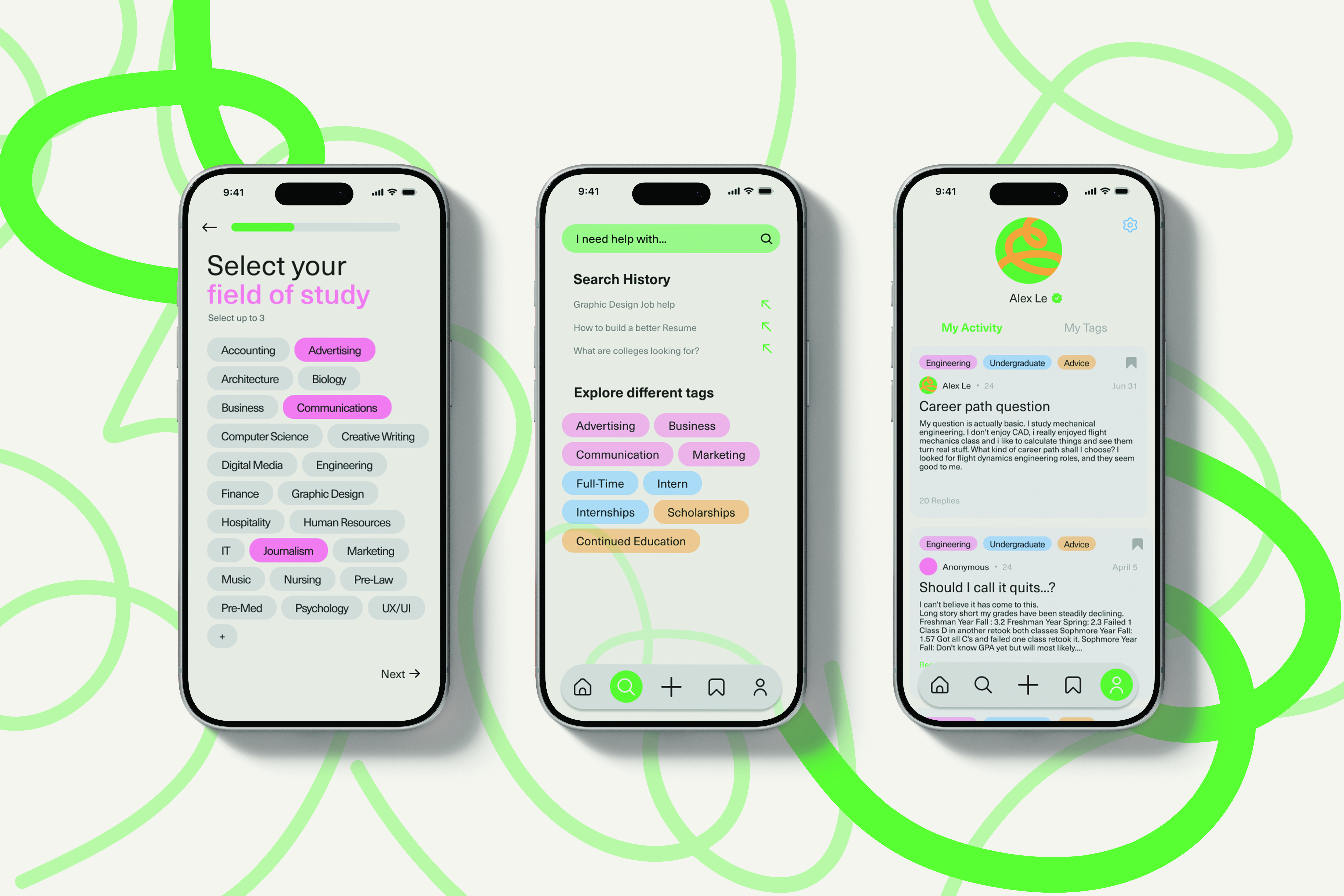
KUDOS, a forum-based app, focuses on mending intergenerational connections, allowing those of all ages to ask and answer questions. Primarily targeting emerging adults, KUDOS allows for those preparing for college or for the workforce to ask for advice from those who have lived those experiences.
The beauty of KUDOS allows different generations to overcome their misunderstandings of one another and realize that they have a lot more in common than they thought.
Describe your research process and findings. If you conducted any surveys or interviews, please include the survey form and/or interview questions here. If you conducted secondary research by pulling from online sources, please include a link to your sources. (Max 500 words)
As an initial step in our research process, we curated a survey that gathered both qualitative and quantitative data from family members, peers, and classmates. With a wide range of respondents, we gathered data on their age, background, their assumptions of different generations, their ability/inability to ask for help, and what platforms they use the most in finding resources.
Originally, we based our research on first-generation college students and the challenges they might encounter throughout their academic journey. Analysis of the collected data revealed that a significant portion of respondents under the age of 29 reported difficulty obtaining sufficient guidance when pursuing higher education. From our collected data, our respondents, ranging from Gen Alpha (under 18) to Gen X (45+), reported that about 67.2% of them are first-generation college students. Using a scale of 1-5 (1 being the least confident and 5 being the most), we asked our participants how confident they felt when applying/preparing for college. We found that more than half (about 70.2%) of all respondents felt that they were “not confident/prepared” when applying for college.
More importantly, the inclusion of a wide age range allowed for broader interpretation of the data beyond higher education alone. While the younger participants predominantly described uncertainty related to college applications, older participants expressed comparable feelings of confusion and lack of support in professional contexts, particularly during job searching, career transitions, or re-entry into the workforce. These responses suggest that feelings of being unprepared or unsupported are not exclusive to younger generations but persist across different life stages.
These findings led to a key insight that challenges associated with navigating complex systems such as education and employment are intergenerational in nature. Although the specific contexts differ, both younger and older respondents reported difficulty accessing clear, trustworthy guidance and expressed hesitation in asking for help. As a result, the scope of our project expanded from a singular focus on first-generation college students to a broader examination of how individuals across generations seek advice, share knowledge, and build confidence in both academic and professional decision-making.
In addition to confidence and preparedness, the survey also examined perceptions of generational understanding, judgment, and credibility. Our quantitative results indicated that generational tension and misinterpretation were widely experienced among respondents. Approximately 85.1% of participants reported believing that other generations misunderstand their own generation, while 79.1% acknowledged holding assumptions about generations other than their own. On top of that,** 70.1% of respondents reported feeling negatively judged by individuals from other generations.** These findings suggest that perceptions of misunderstanding and bias are prevalent and reciprocal across age groups, rather than being isolated to a single generation.
Overall, these findings indicate that generational misunderstanding and perceived judgment are not isolated experiences, but shared challenges across age groups. The prevalence of mutual assumptions and feelings of being misunderstood highlights a breakdown in intergenerational communication, suggesting a need for systems that encourage empathy, context, and more constructive knowledge exchange between generations.
Describe your most important design decisions. What research findings and/or user testing results led you to make these decisions? (Max 500 words)
The main function of our app revolved around the respondents’ critiques of current platforms. Based on the open-ended responses, the main concerns were: Feeling overwhelmed by the amount of information available to the user at one time The heavy use of AI to provide answers instead of another person Information available and advice given are too generalized and not specific enough The reliability and accuracy of information on the internet
Addressing these concerns led to the majority of our UI design decisions. In KUDOS, we made sure information was straightforward and uncluttered, hiding long posts behind a “Read more” CTA button. To avoid AI, we opted out of using AI completely in our research and design process to emphasize the importance of human interaction, especially between generations. Our tag system of industry, employment level, and general interests helps the user to personalize their feed, only consuming relevant information that is tagged. Having tags also provides better context for those wanting to offer help, ensuring that the questions the user receives are equally relevant. To ensure accuracy and reliability in information, we added a simple verification feature involving LinkedIn that is quick enough to not deter new users and also relevant enough to emphasize credibility in a certain industry.
Built With
- figma


Log in or sign up for Devpost to join the conversation.