Inspiration
Humans learn who to trust through experience. We asked whether AI agents could do the same while turning one short product request into tested software, with no human handoffs.
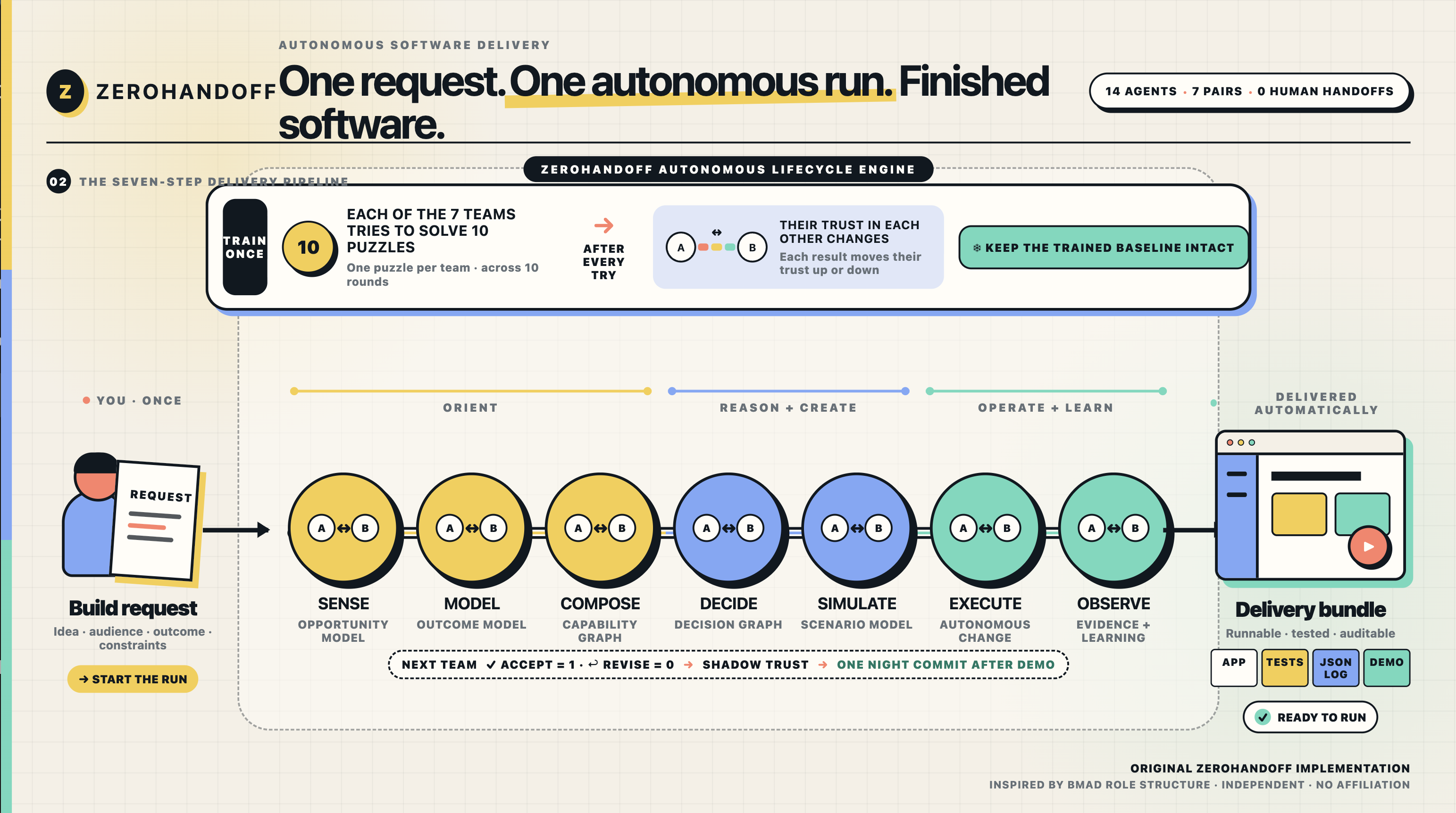
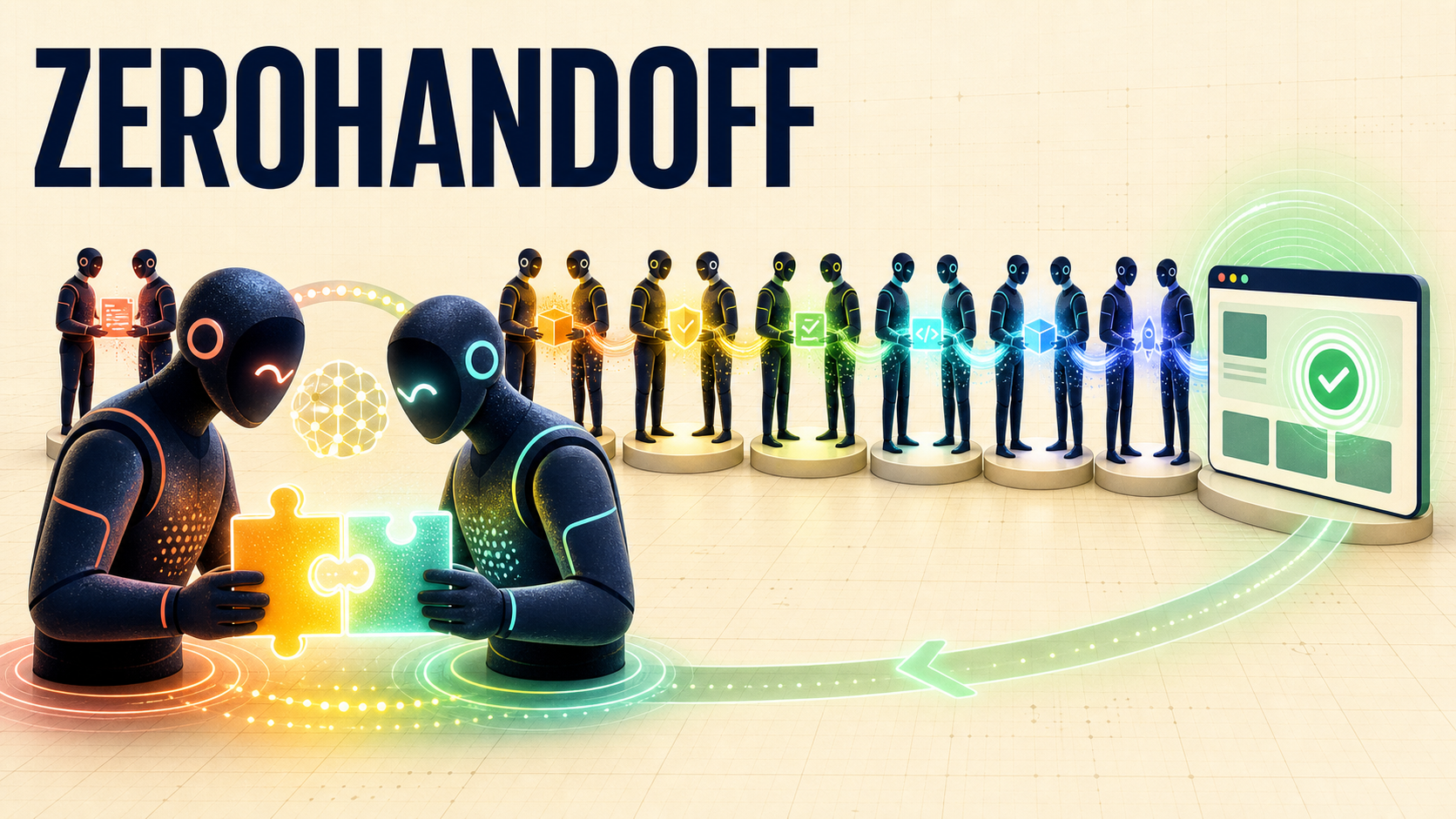
ZeroHandoff has 7 teams of 2 Agents each that work together to deliver enterprise products, teams are:
SENSE → MODEL → COMPOSE → DECIDE → SIMULATE → EXECUTE → OBSERVE
What it does
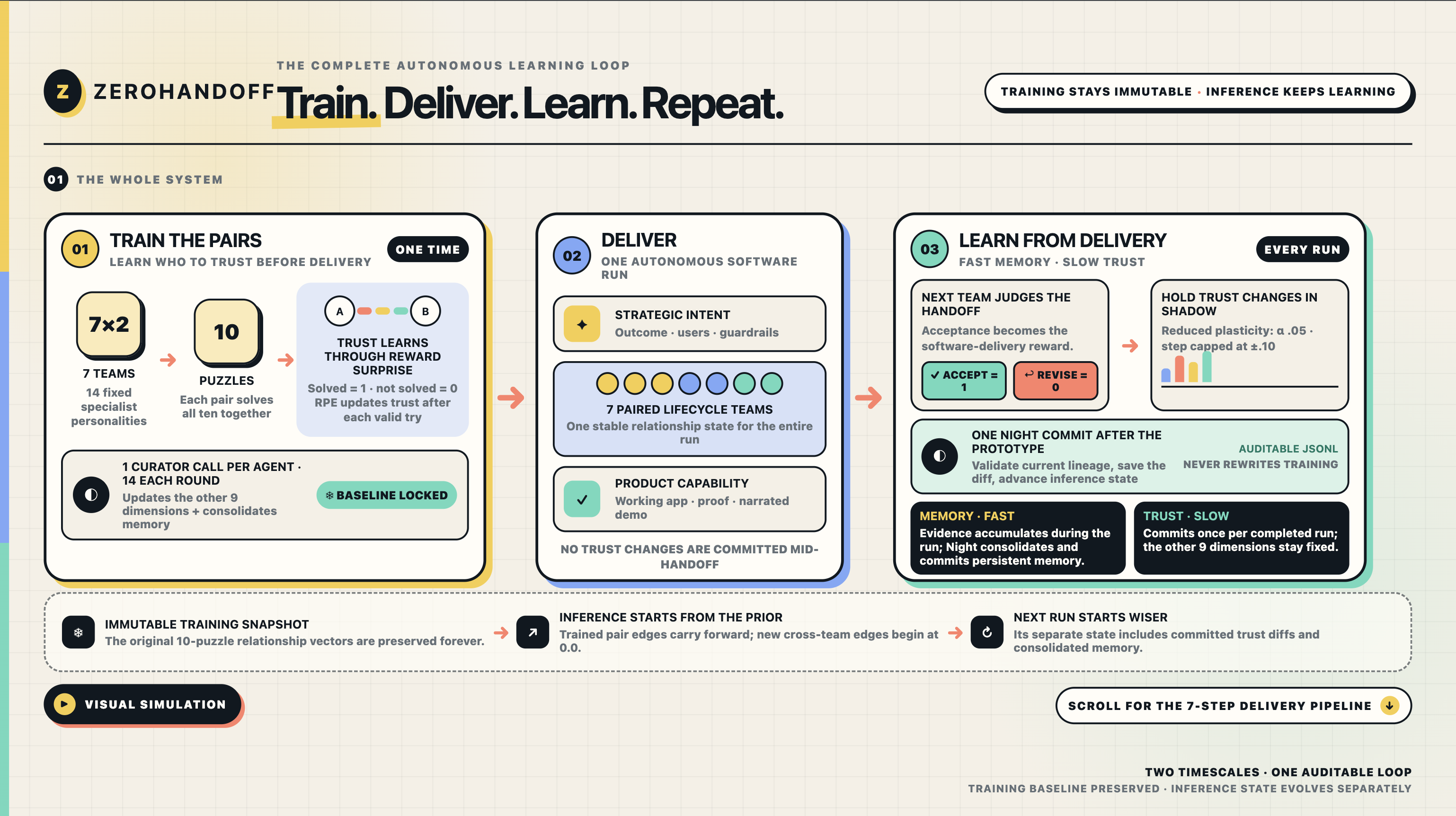
ZeroHandoff gets a user idea for a product as input and gives back a working app + video demo as output, coordinates 14 GPT-5.6 Sol PRE-TRAINED agents in 7 two-agent teams.
Pre-Training
Before delivery, each team solves ten split-clue puzzles. Success or failure updates asymmetric trust (float value), while Curators maintain nine additional relationship dimensions and memory. Training completed 70 team episodes with 63 puzzles solved, producing an immutable relationship baseline.
During delivery, trust helps resolve disagreements. Teams reward accepted handoffs with 1 and rejected handoffs with 0. Updates remain pending until the prototype finishes, when one Night Curator validates and commits reduced-plasticity trust and consolidated memory.
How we built it
Using Codex, we created typed artifact contracts, 14 agent configurations, isolated workspaces, schema-constrained GPT-5.6 Sol calls, deterministic quality gates, repair loops, artifact-lineage tracking, immutable training state, continual learning, JSON logs, browser verification, and checksummed delivery packages.
The final experiment built EchoLedger, which turns customer-support calls into evidence-linked problems and assigned follow-up actions. The run completed all seven stages with 81 agent calls, 32 gates, 18 repairs, a 147-file delivery bundle, and an interactive demo.
Challenges and lessons
Our hardest problem was ensuring learning reflected what really happened. One failed handoff was initially lost during a resume. We preserved the invalid history, restored the last verified state, implemented atomic persistence, and reran it. EchoLedger’s final rewards—[1, 1, 1, 1, 0, 1]—retain that real rejection and repair.
We learned that dependable multi-agent systems require more than roles and prompts. They need relationships, memory, contracts, lineage, repair, and evidence.
What’s next
We plan to support more coding environments, test hundreds of enterprise handoffs, and expand governance and observability.
The vision: one strategic intent enters, a trusted autonomous organization builds the product, and every decision remains inspectable.

Log in or sign up for Devpost to join the conversation.