-
-
Landing
Inspiration
Every pitch deck makes claims: "15 enterprise customers," "3x revenue growth," "a Fortune 500 partner." Most investors, especially angels and small funds, don't have the time or analysts to check them. Due diligence is slow, expensive and usually happens after the decision is already leaning one way. We wanted any investor to be able to check claims as rigorously as a forensic analyst would.
What it does
Sherlock Capital investigates startups before you invest.
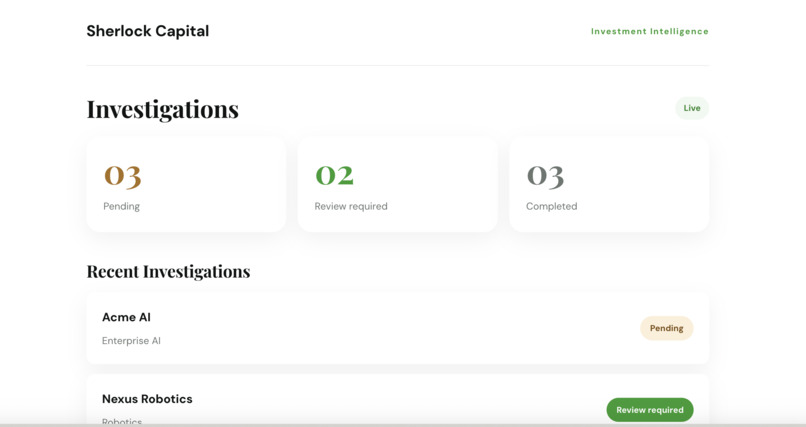
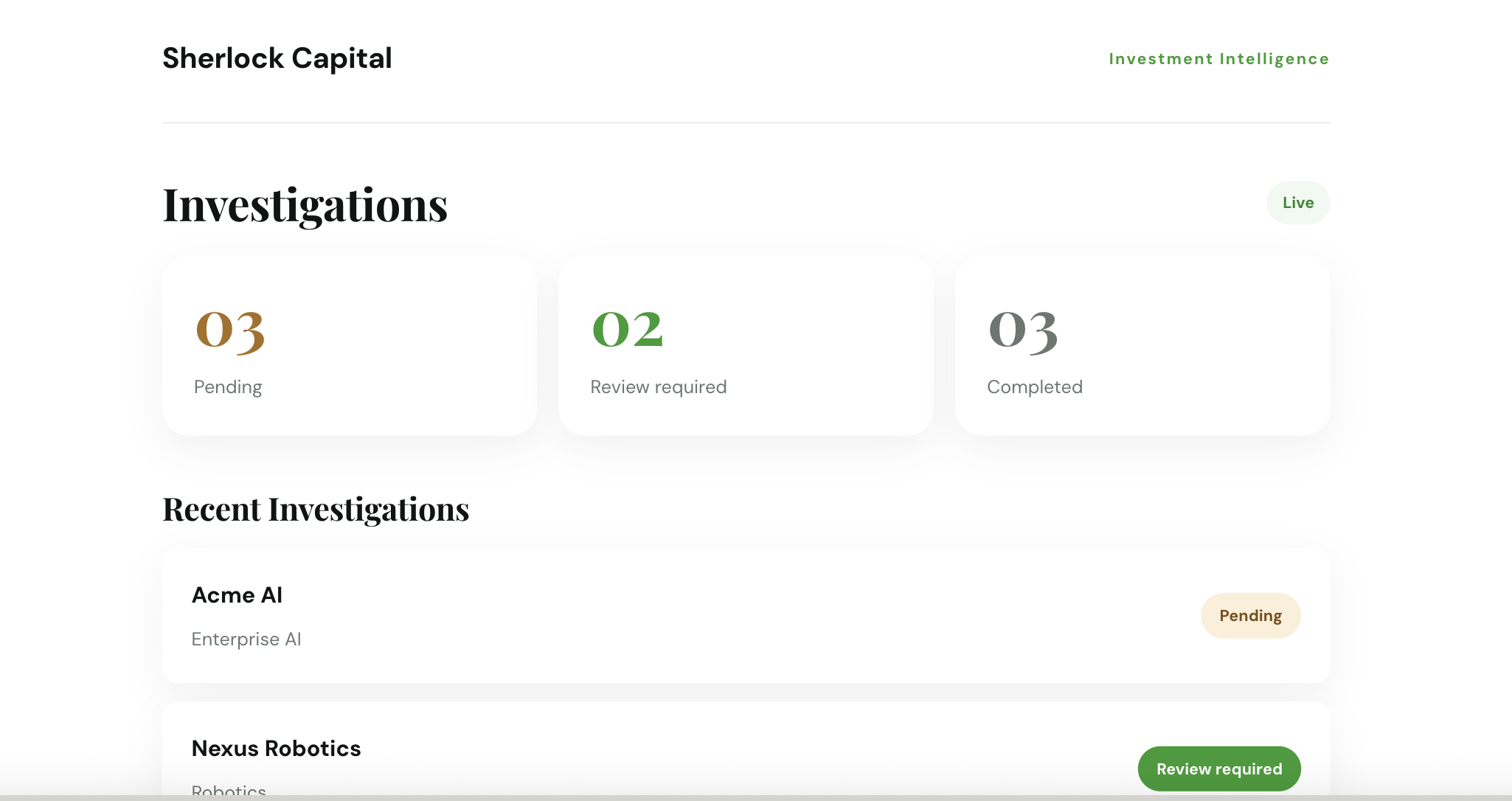
Point it at a company. Enter a name and website, upload the pitch deck, and optionally add financial statements, vendor contacts or a Stripe connection to confirm revenue. Choose how deep to dig. Quick scan (2 min), deep investigation (10 min) or forensic investigation (20+ min). A team of four AI analysts goes to work: The Bull builds the investment case. The Bear looks for evidence against it. The Detective digs up hidden connections. The Judge weighs what the others found. Live intelligence feed. Findings and contradictions show up in real time. Evidence Room. Each claim is pulled out on its own and linked to its sources. Each source is graded (primary, indirect, needs review), and each claim gets a verdict such as supported, disputed or "not independently established." Dashboard. Every investigation, sorted by status.
How we built it
[Frontend stack, e.g. React / Next.js] for the dashboard, intake form, live progress view and Evidence Room. [LLM provider/model] running four agents with separate roles and prompts. The Bear's job is specifically to disagree with the Bull. Document parsing pulls individual claims out of the PDF deck and financial files. Web research tools find and cite sources for each claim. Stripe integration checks stated revenue against actual payment records. [Backend / queue / database] runs investigations asynchronously and streams findings to the UI.
Challenges we ran into
Keeping agents honest. Models tend to agree with each other. We had to design the Bear and the Judge so they push back instead of rubber-stamping the Bull. "Unproven" is not "false." Most claims can't be confirmed or refuted outright, so we needed verdicts like "not independently established" that don't overstate the case. Grading sources. A press release, a job listing and independent coverage are very different kinds of evidence. Turning that into a consistent grade took several rounds. Splitting claims out of decks. Pitch decks are visual and vague. Turning slides into specific, checkable statements was harder than we expected. Showing progress. Investigations can take 20+ minutes, so we built a live feed to make that time feel visible and worth waiting for.
Accomplishments that we're proud of
An adversarial four-agent setup where disagreement is built in. Every finding links back to a source, so nothing is taken on faith. Verified revenue through Stripe instead of revenue the founder simply reports. A clean interface that makes forensic diligence feel calm instead of overwhelming.
What we learned
One AI analyst is easy to fool. Several analysts arguing with each other are much harder to fool. Investors value "we couldn't confirm this" as much as "this is false." How a verdict is worded matters a lot. Overclaiming kills trust faster than missing a finding.
What's next for Sherlock Capital
More data connections: bank accounts, CRMs, cap tables, LinkedIn headcount, regulatory filings. Automatic outreach to customer and vendor references. Ongoing monitoring of portfolio companies after the investment closes. Shareable diligence reports for investment committee memos and syndicate partners. A founder-facing version, so startups can verify their own claims before fundraising.
