-
-
MEDprint logo
-
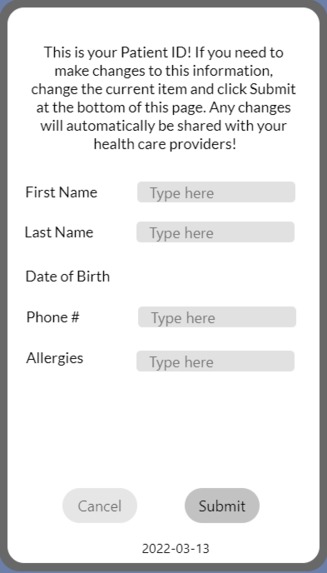
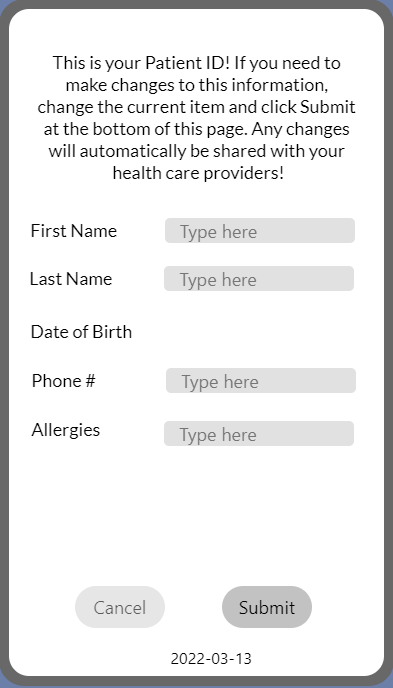
The patient data entry screen of the app
-
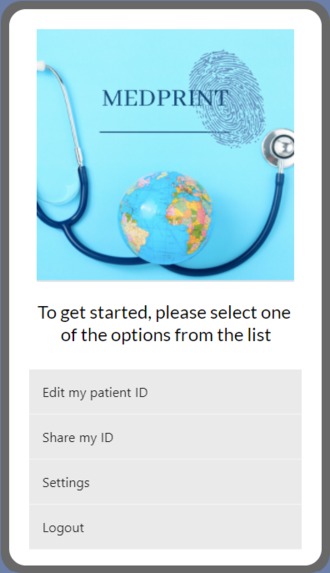
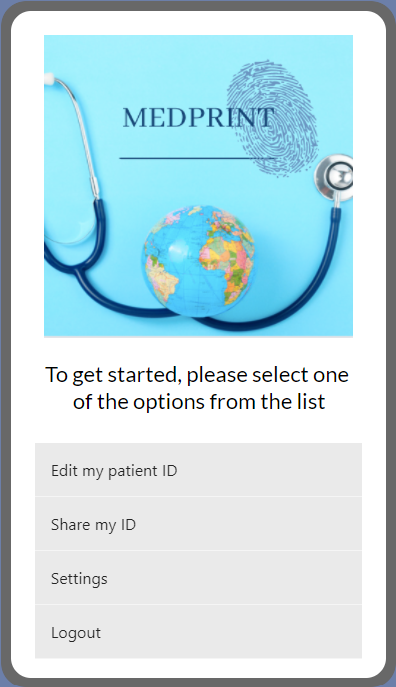
The Home page of the MEDprint app
-

A screenshot of the SQL server which holds patient records online for a health care provider

Challenge Tracks
We are targetting track 2.1 (Reducing Inefficiencies in Health Care: Streamline redundant processes for patients at the pharmacy and/or clinic).
We are also using Google Cloud in this project.
Inspiration
Do you remember a time when you needed to see a doctor, but the doctor’s office asked you to fill out millions of tedious forms before they could even schedule your appointment? What if you could save that time by securely sharing your medical information through a simple phone app, or with a touch-less bracelet, when you arrive at the office? Well, with MEDprint, registering with a new health care provider is seconds away!
What is MEDprint
MEDprint is designed to eliminate the need for new patient forms. Our goal is to recover patient and provider time by letting patients easily share their information using their cellphone or with a bracelet containing an RFID chip.
The process starts with the patient entering their information into the mobile or web app. Once done, the patient will have the option of linking their account with a bracelet that contains an RFID chip. This bracelet can be scanned at a provider’s office to share the information without a cellphone (i.e. in emergency situations or for certain populations), which would only be enabled with the patient’s consent. Alternatively, the MEDprint app can send information with a QR code at the provider’s office. Once shared, patient data is stored inside the hospital’s system.
Day-to-day, MEDprint will save around 15-20 minutes per patient per provider. However, the hidden value of MEDprint is in situations of critical care. You may know about medical allergy bracelets: well, with a MEDprint bracelet, EMTs have the power to learn their patient’s full allergy list within seconds. Furthermore, patients entering the Emergency Room in need of immediate attention may find their life saved by the efficiency behind the MEDprint bracelet.
We believe the current process of medical information transfer is unnecessarily tedious, but with MEDprint, the hand-cramping task of filling out forms becomes a simple scan of a QR code or tap of a bracelet, all 100% securely and HIPPA-compliant.
How we built it
The MEDprint app was made using Thunkable and tested with a Samsung Galaxy Note 10 running Android 11. As is, the app can save information that the user enters and can share that information to an email address after scanning a QR code with the device’s camera. This method of transfer is only for demonstration: in reality, we would use a much more secure method of data transfer. We also created an SQL server using Google Cloud SQL to store patient records as a proof-of-concept. Ideally, we would work with hospitals to determine how they store their patient data, and the QR codes at each provider’s office would allow patients to share information directly with the hospital’s system.
Challenges we ran into
As this hackathon was completely online, our team quickly realized that communication should occur early and often to allow each member to contribute to the project. The largest technical challenge we faced was with integrating the MEDprint app with the SQL server. As Thunkable does not currently have this capability, sharing the MEDprint app’s data with an SQL server required building our own API, and we decided that this would take far too much time. In a future iteration of the project, we would use Google Cloud to make a web server which interacts with our Google Cloud SQL server and with the app, making it easy to connect the app to the SQL server.
Accomplishments
We were proud at pretty much every stage of this journey, from seeing the SQL instance up and running to having data shared by the app and finding different ways to pitch MEDprint!
What we learned
The most valuable lesson we took from this experience was that successfully working with a team online necessitates an easy-to-use and capable communication platform. We are lucky to have Discord (or Slack) in our toolkits, and we can’t imagine how difficult intercontinental cooperation must have been even ten years ago!
In terms of technical skills, app design was a foreign concept to some of us when we started this project, but we found that platforms like Thunkable hide the code and let developers focus on app design and programming.
What's next for MEDprint
As security should be the primary concern with patient data, we would like to learn how we can transfer data from our app to providers’ SQL servers without being immediately vulnerable to attack. Once we feel confident about the app’s security, we would build the API to integrate the app and the servers and begin speaking with providers’ offices to gauge interest. At around the same time, we would be working on testing the RFID bracelet. Thank you for your attention!
Built With
- android
- canva
- google-cloud-sql
- thunkable


Log in or sign up for Devpost to join the conversation.