PlaceHack AI
One-click location intelligence, powered by OpenAI structured outputs and agentic engineering.
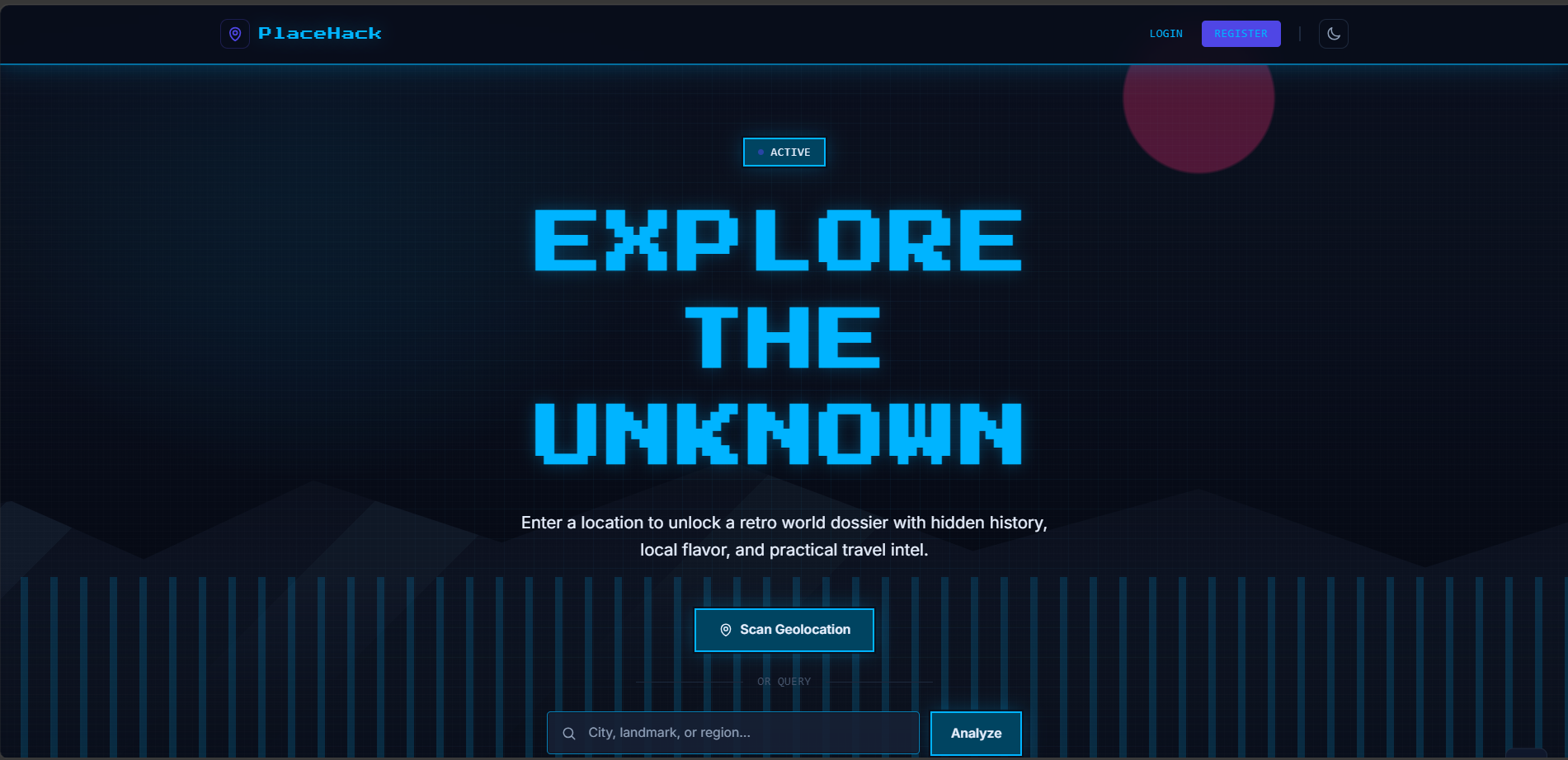
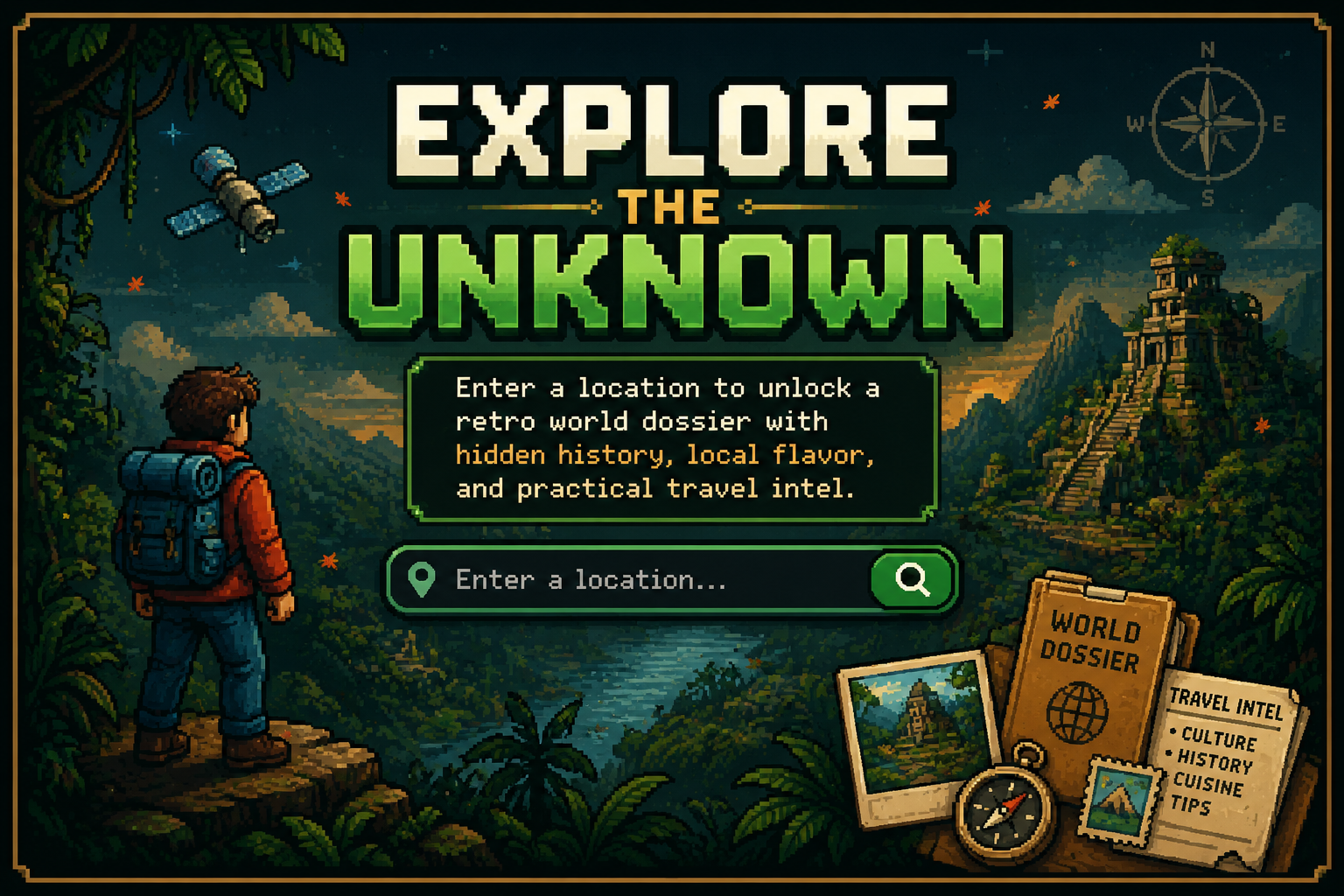
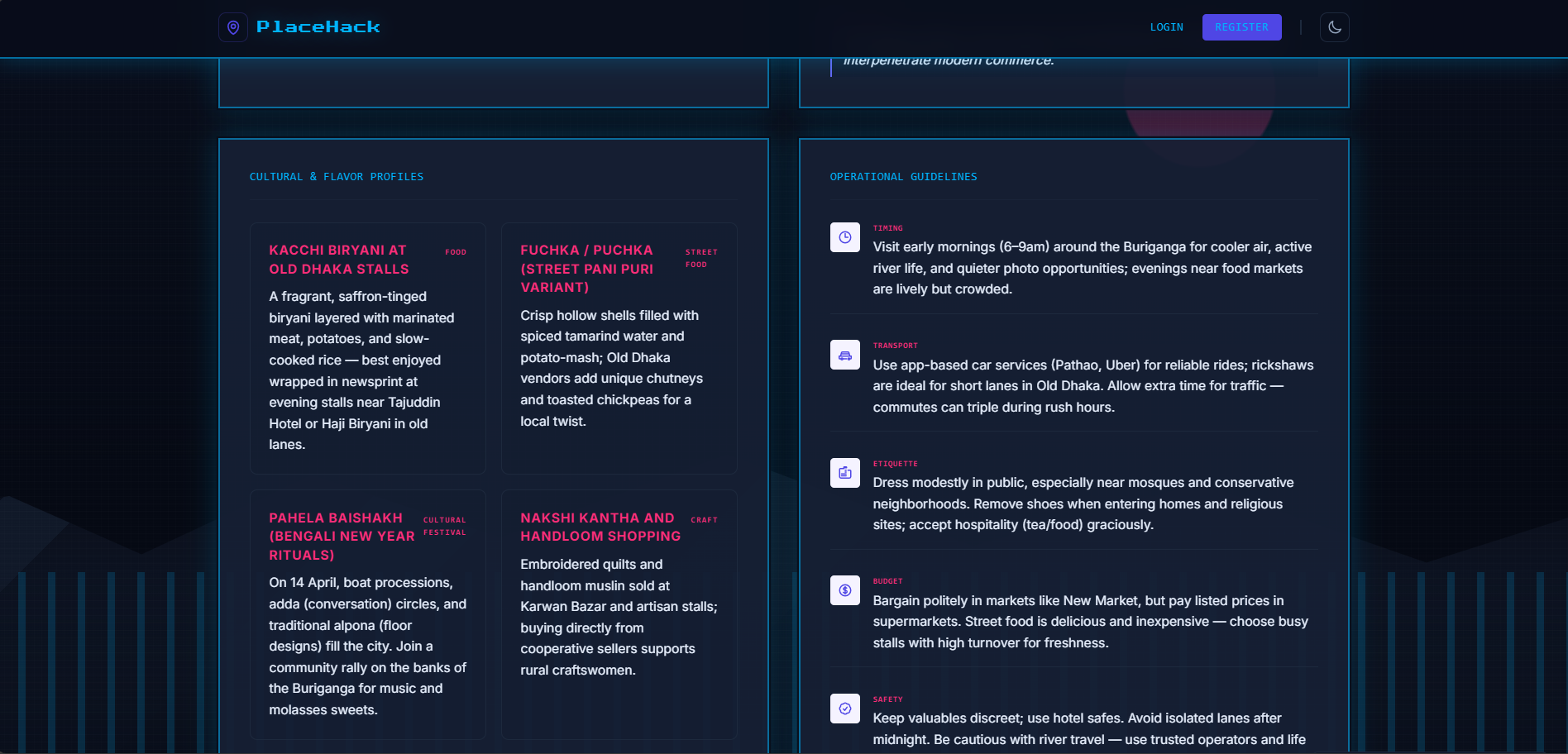
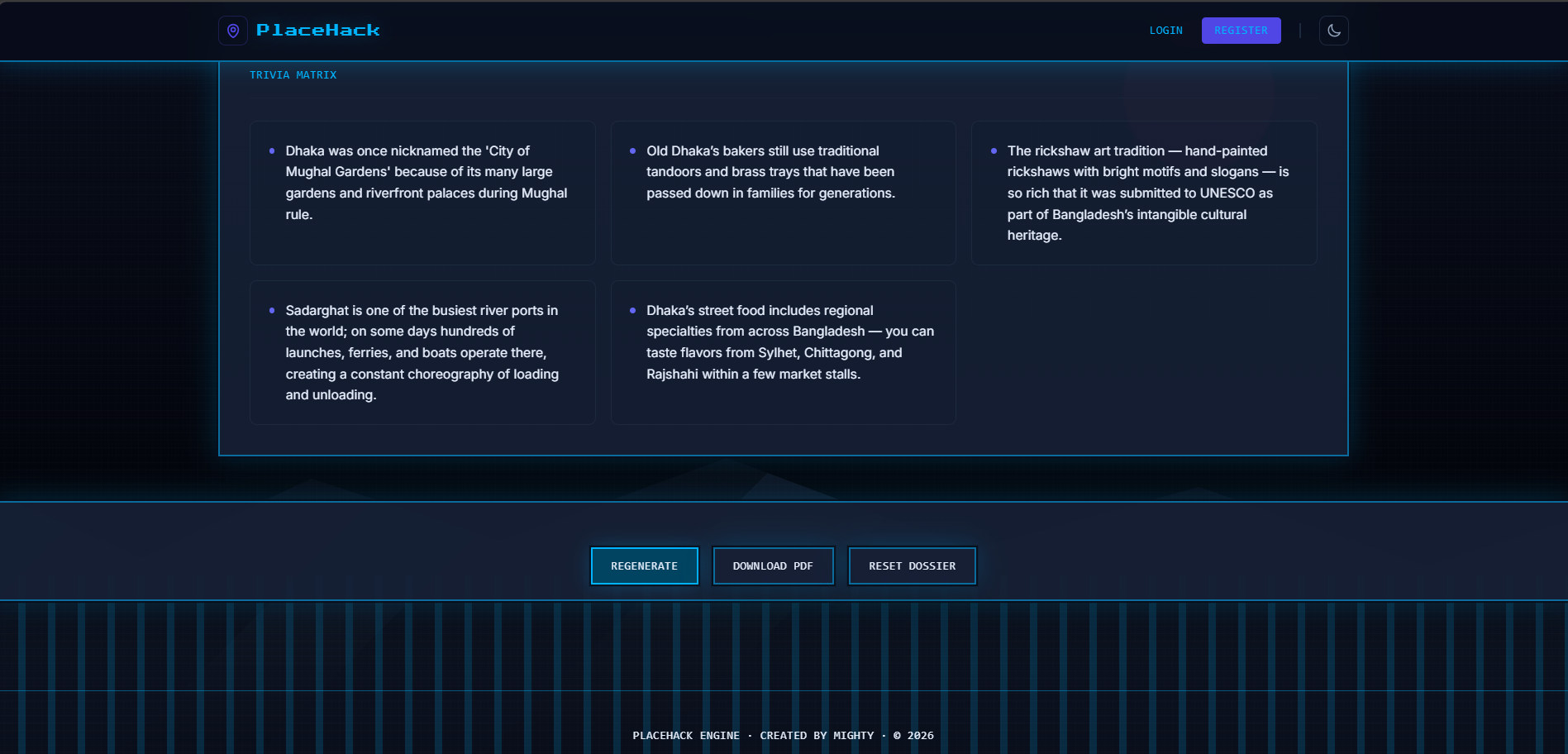
Scan your coordinates or search any place on Earth — PlaceHack AI instantly generates a structured cultural dossier covering hidden history, must-visit spots, local flavors, practical travel tips, and surprising facts. No generic summaries. No scattered tabs. One click, one deep-dive report.
🌍 The Problem
Getting a rich, accurate picture of a place is surprisingly hard. Mainstream travel guides focus on the same fifty cities. Wikipedia is shallow on districts. Blogs are SEO-filler. Pulling together real cultural depth — local history, what's worth visiting, what to eat, how to move around — requires hours of research across a dozen sources, and the result is still rarely structured or trustworthy.
This is especially true for lesser-known districts and towns, where mainstream coverage is thin or nonexistent.
💡 The Solution
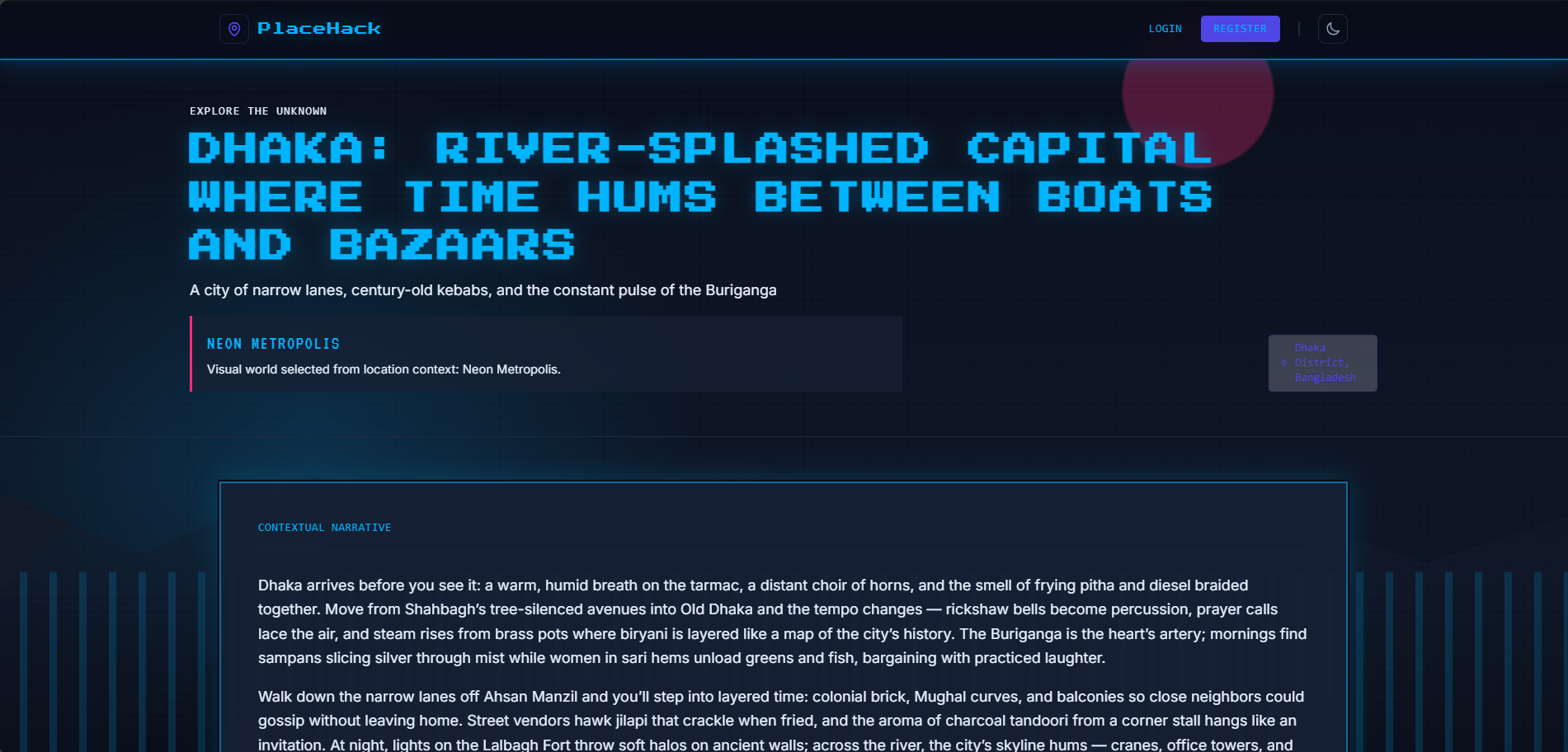
PlaceHack AI eliminates that research gap. It uses the browser's Geolocation API to detect the user's precise location (reverse-geocoded to district + country in English), or accepts a manual text search for anywhere in the world. It then invokes an AI agent that produces a magazine-quality dossier in a single structured API call.
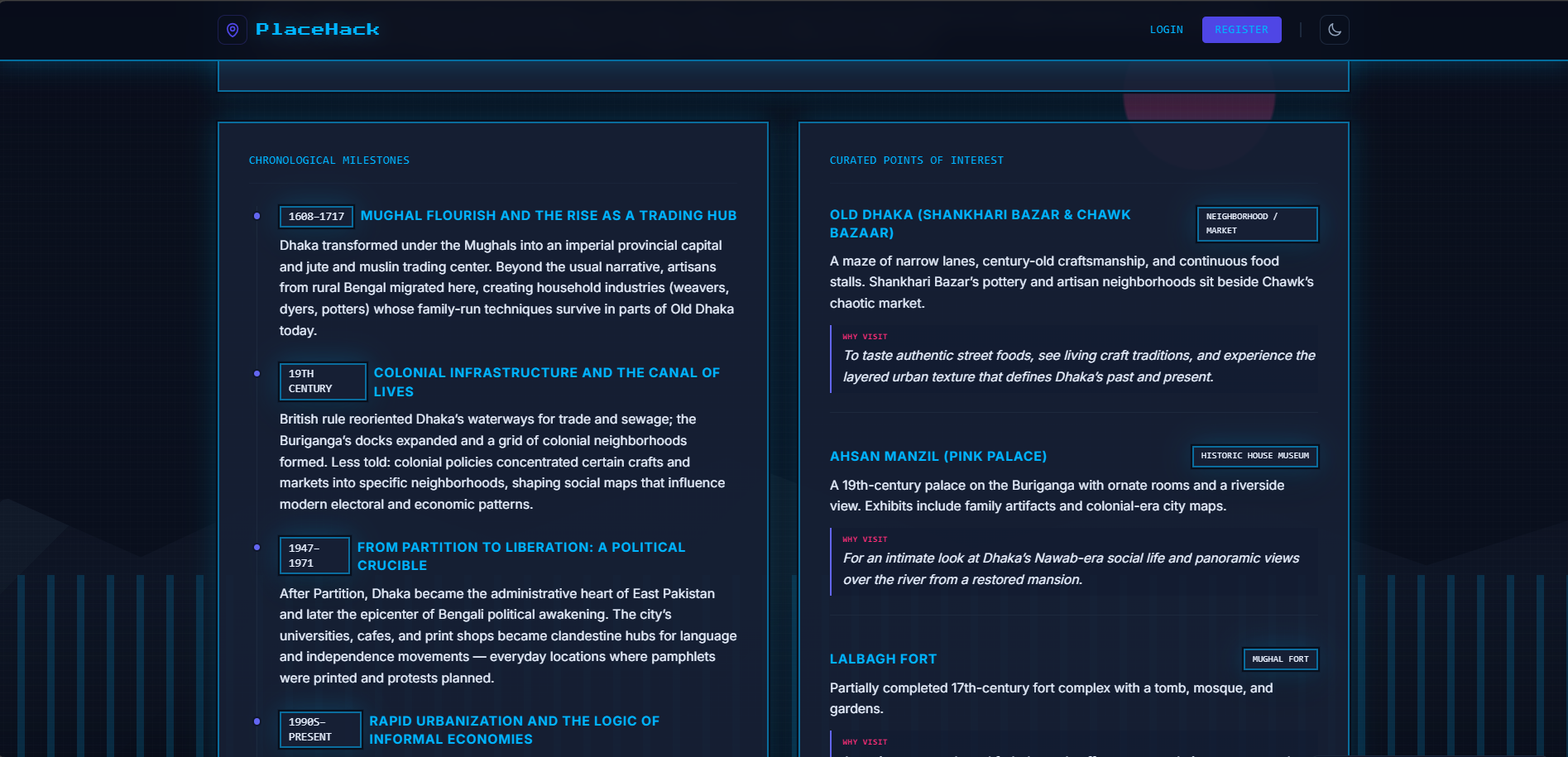
The output isn't a chatbot response or a free-form summary — it's a validated, schema-bound JSON document rendered into a polished UI and exportable as a PDF.
👥 Who It's For
| Audience | Use Case |
|---|---|
| Travelers | Instant cultural briefing before or during a trip |
| Students & Researchers | Quick, structured cultural and historical context |
| Remote Workers | Orientation for unfamiliar cities and neighborhoods |
| Local Communities | A fresh AI lens on their own region's history and identity |
⚙️ How It Works
User (browser geolocation or text search)
        │
        ▼
Reverse geocoding → district + country string
        │
        ▼
OpenAI Chat Completions (/v1/chat/completions)
  └─ Model: gpt-5-mini
  └─ Response format: strict json_schema
  └─ System prompt: PlaceHack Intelligence Agent persona
        │
        ▼
Structured JSON dossier (8 required sections)
        │
        ├─► In-memory / file cache (prevent duplicate API calls)
        ├─► Express.js + EJS UI (responsive, dark mode)
        └─► PDFKit export (downloadable report)
The core pipeline is intentionally simple: one structured API call, one validated JSON object, one rendered dossier. Reliability is built into the schema, not patched in afterward.
🤖 OpenAI Integration
Model & Configuration
| Parameter | Value | Rationale |
|---|---|---|
| Model | gpt-5-mini |
Strong long-form synthesis at hackathon-appropriate cost |
| Endpoint | /v1/chat/completions |
Standard Chat Completions |
| Response format | strict json_schema |
Guarantees parseable, UI-ready output — no regex, no fallbacks |
| Max completion tokens | 9000 |
Reasoning models consume internal tokens; headroom prevents truncation |
| Reasoning effort | low |
Reserves token budget for the output payload rather than internal chain-of-thought |
| SDK | openai (Node.js) |
Official OpenAI Node.js SDK |
Why Structured Outputs?
The entire product depends on the JSON being exactly right every time. Strict schema enforcement means:
- The frontend always has the fields it expects
- PDF export never breaks from a missing key
- No defensive parsing logic scattered across the codebase
The schema enforces eight required top-level sections: title, subtitle, soul, history, must_visit, local_flavors, practical_tips, fun_facts. Every field is typed, required, and validated before the response reaches the UI layer.
The Agent Persona
The system prompt defines the PlaceHack Intelligence Agent as a world-class travel writer, cultural anthropologist, and historian. This produces vivid, non-generic writing with fresh historical angles — not Wikipedia-level summaries or SEO-style bullet points.
🏗️ Technical Architecture
PlaceHack AI is a full-stack Node.js application:
- Backend: Node.js + Express.js — routing, auth, API orchestration, caching, PDF export
- AI Layer: OpenAI Node.js SDK calling
gpt-5-miniwith strict JSON schema - Database: JSON file store / SQLite — lightweight report caching to avoid redundant API calls
- Frontend: EJS templates + Tailwind CSS — responsive UI with dark mode support
- PDF Export: PDFKit — server-side report generation from the same structured dossier data
- Geocoding: Browser Geolocation API → reverse-geocoded to English district + country string
- Hosting: Render (free tier)
⚠️ The live demo runs on Render's free tier and may take 30–60 seconds on first load due to cold starts. The local setup below is instant.
🤝 Agentic Development
This project was co-engineered using Codex as an agentic pair programmer, following documented agentic workflows:
AGENTS.md— Documents the runtime Location Intelligence Agent architecture, Mermaid sequence diagrams, configuration parameters, and system boundariesskills.md— Defines the geocoding skill, structured dossier synthesis spec (with full annotated JSON schema), PDF export contract, UI conventions, and Vite build pipeline
The development process followed three agentic phases: interactive planning (requirements, constraints, design tokens), context-aware implementation (targeted edits with full codebase awareness), and automated verification (Node.js checks + build validation after each cycle).
📐 Dossier Schema
The structured output schema is the backbone of the product. Every report conforms to this contract:
$$ \text{Dossier} = {\ title,\ subtitle,\ soul,\ history[\ ],\ must_visit[\ ],\ local_flavors[\ ],\ practical_tips[\ ],\ fun_facts[\ ]\ } $$
Where each array section contains typed objects with required fields — ensuring the frontend renderer, PDF exporter, and cache layer all operate on a guaranteed, predictable data shape.
🚀 Local Setup
git clone https://github.com/misbah7172/PlaceHack-AI
cd PlaceHack-AI
npm install
# Add OPENAI_API_KEY to .env
npm start
# Open http://localhost:3000
Full instructions in README.md.
🏆 Why PlaceHack AI
- Not a chatbot — a deterministic, schema-bound intelligence report, not a conversational answer
- Genuinely useful — produces depth on lesser-known districts that mainstream guides ignore
- Platform-aware engineering — explicit reasoning effort tuning, token budget management, and strict output schemas show deliberate use of the OpenAI platform, not just an API wrapper
- Documented agent architecture —
AGENTS.mdandskills.mdtreat AI agent design as a first-class engineering artifact - Production-grade pipeline — auth, caching, error handling, PDF export, and dark mode out of the box

Log in or sign up for Devpost to join the conversation.