-
-
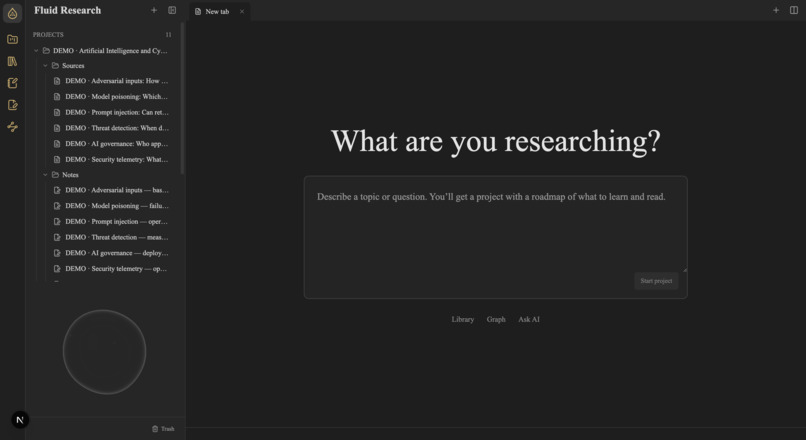
Home Page
-
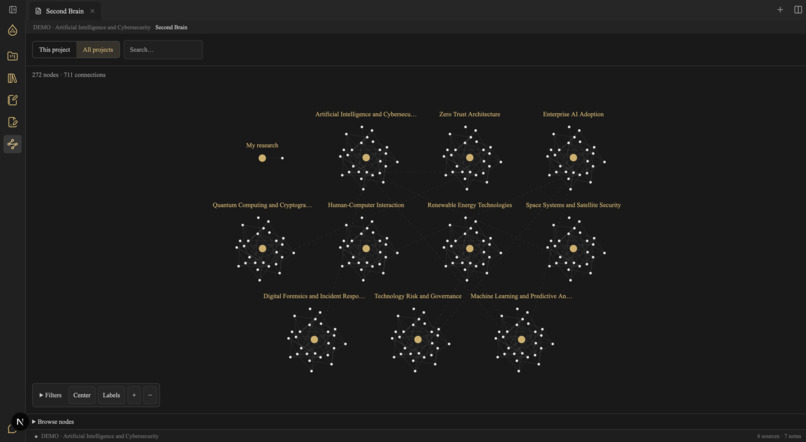
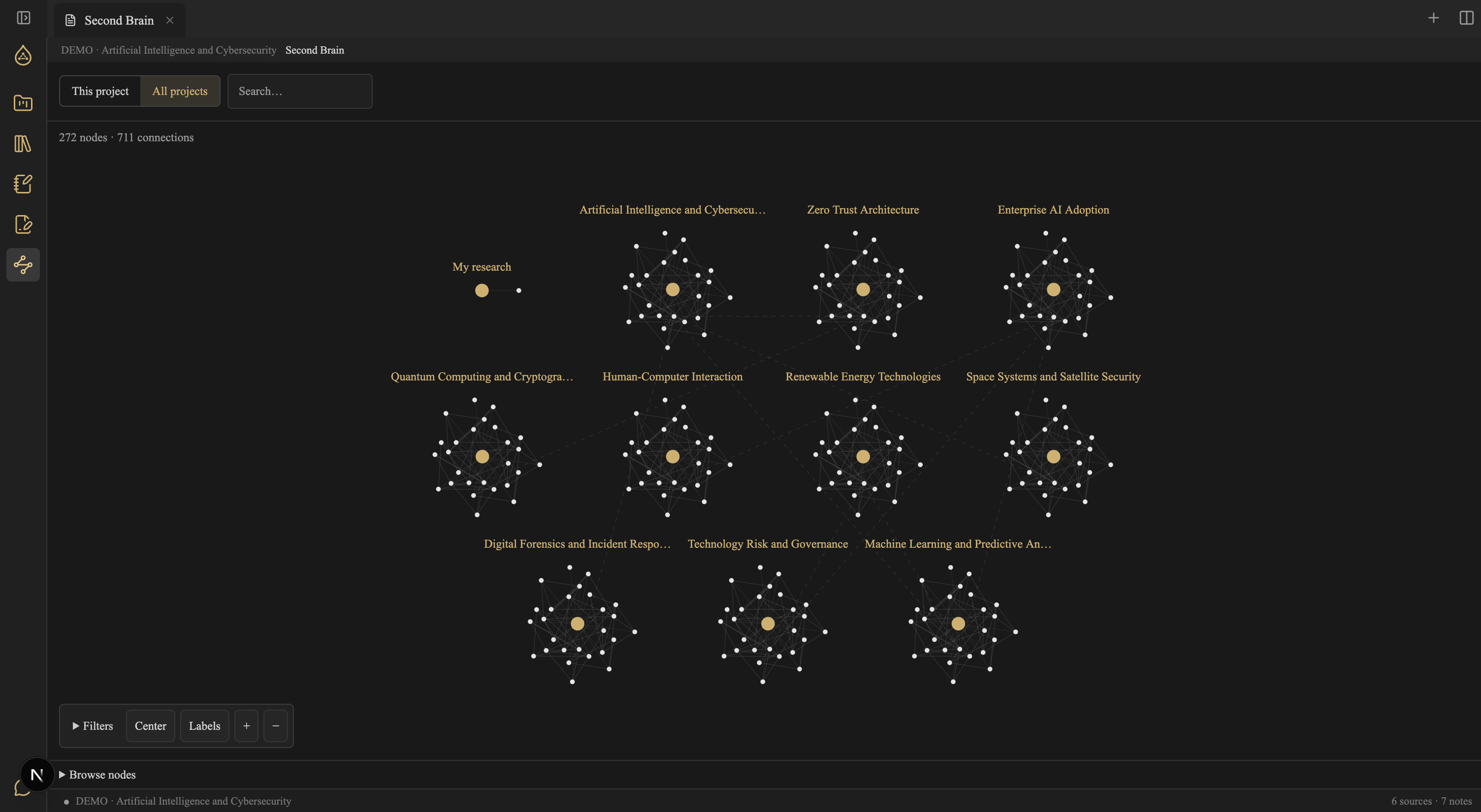
Second Brain Knowledge Graph
-
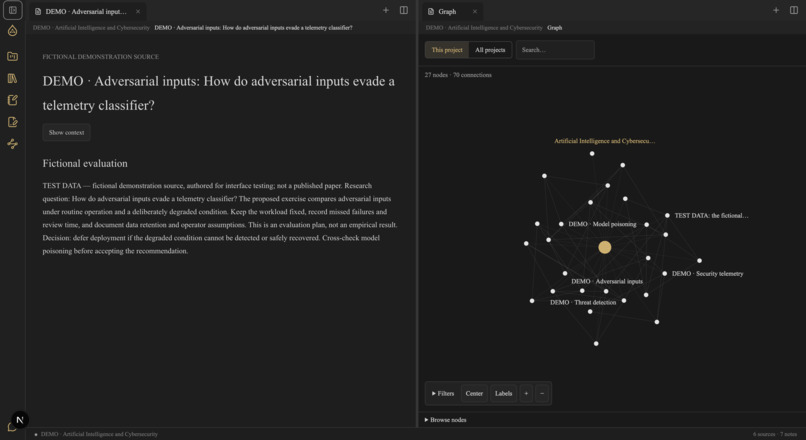
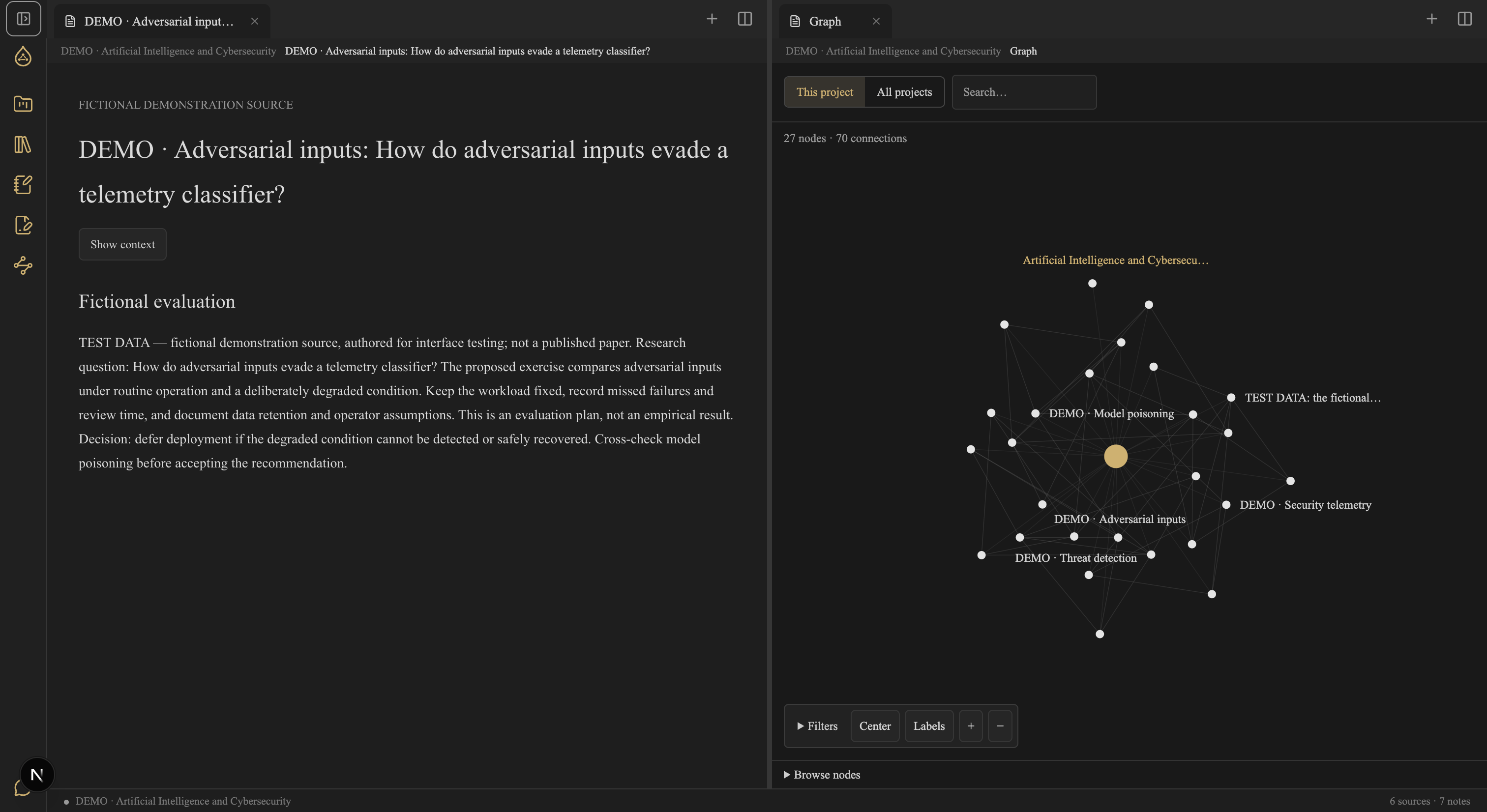
Split screen any two tabs
Fluid Research - About the Project
Inspiration
As college students, we spend a lot of time reading research papers, studying complex topics, and trying to connect information from different sources. We realized that while existing AI tools can summarize documents and answer questions, they don't always help us understand how concepts relate to one another, identify gaps in existing research, or determine what we need to learn before tackling a complicated subject.
Research is also constantly evolving. New ideas, experiments, and alternative approaches are frequently discussed online before they become part of formal academic literature. However, finding these discussions, separating credible ideas from speculation, and understanding how they might influence our own projects can be difficult.
We wanted to create something that goes beyond a traditional AI chatbot or PDF summarizer. Our vision was to build a platform that not only helps people understand existing research but also allows them to discover emerging ideas, evaluate scientific evidence, and make informed decisions about their work.
That's how Fluid Research started.
What it does
Fluid Research is an AI-powered research workspace that helps students, researchers, and independent learners understand, explore, and build upon academic research.
Users can upload research papers, organize projects, interact with documents using AI, visualize connections between concepts, and discover related studies.
Rather than treating each paper as an isolated document, Fluid Research brings the entire research process into one connected workspace.
Our main features include:
AI Research Assistant: Ask questions about uploaded papers and receive contextual explanations with references to specific pages and supporting evidence.
Interactive Knowledge Graphs: Visualize relationships between concepts, research papers, and prerequisite knowledge to understand how complex topics connect.
Research Gap Explorer: Identify unanswered questions, potential gaps, and opportunities for further research across multiple papers.
Cross-Paper Analysis: Compare studies to identify similarities, differences, and potential contradictions supported by source evidence.
Smart Paper Recommendations: Discover relevant academic publications using OpenAlex, including foundational studies and related research.
Personalized Learning Paths: Generate structured learning paths based on prerequisite concepts, assess understanding through AI-generated quizzes, and track learning progress.
AI Research Roadmaps: Describe a research topic and generate an organized roadmap containing concepts to learn and relevant academic papers to explore.
Research Workspace: Highlight PDF passages, annotate documents, create Markdown notes, organize projects, link papers, and save conversations.
Research Brief Generator: Combine information from multiple documents into an editable research brief that can be printed or shared.
Chrome Extension: Access Fluid Research through a browser side panel, analyze PDFs directly from the browser, and transfer research into the main workspace.
AI Read-Aloud: Listen to research material through integrated text-to-speech functionality.
Local Research Storage: Store projects, documents, annotations, and learning progress directly in the browser.
News / Research Radar — Discovering and Evaluating Emerging Ideas
One of our newest features is Research Radar, an AI-powered research discovery system integrated into the application's News tab.
Research Radar was designed to solve a problem we repeatedly encountered: How do we know whether someone has recently discovered a better way to approach the problem we're working on?
Instead of displaying generic news headlines, Research Radar uses the context of the user's current project to discover relevant technical discussions and emerging research ideas.
Using Grok and X Search, the system searches for discussions connected to the user's research topic, including alternative approaches, potential improvements, experimental findings, and technical challenges.
To keep the information timely, Research Radar focuses on social media posts published within the previous seven days.
However, discovering an interesting idea is only the beginning.
A social media post may contain an exciting claim without sufficient evidence. To address this, Research Radar connects discovered ideas to relevant academic literature using research discovery tools such as OpenAlex.
The system then evaluates:
- Relevance: How closely does the idea relate to the user's current project?
- Scientific Evidence: Are there existing publications that support, contradict, or provide context for the claim?
- Credibility: Is the idea supported by meaningful evidence, or is further investigation necessary?
- Technical Feasibility: Could the proposed approach realistically be implemented?
- Project Impact: Would the idea improve the user's research, introduce new risks, or challenge an existing assumption?
- Integration Opportunities: If promising, how could the idea be tested or incorporated into the project?
Research Radar summarizes its findings in the News tab and provides links to the original discussions and relevant academic sources.
Users can also select Deep Dive to investigate a particular finding in greater detail, explore additional evidence, understand competing perspectives, and examine potential implementation strategies.
Importantly, the system distinguishes between supported findings, contradictory evidence, and unresolved questions rather than assuming that every newly discovered idea is scientifically valid.
Our goal is to transform the News tab into a personalized research intelligence feed that helps users move from discovering an idea to understanding whether it is worth pursuing.
How we built it
We developed Fluid Research using Next.js, React, TypeScript, and Tailwind CSS to create a responsive, interactive research workspace.
We integrated Google Gemini to analyze academic documents, generate explanations, identify prerequisite relationships, and support research synthesis.
We also incorporated several technologies to support the different stages of the research process:
- Google Gemini: Powers document understanding, concept extraction, tutoring, and research analysis.
- Grok / xAI: Supports research discovery, analysis of emerging ideas, and additional evaluation of research claims.
- X Search: Retrieves recent public discussions relevant to the user's research.
- OpenAlex API: Connects users to academic literature and provides research evidence for evaluating new ideas.
- PDF.js: Extracts text, page references, and metadata from uploaded PDFs.
- Mistral OCR and Mathpix: Provide advanced processing for scanned documents, mathematical equations, and complex PDF layouts.
- React Flow: Powers interactive knowledge graphs and visualizes conceptual relationships.
- IndexedDB: Stores projects, documents, notes, annotations, conversations, and learning progress locally.
- ElevenLabs: Provides AI-powered audio and read-aloud functionality.
- Chrome Extension APIs: Extend Fluid Research into the browser through a Chrome side panel.
- Zod: Validates structured AI outputs to improve reliability and consistency.
- Cursor: Supported the development and integration of our News / Research Radar feature through AI-assisted programming, debugging, and iteration.
Building the Document Intelligence Pipeline
One of the most important parts of our architecture is how we process academic documents.
When a user uploads a PDF, the application first attempts to extract readable content using PDF.js. Depending on document quality and user authorization, it can use advanced OCR services to process mathematical expressions, scanned pages, and complex layouts.
Gemini then analyzes the extracted information to identify important concepts, prerequisite relationships, and supporting evidence.
We validate the structured output before using it to generate knowledge graphs, personalized learning paths, and research insights.
Building Research Radar with Cursor
For the development of our new News / Research Radar feature, we used Cursor as an AI-assisted development environment.
Cursor helped us iterate on the feature's architecture, implement backend integrations, refine research-processing workflows, and connect the results to our existing application.
The feature brings together several stages of analysis:
- Extracting the user's project context and research goals.
- Searching for relevant recent discussions using Grok and X Search.
- Filtering findings to ensure social posts fall within the previous seven days.
- Identifying meaningful technical claims.
- Retrieving relevant scientific publications through academic research APIs.
- Analyzing supporting and contradictory evidence.
- Assessing feasibility and potential project impact.
- Presenting findings, summaries, and deeper research options through the News interface.
Using Cursor helped accelerate development, particularly when integrating new functionality into an already growing codebase. However, the architectural decisions, integration requirements, and evaluation of the system's behavior remained important parts of our team's engineering process.
Rather than developing Research Radar as a separate application, we designed it to connect with Fluid Research's existing research projects, document analysis capabilities, and academic discovery tools.
This allows the News feature to provide findings that are relevant to what users are actually researching.
Challenges we ran into
One of our biggest challenges was integrating multiple AI models, document-processing services, and external APIs while maintaining a consistent user experience.
Processing Complex Academic Documents
Academic PDFs come in many different formats. Some contain selectable text, while others include scanned pages, mathematical notation, tables, or complex multi-column layouts.
Extracting information accurately required us to think carefully about document processing, OCR fallbacks, and preserving source references.
Making AI Research Analysis Reliable
AI-generated research analysis can be inconsistent, particularly when extracting relationships between complex concepts or comparing multiple publications.
We addressed this through structured output validation, source-grounded references, graph validation, and error handling.
We also learned the importance of distinguishing what the source actually says from what an AI model infers.
Validating Social Media Research Claims
Developing Research Radar introduced a different challenge: discovering a relevant idea does not mean that the idea is correct.
Social media discussions can contain useful technical insights, but they can also include unsupported claims, incomplete experiments, or misleading interpretations of research.
We needed to design a workflow that separates social media discovery from scientific verification.
This involved connecting recent discussions to scholarly literature, identifying supporting and contradictory evidence, and accounting for cases where there is not enough information to reach a confident conclusion.
Another challenge was enforcing the seven-day discovery window while still allowing the system to use older, foundational scientific papers as evidence.
Evaluating Research Feasibility
Even when an idea appears scientifically promising, it may not be practical for a particular project.
We needed to consider technical complexity, implementation constraints, compatibility with existing systems, and whether adopting an idea would provide meaningful benefits.
This pushed us to think beyond simple AI-generated summaries and focus on actionable recommendations.
Building an Intuitive Interface
We wanted Fluid Research to feel like a complete research workspace rather than another chatbot.
Designing the document viewer, annotations, knowledge graphs, project dashboard, and News interface required careful attention to visual consistency and usability.
The challenge was presenting complex information without overwhelming the user.
Working Under Hackathon Constraints
Balancing backend development, AI integrations, frontend design, and research functionality within a limited timeframe required us to prioritize carefully.
We used AI-assisted development tools such as Cursor to accelerate implementation while continuing to review how new functionality connected to the rest of the system.
Accomplishments that we're proud of
We're particularly proud of creating a platform that connects multiple stages of the research process into one experience.
Some of our biggest accomplishments include:
Unified Research Workspace: Combined document analysis, AI assistance, knowledge visualization, research discovery, and project organization in one platform.
Research Radar: Developed a project-aware News feature that discovers recent technical discussions, connects claims to academic evidence, and examines their potential relevance and feasibility.
Evidence-Based Research Exploration: Incorporated supporting and contradictory scientific literature into the evaluation of emerging ideas rather than treating social media claims as established facts.
Source-Grounded AI Responses: Built an assistant that connects explanations to supporting passages and page references from research documents.
Interactive Knowledge Graphs: Created visualizations that make prerequisite relationships and complex research concepts easier to explore.
Personalized Learning: Implemented learning paths, research roadmaps, quizzes, and progress tracking.
Cross-Paper Analysis: Connected multiple research documents to identify relationships, potential contradictions, and unexplored questions.
Chrome Extension: Extended the research experience beyond the main application into the browser.
Privacy-Focused Architecture: Designed browser-based storage for local research information while keeping external API credentials on the backend.
One of the most rewarding aspects was seeing our different features come together. A user can begin by reading a paper, explore prerequisite concepts, discover related research, and investigate emerging ideas that may influence their project.
What we learned
Building Fluid Research taught us that creating a useful AI application requires much more than connecting an LLM to a user interface.
We gained practical experience in:
- AI Systems Engineering: Integrating multiple AI services and designing structured workflows for complex research tasks.
- Document Intelligence: Processing academic PDFs and handling challenging document formats.
- Research Verification: Evaluating claims against scholarly evidence and distinguishing supported findings from speculation.
- API Integration: Connecting document-processing, academic research, and social discovery services.
- Knowledge Representation: Building interactive graphs that represent conceptual prerequisites and research relationships.
- Full-Stack Development: Developing backend APIs, responsive frontend interfaces, and persistent local storage.
- AI-Assisted Development: Using Cursor to accelerate development while maintaining responsibility for system architecture, debugging, and integration.
- Browser Extension Development: Understanding how Chrome extensions interact with browser content and communicate with web applications.
- Team Collaboration: Dividing responsibilities, integrating features, and solving engineering problems under time constraints.
One of our most important lessons came from building Research Radar.
We learned that discovering information, validating information, and acting on information are three different problems.
A new idea may be interesting without being supported. A scientifically supported idea may still be impractical. And an idea that works in one research setting may not be appropriate for another.
Designing a system that recognizes these distinctions helped us better understand the importance of evidence, uncertainty, and context in AI-powered research.
Ultimately, we learned that good research tools should not simply provide more information. They should help users understand what matters, why it matters, and what they can do with it.
What's next for Fluid Research
We see Fluid Research as the foundation for a more comprehensive AI-powered research platform.
Our next steps include:
Expanded Research Radar: Broaden research discovery across additional authorized sources, including Reddit, while improving relevance ranking and source verification.
Stronger Scientific Validation: Improve how Research Radar evaluates research quality, conflicting evidence, and uncertainty.
Deeper Project Integration: Allow users to turn promising Research Radar findings into experiments, research tasks, and proposed project improvements.
Improved Research Recommendations: Make academic paper discovery more accurate and personalized.
Expanded Knowledge Graphs: Introduce deeper relationships between documents, prerequisite concepts, and research findings.
Real-Time Collaboration: Allow multiple users to work together on research projects.
Enhanced Chrome Extension: Bring additional research tools directly into the browsing experience.
Additional Document Support: Expand beyond PDFs to support more research formats.
Personalized Research Intelligence: Improve how the application understands a user's goals, identifies important developments, and recommends relevant next steps.
Our long-term goal is to make Fluid Research a system that supports the entire journey of research: from encountering an unfamiliar concept, to understanding the existing literature, to discovering new ideas, and eventually building upon them.
We want to help people move beyond simply reading research and toward understanding, questioning, connecting, and advancing it.
Built With
- chrome
- chrome-extension-apis
- cursor
- elevenlabs
- gemini-api
- google-gemini
- grok
- indexeddb
- javascript
- mathpix
- mistral-ai
- next.js
- openalex
- pdf.js
- react
- react-flow
- spacexai
- tailwind-css
- three.js
- typescript
- xai
- zod

Log in or sign up for Devpost to join the conversation.