💡 Inspiration
The inspiration behind MatrixGrid came from a desire to build a fast-paced, brain-teasing puzzle that tests a player's spatial recognition and logical thinking under pressure. We wanted to combine a retro cyber-grid aesthetic with modern, fluid, and responsive gameplay mechanics using a powerful 2D game framework.
🎮 What it does
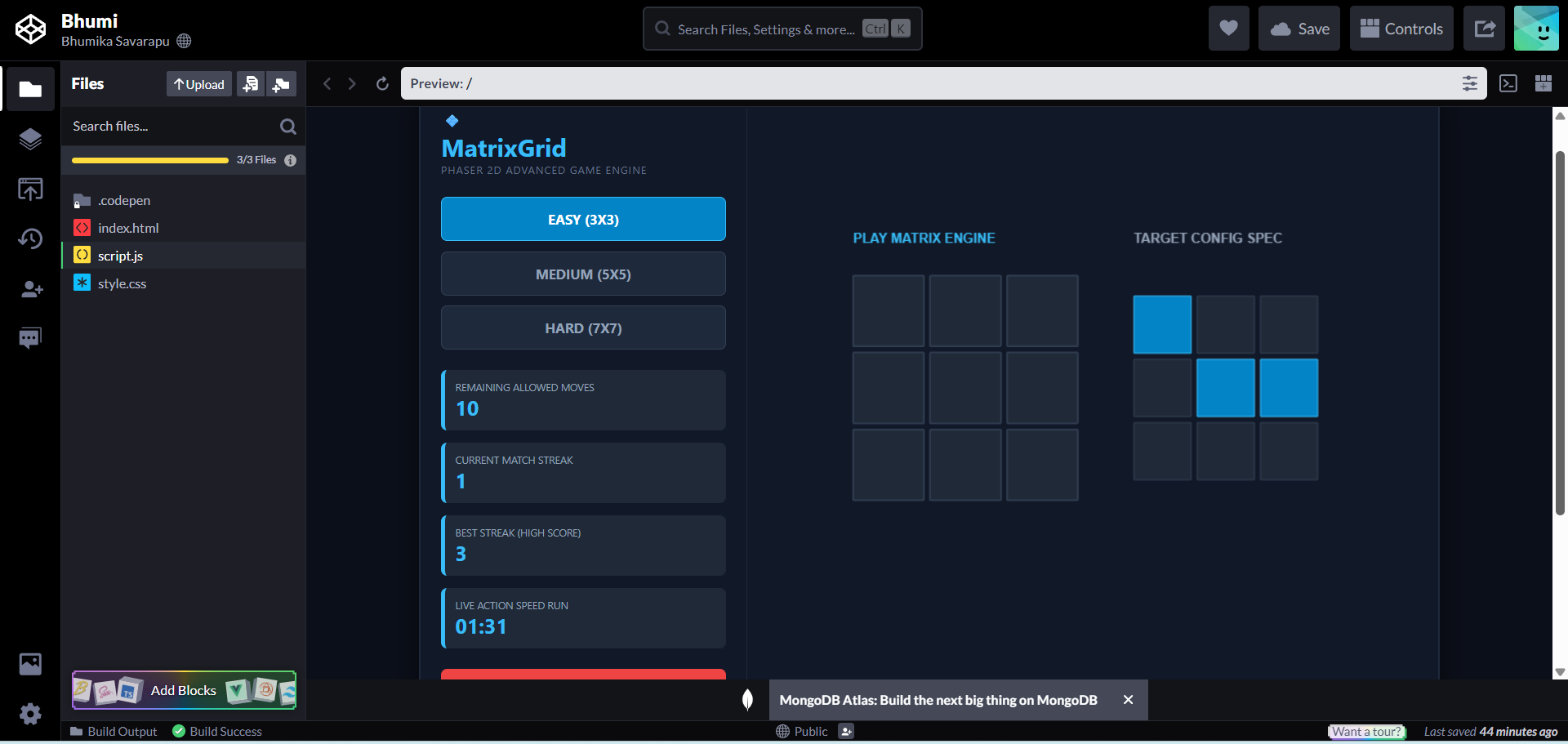
MatrixGrid challenges players to match a customizable user-controlled grid (the "Play Matrix") to a randomly generated reference grid (the "Target Config Spec").
- Players toggle the states and colors of blocks by clicking them.
- Every interaction subtracts from the Remaining Allowed Moves.
- It features dynamic difficulty levels: Easy (3x3), Medium (5x5), and Hard (7x7).
- It includes a live-action speed run timer, dynamic win/lose overlay modules, an algorithmic sound synthesizer, and a persistent high score streak tracker using browser storage.
🛠️ How we built it
- Game Engine: Built using the Phaser 3 framework to handle canvas rendering, input interactions, and state updates.
- Frontend UI: Structured with clean HTML5 and styled with a glowing responsive cyber-neon dark theme using CSS3.
- Audio Architecture: Implemented via the native browser Web Audio API to procedurally synthesize custom interactive audio clips (button clicks, win chimes, game-over buzzes) using raw oscillator code, entirely bypassing external asset latency.
🧠 Challenges we ran into
One of our biggest hurdles was calculating dynamic block scaling and coordinates uniformly for varying dimensions ($3 \times 3$ up to $7 \times 7$) inside a fixed canvas region ($500 \times 480$).
To solve this responsively without hardcoding positions, we implemented an exact algebraic bounding box distribution formula:
$$BoxSize = \frac{AreaWidth - (Padding \times (GridSize - 1))}{GridSize}$$
Another challenge was preventing edge-case instances where the randomized target grid accidentally generated identical to the player's initial starting empty state. We mitigated this by writing a strict JSON pre-validation deep check before launching the level graphics.
🏅 Accomplishments that we're proud of
- Delivering a fully functional, complete gameplay loop with robust win/lose states and multiple difficulty structures.
- Crafting a completely asset-free sound effects system running entirely on continuous web oscillators.
- Creating a modern, distraction-free UI that loads instantaneously.
📚 What we learned
We gained hands-on experience handling multi-dimensional array comparisons in JavaScript, linking HTML DOM interface states smoothly with a separate web canvas engine like Phaser, and implementing local state permanence across browser sessions via localStorage.
🔮 What's next for MatrixGrid
- Introducing specialized tile types like "locked blocks" or multi-state color shifts to increase puzzle complexity.
- Adding responsive canvas particle burst animations when rows or entire grids match successfully.
- Connecting a cloud-hosted leaderboard API to allow real-time global player competition.
Built With
- css3
- html5
- javascript
- phaser.js
- webaudioapi


Log in or sign up for Devpost to join the conversation.