Inspiration
North Carolina gets hit hard by weather every year, floods, hurricanes, storms that turn a normal drive into a real hazard. Nationally, weather-related crashes cause over 5,700 deaths a year on wet pavement alone, and 3,400+ during rainfall specifically (FHWA). Most drivers only think about weather in the moment, "is it raining right now," instead of before they ever leave the driveway. We wanted to build something that answers the real question people should be asking: which route, and when should I leave. That reframe, from a weather question to a travel-planning question, is where PIVOT started.
What it does
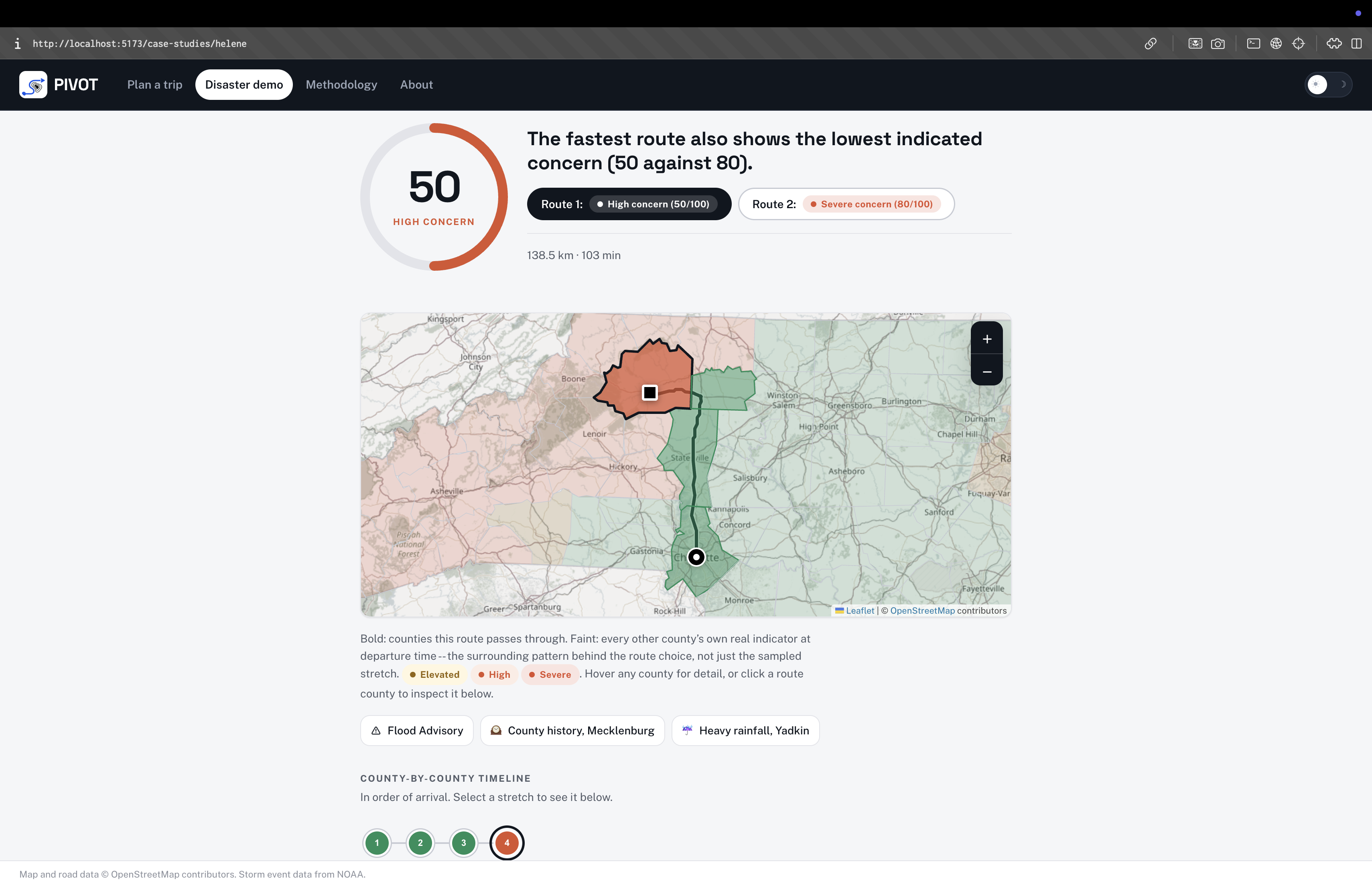
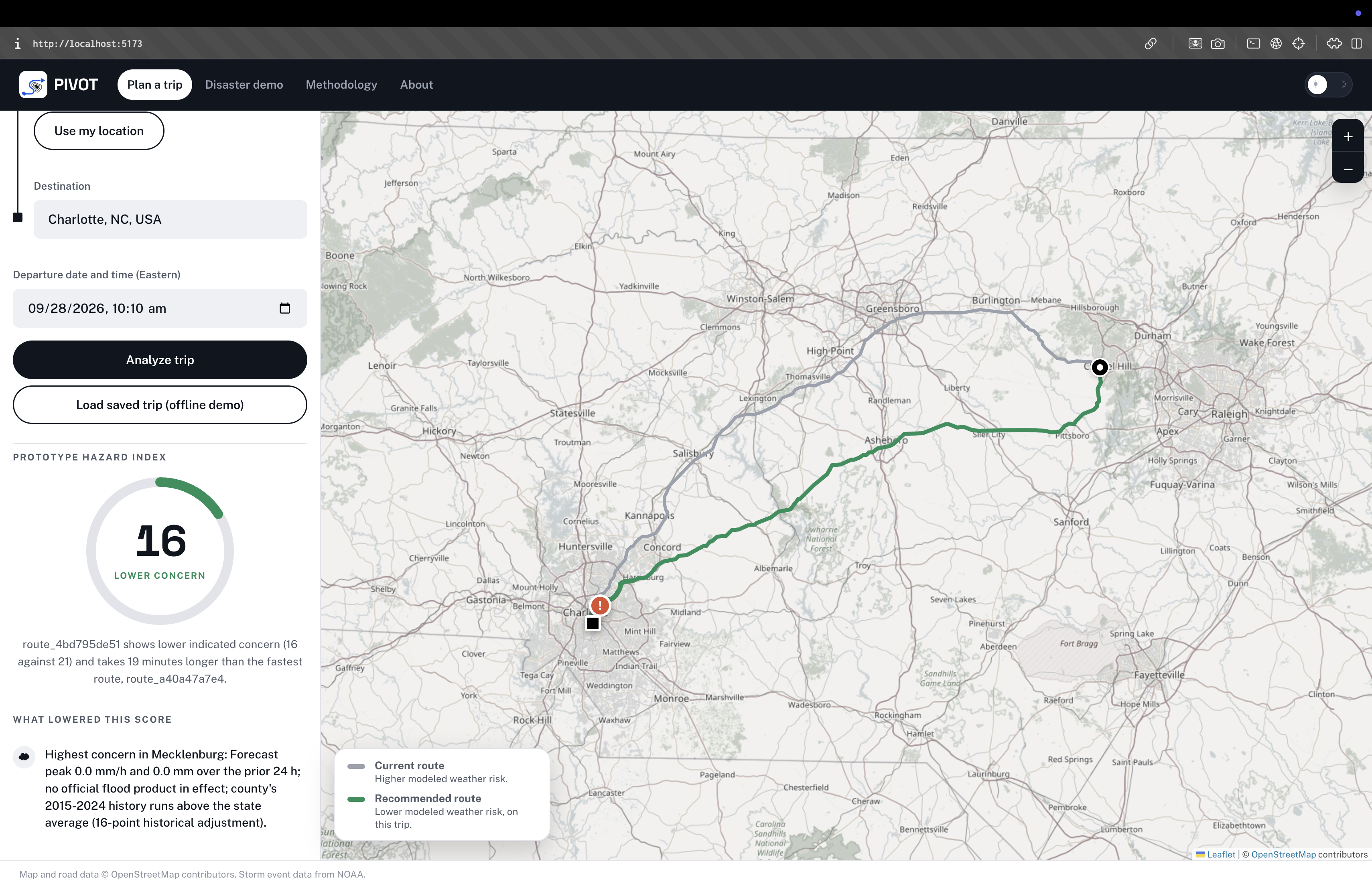
PIVOT is a website where you enter your origin, destination, and departure time anywhere in North Carolina, and it scores your route on a 0-100 weather-concern index. It pulls real routing (OSRM), real live forecasts (Open-Meteo), and real official NWS alerts, breaks your trip into county-by-county stretches, and shows you which segment carries the most risk and why. Official alerts always show above the score and can only raise it, never lower it. We also built a historical case study replaying Hurricane Helene (Sept 2024) so you can see exactly how the tool would have scored that real, devastating event county by county.
How we built it
We split the project across three roles so we could work in parallel without stepping on each other's code. Mason led the product direction, the scoring rule, and the EDA/data pipeline on the backend. Jeffrey handled the geospatial layer and the website itself, routing, county mapping, and the results screen. Cameron led evaluation, econ/stats review, and the responsible-AI framing that shaped our language and disclaimers. We used NOAA Storm Events data (2015-2024) as our historical ground truth, ERA5-Land for weather features, Census TIGER/Line for county geography, and OSRM plus the NWS API for live serving. Everything ran through Git with PRs and reviews so we could each build our piece and merge them into one working product.
Challenges we ran into
Figuring out the datasets to accompany the given ones was a real challenge, we had to go beyond the base data to find weather sources that actually had the variables we needed (early on we discovered Open-Meteo's ERA5-Land had no precipitation or wind data at all, which sent us back to source directly from Copernicus). We also spent a lot of time deliberating task workflows to optimize efficiency across the team, figuring out how to split geospatial, product, and evaluation work so nobody was blocked waiting on someone else, while still keeping everything reviewable and mergeable under a tight deadline.
Accomplishments that we're proud of
We're proud of building the actual risk calculation using the data we were given and turning it into a real, working product that runs end to end, from a user typing in a route, to real routing and weather data, to a live score on screen. Getting that full pipeline working live, not mocked, under deadline pressure was the accomplishment that made everything else feel real.
What we learned
We learned just how large weather-related car accidents actually are at scale, thousands of deaths a year nationally, which reframed this from a class project into something that felt genuinely worth building. We also learned a lot technically about optimizing workflow as a team using AI, how to split ownership cleanly, move fast without duplicating work, and use AI tools to accelerate our individual pieces while still keeping the codebase coherent as a team.
What's next for PIVOT
PIVOT can grow into something used for real social good, helping reduce weather-related accidents by giving drivers the information they need before they ever get on the road. Next steps include closing our EDA sign-off gate, replacing our current prototype rule with a properly trained and calibrated model, expanding beyond flood risk to winter and wind hazards, and eventually scaling coverage beyond North Carolina.
Built With
- chatgpt
- claude
- css
- dockerfile
- html
- javascript
- makerfile
- python
- react
- typescript

Log in or sign up for Devpost to join the conversation.