Inspiration
The inspiration for Pitt Point was to provide an all inclusive website and eventually app that allows a student to access a multitude of features in the same place with a single sign-on. We wanted to create something using the Gemini AI and were also interested in building an application for the University since we are students and have experience using the current apps given to us.
What it does
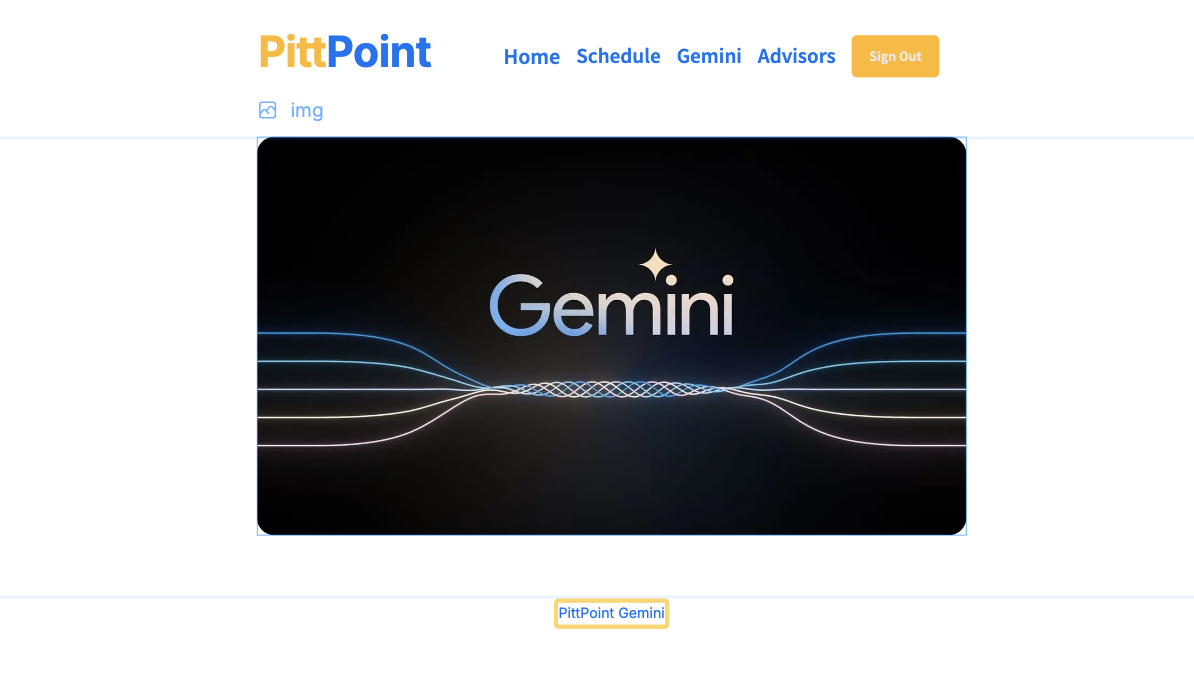
Our app provides users with a range of features to enhance their experience. After signing in through a secure authentication page, users are directed to the homepage, where they can navigate between five main tabs. These include a Schedule and Calendar tab for managing events, with plans to integrate Google's Gemini AI for enhanced functionality. The Gemini tab allows users to ask questions, and the AI provides responses based on a model trained with data from official University of Pittsburgh sources. Additionally, users can access an Advisor Directory to easily find and contact advisors, with plans to add a search function for more efficient navigation.
How we built it
Most of our web application was built using a program called Plasmic. We used Plasmic to create our HTML and CSS elements for the website. Plasmic utilizes visual coding in order to make web development simpler and faster. Due to our time crunch we decided to go with visual coding. We also utilized the Gemini API and Gemini training model in order to train a custom version of Gemini on a dataset of questions we formulated and answered using sources from Pitt. To host our site on the internet we utilized Plasmic's built in web hosting feature.
Challenges we ran into
A few challenges we ran into included time, web hosting, live collaboration, and learning technologies we were unfamiliar with. For the duration of the event we along with many others had a constant time constraint of 24 hours where we had to solve many problems in a short amount of time. For the problem of web hosting, we attempted to get our own domain name and run our server from there but were unable to figure out how to get our website from plasmic to the server. Live collaboration was also a big problem we had to find a workaround for. The initial program we attempted to use made it difficult to collaborate on our website live without constant pushes and pulls to the repository. Plasmic was a great solution to this problem because it allows everyone to work on the website and see changes as they happen live. Finally, during this hackathon we spent many hours learning new languages and frameworks via tutorial videos and reading documentation.
Accomplishments that we're proud of
- A major accomplishment we are proud of is fine tuning our own AI model using Google Gemini.
- Another accomplishment we are proud of overall is completing our very first hackathon. We realized very early on that this was not going to be an easy task and we worked very hard the entire time to be able to have a presentable website.
- We're also proud of collaborating as a team in a software environment as many of us have never worked in a team environment creating an application.
What we learned
Throughout the entire process, we learned various things such as working on plasmic to format our website and insert Gemini API along with other tabs. Additionally, we learned the process of researching and cleaning our data to use in the project.
What's next for Pitt Point
In the future we hope to expand upon the website. This includes incorporating Gemini more thoroughly into the site, with the hyperlink being replaced by an actual interface. We would also like to work more on the design as a whole, cleaning it up and making it easier to navigate through.


Log in or sign up for Devpost to join the conversation.