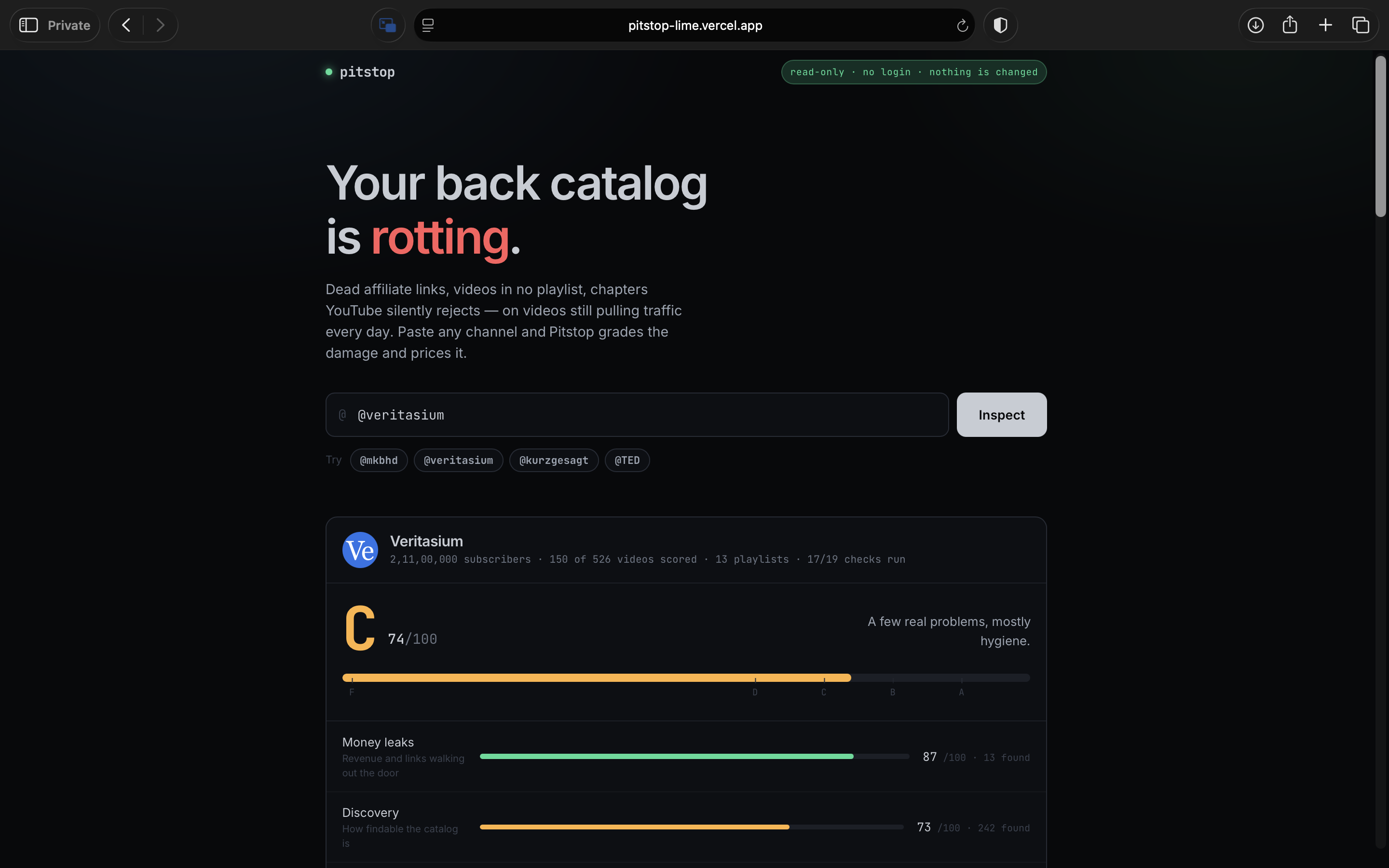
The tool exists for a video nobody's opened in two years
A creator four years in has 200 videos. Video #47 still pulls 400 views a day — YouTube keeps recommending it. It also has a dead affiliate link, sits in no playlist, has no chapters, and carries a title written for a trend that ended two years ago. Multiply by 200.
Every optimization tool on the market — TubeBuddy, VidIQ — points at the video you're about to upload: better titles, better thumbnails, better tags for next time. Nobody looks backward. The back catalog just sits there, quietly leaking watch time and revenue, because auditing 200 videos by hand in YouTube Studio is a week of clicking nobody has.
Pitstop is the tool that looks backward. Paste a channel, no login, and it scans the entire public catalog, scores what it finds, and ranks the findings by what they're actually costing you.
Real scans, on real channels, right now
https://pitstop-lime.vercel.app
Paste any public channel — this isn't a demo dataset:
| Channel | Health Score | Scope |
|---|---|---|
| MKBHD | 78 (C) | 150 of 1,841 videos, 23 playlists |
| Veritasium | 74 (C) | 150 of 526 videos, 13 playlists |
| Kurzgesagt | 79 (C) | 150 of 377 videos |
| TED | 86 (B) | 150 of 5,768 videos, 60 playlists |
Every one of those numbers is on-screen in under 25 seconds, from a cold start, on a channel we don't own.
Read-only, public, no OAuth — that's the entire design decision
Public YouTube data (titles, descriptions, view counts, playlists) needs nothing but an API key. So the public web page audits, and requires no login at all — anyone, including a judge, can try it on their own channel or anyone else's in the time it takes to paste a URL.
The CLI repairs — and repairs genuinely need OAuth, because you're mutating a channel you own. That split is deliberate: the free, zero-friction layer is the one that proves the tool is real; the authenticated layer is the one that does the work.
pitstop scan @yourchannel
pitstop connect          # guided OAuth, only when you're ready to fix things
What it checks
19 checks across four categories: dead and expiring affiliate/sponsor links, orphaned videos with no playlist, missing chapters, stale metadata, thumbnail issues, SEO gaps. Every finding is priced — the interface shows what it's costing you, not just that something's wrong.
Honest about what it didn't do
The web page has a dedicated "What this scan did not do" section, not a footnote:
- Partial catalog, stated as a number. "Scored the 150 most recent videos of 1,841" — never implies full coverage when it wasn't.
- Playlist checks past 60 switch themselves off rather than silently reporting videos as playlist-less when the scan simply never reached that far.
- Link resolution is bounded and disclosed — "resolved 399 of 1,016 unique links", checked highest-traffic-first so the budget spends on what matters, and an unreached link is reported as unknown, never as dead.
- 2 of 19 checks need channel ownership (tags, broken playlist items) — YouTube only returns those to the owning account, and the scan says so rather than pretending they ran.
Built to be scriptable, not just clickable
pitstop scan @yourchannel --json -
--json now accepts - for stdout, so it pipes cleanly: pitstop scan @x --json - | jq. Human-readable output routes to stderr so the two never collide.
223 tests
pytest — 223 tests, 19 of them added for the public scanner specifically: that a link the quota budget never reached is never reported dead, that truncation always surfaces as a stated limit rather than silent coverage, that an API key can never leak into a returned error message, and that the deployed public-scan path has no import-graph route to the OAuth writer at all — asserted by importing it in a clean interpreter and checking what actually loaded.
The bug the public launch found
Building the public endpoint surfaced something real: the Google API client embeds the full request URL — including the API key — inside its own error objects, and that string was on its way back to anonymous callers by default. Found it, fixed it with a redact() function that every exception-derived message now passes through, and wrote a regression test so it can't come back quietly.
I'm stating this because a tool whose whole pitch is "audit what's actually wrong" should hold itself to the same standard.
Where it came from
Built for the original YouTube Automation Hackathon, which went dark mid-event and reappeared as this one. All prior work — the CLI, the 19 checks, the 204 original tests — predates this weekend, and I'm saying so plainly rather than letting a judge assume otherwise. What's new this weekend is the public web scanner: the read-only endpoint, the honest-limits UI, the redaction fix, and 19 new tests. That's the part built for Social Media Automation specifically.
Honest limits
- Structure and cost, not truth — it can tell you a link is unreachable, not what should replace it.
- Public scans are bounded by quota; a full audit of a very large channel needs the CLI's owner-authenticated path.
- English-language findings only; no localization yet.
Built With
- fastapi
- pytest
- python
- vercel
- youtube-data-api

Log in or sign up for Devpost to join the conversation.