-
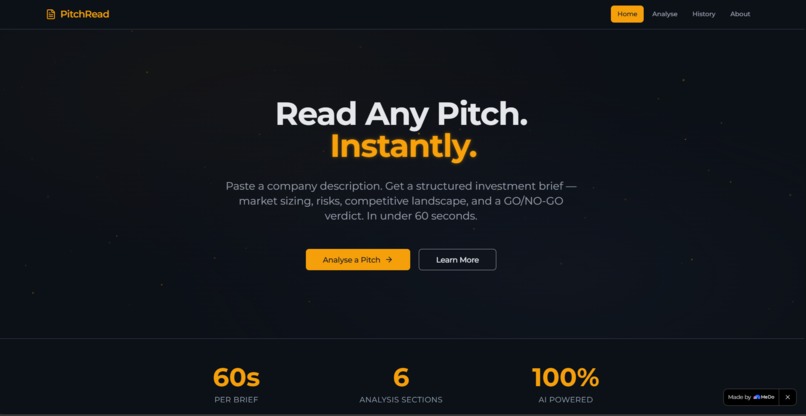
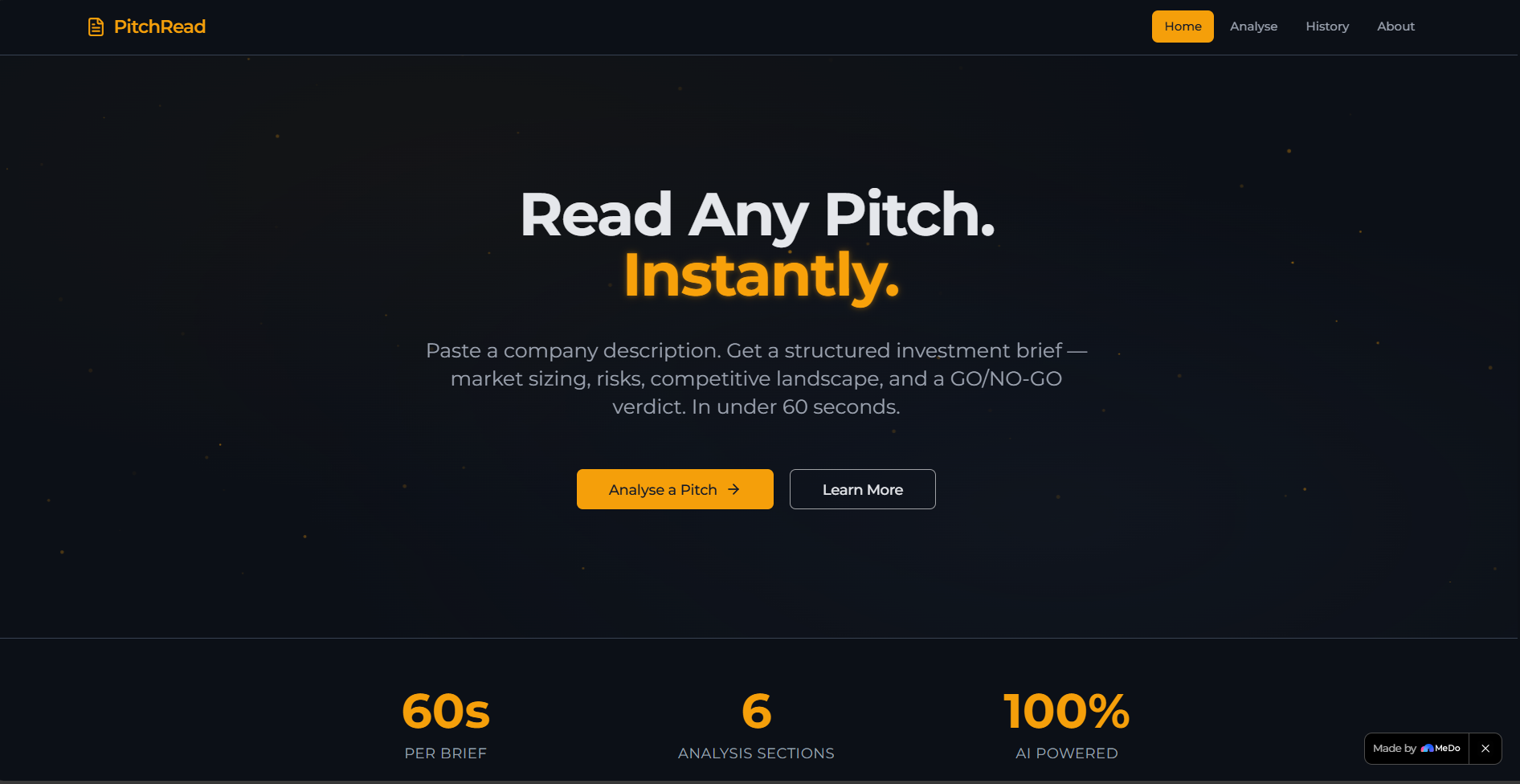
Landing Page
-
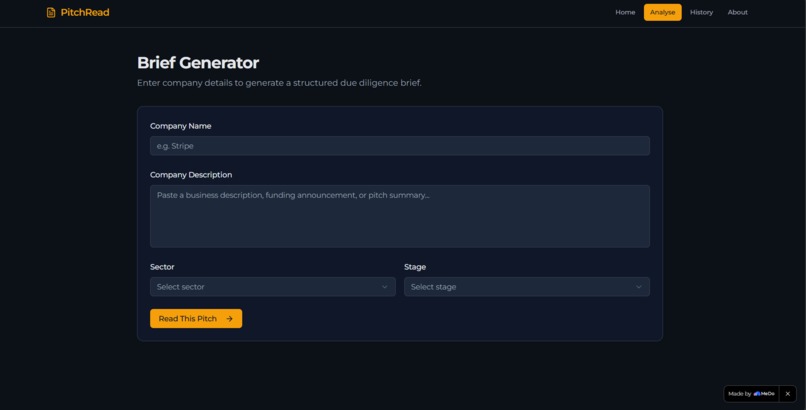
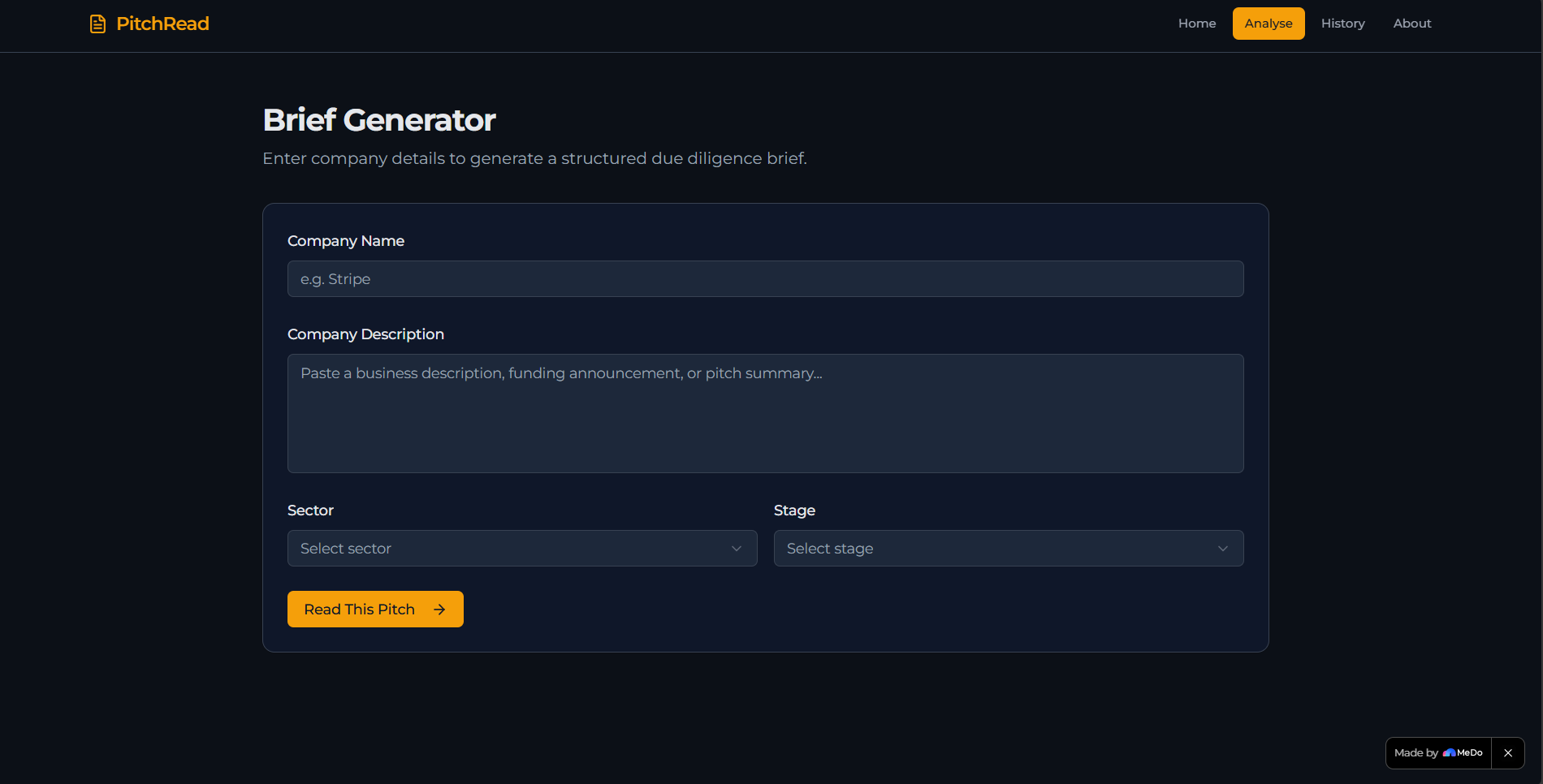
Analyze
-
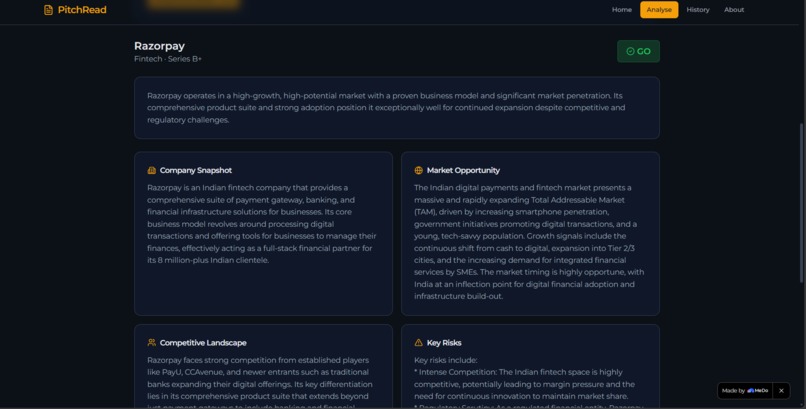
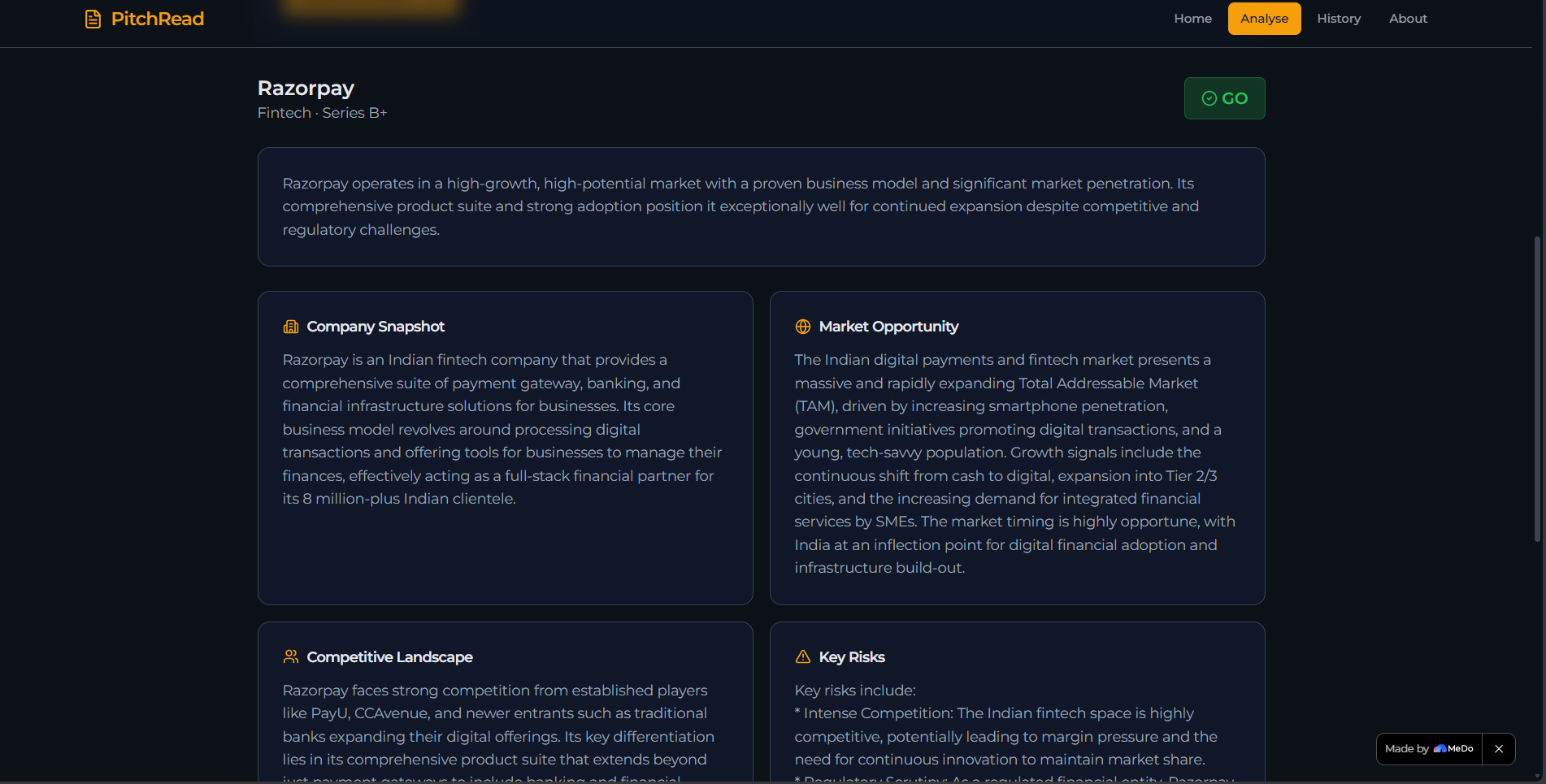
Output 1
-
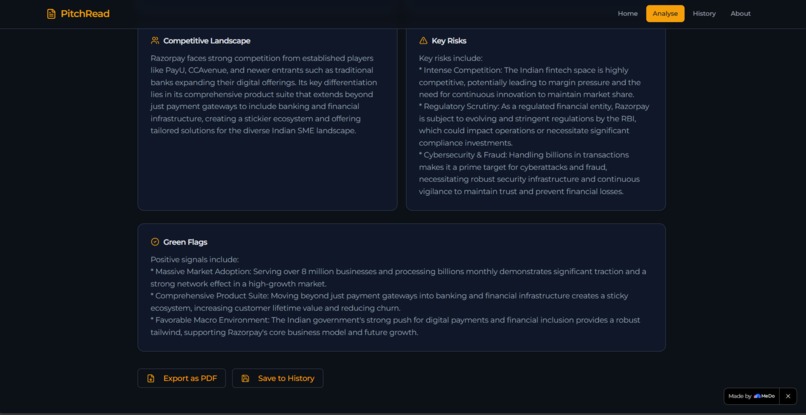
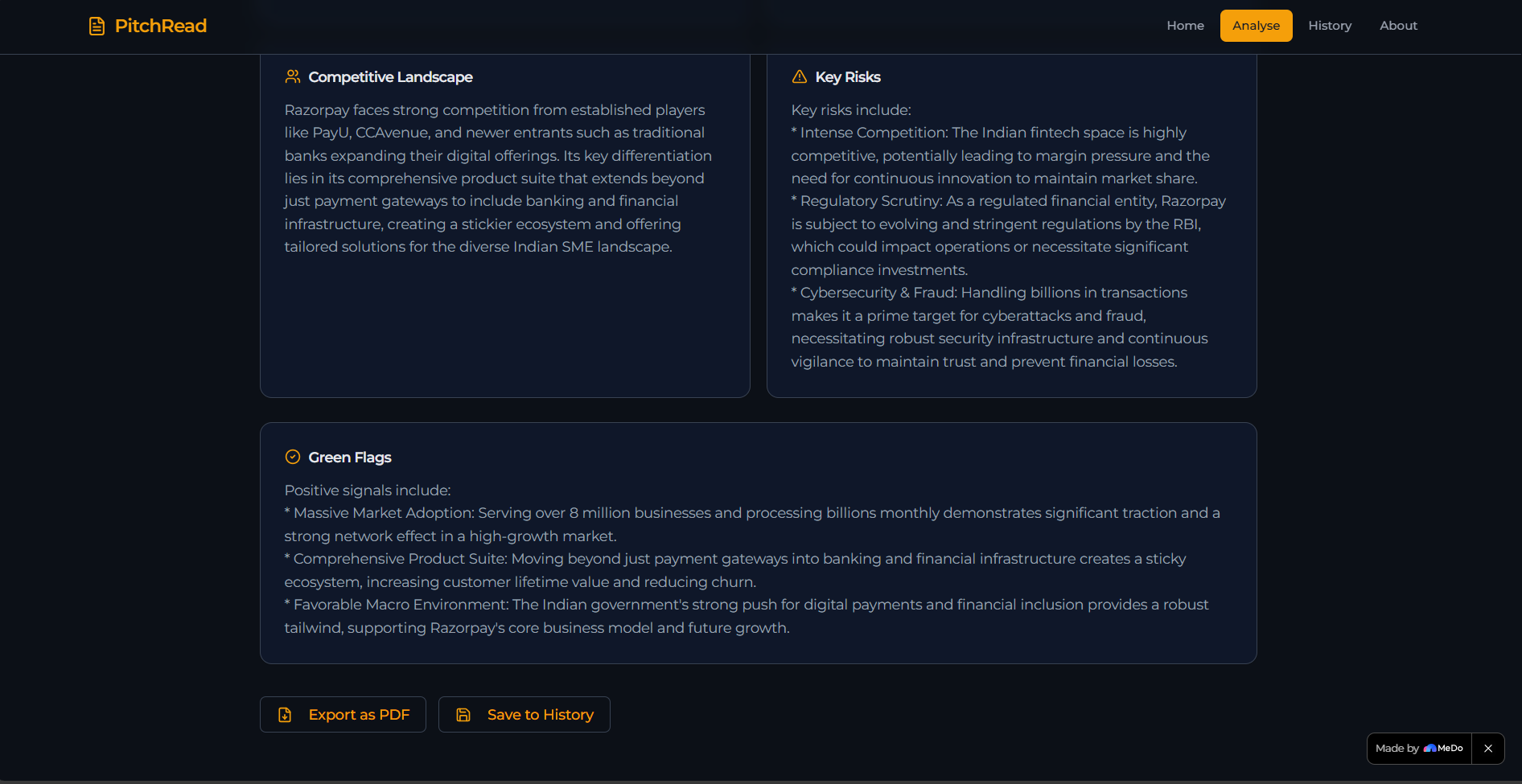
Output 2
-
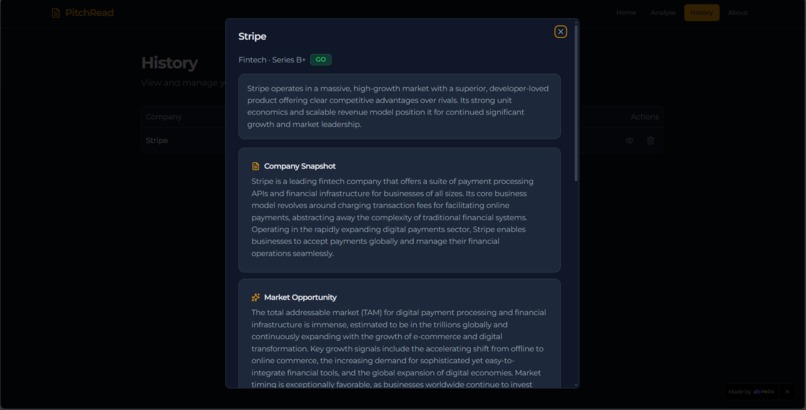
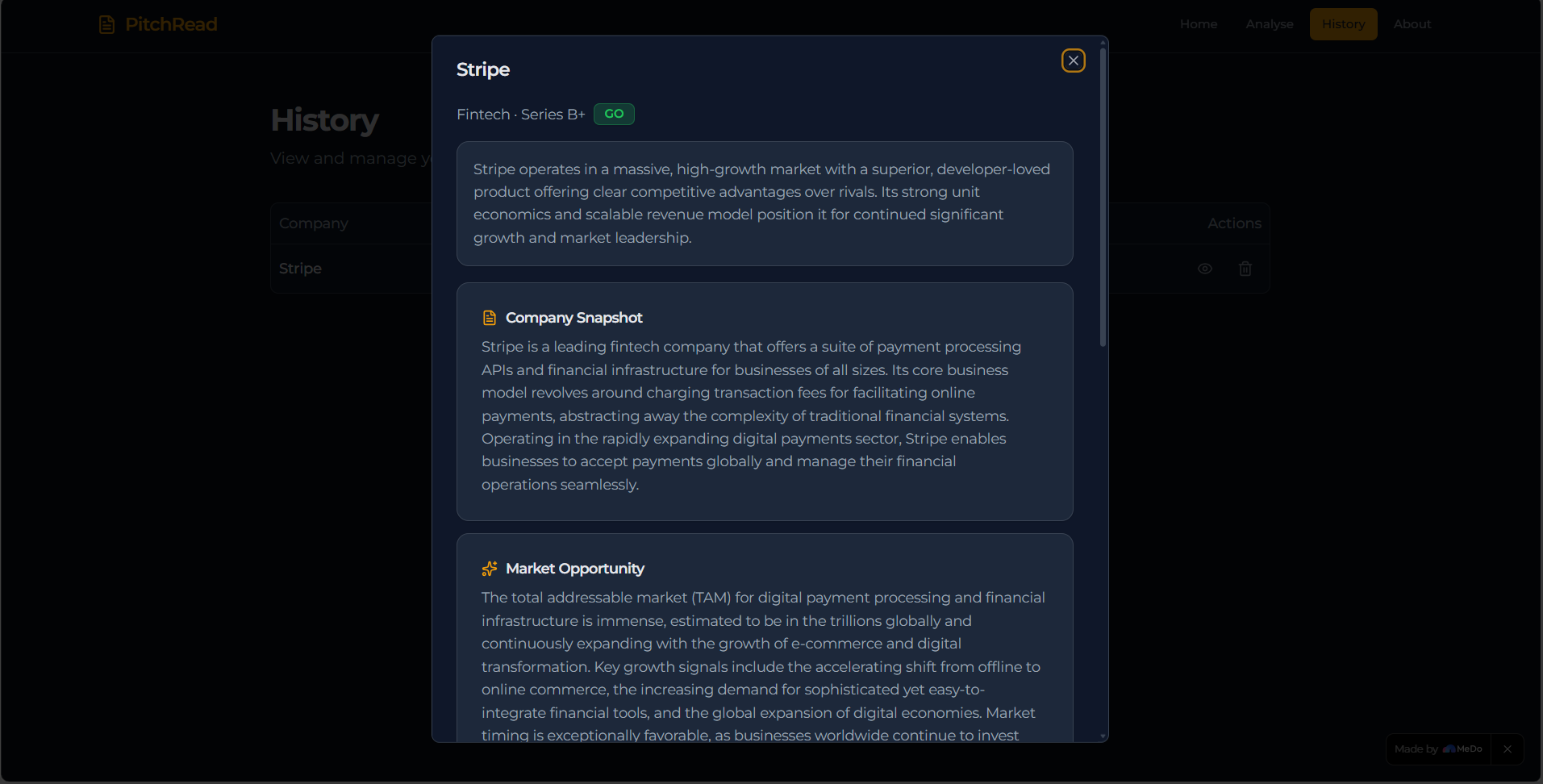
History
-
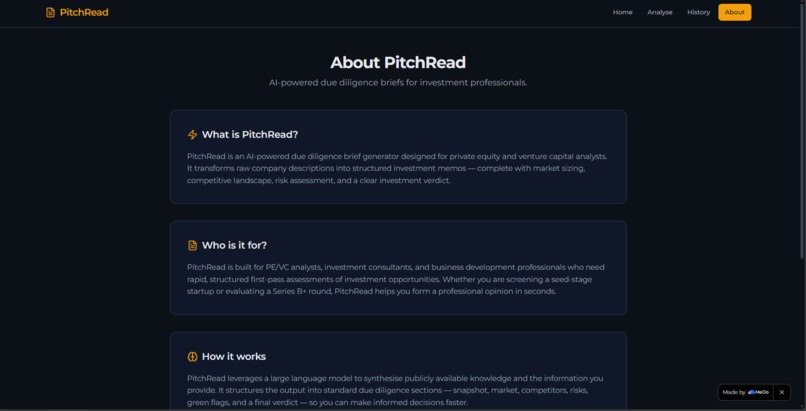
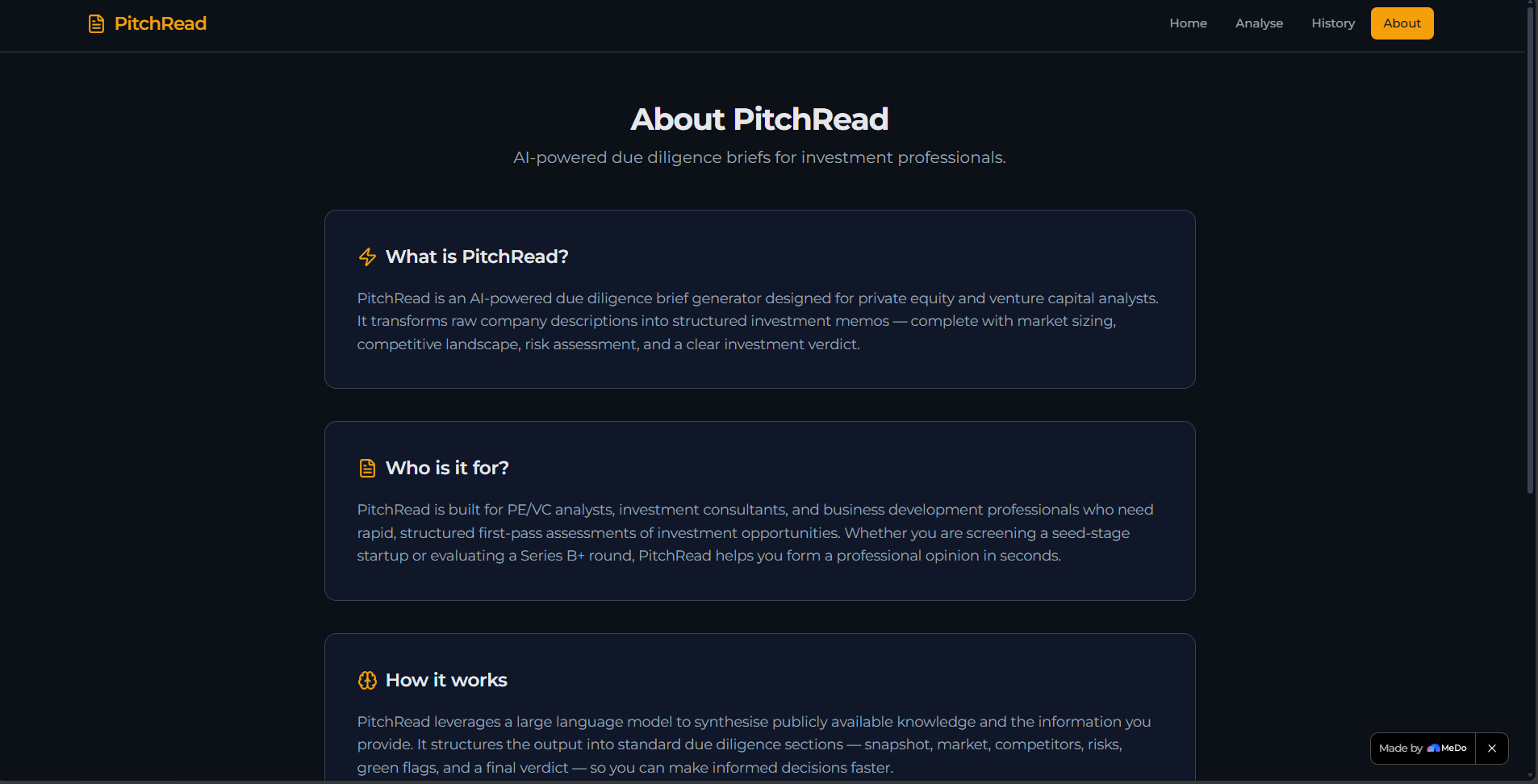
About the App
The Problem That Costs Analysts Their Mornings
A PE analyst receives 40+ pitch decks a month. Before any real analysis happens, someone has to write the same document: company snapshot, market sizing, competitive landscape, risks, green flags. Every single time. For companies that get cut in the first meeting.
That is 3-4 hours of structured formatting. Not thinking. Not judgment. Formatting.
At consulting firms, this is what junior analysts spend their first week on. Every week.
PitchRead eliminates that entirely.
The Insight
The first-pass due diligence brief has a fixed structure. It always has. Six sections, same order, same logic. The only variable is the company being analysed.
If the structure never changes, the generation should be instant.
A senior analyst's value is in the judgment call, the GO or NO-GO. Not the template. PitchRead handles the template so analysts can focus on the call.
What PitchRead Does
Paste any company description. Select sector and stage. Hit Read This Pitch.
In under 60 seconds you get:
| Section | What It Covers |
|---|---|
| Company Snapshot | Business model, sector, how they make money |
| Market Opportunity | TAM estimate, growth signals, timing |
| Competitive Landscape | Key rivals, moat, differentiation |
| Key Risks | Operational, financial, regulatory |
| Green Flags | Strongest positive signals |
| Analyst Verdict | GO / CONDITIONAL GO / NO-GO with rationale |
Every brief exports as PDF and saves to your history. Zero hours of formatting.
The Build
Built entirely on MeDo with no manual coding. What MeDo generated under the hood:
- AI Backend — Edge Function with MeDo's native AI plugin, structured JSON prompting returning all 6 brief sections in approximately 2-3 seconds
- Database — Supabase briefs table with real-time read/write, full history with retrieve and delete operations
- Frontend — Dark professional UI with particle background, scroll-triggered animations, hover effects, and full mobile responsiveness
- PDF Export — jsPDF with professional formatting, company name, date, and verdict prominently displayed
The entire stack, frontend, backend, database, and deployment, was generated from a single detailed prompt. Zero lines of manual code written.
The Hard Parts
Structured output consistency was the core challenge. Getting the AI to return clean, parseable JSON across different inputs, a pre-seed EdTech startup versus a Series B+ fintech, without breaking the UI required careful prompt engineering. The six keys (snapshot, market, competitors, risks, green_flags, verdict, rationale) had to be enforced strictly or the cards would fail to render.
Edge Function deployment hit an error on first launch. The AI backend was attempting to call an external API key rather than MeDo's injected plugin credentials. Once rewired natively, response times dropped to 2-3 seconds per brief.
Verdict calibration required tuning so the verdict reflects genuine signal weight. Strong green flags with weak risks produces GO. Significant structural concerns produce NO-GO. Tested across 10+ real companies to validate consistency.
What I Learned
MeDo does not just scaffold UI. It thinks about the full product, error states, empty states, loading indicators, form validation, and mobile responsiveness, without being explicitly instructed. The output is closer to a senior engineer's first draft than a template.
The gap between no-code and production-ready is smaller than expected. The gap between production-ready and actually useful is entirely about the problem you choose to solve.
Choosing a real, specific, high-stakes problem and knowing that domain made every prompt sharper.
What's Next for PitchRead
- User authentication for personal brief history tied to accounts
- Confidence scoring with a numerical signal alongside the verdict, calculated as:
$$\text{Score} = \frac{w_1 \cdot \text{GreenFlags} - w_2 \cdot \text{Risks}}{w_1 + w_2} \times 100$$
- Batch processing to upload a CSV of companies and generate multiple briefs in one run
- Live data integration to ground AI analysis in current market signals and recent news
- Team workspaces with shared history, commenting, and flagging
Built with MeDo. Deployed in hours. Solving a problem that costs the industry thousands of analyst-hours every week.
Built With
- css
- html
- javascript
- jspdf
- medo
- supabase

Log in or sign up for Devpost to join the conversation.