Devpost Submission Text — PitchPulse
Inspiration
Most cricket dashboards stop at "who scored the most runs." Real front offices need harder answers: who's quietly being overworked before an injury shows up, who actually performs when a match is on the line, and whether a match outcome can be honestly predicted at all — or whether that honesty itself is the insight. PitchPulse was built to answer those questions using 19 seasons of real IPL history.
What it does
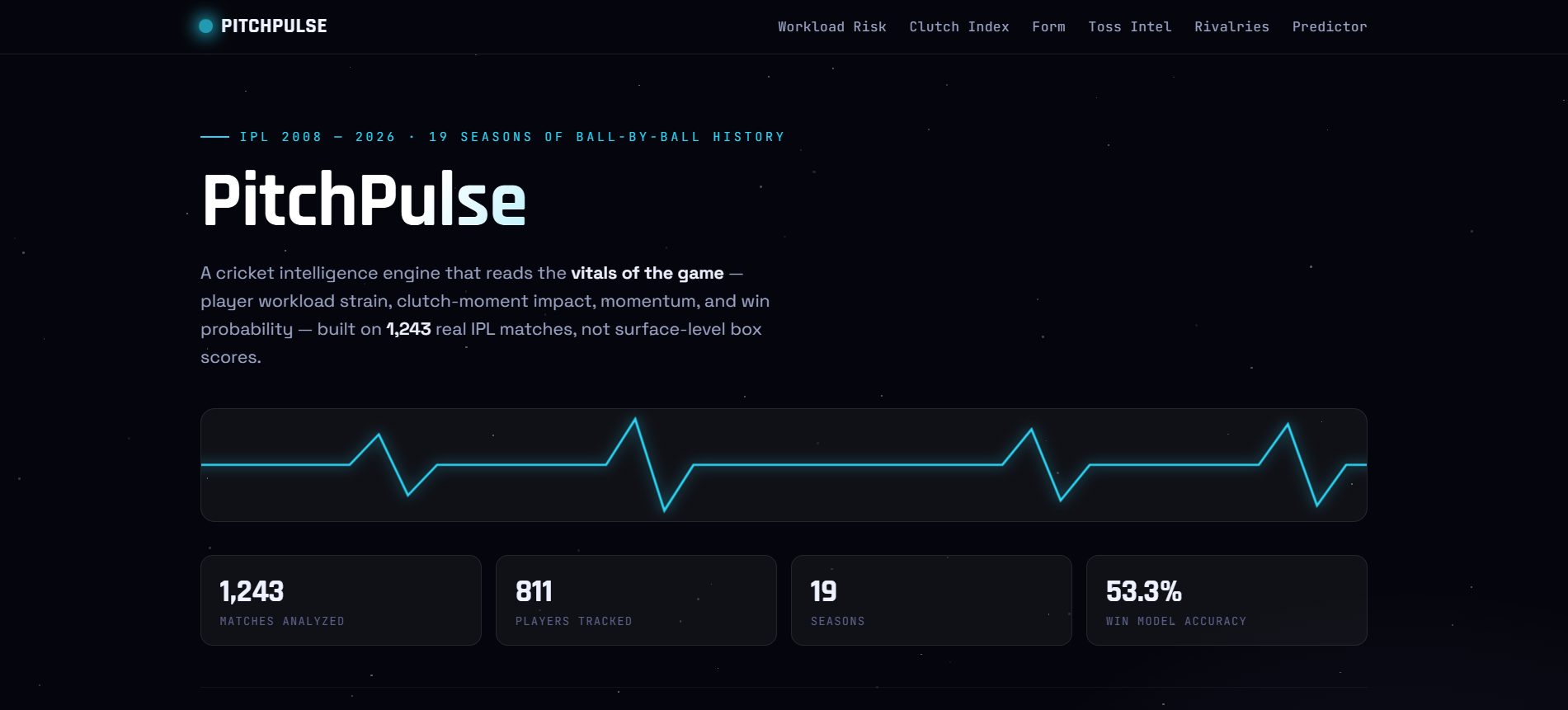
PitchPulse is a cricket intelligence dashboard built on 1,243 IPL matches (2008–2026, 800+ players):
- Workload & Fatigue Risk Index — flags players whose recent schedule has been densest in short-rest turnarounds, using a rest-gap-weighted strain score (0–100), not just raw match count.
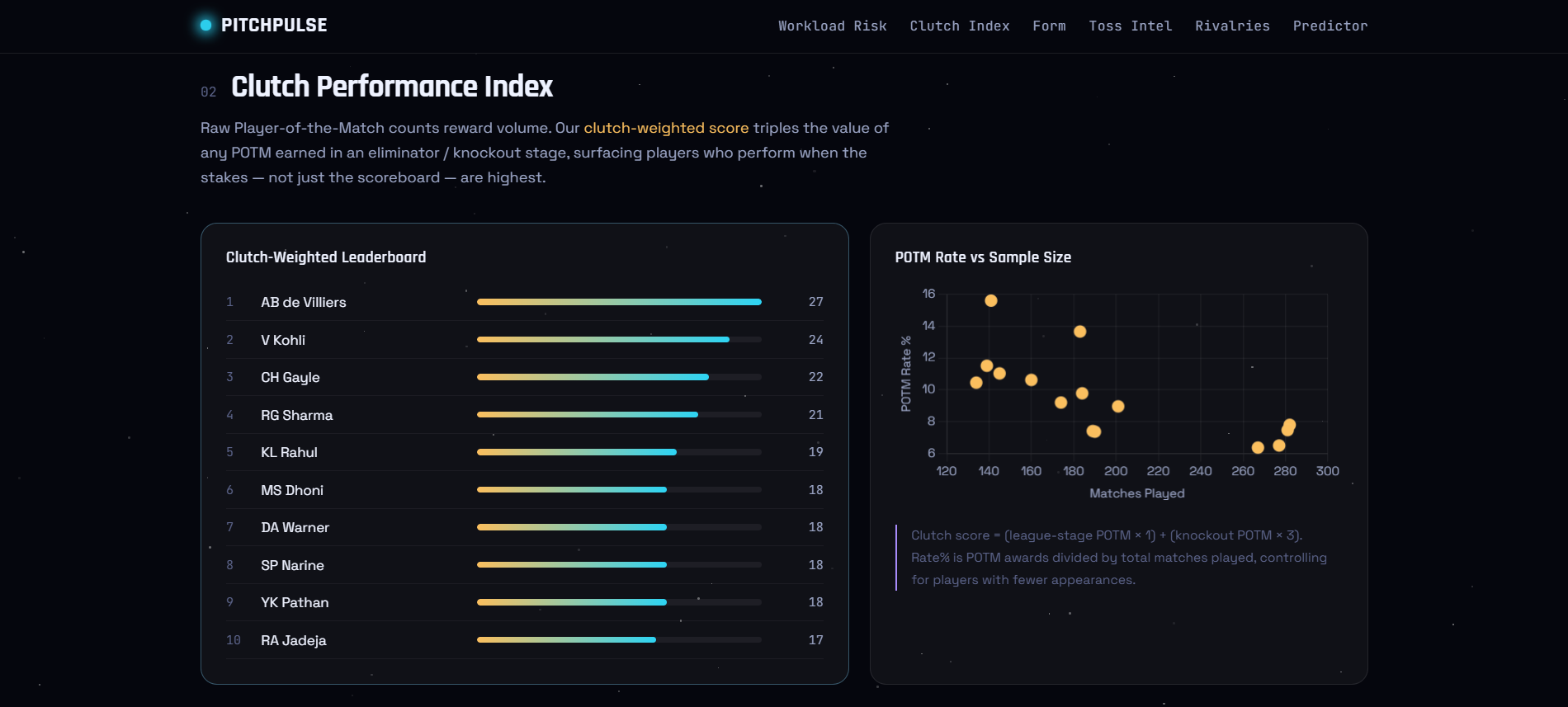
- Clutch Performance Index — weights Player-of-the-Match awards 3× when earned in an eliminator/knockout, surfacing genuine big-match performers.
- Form Trajectory — 15-match rolling POTM rate tracing momentum across a career.
- Toss & Venue Intelligence — bat/field-first win rates sliced per venue rather than blindly averaged.
- Team Rivalries — all-time head-to-head records.
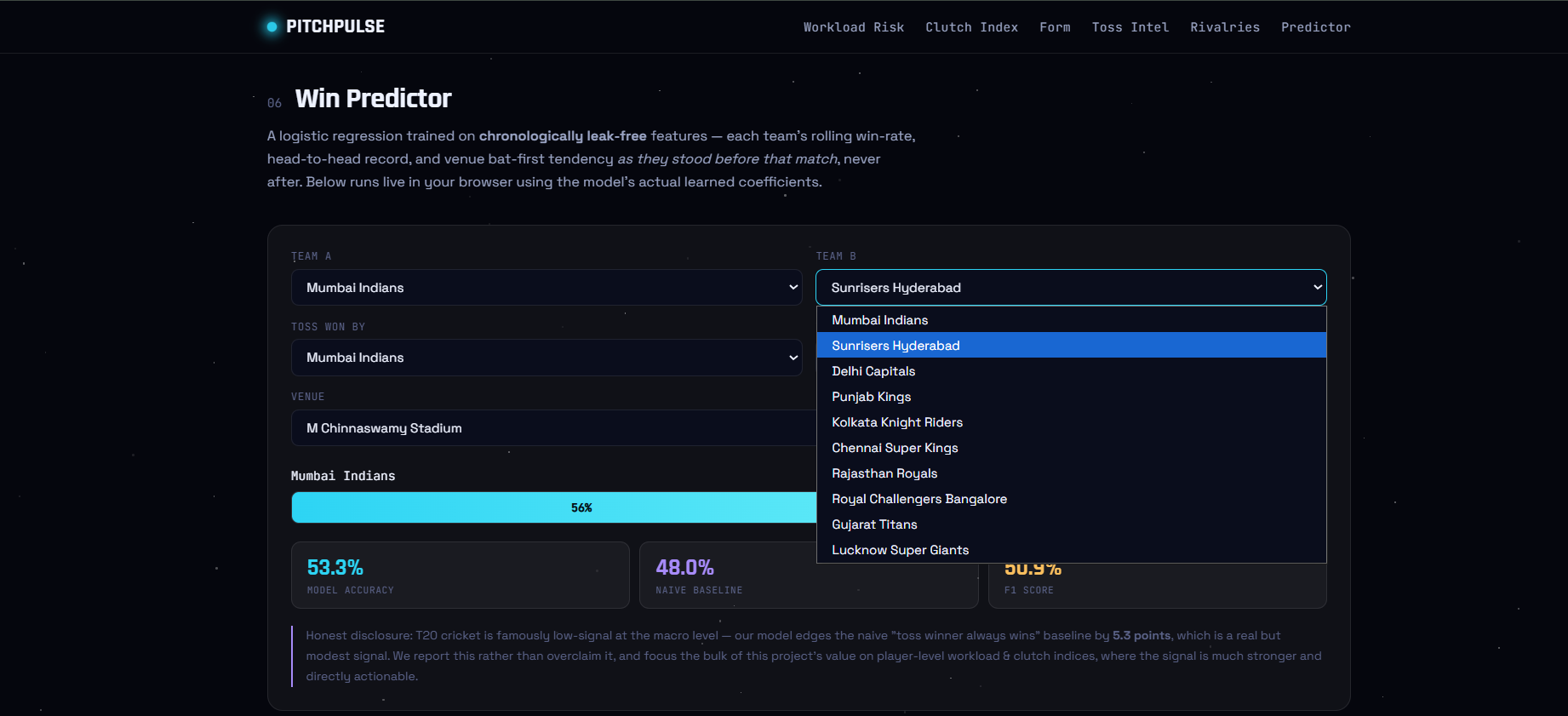
- Win Predictor — a Logistic Regression + Random Forest model trained on chronologically leak-free rolling features, running live in-browser off the model's actual learned coefficients, honestly benchmarked against naive baselines.
How we built it
Python (pandas) for data cleaning and feature engineering, scikit-learn for the prediction models, and a dependency-light HTML/CSS/JS dashboard (Chart.js) so the entire prototype runs standalone in any browser with zero install. All computed insights are pre-baked into a single JSON payload consumed by the dashboard.
Challenges we ran into
The biggest challenge was avoiding data leakage in the win-predictor: naive approaches compute "historical" team strength using the full dataset, silently leaking future results into past predictions. We rebuilt every rolling feature (team win-rate, head-to-head, venue tendency) by walking matches strictly in chronological order and updating state only after using it for that row. After fixing leakage and adding venue-tendency features, our model moved from performing worse than naive baselines to beating them by ~5.3 accuracy points — a real result we report honestly rather than an inflated one.
Accomplishments that we're proud of
Building genuinely novel, actionable metrics (workload risk, clutch weighting) that don't exist in the raw data, and being disciplined enough to honestly report a modest ML edge instead of overclaiming — which we think is exactly the kind of statistical soundness this hackathon's judging criteria rewards.
What we learned
T20 cricket outcomes are famously high-variance at the macro level — pre-match features alone (team strength, toss, venue) top out around a 5-point edge over coin-flip-style baselines. The real signal in this dataset lives at the player level, not the match level, which is why we built four player-facing modules and one honestly-caveated match predictor.
What's next for PitchPulse
Incorporating ball-by-ball data for in-play win probability, extending the workload index with travel distance between venues, and generalizing the pipeline to other T20 leagues (BBL, PSL, The Hundred) using the same Cricsheet data format.


Log in or sign up for Devpost to join the conversation.