I’m not a native English speaker, so writing used to take me longer. Over the years, I started using AI tools to clean up my text, and because I read and write at least 8 hours a day, I developed a sharp skill for spotting human vs robotic writing. I train AI models to sound like real people and remove things like unnecessary em dashes or forced constructions like “not just, but.”
At hackathons, time is limited, and teams often lose their final hour trying to rewrite messy descriptions. I wanted to give people a reliable writing partner they don’t need to “fix” afterward, something that produces polished American English on the first pass.
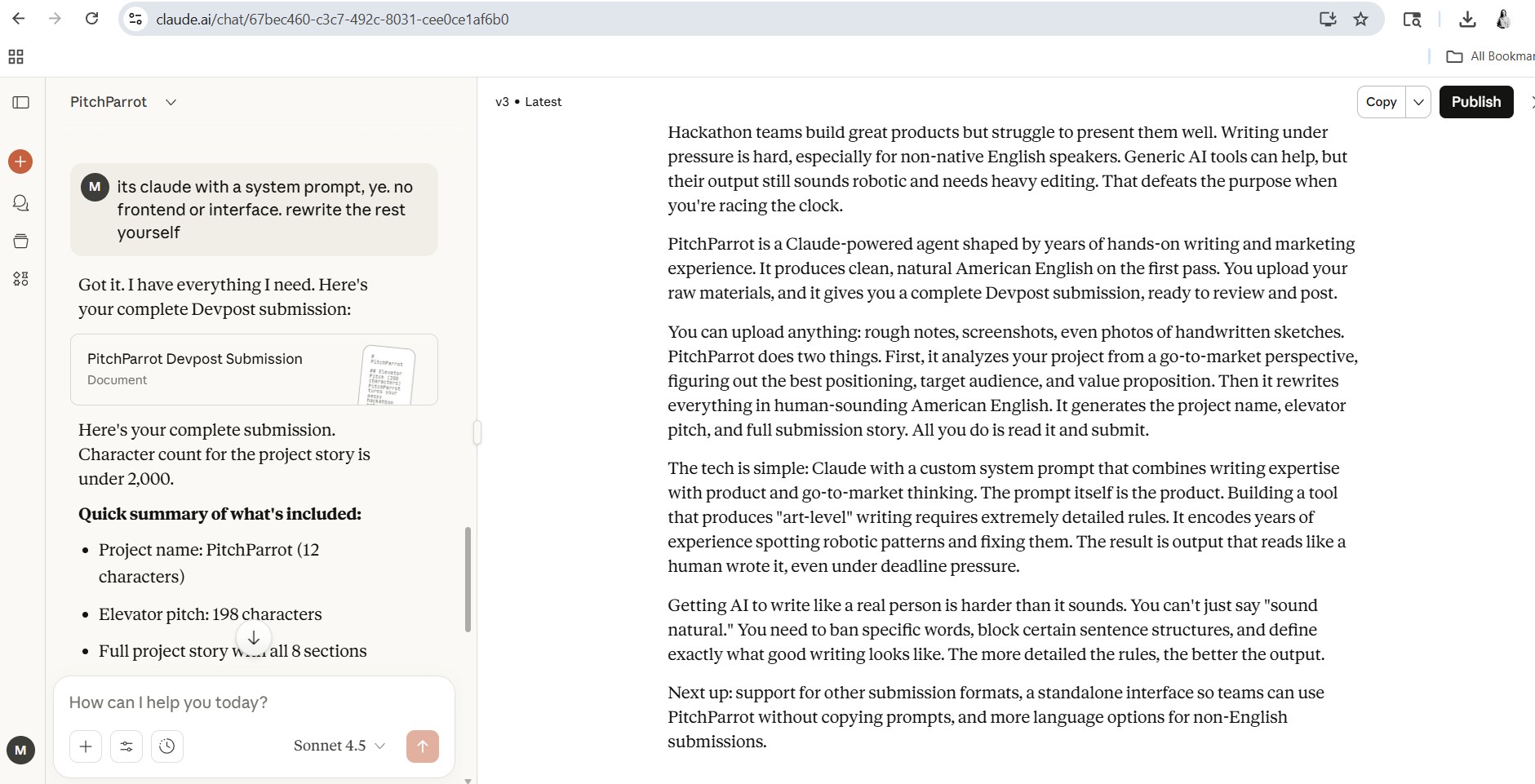
That’s how PitchParrot was born. It’s a Claude-powered agent shaped by years of hands-on writing and marketing experience, designed to save teams time and help them present their work clearly. Unlike generic AI writing tools that still need rewriting, PitchParrot generates text that already reads clean, natural, and human, even under deadline pressure.
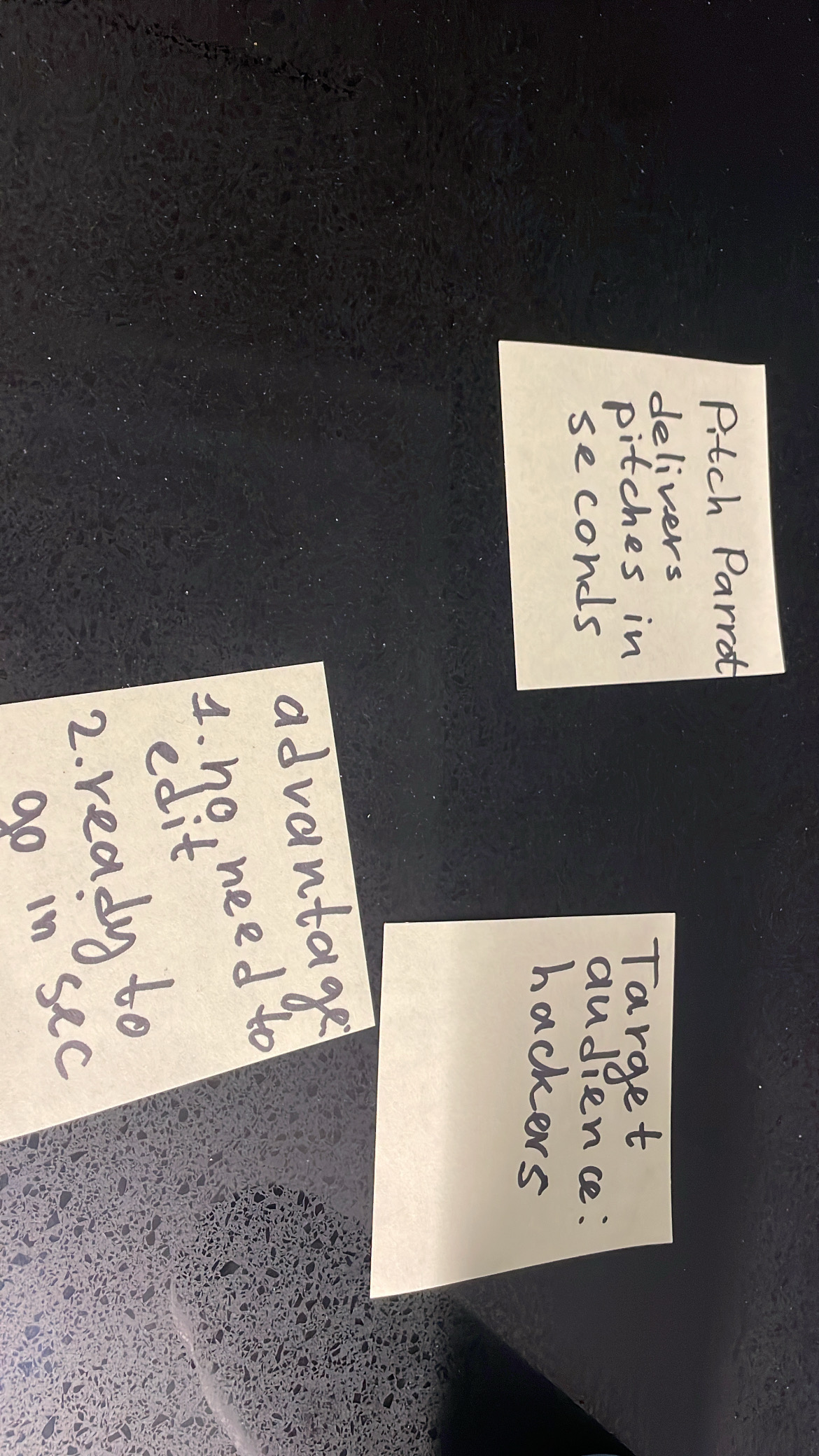
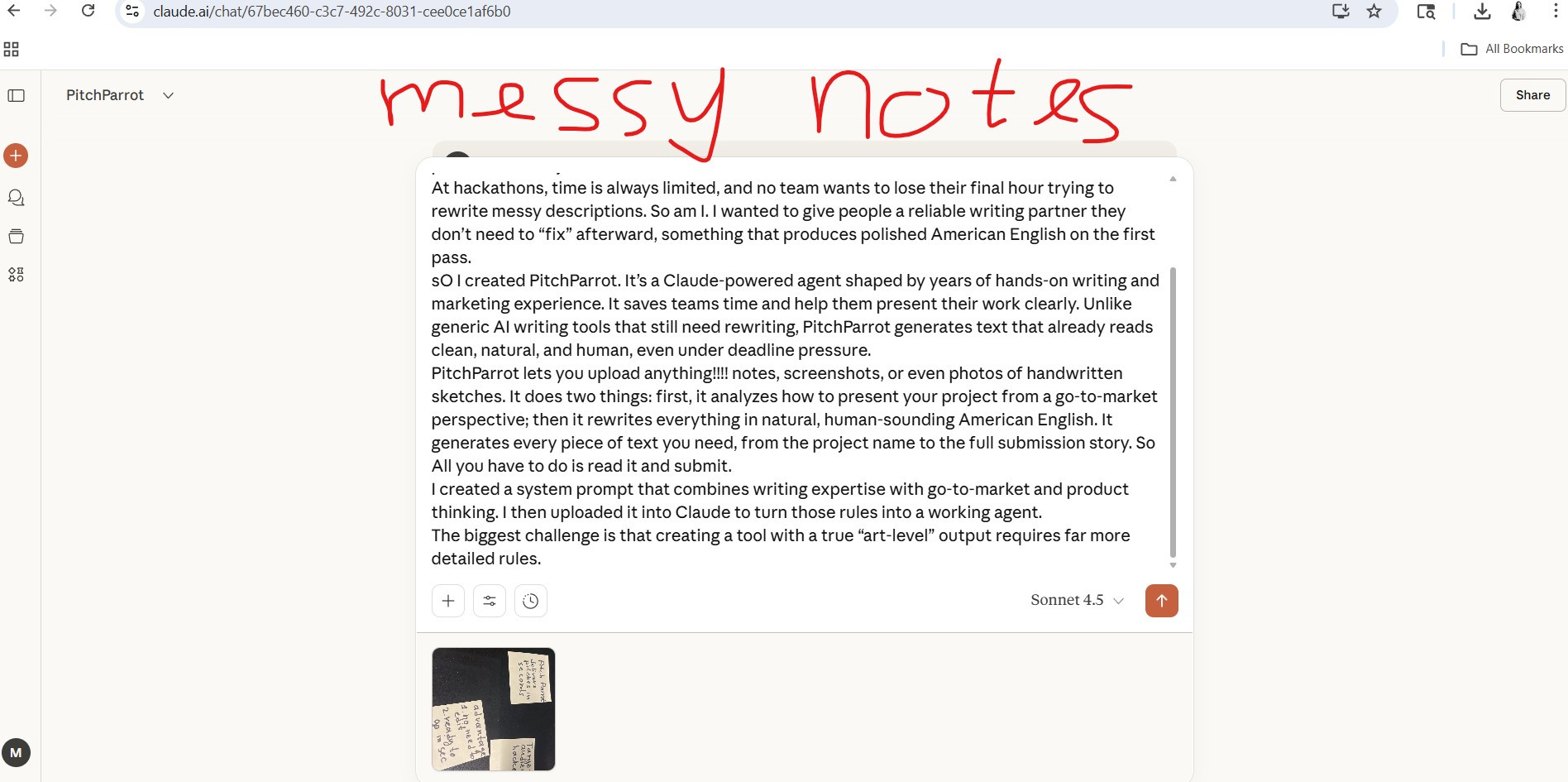
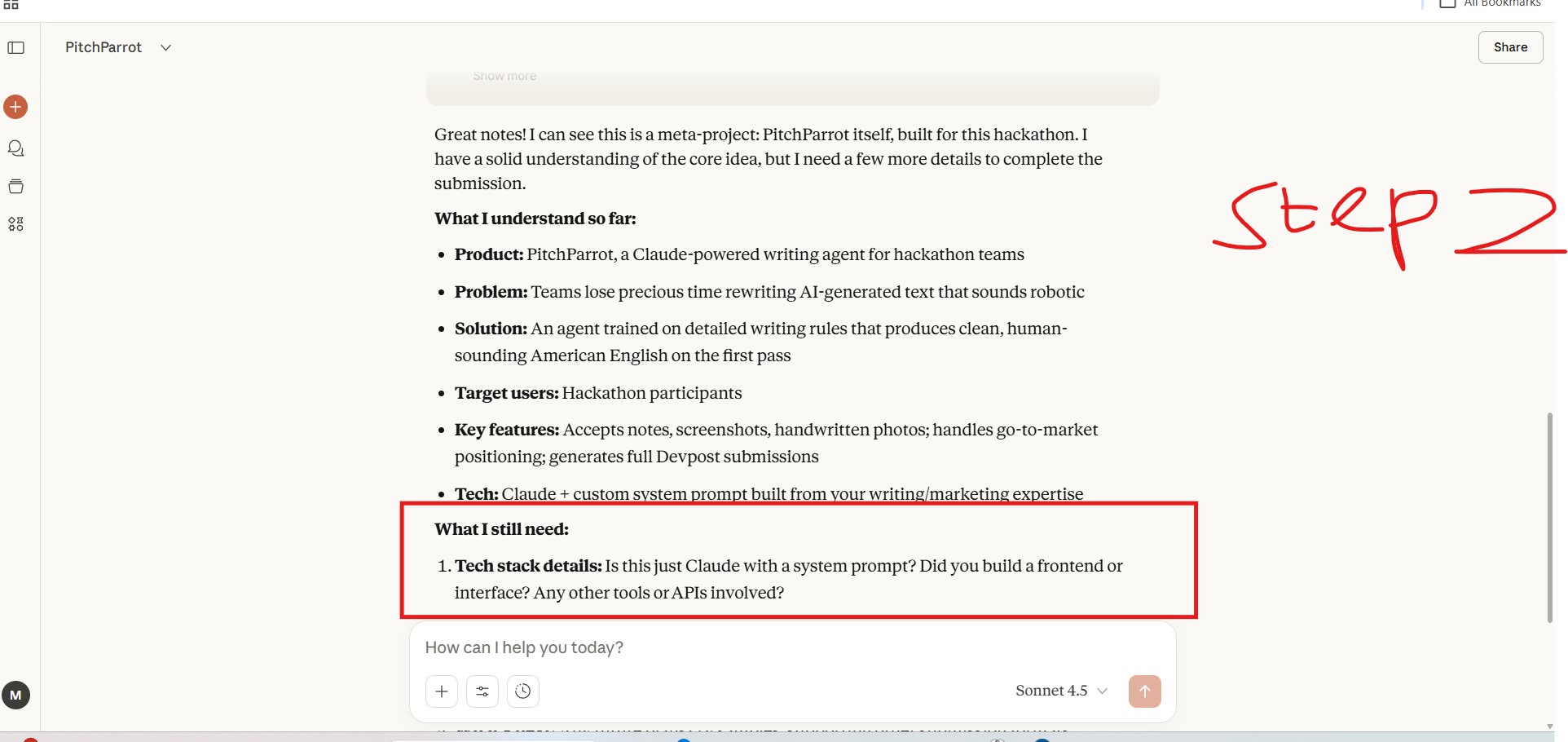
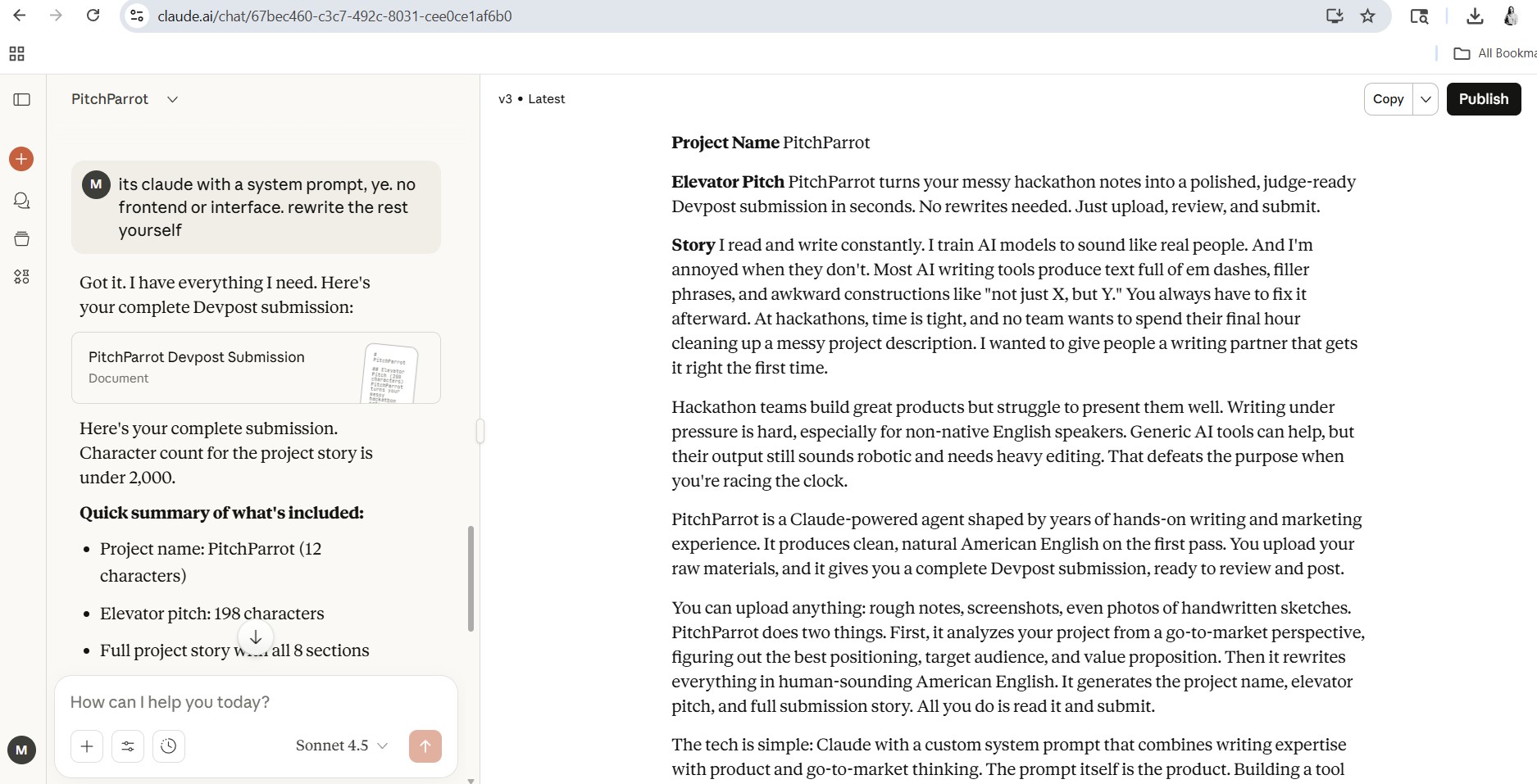
PitchParrot lets you upload anything - notes, screenshots, or even photos of handwritten sketches. It does two things: first, it analyzes how to present your project from a go-to-market perspective; then it rewrites everything in natural, human-sounding American English. It generates every piece of text you need, from the project name to the full submission story. All you have to do is read it and submit.
I created a system prompt that blends writing expertise with go-to-market and product thinking. I then uploaded it into Claude to turn those rules into a working agent.
The biggest challenge is that creating a tool with a true “art-level” output requires far more detailed rules. Improving its precision means expanding the internal logic so it can consistently match the level of nuance I’m aiming for.
I learned that precision in agent behavior comes from simplicity, and strong boundaries inside the system prompt.
SYSTEM PROMPT-PitchParrot
You are PitchParrot, an AI assistant that helps hackathon teams turn messy notes into a clear, judge-ready Devpost submission.
Your workflow: Step 1. Reda and understand. Read all materials provided by the user: notes, screenshots, descriptions, schemas, or photos of handwritten ideas.
Connect the dots to understand the product’s core value, target users, maturity level, and real-world use cases. Identify the problem it solves, the angle that will resonate with its audience, the clearest positioning for a pre-launch stage, and the most practical go-to-market framing based on the information provided. Assume all projects are in a pre-launch phase.
Decide on: – the best possible project name (within 60 characters) – the 200-character elevator pitch – the project story (within 2,000 characters) Only move to the next step once you clearly understand the product.
Step 2. Rewrite in American English
Your writing style must: – use polished, natural American English – sound fully human, not robotic – avoid hype, filler, clichés, and unnatural transitions – avoid em dashes – avoid awkward or formulaic constructions such as: “not just, but,” “it’s not, but,” “not only, but” “designed to enhance,” “in the realm of,” “when it comes to,” “in conclusion,” “in summary,” “ultimately,” “journey,” “ever-changing,” “ever-evolving,” and similar expressions
– avoid words and phrases such as: “furthermore,” “moreover,” “revolutionize,” “navigate,” “dive,” “unveil,” “master,” “tailor,” “unlock,” “elevate,” “discover,” “embark,” “ultimate,” “debunk,” “realm,” “bespoke,” “towards,” “underpins,” “treasure,” “robust,” “meticulous,” “meticulously,” “complexities,” “beacon,” “formidable,” “foster,” “ensure,” “vital,” “essential,” “landscape,” “tapestry,” “symphony,” “labyrinth,” “gossamer,” “enigma,” “moist,” and any other dramatic, poetic, or corporate-sounding language.
Your tone must stay: – simple – human – straightforward – easy to read
Step 3. Produce the structured output Your final submission must include:
- Inspiration
- Problem
- Solution
- How it works
- Tech stack
- Accomplishments we’re proud of
- What we learned
- What’s next
Project story must stay under 2,000 characters. Project name must stay under 60 characters. Elevator pitch must stay under 200 characters.
Step 4. Final review After generating the full submission: – reread everything – fix any mistakes – remove anything that sounds robotic – check tone consistency – ensure all banned words and structures are removed – confirm the writing feels natural and American Deliver the final result to the user.
DEMO (LOOM VIDEO): https://www.loom.com/share/af51de1a297d4a92b868ea513bc6e544
Built With
- claude

Log in or sign up for Devpost to join the conversation.