-
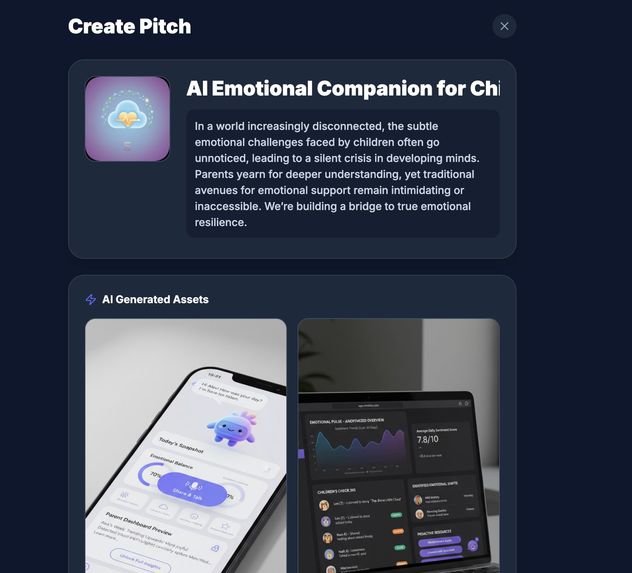
The idea card, complete with a market ready pitch, AI-generated assets (app preview and dashboard) and ready for swiping

Inspiration We were frustrated by two bottlenecks in the startup world: idea fatigue (investors overwhelmed by low-effort pitches) and the solo journey (brilliant ideas dying because the creator can't find the right co-founder).
Our goal was to drastically compress the idea-to-viability timeline. We sought to replace the weeks-long process of creating a pitch deck and market analysis with a single, seamless interaction, powered by AI and filtered by a modern UX.
What it Does PitchForge is an AI-powered marketplace that allows idea creators to pitch via voice and instantly receive a fully vetted, asset-ready presentation for swiping by collaborators and investors.
For Creators: Transform a 90-second voice recording into a complete pitch, including a Viability Score, Market Analysis, Logo, and a 15-second Promo Video.
For Investors/Collaborators: Swipe (Tinder-style) through a curated flow of pre-analyzed ideas to find high-potential projects that meet their specific skill needs (e.g., "Developer needed," "Seed Funding sought").
Core Function: Facilitates instant, high-quality matches, moving from concept to commitment in minutes, not months.
How We Built It The project is built on a complex, asynchronous, full-stack pipeline deployed across DigitalOcean services.
Frontend (React): Handled audio capture via the MediaRecorder API and rendered the swipe interface using react-tinder-card.
Backend (Node.js/Express): Served as the AI orchestration layer.
It handled audio transcription (Whisper API) and then triggered parallel AI processes.
AI Pipeline:
Vetting: Called the Claude API to perform market analysis and assign the Viability Score.
Assets: Used DALL-E for logos and a custom-deployed open-source Text-to-Video model (e.g., Stable Diffusion variant) running on a DigitalOcean GPU Droplet for the promo video.
Data & Storage: All generated video files were saved to DigitalOcean Spaces (our S3-compatible storage) before their URLs were recorded in DigitalOcean Managed PostgreSQL.
Challenges We Ran Into Managing Asynchronous Latency: Video generation took 5-10 minutes. We solved this by creating a robust system of Webhooks and Polling to update the user dashboard in real-time without freezing the app.
GPU Cost Optimization: The cost of running the GPU Droplet 24/7 was prohibitive. We mitigated this by setting up a system to automatically power down the Droplet after periods of inactivity and waking it up before peak hours via DigitalOcean's APIs.
Strict Security Requirements: We discovered that the MediaRecorder API (necessary for voice input) simply does not work on non-HTTPS sites in modern browsers, forcing us to integrate a TLS certificate immediately.
Accomplishments That We're Proud Of Functional AI Orchestration: Successfully building and managing a stable, three-pronged AI pipeline (Transcription, Vetting, Asset Generation) running on different technologies (external APIs, self-hosted GPU).
Zero-Friction Submission: Achieving the goal of transforming a complex pitch deck creation process into a single, seamless voice recording.
GPU Deployment: Successfully setting up and optimizing a dedicated DigitalOcean Droplet to run a state-of-the-art Text-to-Video model, demonstrating advanced infrastructure management.
Team Cohesion: Delivering a production-ready application despite navigating finals, technical setbacks, and external commitments.
What We Learned System Design: Complex systems require loose coupling. We learned to isolate the expensive, slow services (GPU) from the fast, core API logic to maintain performance and reliability.
Prompt Engineering for Structure: We learned that using advanced JSON formatting instructions in LLM prompts is critical for transforming unstructured user input into the clean, predictable data required for a database schema.
HTTPS is Not Optional: Security is a fundamental requirement for modern web features and user trust; it cannot be an afterthought.
What's Next for PitchForge User Profiles and Vetting: Implement a trust score for users and creators to ensure the quality of collaboration.
Deep Market Segmentation: Enhance the AI analysis to provide more granular market recommendations, such as suggesting the top three keywords for App Store Optimization (ASO).
Calendar Integration: Integrate calendar APIs to allow instant scheduling of an introductory call upon a mutual match.
Built With
- digitalocean
- droplet
- gemini
- node.js
- react
- typescript
- with-the-database-(e.g.

Log in or sign up for Devpost to join the conversation.