Inspiration
The path of an early-stage entrepreneur is paved with generic advice. Founders often pitch their business ideas to friends or family who offer polite, uncritical encouragement, or they end up paying high consultancy fees to mentors just to hear basic strategic outlines. We wanted to build something that bridges this gap—an interactive tool that delivers brutal, unfiltered market reality checks wrapped in engaging humor, immediately followed by the actionable strategic medicine required to fix the flaws. The inspiration came from combining the theatrical, high-stakes pressure of a television venture capital panel with the structural guidance of a world-class startup incubator dashboard.
What it does
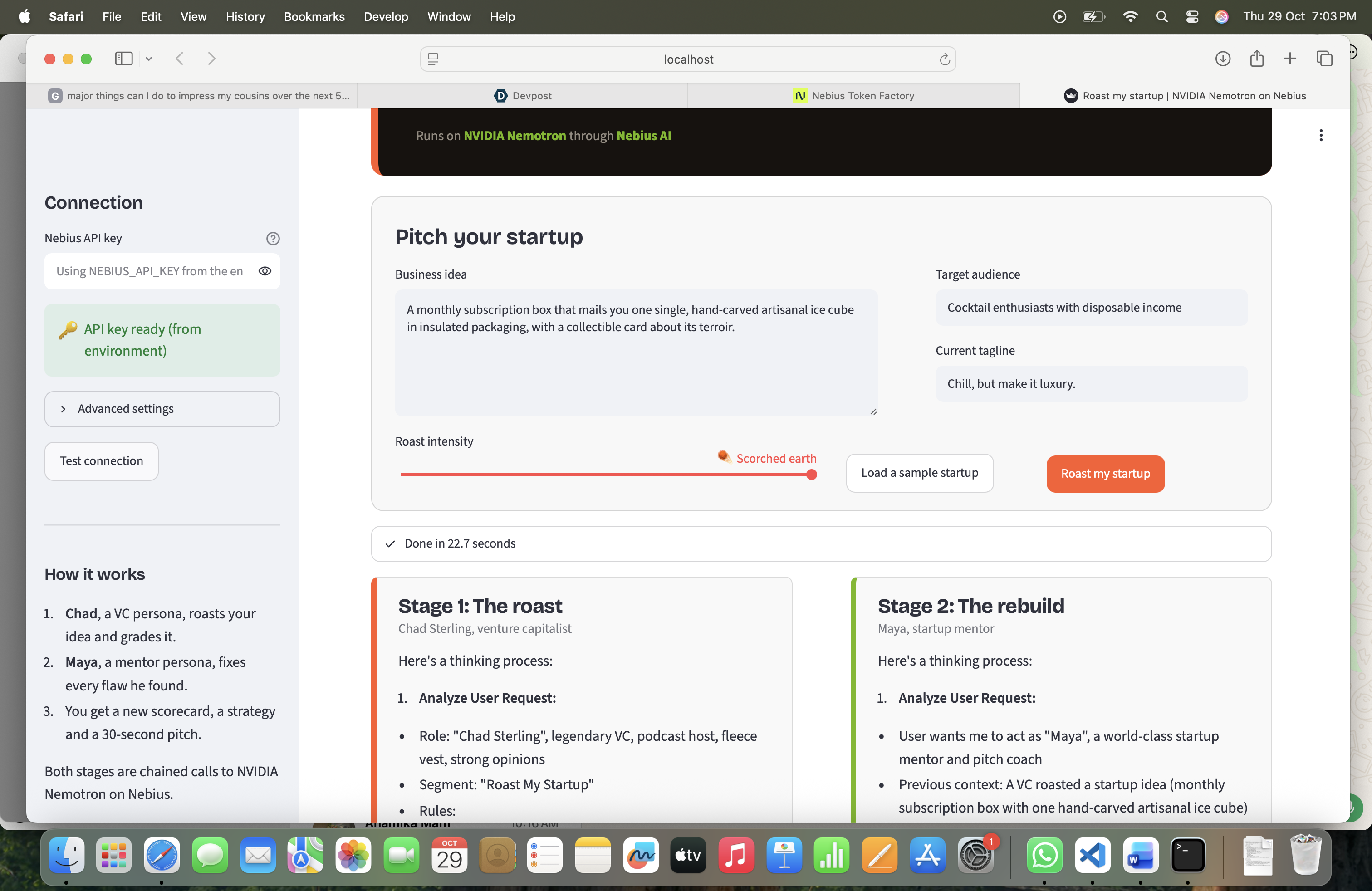
PitchBurner AI is a two-stage interactive startup optimization engine built using Streamlit and powered by the nvidia/Nemotron-3_5-Lightning model hosted on the Nebius AI infrastructure. The application bridges the gap between harsh reality and strategic growth for early-stage entrepreneurs. • Stage 1 (The VC Roast): The app triggers a custom persona, "Chad Sterling," a merciless Silicon Valley venture capitalist who uses advanced inference parameters to hilariously critique the user's business idea, market size, and tagline. • Stage 2 (Strategic Rebuild): The pipeline automatically captures Stage 1's text, feeds it directly into a supportive mentor persona named "Maya," who isolates the underlying valid business concerns, and transforms them into an actionable 90-day action plan and a spoken 30-second elevator pitch.
How we built it
PitchBurner AI was developed as a single-file web application engineered entirely in Python using the streamlit framework. The core system architecture relies on an advanced generative pipeline that chains two distinct inference iterations together:
- The Catalyst (Stage 1): The user inputs their startup core parameters. The application formats the payload and transmits it directly to the Nebius AI Cloud infrastructure, invoking the highly optimized text model nvidia/Nemotron-3_5-Lightning. The model adopts the persona of "Chad Sterling," a merciless Silicon Valley venture capitalist, who breaks down the concept, calculates an algorithmic viability assessment, and prints a structured Markdown critique.
- The Synthesis (Stage 2): Instead of forcing the user to process raw sarcasm, the application captures the string output of Stage 1, strips out the machine-readable scores, and pipes the payload back into a second inference loop. The model shifts weights to adopt the persona of "Maya," an expert pitch coach. Maya analyzes the transcript, extracts the valid target adjustments, and outputs a concrete 90-day execution framework alongside a 30-second spoken elevator pitch. The system uses standard openai SDK routing primitives to handle streaming completion chunks, providing a live typewriter layout directly inside the browser viewport. ## Challenges we ran into The primary challenge revolved around building a robust output parsing routine for live streaming strings. Because the model calculates evaluation arrays concurrently with text generation, we had to ensure our regular expressions could safely isolate the internal JSON metadata array: (\text{SCORE_LINE}=\text{[[SCORES]]}\times \left{\text{"viability"}:v,\text{"originality"}:o,\dots \right}) If the model half-typed the marker sequence at the absolute end of a network packet, early iterations would parse corrupted text frames or dump a raw stack trace onto the screen. We engineered an isolated caching layer that monitors trailing character sequences, buffering the token arrays until a valid JSON closure is validated. Additionally, adapting to changing catalog definitions down the wire required deep-diving into local terminal directory routing structures on macOS to properly hook our environment token strings into the dynamic serverless endpoints without triggering billing thresholds or dedicated memory container locks. ## Accomplishments that we're proud of • Successful Asynchronous Prompt Chaining: I successfully engineered a real-time data pipeline where the second AI agent reads, parses, and acts upon the text output generated by the first agent in a single seamless user click. • Flawless Live-Streaming UI: I wrote a custom token-monitoring layer in Python to handle streaming text chunks smoothly. The app securely strips away hidden JSON scoring metadata mid-stream, ensuring the user only sees a clean, professional, typewriter-style interface without any code leaks or application crashes. • Rapid Solo Engineering Deployment: Despite starting down to the wire and working entirely on my own, I successfully navigated macOS terminal structures, resolved system environment paths, and successfully deployed a fully functional AI application tied straight to NVIDIA Reference Platform cloud infrastructure. ## What we learned This project provided immense insight into the architectural patterns of asynchronous prompt chaining. We discovered that a model's operational capacity scales significantly when forced to cross-examine its own reasoning bounds under contrasting contextual instructions. Rather than asking a single system prompt to balance critiquing and optimization simultaneously—which often leads to flat, middling results—splitting the workflow into distinct components yielded a much sharper analytical variance. Furthermore, we learned that highly optimized inference networks running on dedicated Reference Platform architectures can process dense logical parameters at incredibly high token velocities: (T_{\text{velocity}}=\frac{\Delta \text{Tokens}{\text{total}}}{\Delta t{\text{seconds}}}) This allows full-stack pipelines to compute multithreaded persona transformations in mere seconds, proving that interactive, low-latency AI software agents are ready for complex, real-world deployment. ## What's next for PitchBurner AI • Multi-Agent VC Panel Simulation: I plan to expand the single-VC layout into a multi-agent framework where three distinct AI investor personas (e.g., a conservative fintech expert, a consumer tech guru, and a sustainability advocate) debate the startup's idea concurrently before handing it over to the mentor. • Dynamic Pitch Deck Slide Generation: Integrating automated slide-generation tools so that when Maya finishes optimizing the startup strategy, the user can click a button to instantly download a customized 5-slide pitch deck presentation. • Voice-to-Voice AI Mock Pitching: Leveraging low-latency web audio protocols to allow founders to verbally pitch the AI directly using their microphones, receiving live vocal interruptions and real-time speech coaching.
