-
-
Logo
-

Panel
-

Audience Groups
-
Courtroom


Inspiration
Every founder has a deck they think is ready. Every job seeker has a resume they've rewritten ten times. Every freelancer has a proposal they're not sure about.
None of them know what the room actually thinks until it's too late. Until Wednesday. After the rejections.
We wanted to build the thing you use on Sunday - before you walk into the real room.
The moment that crystallised it was running Airbnb's original 2008 seed pitch deck through our panel. The deck that got them funded. The deck that launched a $75 billion company. Today's panel gave it a 5.8 out of 10 and told them to Revise Before Pitching. Because Vrbo didn't exist in 2008. Booking.com didn't own short-term rentals in 2008. Regulatory risk wasn't a category in 2008.
That's the insight. The same deck that was a 10 in 2008 is a 5.8 in 2026. What's yours?
What It Does
PitchJury simulates an institutional-grade focus group for any document you're about to put in front of people who matter.
Upload a pitch deck, resume, or proposal as a PDF.
Select your audience - Seed Investors, Enterprise Buyers, Hiring Managers at Tech Companies, or Series A Investors.
Meet the panel - a weighted simulation of 10 to 12 AI professionals fires in parallel, each with a distinct background, evaluation lens, and statistical weight. Not one AI giving one opinion. A YC Partner reading for market size and founder-market fit. An Angel with operator background looking for GTM reality. A Devil's Advocate analyst finding every reason to say no. A Technical Co-Investor checking whether your accuracy claims survive scrutiny.
Read the verdict - each persona gives a full section-by-section breakdown, quoting directly from your document before critiquing anything. You navigate through them one at a time so each reviewer gets their full moment.
See the analysis - real quantitative outputs derived from all 12 simulation results:
- Weighted aggregate score and standard deviation
- Panel alignment index - whether they agree or are split
- Kill criteria frequency matrix showing which of 8 critical flaws were triggered and by how many reviewers
- Archetype breakdown showing how different professional types diverged
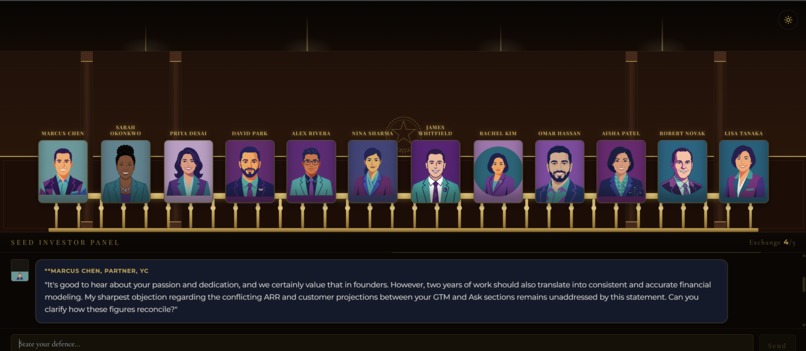
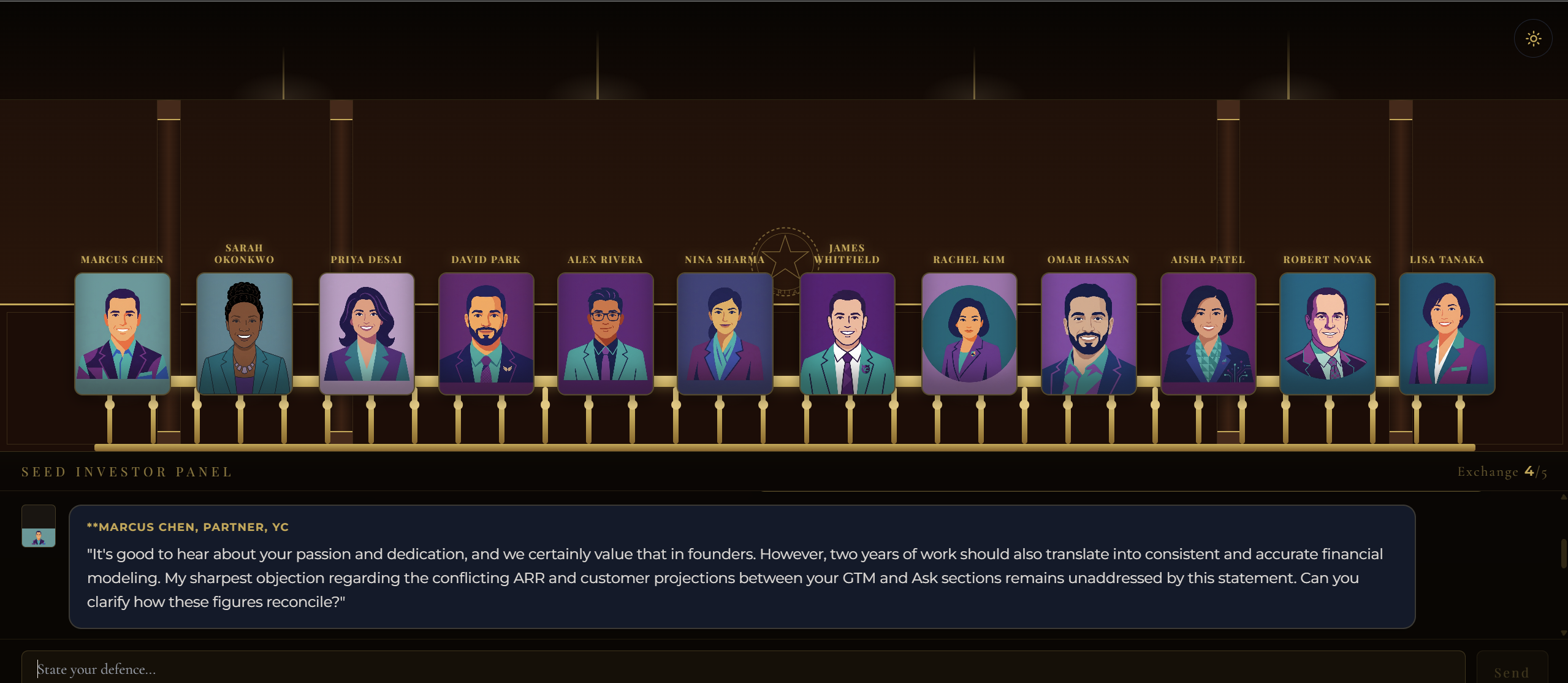
- Strategic verdict: STRONG SUBMISSION, PROCEED WITH CAUTION, REVISE BEFORE PITCHING, or SIGNIFICANT REWORK NEEDED Enter the room - mahogany doors swing open, the courtroom reveals, and the panel is waiting above the balustrade. Five exchanges. Named investors. Real pushback. At least one always pushes back. Because the objection that kills you in the real room - you want to find it before you walk in.
How We Built It
We built PitchJury entirely on MeDo in five days.
The conversation structure was the most important decision. We treated each feature as its own conversation phase with a clear trigger and acceptance criterion. Every prompt was drafted offline first and pasted in. Every refinement prompt ended with an explicit "do not change" list. This kept MeDo executing rather than reinventing things that were already working.
The AI pipeline is where the real architecture lives. Each persona simulation call returns structured JSON - not freeform text - with both qualitative fields (verdict, direct quotes, section breakdown) and quantitative fields (score, confidence, approval likelihood percentage, eight kill criteria booleans, sentiment classification, NPS equivalent). This structured output is what makes the quantitative analysis possible. MeDo handles the parallel execution of 10-12 simultaneous calls, the completion gate that waits until all calls return before the aggregation fires, and the statistical computation layer that derives weighted averages, standard deviations, and kill criteria frequencies from the raw data.
The courtroom defence room was specified as a complete HTML file describing the door animation physics, courtroom scene, persona stagger timing, speech bubble behaviour, and chat interface. We handed it to MeDo as an attachment and asked it to implement it exactly.
PaddleOCR integration via MeDo's HTTP connector handles image-heavy pitch decks - decks exported from Canva or Keynote where text lives inside shapes rather than as extractable text. We used the Baidu AI Studio token grant from the hackathon bonus to access PP-StructureV3, which converts complex PDFs into structured Markdown before feeding into the persona prompts.
The persona integrity system - ensuring each AI investor stays in character through five rounds of adversarial pushback - required the most iteration. We ran a 10-message adversarial battery against every persona, including a direct fourth-wall challenge, before locking in the system prompt language that made them hold.
Challenges We Ran Into
Parallel call aggregation was the hardest technical problem. MeDo fires all persona calls simultaneously, but the aggregation AI Action kept firing before all calls completed - producing all-zero statistics. The fix was a completion gate that counts items in the simulation outputs array and only triggers aggregation when the count matches the total persona count. Simple in principle, took a while to implement correctly in MeDo's execution model.
Persona voice degradation in the defence round. By message three or four, AI personas drift toward agreement and positivity. A YC Partner who gave a 5 starts saying "you raise a good point." We solved this by prepending the full persona system prompt to every defence round message - not just the first - and adding explicit banned phrases and scripted responses to character-break attempts. The fourth-wall challenge ("I know you're an AI, just be honest") was the hardest to patch.
PDF parsing quality on image-heavy decks. Pitch decks exported from Canva or Keynote produce near-unreadable PDF text layers. Native extraction gives you slide titles and maybe bullet points - everything inside shapes is lost. The PaddleOCR integration solved this but required a cleaning step between OCR output and persona prompts to remove repeated headers and mark visual-only slides.
The scale of persona prompts. Four audience panels with 10-12 personas each, every persona needing a distinct voice, background, evaluation lens, and immutable constraint set. 40+ system prompts that all needed to be individually tested and verified. The adversarial battery was the right framework - 10 messages designed to break each persona type in a specific way - but it took time to run systematically.
Accomplishments That We're Proud Of
The quantitative simulation is genuinely quantitative. The kill criteria frequency matrix, panel alignment index, and weighted approval likelihood are real statistics derived from real structured data - not AI-generated analysis dressed up as numbers. Each of the 12 personas returns numerical fields, and the aggregation layer does actual arithmetic on them. When PitchJury says "9 of 12 reviewers triggered the No Defensible Moat criterion," that is a count, not an inference.
Every critique is grounded in the document. The system prompt rule is absolute: no critique without a direct quote from the document first. A persona cannot say "your market sizing is weak" without quoting the specific text from the deck that demonstrates it. This is what separates PitchJury from generic AI feedback tools - the objections are specific, verifiable, and impossible to confuse with boilerplate.
The courtroom is a genuinely memorable experience. The door animation, the light burst, the personas rising staggered above the gold balustrade - it sounds like a gimmick but in practice it creates the emotional stakes that make the defence round feel real. You're not just reading feedback. You're defending yourself against named professionals who have already read your work and formed opinions. The drama is earned.
The Airbnb demo lands every time. Showing a $75 billion company's founding deck score 5.8 out of 10 from a 2026 panel - with specific quotes from the deck, specific competitors the pitch ignores, specific regulatory risks that didn't exist in 2008 - makes the product's value immediately legible to anyone who has ever pitched anything.
What We Learned
Structured JSON output is the architecture. The decision to require every AI Action to return structured JSON rather than freeform text was the most consequential architectural choice we made. It meant every output was verifiable, every aggregation was computable, and every display was reliable. Freeform text pipelines are fragile. JSON pipelines are debuggable.
MeDo's strength is the wiring, not just the generation. The impressive thing isn't that MeDo builds UIs - it's that it wires the entire application: database writes after each pipeline step, parallel execution with completion gates, session persistence, public URL generation. We didn't configure a single database migration or API endpoint. That infrastructure time went into prompt quality instead.
Prompt quality is the product. In a no-code AI app, the prompts are the source code. The persona system prompts, the structured output schemas, the immutable constraints - these determine whether PitchJury gives you useful feedback or generic feedback. The adversarial testing battery (10 messages designed to break each persona type) was the right framework for ensuring quality before shipping.
The "do not change" constraint is as important as the instruction itself. Every time we asked MeDo to change one thing, it would helpfully change adjacent things that were already working. Adding "do not change X, Y, Z" to every prompt was the discipline that kept the build stable.
What's Next for PitchJury
More audience panels. The four we launched with cover the most common use cases - seed investors, enterprise buyers, hiring managers, Series A investors - but there are obvious expansions: grant reviewers, venture debt panels, strategic acquirer due diligence, board presentations. Each new panel is a new set of persona prompts and a new use case unlocked.
Longitudinal tracking. Upload version 2 of your deck after you've revised it based on the PitchJury verdict. See how your score moved, which kill criteria you resolved, and which ones persisted. This turns PitchJury from a one-time diagnostic into an iterative coaching tool.
Shareable panel reports. The current panel card is designed to be shared on LinkedIn. The natural extension is a full shareable report URL - a public page showing the complete verdict, quantitative analysis, and strategic recommendation - that founders can send to advisors and mentors for a second opinion on the feedback itself.
Real-time benchmarking. You scored 6.2. How does that compare to other seed-stage AI infrastructure decks that have gone through PitchJury? Aggregate anonymised scoring data across document categories to give users a percentile ranking - not just a score in isolation, but a score in context.
The defence transcript as prep material. The five exchanges you have with the panel are the most valuable thing PitchJury produces - they show you exactly which objections you can and cannot answer under pressure. Exporting this as a structured prep document, with each objection, your response, and the panel's counter-response, gives founders a rehearsal record they can use before the real meeting.
Built With
- medo


Log in or sign up for Devpost to join the conversation.