-
-
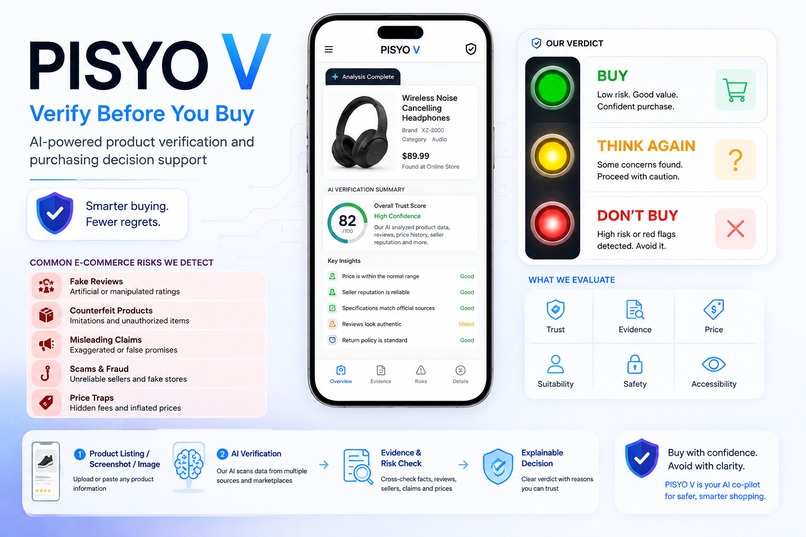
PISYO V — Verify Before You Buy with AI-powered trust, risk and product decision analysis.
Inspiration
Online shopping has made purchasing faster and more convenient, but it has not necessarily made buying decisions safer, smarter, or more trustworthy.
Consumers are constantly exposed to exaggerated product claims, misleading advertisements, manipulated reviews, counterfeit goods, unreliable sellers, fake discounts, hidden risks, and products that may not match their actual needs.
Most e-commerce platforms are designed to maximise clicks, conversions, and transaction volume. They are very effective at helping people complete a purchase, but they do not always help people determine whether the purchase is genuinely safe, suitable, fairly priced, or worthwhile.
PISYO V began with a simple question:
What if AI could protect consumers before a purchase happens?
Instead of creating another shopping assistant that encourages people to buy more products, we wanted to build an AI-powered platform that helps users pause, investigate, verify, and avoid costly purchasing mistakes.
Our core philosophy is:
We do not simply help people shop. We help people avoid buying mistakes.
PISYO V — Verify Before You Buy is designed as an AI-powered trust, verification, and decision platform for digital commerce.
The platform evaluates current product information, seller details, prices, reviews, supporting evidence, user suitability, safety risks, and possible warning signs before presenting the consumer with a clear and explainable buying decision.
The project was also inspired by users who are often underserved by conventional e-commerce systems, including people with visual impairments, senior citizens, users with limited reading ability, and people who prefer voice-based communication.
We believe that the future of digital commerce should not only be faster.
It should be safer, more transparent, more inclusive, more ethical, and more accountable.
PISYO V represents a future in which AI does not merely help businesses sell.
It also helps consumers decide when not to buy.
What it does
PISYO V is an AI-powered product verification, consumer-protection, and purchasing-decision platform.
A user can submit a current product listing, paste product information, upload a screenshot, provide a product image, describe an advertisement, or explain what they are planning to purchase.
PISYO V then analyses the evidence available at the time of the request.
The system evaluates factors such as:
- Product descriptions and specifications
- Marketing claims and supporting evidence
- Seller credibility and trust indicators
- Review quality and possible review manipulation
- Current price and apparent price fairness
- Product suitability for the user’s intended purpose
- Safety, ethical, and policy-related risks
- Possible counterfeit or scam indicators
- Missing, incomplete, or inconsistent information
- Available alternatives and second-hand options
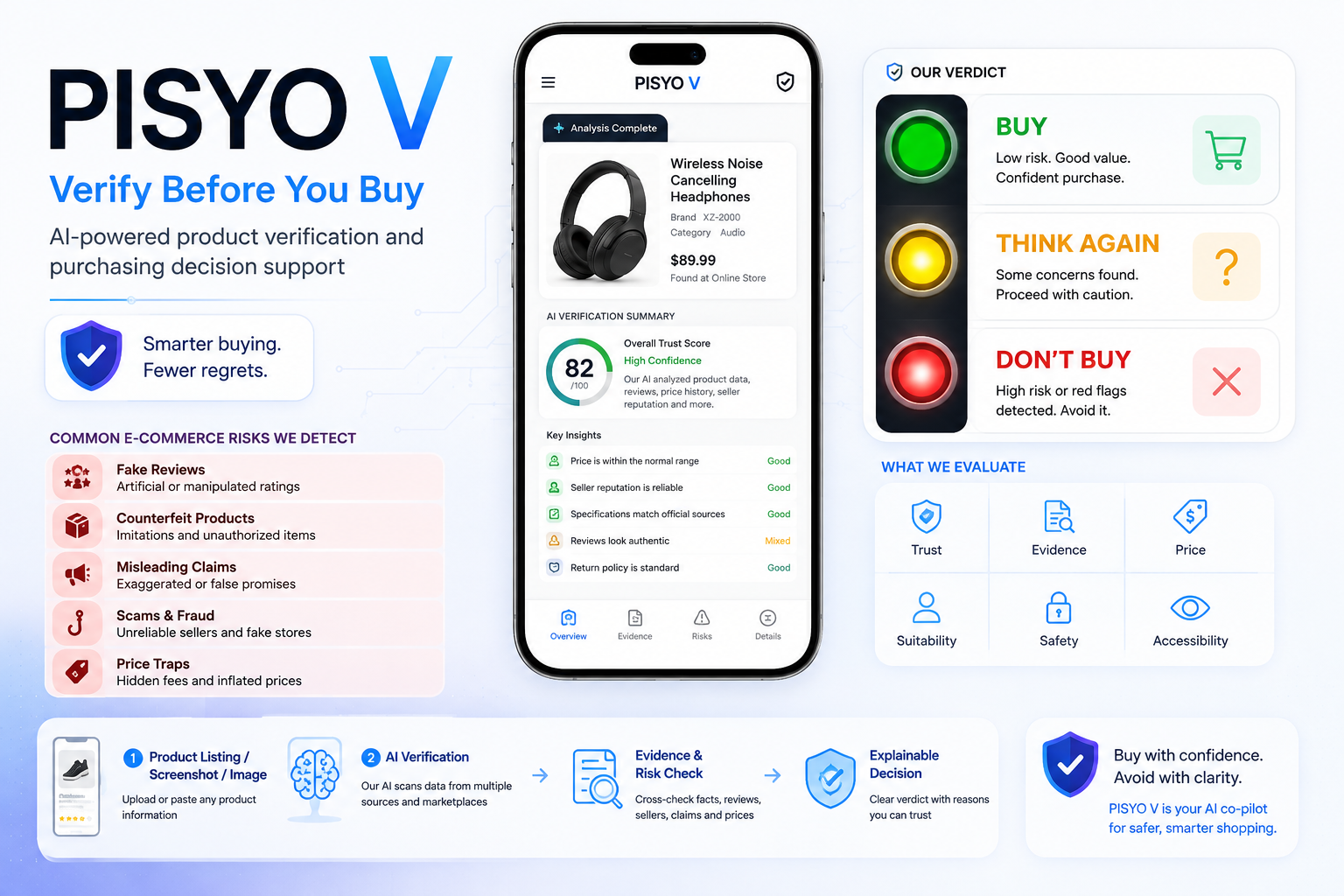
After completing the analysis, PISYO V presents the result using a simple traffic-light decision system:
- 🟢 Buy — The available evidence indicates that the product appears suitable, reasonably priced, and supported by sufficient information.
- 🟡 Think Again — The product may still be considered, but there are concerns involving price, suitability, seller reliability, missing evidence, product claims, or better alternatives.
- 🔴 Don’t Buy — Significant warning signs have been detected, such as possible scams, misleading claims, unsafe products, serious suitability issues, counterfeit indicators, or insufficient evidence to justify the purchase.
PISYO V does not only generate a verdict.
It explains why the verdict was generated.
The user can see the key evidence, detected risks, missing information, warning signs, and the main factors that influenced the decision.
When the available evidence is incomplete, PISYO V does not pretend to be certain. It clearly explains what remains unknown and what the user should verify before proceeding.
The prototype is designed around a real-time verification workflow.
This means that PISYO V evaluates the current product and marketplace evidence supplied by the user at the time of the request, rather than depending only on static, pre-written, or hypothetical examples.
Each verification can generate a decision record containing:
- The product or listing being evaluated
- The evidence available during the request
- The detected product claims
- Seller and pricing indicators
- Identified risks and inconsistencies
- The final traffic-light decision
- The explanation behind the decision
- Missing evidence that still requires verification
- Suggested next actions before purchasing
This creates measurable proof that the decision was generated from current marketplace information.
PISYO V is also designed to support:
- Voice-based product verification
- Multilingual interaction
- Spoken responses
- Simplified explanations
- Large and accessible visual indicators
- Personalised product suitability
- Global price comparison
- Seller and buyer trust profiles
- Scam and counterfeit warnings
- Second-hand product discovery
- Negotiation assistance
- Responsible and ethical commerce
PISYO V is not intended to become an uncontrolled marketplace where every product can be listed.
Products or services involving weapons, dangerous materials, black magic, prohibited food categories, scams, exploitation, violent propaganda, war promotion, or other activities that may harm individuals or society are not intended to be permitted within the PISYO V ecosystem.
The platform is designed to place safety, trust, responsibility, and consumer wellbeing above transaction volume.
How we built it
We developed PISYO V as a modular AI decision system using Gemini models and Google AI Studio as key components of our prototyping, multimodal analysis, and reasoning workflow.
The system begins by identifying the user’s actual purchasing question.
A user may be asking:
- Is this product genuine?
- Is this seller trustworthy?
- Is the current price reasonable?
- Does this product match my needs?
- Are the product claims supported by evidence?
- Are the reviews reliable?
- Is there a safer or better alternative?
- Should I buy this product now?
The submitted product information is then processed through several intelligence layers.
Product Intelligence
The Product Intelligence layer examines the product name, description, specifications, images, packaging, advertisements, and technical information.
Its purpose is to understand what the product claims to be and whether the available information is complete, relevant, and internally consistent.
Evidence Intelligence
The Evidence Intelligence layer evaluates whether important product claims are supported by meaningful evidence.
It identifies claims that appear:
- Supported
- Partially supported
- Incomplete
- Exaggerated
- Ambiguous
- Potentially misleading
- Impossible to verify using the available information
The system highlights missing information instead of automatically assuming that every marketing statement is true.
Trust Intelligence
The Trust Intelligence layer evaluates seller information, review patterns, credibility indicators, inconsistencies, and possible warning signs.
A high star rating alone is not treated as proof of trustworthiness.
The system considers the broader context of the seller, the listing, the claims, and the available evidence.
Price Intelligence
The Price Intelligence layer evaluates whether the current price appears reasonable based on the available specifications, product category, market positioning, condition, and possible alternatives.
The objective is not always to find the cheapest product.
The objective is to determine whether the user is receiving fair value.
Consumer Intelligence
The Consumer Intelligence layer considers the user’s intended use, budget, preferences, accessibility requirements, limitations, and actual needs.
A product may be genuine and affordable but still be unsuitable for a particular person.
PISYO V therefore evaluates suitability, not only product popularity.
Policy and Safety Intelligence
The Policy and Safety Intelligence layer identifies products or services that may be unsafe, unethical, prohibited, deceptive, exploitative, or inconsistent with the platform’s responsible-commerce policies.
This layer helps prevent the platform from becoming a channel for harmful products, dangerous activities, prohibited materials, scams, violent propaganda, or irresponsible commercial practices.
Decision Intelligence
The findings from the previous layers are combined through the Decision Intelligence process.
The system generates one of three final verdicts:
- Buy
- Think Again
- Don’t Buy
It then produces a clear explanation in human-readable language.
Gemini supports:
- Natural-language understanding
- Multimodal product analysis
- Image and text interpretation
- Evidence assessment
- Reasoning across multiple decision factors
- Risk identification
- Summarisation
- Explanation generation
- Multilingual communication
Google AI Studio allowed us to rapidly test prompts, compare decision flows, prototype interactions, refine the traffic-light system, and evaluate how the platform responds to different purchasing scenarios.
We designed the user experience around simplicity.
Consumers should not need to understand complex risk models, technical AI terminology, or large amounts of raw data.
PISYO V converts multiple signals into a clear decision while still allowing the user to inspect the reasoning behind it.
The prototype demonstrates the following core workflow:
- The user submits current product or marketplace information.
- PISYO V identifies the product, seller claims, specifications, price, reviews, and available evidence.
- The intelligence layers evaluate trust, value, suitability, safety, ethics, and risk.
- The system generates a traffic-light decision.
- PISYO V explains the decision and identifies missing evidence.
- The user receives a recommended next action before purchasing.
The architecture is modular so that future components can be added without rebuilding the entire platform.
These future components may include:
- Direct marketplace APIs
- Verified product databases
- Fraud-detection services
- Product-authentication systems
- Payment services
- Identity-verification services
- Price-monitoring tools
- Consumer-protection databases
- Logistics and delivery systems
- Business-performance analytics
Challenges we ran into
One of our biggest challenges was defining what a trustworthy buying decision actually means.
A product may be genuine but overpriced.
It may be affordable but unsuitable for the user.
A seller may have a high rating but still use misleading descriptions.
A product may receive thousands of positive reviews, but some reviews may be duplicated, incentivised, irrelevant, incomplete, artificially generated, or manipulated.
Trust cannot be calculated from a single rating or data point.
Another major challenge was distinguishing real evidence from marketing language.
Product listings frequently use phrases such as:
- Premium quality
- Clinically proven
- Best in the market
- Number one product
- Limited-time offer
- Guaranteed results
- Original product
However, these statements may be presented without sufficient supporting information.
PISYO V therefore needed a way to distinguish between claims that are supported, unsupported, incomplete, exaggerated, or impossible to verify.
We also faced the challenge of transforming complex analysis into a simple decision.
The traffic-light interface appears straightforward, but each verdict may involve multiple factors, including:
- Product evidence
- Seller behaviour
- Price fairness
- Product suitability
- Safety concerns
- Ethical considerations
- User context
- Missing information
- Possible manipulation
Another challenge was avoiding false confidence.
AI systems can sometimes produce confident answers even when the available evidence is limited.
PISYO V must clearly distinguish between:
- Verified information
- Reasonable indicators
- Unverified claims
- Uncertainty
- Missing evidence
When information is incomplete, the responsible action is not to invent certainty.
The system must explain what it does not know.
Data consistency was another major issue.
Marketplace listings may use different:
- Languages
- Units
- Product names
- Description formats
- Image qualities
- Pricing structures
- Review systems
- Specification formats
Important information may also be hidden, omitted, or presented in promotional language.
Designing for accessibility introduced additional challenges.
Voice interaction must be simple and natural. Explanations must remain understandable without becoming overly technical. Visual decisions must be clear to users with different levels of digital literacy.
We also needed to balance consumer protection with user autonomy.
PISYO V should provide strong warnings when risks are detected, but the user must still understand the evidence and make the final decision.
Finally, we had to control the project scope.
The complete PISYO V vision includes:
- An AI verification engine
- A digital marketplace
- Seller and buyer trust profiles
- Global price comparison
- Second-hand commerce
- Voice and multilingual accessibility
- Negotiation tools
- Secure payments
- Ethical product governance
- Business rewards
- Institutional APIs
- Global trust infrastructure
For the prototype, we focused on demonstrating the most important concept:
PISYO V can analyse current product evidence and provide an immediate, explainable decision before the user buys.
Accomplishments that we're proud of
We are proud that PISYO V moves beyond the conventional idea of an AI shopping assistant.
Most shopping assistants are designed to recommend more products, increase engagement, and encourage more transactions.
PISYO V introduces a different behaviour:
It can tell the user not to buy.
That ability represents an important change in how AI can participate in digital commerce.
We developed a clear traffic-light decision framework that transforms complex product and trust information into an interface that ordinary users can understand immediately.
We also created a modular intelligence model that combines:
- Product analysis
- Evidence verification
- Seller trust
- Price evaluation
- Consumer suitability
- Safety and ethical governance
- Decision explanation
Another accomplishment is the real-time verification workflow.
The prototype is designed to evaluate current product information submitted by the user and generate an immediate decision based on the evidence available at that moment.
This allows PISYO V to move beyond purely hypothetical examples and demonstrate how the decision framework can be tested using real products and active marketplace information.
We are also proud of the project’s focus on explainability.
PISYO V is not intended to operate as a mysterious scoring system.
Users should be able to understand:
- What influenced the decision
- What risks were detected
- Which claims were unsupported
- What evidence is missing
- What they should verify before proceeding
The accessibility-first direction is another important achievement.
Voice interaction, multilingual communication, simplified explanations, and large traffic-light indicators can make safer digital commerce available to users who are often underserved by existing platforms.
We are also proud that PISYO V includes responsible product-governance principles from the beginning.
The platform is not designed to profit from harmful products or irresponsible commercial activity.
Most importantly, PISYO V demonstrates that AI can be designed to protect the consumer’s interests rather than only optimise sales.
What we learned
We learned that a good buying decision cannot be based only on price, popularity, advertisements, or star ratings.
Trust is multidimensional.
It depends on:
- Evidence
- Transparency
- Seller behaviour
- Product quality
- Price fairness
- User suitability
- Safety
- Ethical considerations
- Risk
- The individual consumer’s context
We also learned that explainability is essential.
A recommendation becomes more valuable when the user understands the reason behind it.
Consumers should not be expected to blindly trust an AI-generated verdict.
Another important lesson was that uncertainty must be handled honestly.
When evidence is weak, unavailable, outdated, or contradictory, the responsible response is not to invent confidence.
The system should explain what remains unknown and guide the user towards the next verification step.
We learned that real-time verification is more meaningful than analysing only pre-prepared examples.
A system that claims to protect consumers must be able to examine current listings, changing prices, active advertisements, and the evidence available at the moment of purchase.
We also learned that accessibility should be included in the original system design, not added as an optional feature later.
Voice, language, readability, visual clarity, and interface simplicity directly affect whether people can benefit from the technology.
Another major lesson was that the best recommendation is not always another product.
Sometimes the most useful and responsible decision is:
Do not buy anything yet.
We also learned that technology alone cannot create trust.
A trusted commerce ecosystem also requires:
- Clear policies
- Responsible governance
- Transparent evaluation
- Reliable evidence
- Business accountability
- Consumer education
- Continuous improvement
PISYO V must therefore be developed not only as an application, but as a complete trust-based ecosystem.
What's next for PISYO V — Verify Before You Buy
The next stage for PISYO V is to expand and validate its real-time verification capability across more products, marketplaces, languages, and purchasing scenarios.
We plan to conduct broader real-market testing using a larger number of current product listings and measurable verification outcomes.
This will allow us to evaluate and improve:
- Decision consistency
- Evidence quality
- Risk detection
- Explanation clarity
- Product suitability assessment
- Seller trust evaluation
- Price fairness analysis
- Scam and counterfeit identification
- False-positive and false-negative rates
Future development will include direct marketplace API connections and automated evidence collection.
These integrations will allow PISYO V to retrieve current product information, price changes, seller data, review patterns, and availability more efficiently.
However, direct marketplace API integration is an expansion of the system, not the core proof of the concept.
The core proof is that PISYO V can use current marketplace evidence to generate an immediate, explainable, and measurable purchasing decision.
We also plan to develop:
- Continuous price and seller monitoring
- Advanced counterfeit detection
- Suspicious-review analysis
- Stronger product-claim verification
- Verified buyer and seller profiles
- Personalised product suitability
- Multilingual voice-first interaction
- A second-hand marketplace
- Product-condition verification
- Sustainability scoring
- Negotiation assistance
- Secure payment and transaction services
- Browser-extension support
- Mobile product scanning
- Institutional and marketplace APIs
PISYO V also aims to create a responsible business ecosystem.
Businesses operating within the PISYO V ecosystem could be evaluated based on:
- Consumer trust
- Ethical conduct
- Product quality
- Customer value
- Platform participation
- Sustainable profitability
- Positive contribution to the ecosystem
Through the future PISYO V Business Excellence Programme, the five highest-performing responsible companies could receive annual recognition, strategic support, and rewards based on transparent and measurable criteria.
Our future corporate growth roadmap begins with establishing the company as:
PISYO V Technologies Sdn. Bhd.
During this stage, the company would focus on validating the technology, strengthening the business model, protecting intellectual property, building strategic partnerships, developing the marketplace ecosystem, generating sustainable revenue, and proving measurable value for consumers and businesses.
As the company grows, demonstrates sustainable financial performance, expands its operations, and develops the necessary governance and compliance capabilities, the long-term plan is to transition into:
PISYO V Technologies Berhad
Subject to financial readiness, regulatory approval, market conditions, due diligence, and compliance with applicable listing requirements, PISYO V Technologies Berhad would ultimately aim to pursue an:
Initial Public Offering and public listing on Bursa Malaysia.
The planned corporate journey can be represented as:
Prototype validation → PISYO V Technologies Sdn. Bhd. → National commercial growth → Regional expansion → PISYO V Technologies Berhad → Initial Public Offering → Public listing → Global-scale trust infrastructure.

Log in or sign up for Devpost to join the conversation.