-
-

Pip
-
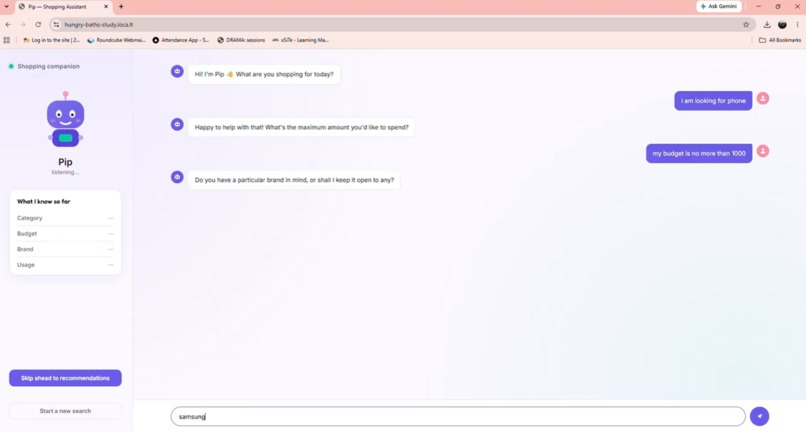
pipiko page

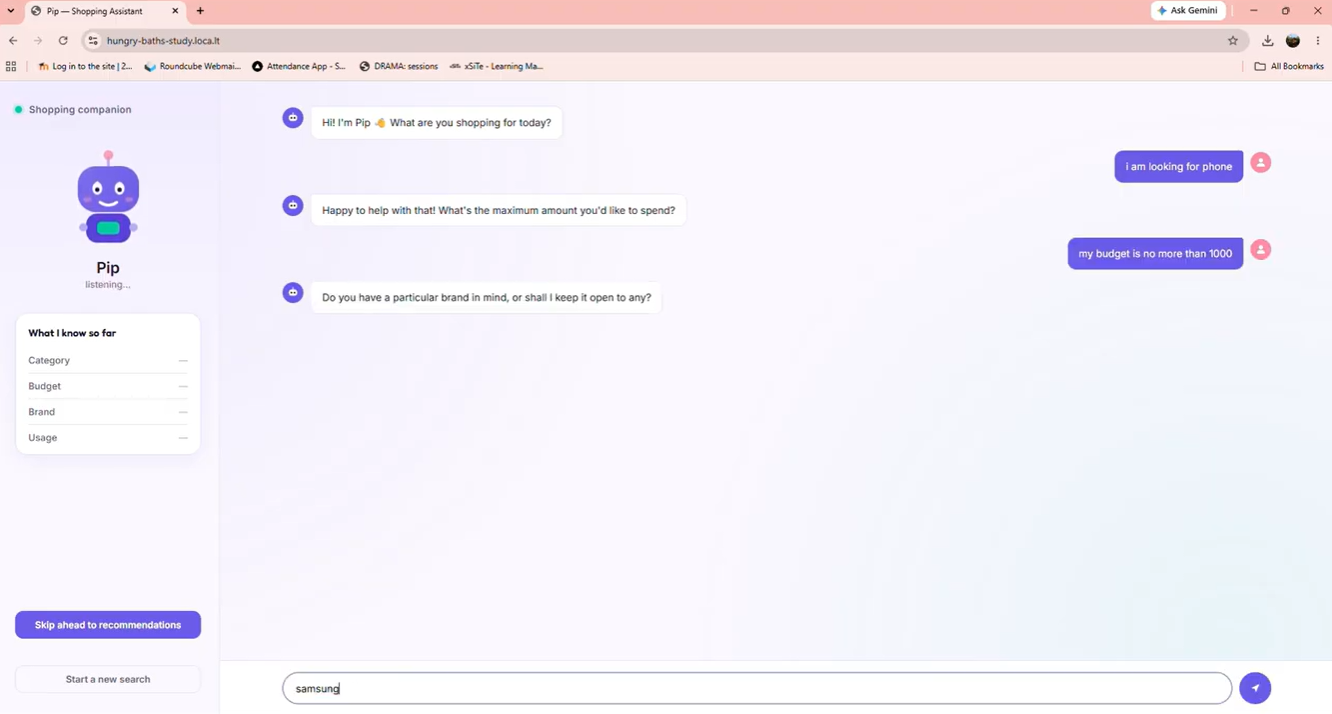
Inspiration
Traditional shopping search assumes you already know what you want. You need the right keywords, brand, specifications, and often even a budget before you can find a product. We wanted to change that experience. We created Pip, an AI shopping companion that lets users simply describe what they are interested in and have a natural conversation. Instead of forcing users to figure everything out themselves, Pip helps them discover what they actually need.
What it does
Pip has a conversational interaction with the user to understand their preferences and progressively narrow down their needs. It asks one relevant question at a time, remembers previous answers, avoids repeating questions, and adapts its conversation based on the information provided. Pip can help even when users are unsure about their budget, brand, or specifications. Once enough information has been gathered, Pip converts the conversation into a structured shopping request that can be used to identify suitable products.
How we built it
We built Pip around a locally running Qwen2.5 1.5B Instruct model using Python, Transformers, and PyTorch. Designed a structured conversational prompt that guides Pip to extract useful information while maintaining a natural dialogue. The system determines what information to ask for next. Once Pip determines that it has enough information, it generates a concise summary and converts the requirements into structured fields such as category, brand, usage, and budget. This structured output provides the foundation for our product retrieval and recommendation pipeline.
Challenges we ran into
One of our biggest challenges was making the AI understand that shopping conversations are not always linear. Users may provide information gradually, change their minds, or be unsure about important specifications. We therefore had to design Pip to use previous conversation context while asking only one useful question at a time. Another challenge was balancing how much information Pip should collect against the need to keep the conversation efficient. Asking too many questions creates unnecessary cognitive load, while asking too few can lead to poor recommendations.
Accomplishments that we're proud of
We are proud of creating a shopping agent that focuses on the user rather than the search query. Pip does not require users to know exactly what to type or what specifications to search for. It can progressively understand their interests through conversation and transform an unstructured dialogue into structured product requirements. We are also proud that Pip runs using a relatively lightweight local language model, allowing us to build an intelligent conversational experience without depending on a paid external LLM API.
What we learned
We learned that building an effective AI agent is about more than simply connecting an LLM to a product database. The way an agent manages conversation, decides what information is important, and guides the user can have a major impact on the final result. We also learned the importance of structured state and prompt design when turning natural language conversations into reliable information that downstream systems can use.
What's next for PipPiko
Our next step is to connect Pip's conversational understanding directly to the full product retrieval and ranking pipeline. We want Pip to combine semantic understanding, keyword retrieval, product metadata, and intelligent ranking to identify the most relevant products. We also plan to make Pip more adaptive by allowing it to recognise changes in user intent, dynamically adjust its retrieval strategy, and ask clarification questions that provide the most useful information with the fewest possible turns. Ultimately, we want PipPiko to make product discovery feel less like searching a database and more like talking to a smart shopping companion.


Log in or sign up for Devpost to join the conversation.