-
-
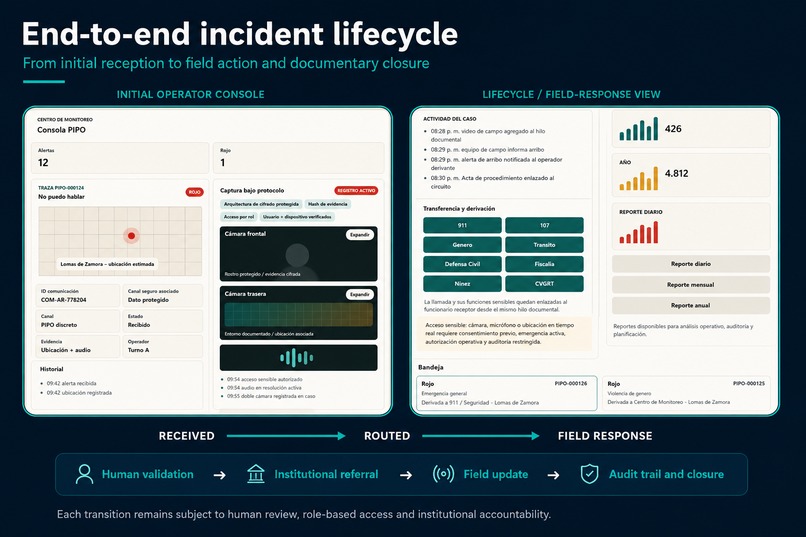
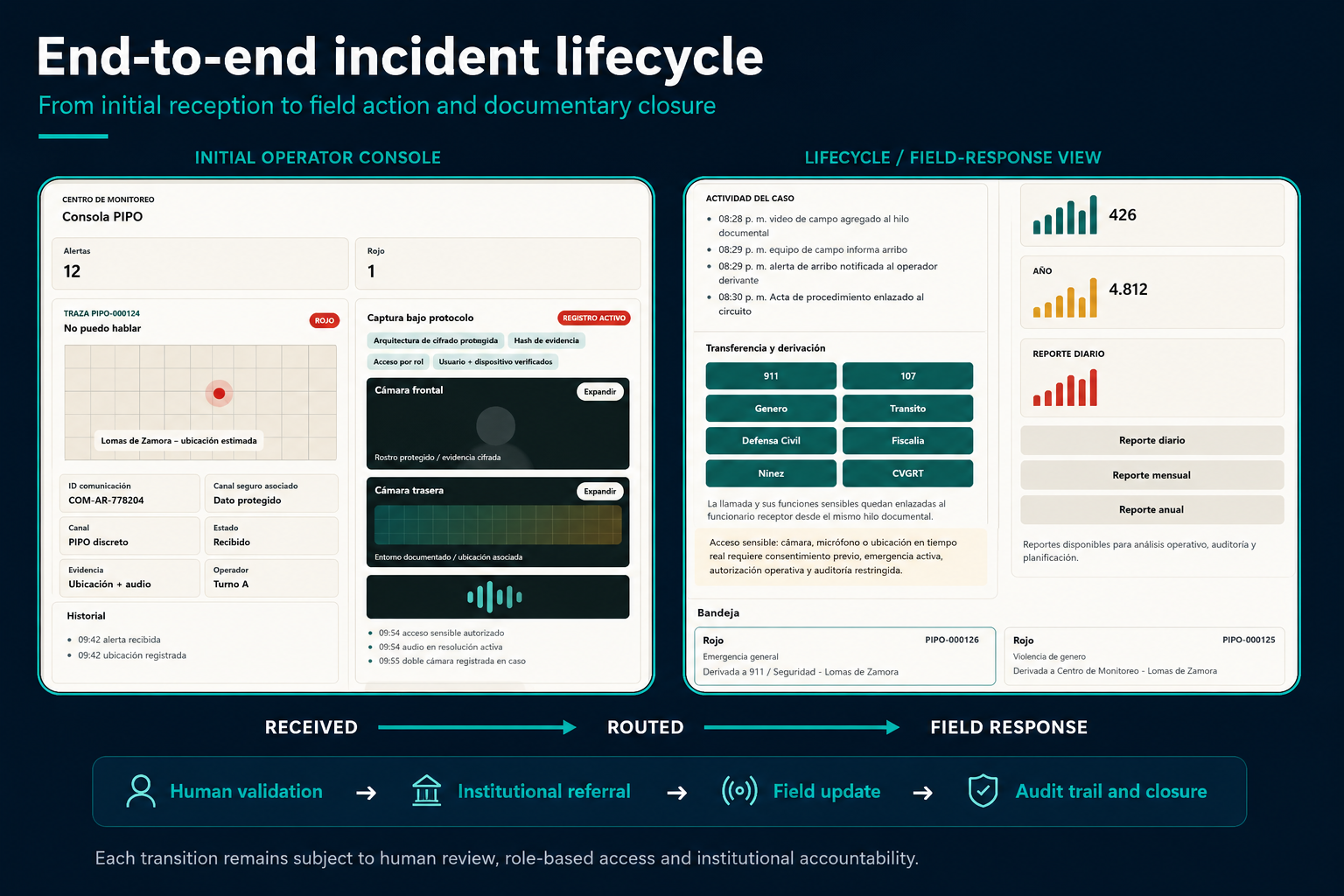
Complete incident lifecycle: human validation, institutional routing, field updates, audit trail, and documented closure.
-
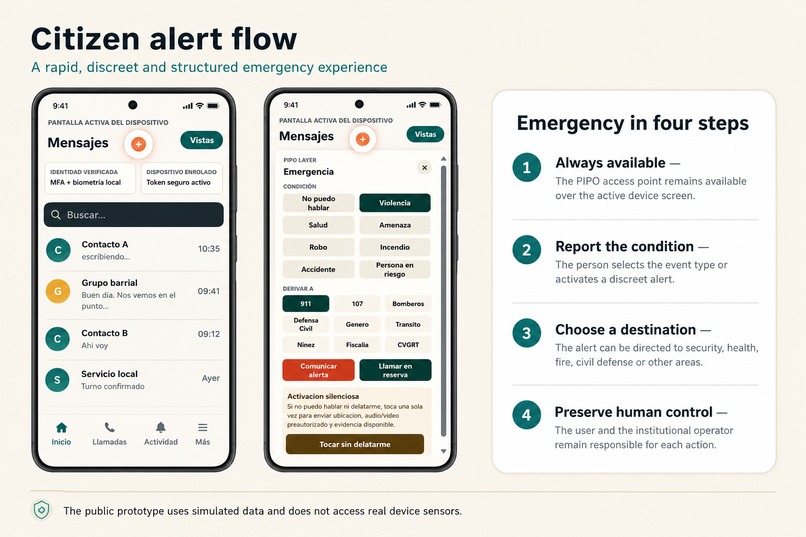
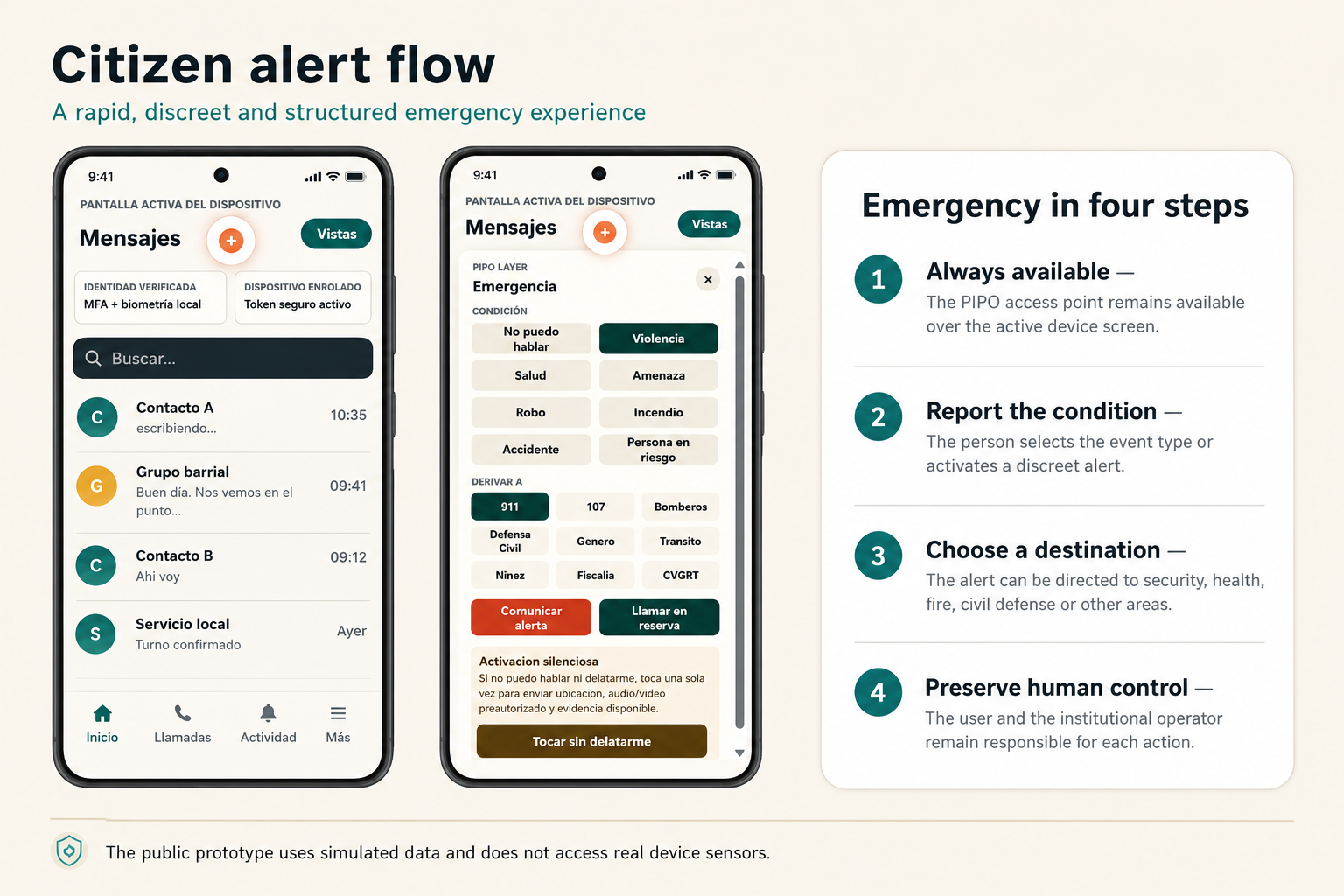
Citizen alert flow: fast activation, incident selection, institutional routing, and human control using simulated data.
-
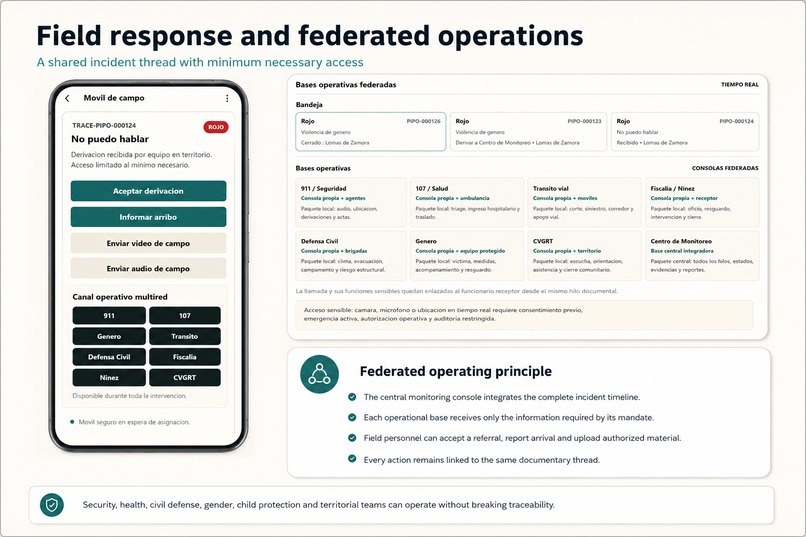
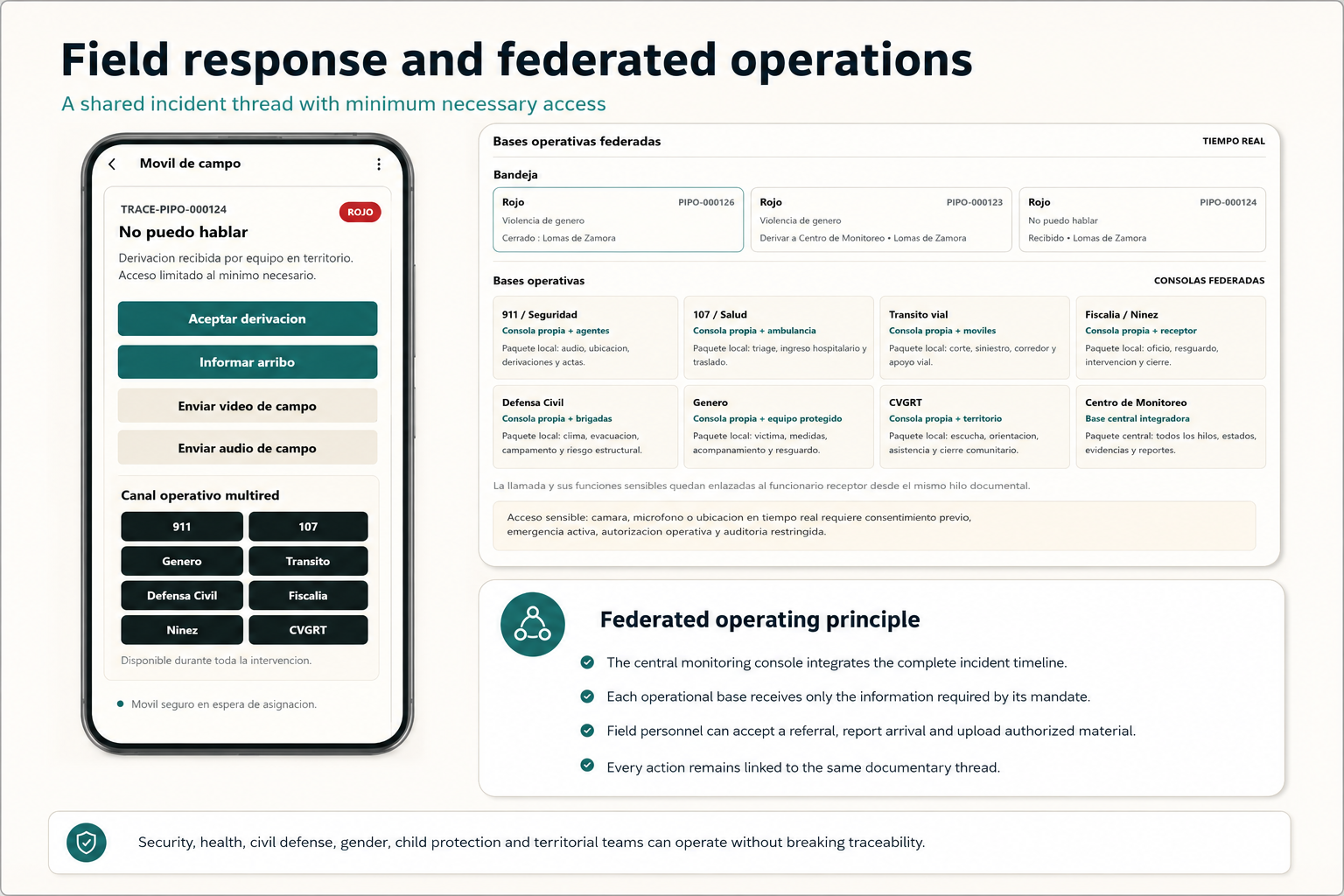
Federated response model linking field teams and operational bases through one secure, traceable incident thread.
-
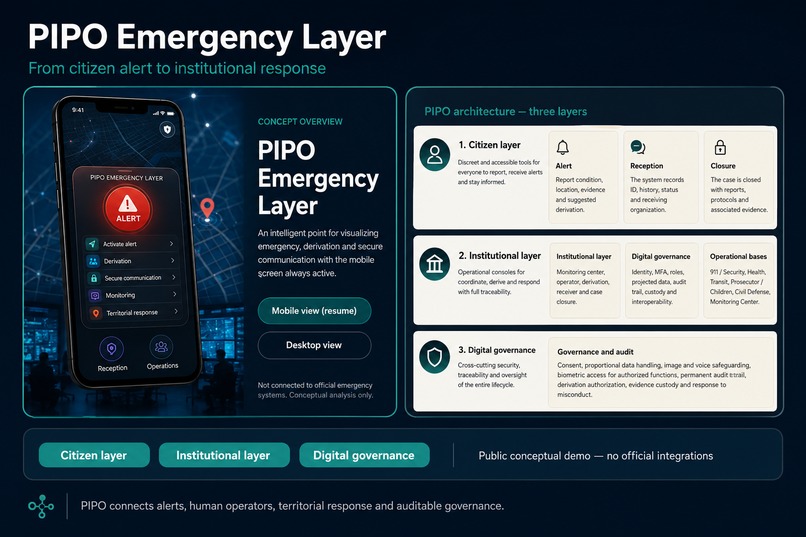
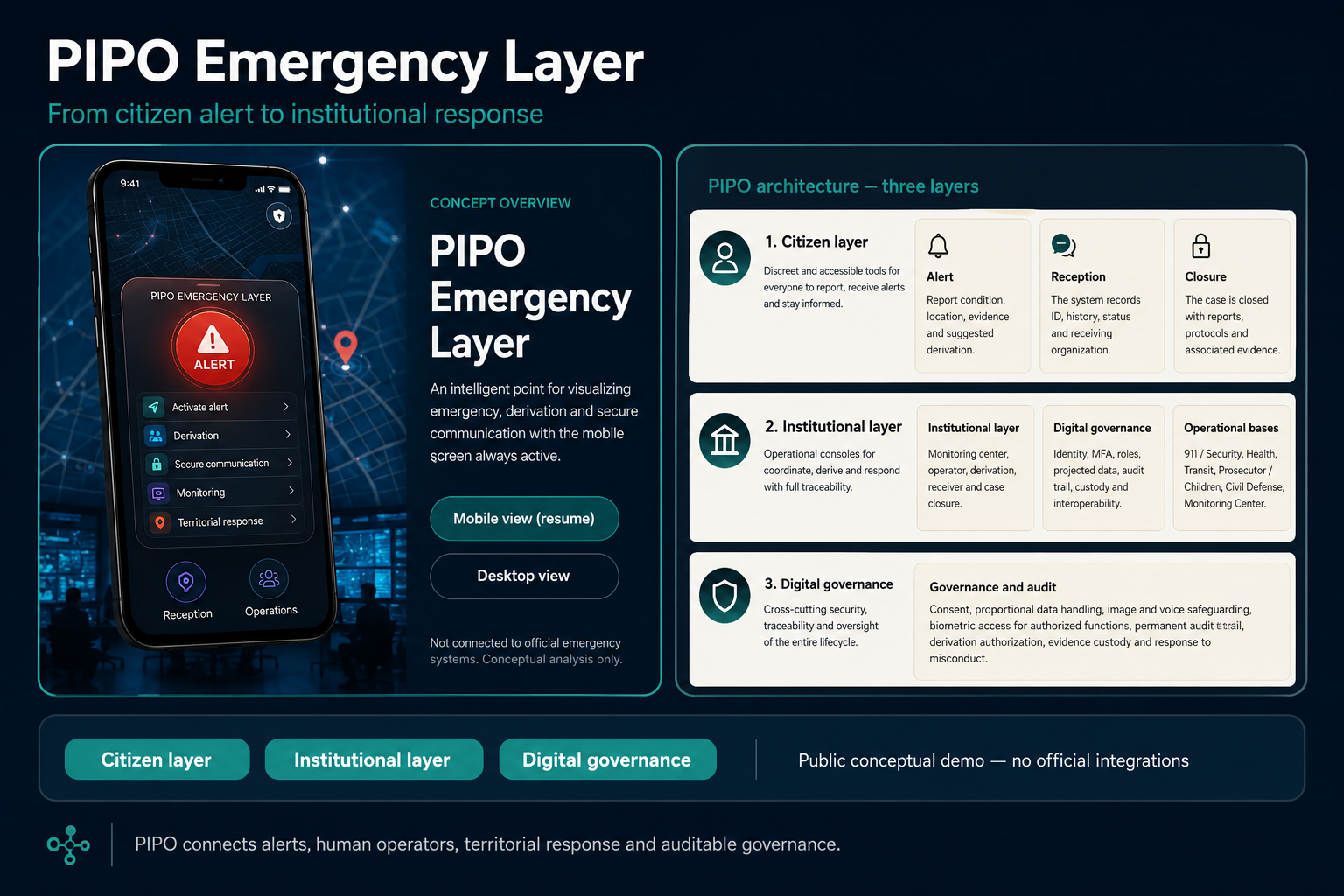
PIPO’s three-layer architecture connects citizen alerts, institutional response, and digital governance in one auditable flow.
Inspiration
Many emergencies begin through fragmented and informal channels: messages to relatives, neighborhood groups, personal contacts, or public officials. This can delay the correct response, disperse critical information, and leave no clear institutional record of what happened.
PIPO Emergency Layer was created from a simple principle: access to emergency assistance should not depend on which application is open on a person's device.
What it does
PIPO Emergency Layer is a public and responsible prototype of a digital emergency layer designed to connect people at risk with institutional and territorial response systems.
The prototype demonstrates:
- a rapid and accessible emergency activation interface;
- incident-type selection;
- structured alert creation;
- a simulated institutional reception console;
- preliminary risk classification;
- referral to the appropriate response area;
- incident status tracking;
- an auditable action timeline;
- mandatory incident closure.
PIPO is organized into three connected layers:
- Citizen layer: alert activation, minimum incident information, location and available evidence.
- Institutional layer: operator reception, classification, referral, follow-up and closure.
- Digital governance layer: identity, roles, minimum privilege, auditability, privacy and security-by-design.
Responsible public scope
This public version does not replace official emergency services such as police, medical response, fire departments, civil defense or public monitoring centers.
It does not collect personal data, access real device sensors, activate cameras or microphones, provide real-time location, or connect to official emergency infrastructure. All incidents, locations, identities and institutional actions shown in the demo are simulated.
A real implementation would require legal authorization, institutional agreements, cybersecurity controls, privacy impact assessment, trained operators, auditing and validated emergency protocols.
How we built it
The project was developed through an iterative product-design and prototyping workflow supported by OpenAI Codex.
The public prototype uses HTML, CSS and JavaScript and is deployed through GitHub Pages. The repository also includes functional architecture, MVP definition, visual flows, security principles, privacy boundaries and responsible-use documentation.
Before OpenAI Build Week, PIPO already had a public visual prototype and an institutional design framework.
During Build Week, the project is being extended toward an AI-assisted incident workflow focused on:
- transforming free-text reports into structured incident information;
- suggesting preliminary risk categories;
- identifying missing critical information;
- recommending possible institutional destinations;
- preserving human review and final decision-making;
- generating an auditable incident summary.
AI is designed to assist operators, not replace emergency professionals or make autonomous dispatch decisions.
Challenges
The main challenge was not only technical. Emergency systems must balance speed, accessibility and discretion with privacy, legal authority, data minimization and institutional accountability.
Another challenge was creating a public prototype that communicates the concept without exposing sensitive operational procedures or presenting simulated capabilities as production-ready technology.
Accomplishments
We created:
- a navigable public emergency-layer prototype;
- a citizen-facing alert experience;
- a simulated operator console;
- an institutional referral workflow;
- a three-layer governance architecture;
- a clearly limited and responsible public scope;
- technical, security and functional documentation;
- a foundation for human-in-the-loop AI assistance.
What we learned
Emergency technology cannot be reduced to a panic button.
A reliable system also needs governance, role-based access, traceability, incident ownership, closure procedures, data protection and clear limits on automated decision-making.
We also learned that AI can provide meaningful value by organizing incomplete information and supporting human operators, while preserving institutional responsibility.
What's next
The next stage is to complete and validate the AI-assisted incident module, strengthen the operator dashboard, document the Build Week implementation, and conduct controlled usability and security evaluations.
Any real-world pilot would begin with an institutional and technical diagnostic before defining integrations, costs or deployment scope.


Log in or sign up for Devpost to join the conversation.