-
-
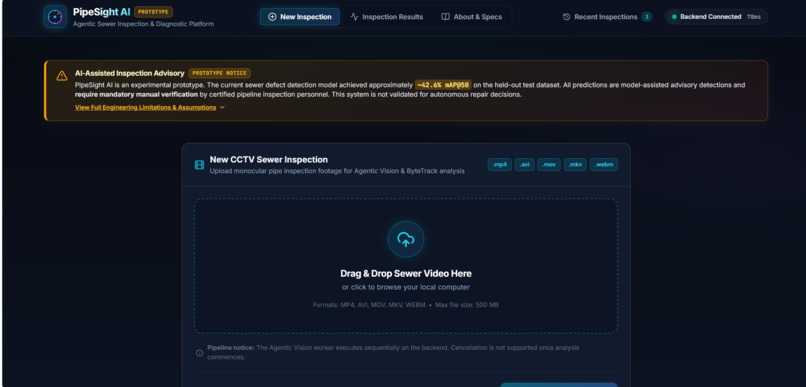
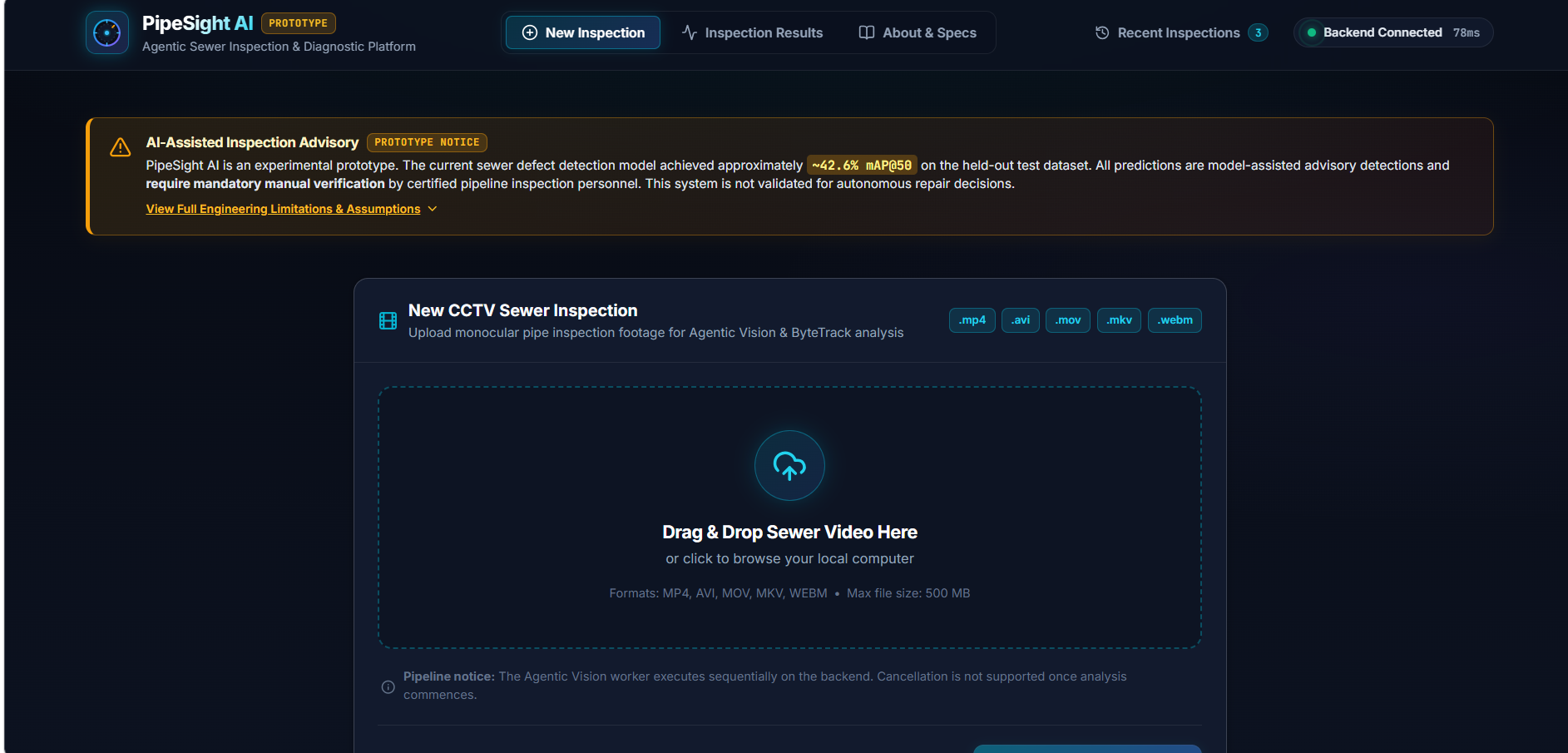
Dashboard
-
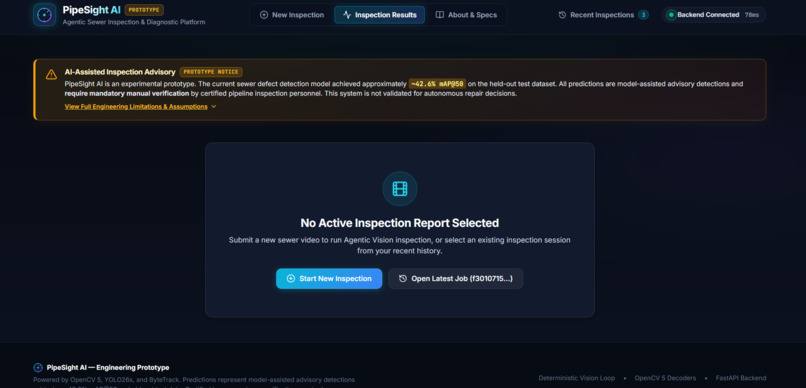
Inspection Results
-
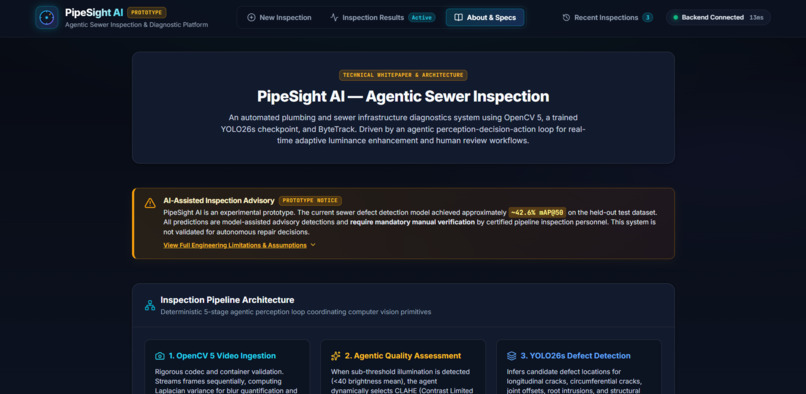
Basic Information
Inspiration
Sewer and stormwater pipelines are important parts of urban infrastructure, but inspecting them can require reviewing long CCTV recordings to identify cracks, debris, root intrusion, joint faults, and surface damage. We wanted to explore how computer vision could assist this process and make preliminary defect identification more efficient.
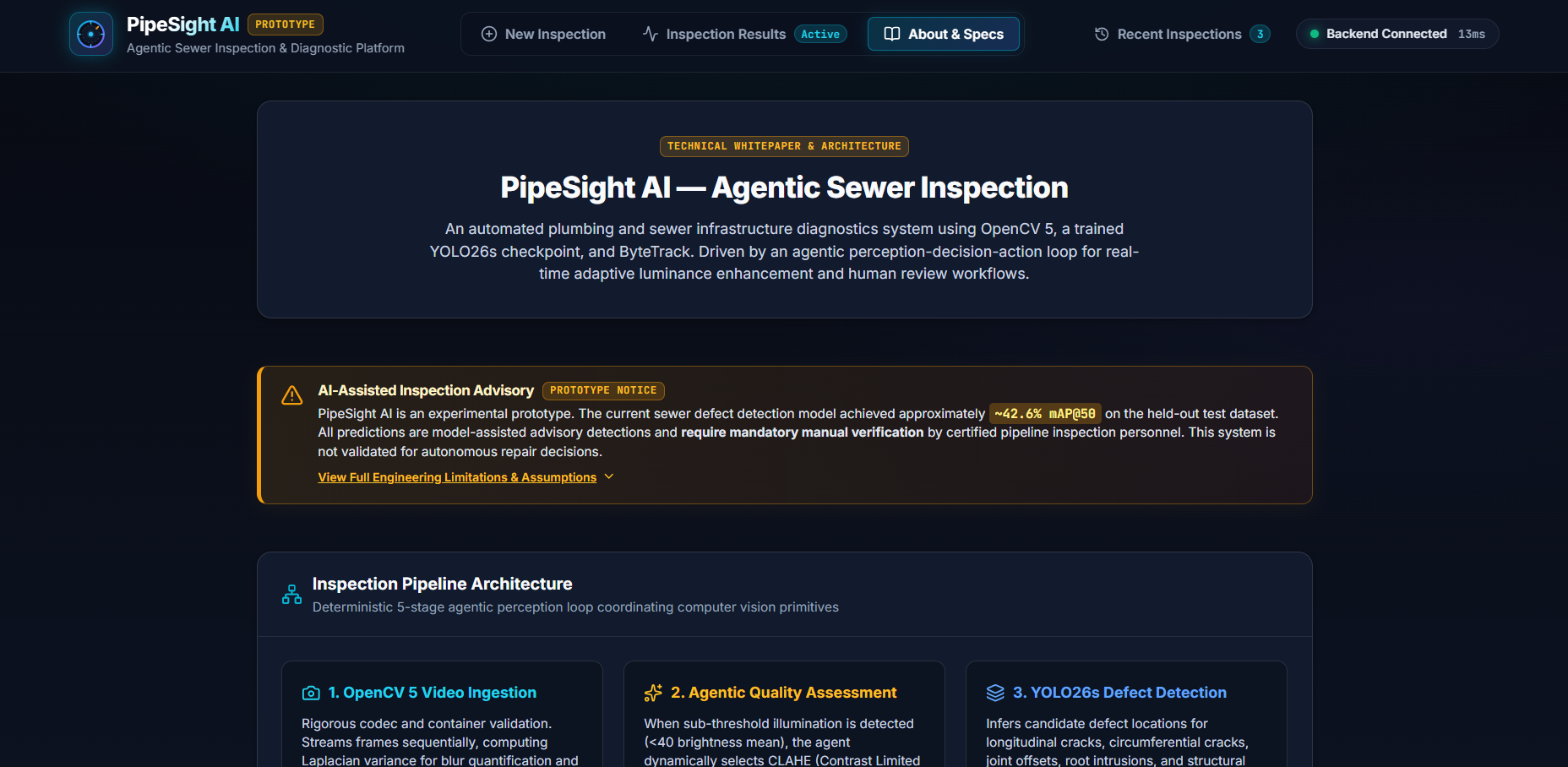
This inspired PipeSight AI, a project focused on AI-assisted sewer pipe defect detection using YOLO26s and OpenCV 5.
What it does
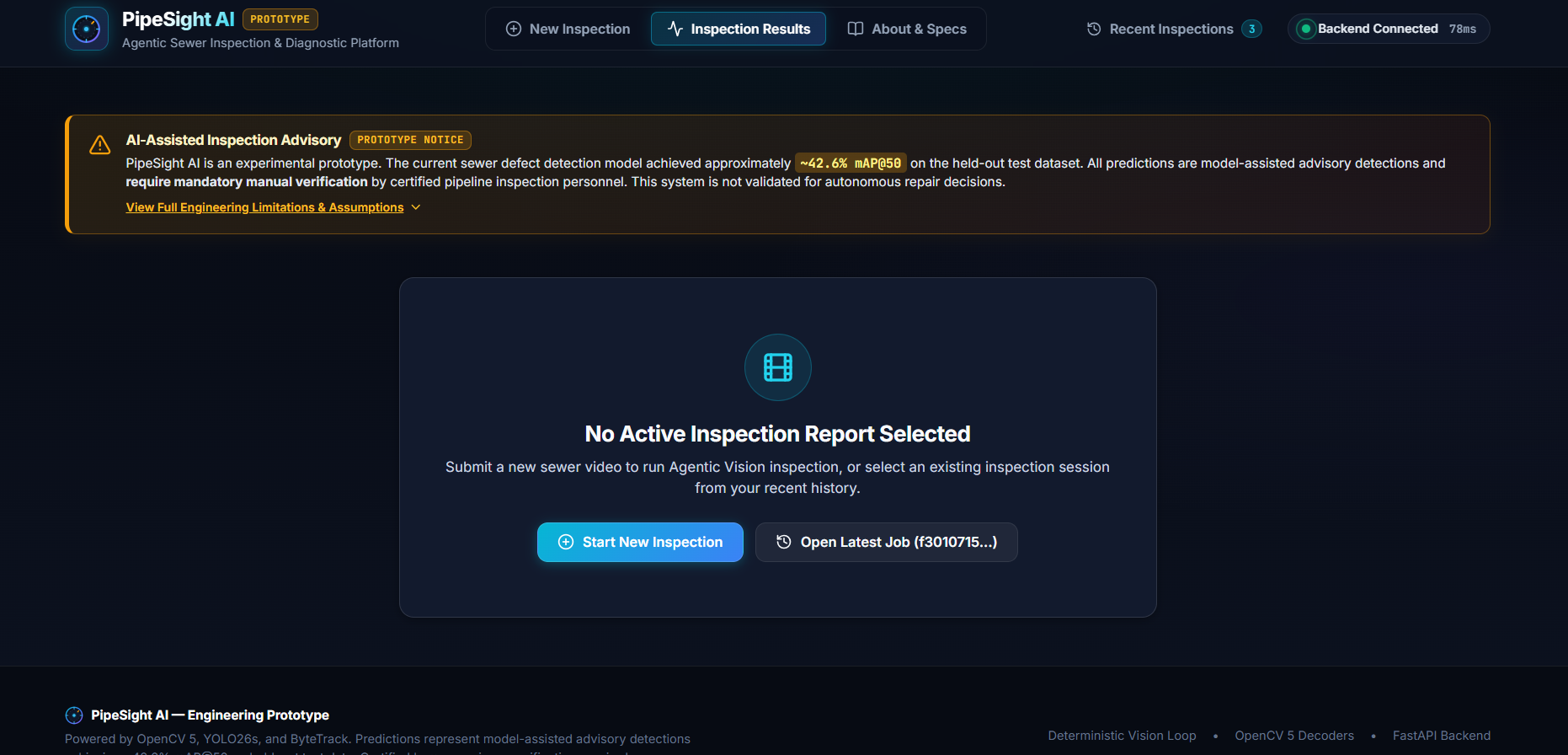
PipeSight AI uses a custom-trained YOLO26s object detection model to identify potential defects in sewer pipe inspection imagery. The project targets five categories: Crack, Debris, Joint Fault, Root Intrusion, and Surface Damage.
OpenCV 5 provides the foundation for image and video processing. The broader goal is to extend image-level detection into a video inspection workflow that organizes annotated evidence and supports human review.
The current prototype focuses on the trained detection model. Multi-object tracking with ByteTrack, a complete web application, and cloud deployment remain future development goals.
How we built it
We trained a YOLO26s model on a custom dataset of 978 images. Data augmentation was applied to the training images, while validation and test images were kept unaugmented. The training experiment completed 48 epochs, with the best checkpoint recorded at epoch 33.
Our development environment included Python, Ultralytics, PyTorch, and OpenCV 5.0.0. We also explored AWS EC2 as a potential environment for hosting the backend. The initial deployment attempt encountered connection difficulties, and the EC2 instance was terminated. Therefore, a working public cloud endpoint is not currently available.
Challenges we faced
One of the main challenges was developing a useful defect detector with a relatively limited dataset. Sewer defects can have similar visual appearances, and detection quality can be affected by lighting, blur, obstructions, and differences between inspection environments.
We also had to configure the development environment to use OpenCV 5 rather than an earlier OpenCV version, and we encountered difficulties connecting to the AWS instance.
The model's reported performance is approximately 50 mAP, although the exact metric variant and evaluation split need to be confirmed. This highlights the need for further dataset improvements, rigorous evaluation, and testing on real inspection footage.
What we learned
This project helped us understand the practical workflow behind training an object detection model, preparing image datasets, evaluating model performance, and configuring a computer vision development environment.
We also learned that a successful AI project requires more than model training. Reliable video processing, deployment, testing, clear evidence, and honest communication of limitations are equally important.
What's next
Our next steps are to improve detection performance, implement video processing and ByteTrack-based tracking, develop a simple interface for presenting results, and establish a verified deployment workflow. We also aim to explore a deterministic Agentic Vision controller that uses OpenCV measurements, such as image sharpness, to guide subsequent processing decisions.
PipeSight AI is currently a developing prototype intended to support preliminary inspection, not replace professional engineering judgment.
Built With
- amazon-web-services
- computer-vision
- ec2
- fastapi
- object-detection
- opencv
- python
- sewer-inspection
- ultralytics
- video-analysis
- yolo26

Log in or sign up for Devpost to join the conversation.