Inspiration
Every engineering team knows the ritual: a CI pipeline goes red, someone copies job logs into a chat, twenty minutes of archaeology follow, and the "fix" gets pushed with no review trail. We wanted the response to a pipeline failure to be as governed as the code itself — diagnosed by AI, but approved by a human through a real case-management workflow.
What it does
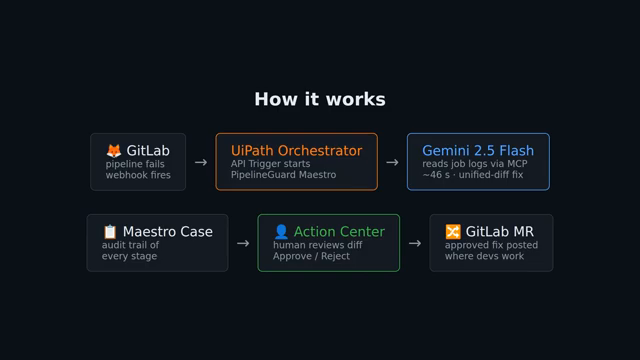
PipelineGuard turns every GitLab pipeline failure into a UiPath Maestro Case that moves through five auditable stages: Open → AI Diagnosing → Human Review → Fix Applied → Closed.
- GitLab fires a pipeline-failure webhook at a UiPath Orchestrator API Trigger
Main.xamlorchestrates the response:DiagnoseWithAI.xamlcalls our Cloud Run agent, where Gemini 2.5 Flash reads the failed job logs through MCP tooling and produces a root cause, failure category, and a unified-diff fix proposal — in ~46 secondsCreateMaestroCase.xamlopens the Maestro Case with the full diagnosis as case dataHumanReview.xamlcreates an Action Center task — an engineer sees the root cause and proposed diff side by side and clicks Approve or Reject- On approval,
PostApprovedFix.xamlposts the fix to the GitLab merge request via our/api/uipath/callbackendpoint
No fix reaches the repository without a human signature. Every incident leaves a complete case history.
How we built it
- UiPath: Studio Web project (
Main.xaml+ 4 workflows), Orchestrator Assets for configuration, a Maestro Case Catalog (Pipeline Failure Incident) with 6 data fields, Action Center for human-in-the-loop approval, and an API Trigger as the entry point. The Cloud Run service can also trigger the process directly via OAuth2 client-credentials (OR.Jobs OR.Jobs.Executescopes) with automatic token refresh. - AI backend: Python/FastAPI on Google Cloud Run. Gemini 2.5 Flash receives tools from MCP servers (job log retrieval, failure categorisation, MR note posting) and emits structured diagnoses.
- GitLab: webhook integration plus MR comment posting, so the approved fix lands where developers already work.
Challenges we ran into
- Designing the handoff so UiPath owns process state while the AI agent stays stateless — case data lives in Maestro, not in our service
- OAuth2 token lifecycles for unattended API Trigger calls (solved with a client-credentials exchange and graceful fallback to local diagnosis if the trigger fails)
- Making a 46-second AI diagnosis feel synchronous inside a workflow engine built for long-running cases
Accomplishments we're proud of
- A complete closed loop — failure to approved fix — with zero custom UI: Action Center is the approval surface
- The agent's fix proposals are unified diffs, not prose, so approvers review exactly what will be posted
- 70 automated tests and a fully reproducible 20-minute setup guide (
uipath/SETUP.md)
What we learned
Maestro's case model is the missing piece for AI agents in production: the agent supplies judgment, but the case supplies accountability — stages, data, audit trail, and a human gate.
What's next
Auto-applying approved fixes as MR commits, failure-pattern analytics across cases, and packaging the Maestro template for the UiPath Marketplace.
Built end-to-end with Claude Code (Anthropic's AI coding CLI) driving development across the UiPath workflows, the FastAPI service, and the test suite.
Built With
- action-center
- fastapi
- gemini
- gitlab
- google-cloud
- maestro
- mcp
- oauth2
- python
- uipath

Log in or sign up for Devpost to join the conversation.