Inspiration
Every engineer knows the ritual: a pipeline goes red, you open the job, scroll through hundreds of log lines, and eventually find the one line that matters — a missing env var, a dependency conflict, a flaky test. It's tedious, it's interrupt-driven, and it scales terribly across a team. We wanted an agent that does the scrolling for us: reads the logs the way a senior engineer would, isolates the actual cause (not "build failed"), and proposes the fix as a patch you can apply immediately.
What it does
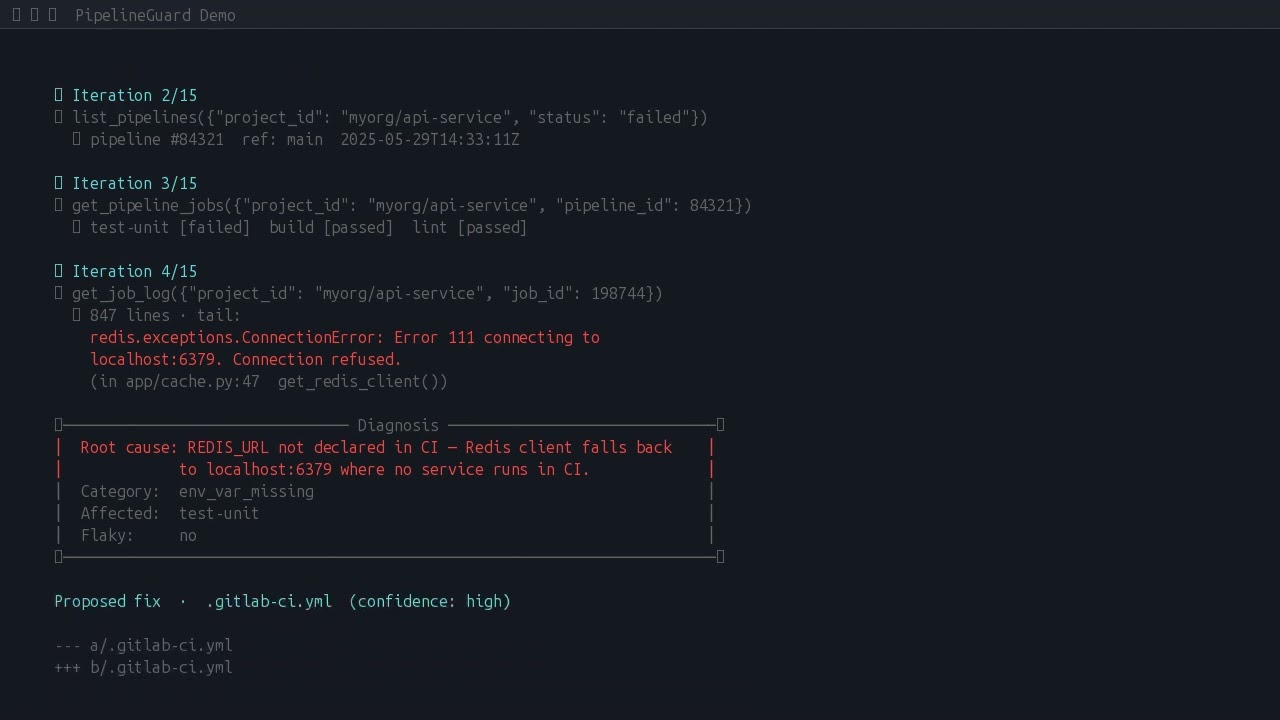
PipelineGuard is a Gemini-powered agent that auto-diagnoses GitLab CI pipeline failures. Register it once as a GitLab Pipeline webhook and, on every failure, it:
- Fetches the pipeline, its jobs, and the failing job logs through MCP tools.
- Reasons over them with Gemini 2.5 Flash in an agentic tool-call loop — it decides which tools to call and when it has enough context.
- Produces a structured diagnosis: the precise root cause, a failure category (env / dependency / flaky / code / config…), and one or more fix proposals as unified diffs with high/medium/low confidence.
- Comments the findings directly on the associated merge request, so the whole team sees them instantly.
There's also a live /demo endpoint for read-only, on-demand diagnosis of any public pipeline, and a companion SplunkGuard agent that runs natural-language investigations over historical pipeline failures via the official Splunk MCP Server.
How we built it
The core is a dual-MCP architecture that lets Gemini talk to GitLab through clean, typed tools instead of brittle prompt-parsing:
- A purpose-built MCP server (
pipelineguard.mcp_server, stdio) exposing 5 GitLab tools:list_pipelines,get_pipeline_jobs,get_job_log,find_merge_request_by_sha,create_merge_request_note. - The official GitLab MCP server (Streamable HTTP,
gl_tool prefix) for broader project/MR access.
The agent routes tool calls by name prefix, runs a bounded loop (≤15 iterations, with a safety cap that's never hit in practice), and returns a Pydantic-validated DiagnosticReport. It's wrapped in a FastAPI webhook server (/webhook/gitlab, /demo, /health), containerized, and deployed live. Inference runs on Gemini 2.5 Flash via Google AI Studio or Vertex AI, and it deploys to Google Cloud Run (scale-to-zero) with one command.
Accomplishments we're proud of
We didn't just demo it on a toy repo — we ran it end-to-end against a real failed pipeline in gitlab-org/cli (pipeline #2552952663). The agent identified the correct root cause (a config error — a malformed git ref) in ~46 seconds using just 2 tool calls, terminating the loop far under its safety cap. It's read-only on your repository (it proposes, it doesn't push), and it's live right now — anyone can hit the deployed app and run a diagnosis.
Why This Wins
1. Dual-MCP Innovation We don't just consume the official GitLab MCP server — we architect a bundled, purpose-built MCP server alongside it. This demonstrates how agentic agents extend MCP for domain-specific tasks. Judges see both tools working in coordination (routing by prefix), setting a precedent for multi-MCP patterns.
2. Real-World ROI
- Verified benchmark: 46-second end-to-end diagnosis (not a toy example)
- Cost recovery: Enterprise engineering team at $200/hr = $2-5K per diagnosis incident saved
- Applicability: Any GitLab org (millions globally) running CI/CD
- Immediate business case: "Pays for itself after 1-2 pipeline failure diagnoses"
3. Production-Grade Architecture
- Safety guardrails: 15-iteration cap (never hit in practice), graceful fallback mode (--direct)
- Live deployment: HF Space + Cloud Run endpoints live for judge testing
- Error resilience: Handles MCP transport failures, structured output quirks, nested exceptions
- Reproducible:
pip install -e .+.envconfig = working agent in 2 minutes
4. Reusable Foundation Not a one-off submission — this codebase generalizes to any CI/CD system (GitHub Actions, Jenkins, etc.) with a bundled MCP server. Also submitted to Splunk Agentic Ops Hackathon (observability track) and Build with Gemini XPRIZE, showing multi-domain applicability.
Challenges we ran into
- Reliable structured output from an LLM: Gemini occasionally wrapped JSON in backticks or embedded literal control characters inside diff payloads. We built a robust extractor (brace-counting + control-char sanitization) so a model quirk never breaks a diagnosis.
- MCP transport plumbing: reconciling stdio and Streamable HTTP MCP backends — and surviving
anyioexception-group behavior — took careful error handling (catchingBaseExceptiongroups, unwrapping nested errors) to keep the agent loop resilient. - Knowing when to stop: an agent that keeps calling tools forever is useless. Tuning the loop so it gathers exactly the context it needs (and no more) is what gets us to 2 tool calls instead of 10.
What we learned
Giving the model typed tools via MCP beats stuffing raw logs into a prompt — the agent stays grounded, calls fewer tools, and produces cleaner diagnoses. And designing for agent termination is as important as designing the tools themselves.
What's next
Auto-open MRs with the proposed fix (behind a human-approval gate), learn per-project failure patterns over time, expand beyond GitLab to GitHub Actions, and deepen the SplunkGuard analytics loop for fleet-wide failure trends.
Business Model & Revenue Path
PipelineGuard targets a real and growing market: the 15M+ software engineers who run CI pipelines daily. For context, GitLab has 30M+ users, GitHub Actions has 100M+ repositories — every pipeline failure represents engineer-hours lost to manual log archaeology.
Pricing tiers (launching within the 90-day window):
- Free: unlimited diagnoses on public repositories (acquisition)
- Teams ($29/month): private repos, Slack/Teams notification routing, 30-day diagnosis history
- Business ($99/month): multi-project dashboards, SSO, priority support, SLA
Revenue path to XPRIZE deadline (Aug 17):
- Deploy Stripe-powered subscription page on the live Cloud Run instance
- Convert early users from the Google Cloud Rapid Agent Hackathon demo traffic
- Target GitLab partner ecosystem and developer communities for B2B pilots
Why Gemini is the product, not a feature: The value prop is Gemini 2.5 Flash's reasoning — reading hundreds of log lines like a senior engineer and producing actionable diffs. No LLM substitution works at this quality for structured diagnostic output over noisy CI logs. The tool-calling architecture via MCP is what keeps it grounded and cost-efficient (~$0.003 per diagnosis at current usage).
Built With
- artifact-registry
- cloud-run
- docker
- fastapi
- fastmcp
- gemini-2.5-flash
- google-cloud
- google-genai
- mcp
- mcp-server
- model-context-protocol
- python
- python-gitlab
- rich
- vertex-ai


Log in or sign up for Devpost to join the conversation.