-
-
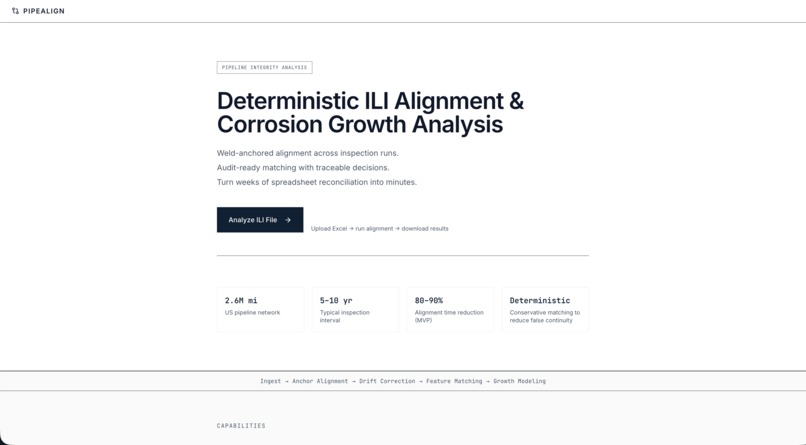
Home Page
-
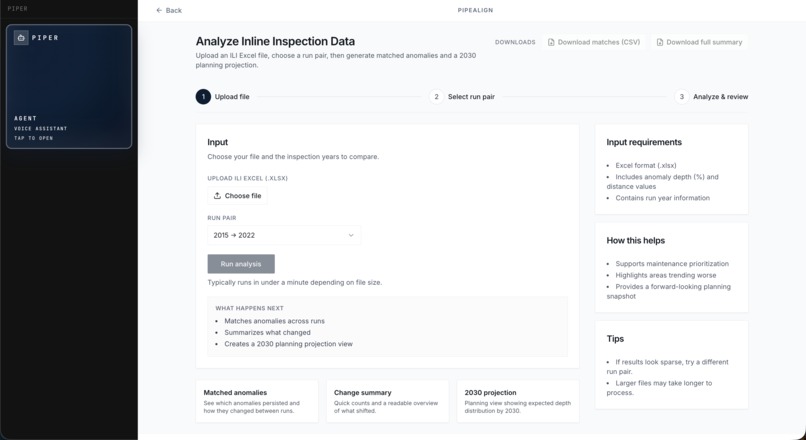
Analysis Page
-
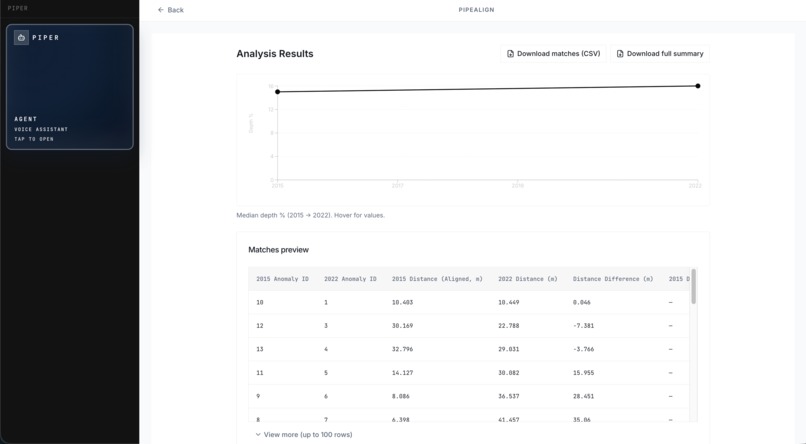
Data Output Page
-
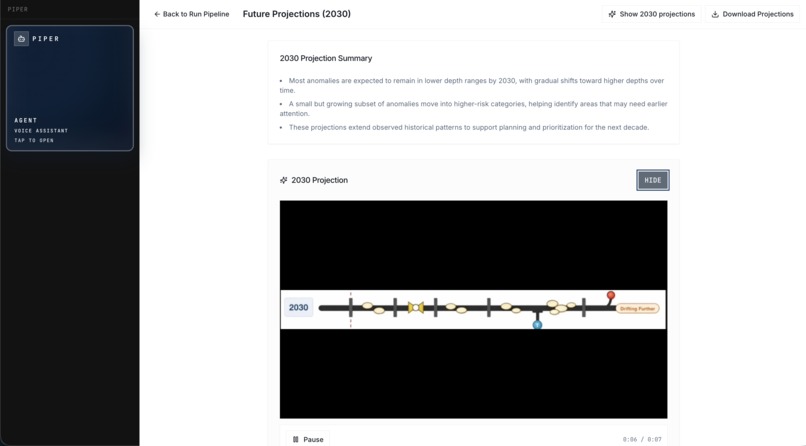
ML Future Prediction Images
-
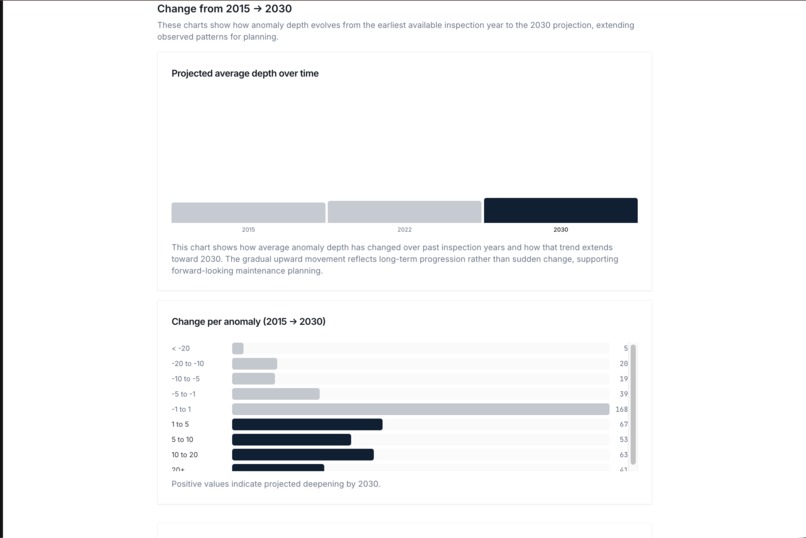
ML Future Prediction Data
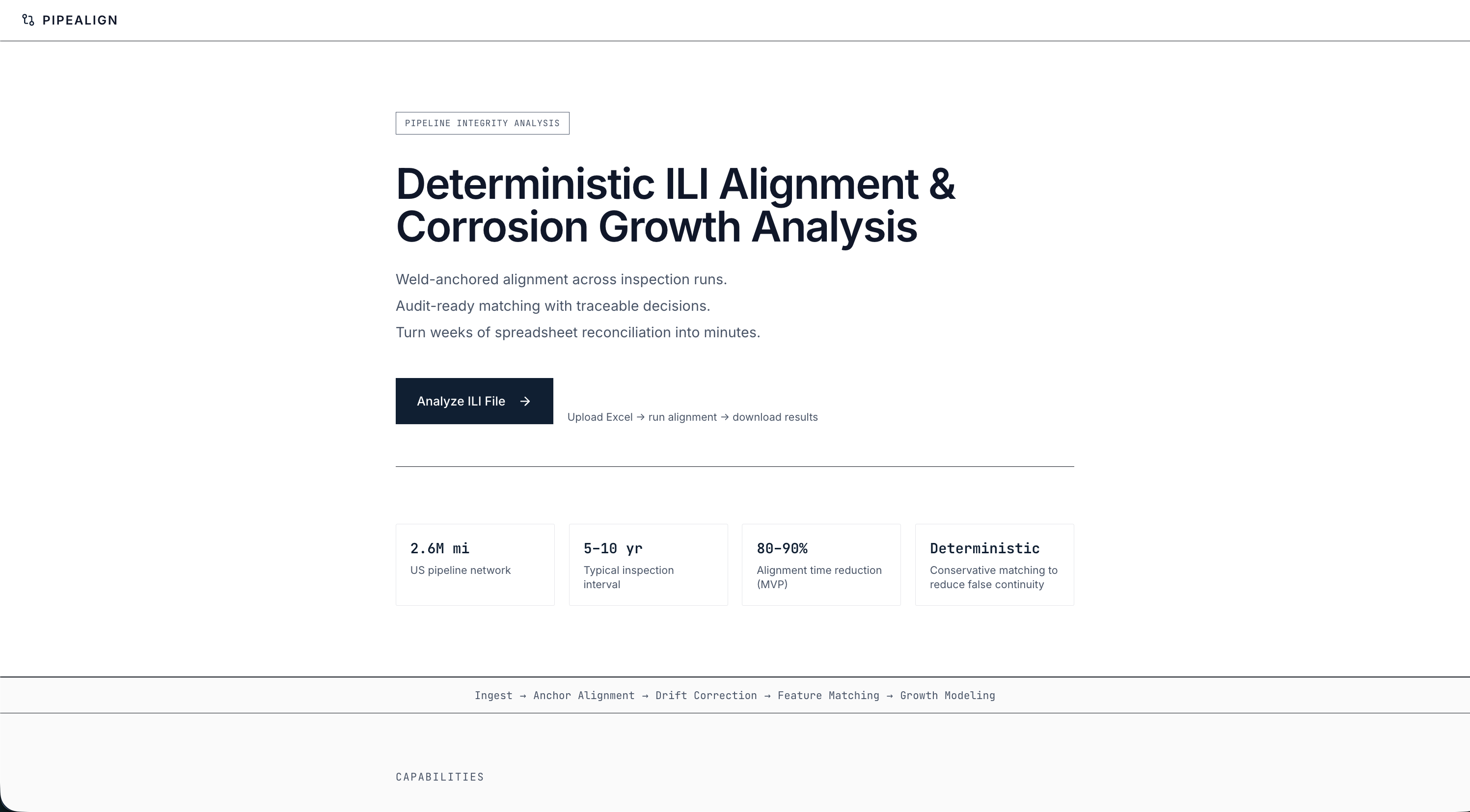
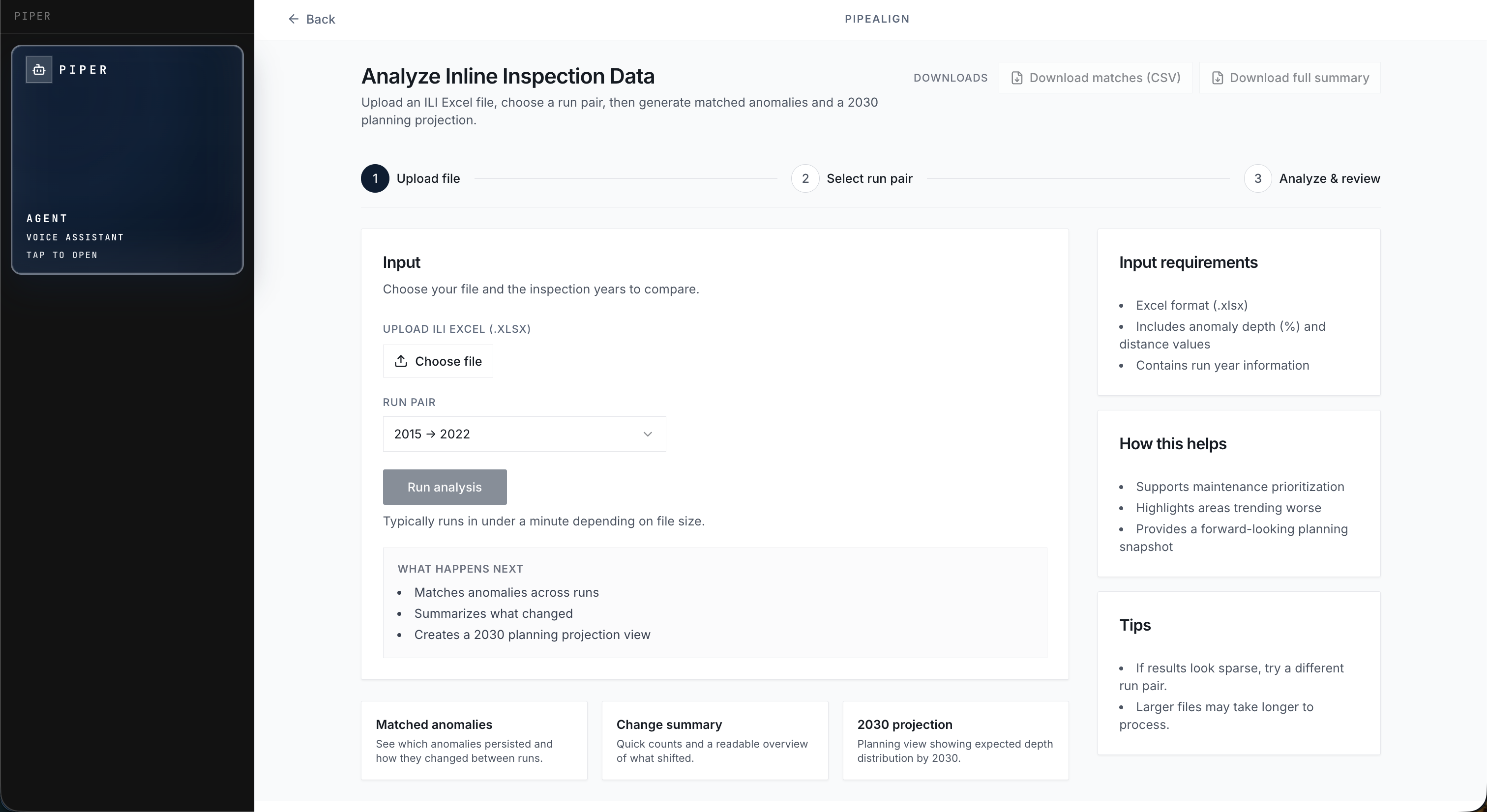
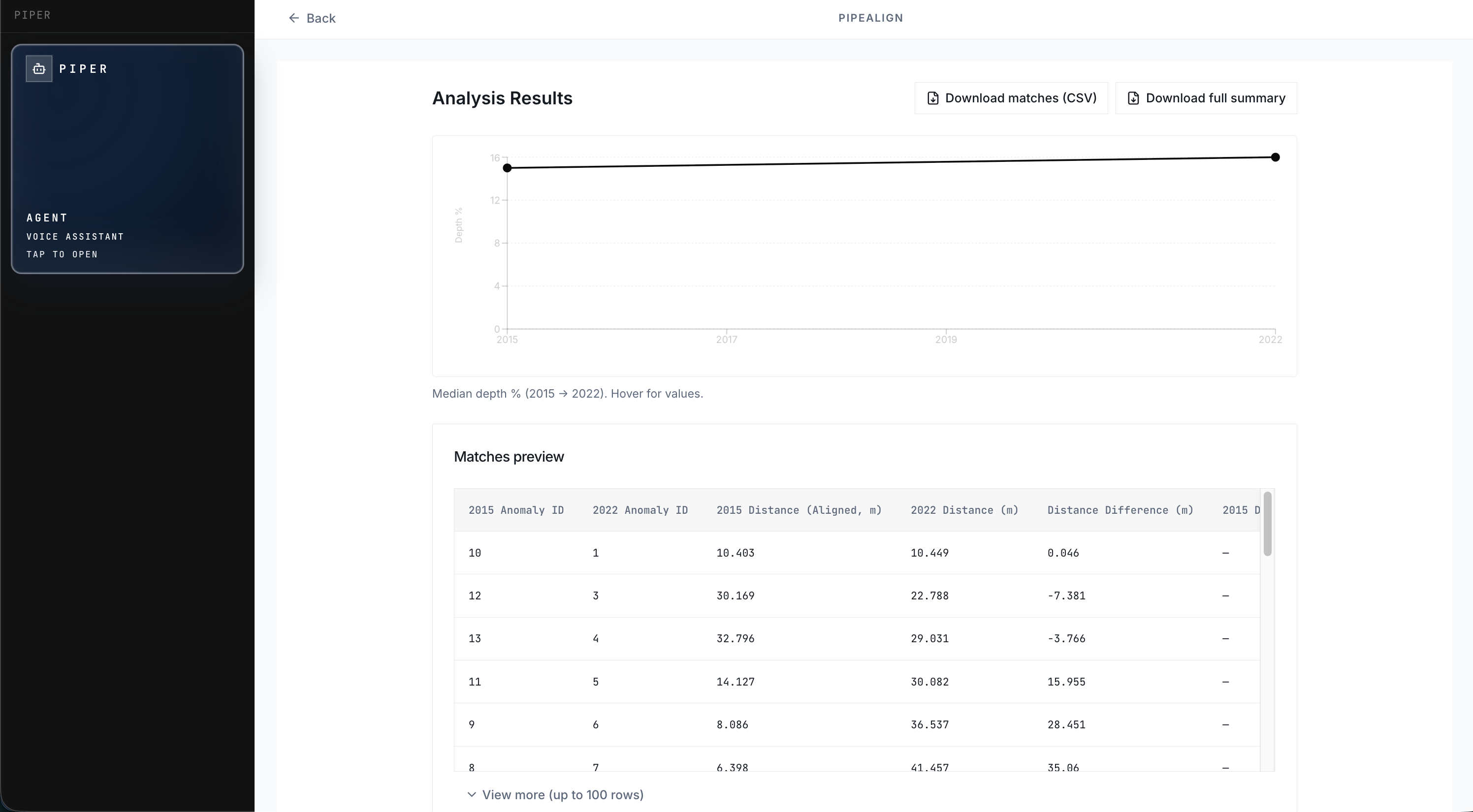
PipeAlign: Automated ILI Alignment & Integrity Analysis
Pipeline integrity analysis is high-stakes, but ILI data is messy: inconsistent vendor schemas, unit mismatches, and odometer drift make multi-run comparison slow and error-prone. Engineers often rely on manual spreadsheet alignment just to determine what actually changed.
PipeAlign turns raw, multi-year ILI files into a deterministic, traceable integrity analysis in minutes.
What It Does
PipeAlign automates multi-run ILI analysis end-to-end:
- Ingests Excel/CSV ILI exports from different vendors
- Normalizes schemas, units, and feature fields
- Aligns inspection runs using girth welds as fixed physical anchors
- Matches anomalies using deterministic physical tolerances
- Explicitly flags new, missing, and ambiguous features
- Computes corrosion growth rates
- Generates tables, charts, and downloadable outputs
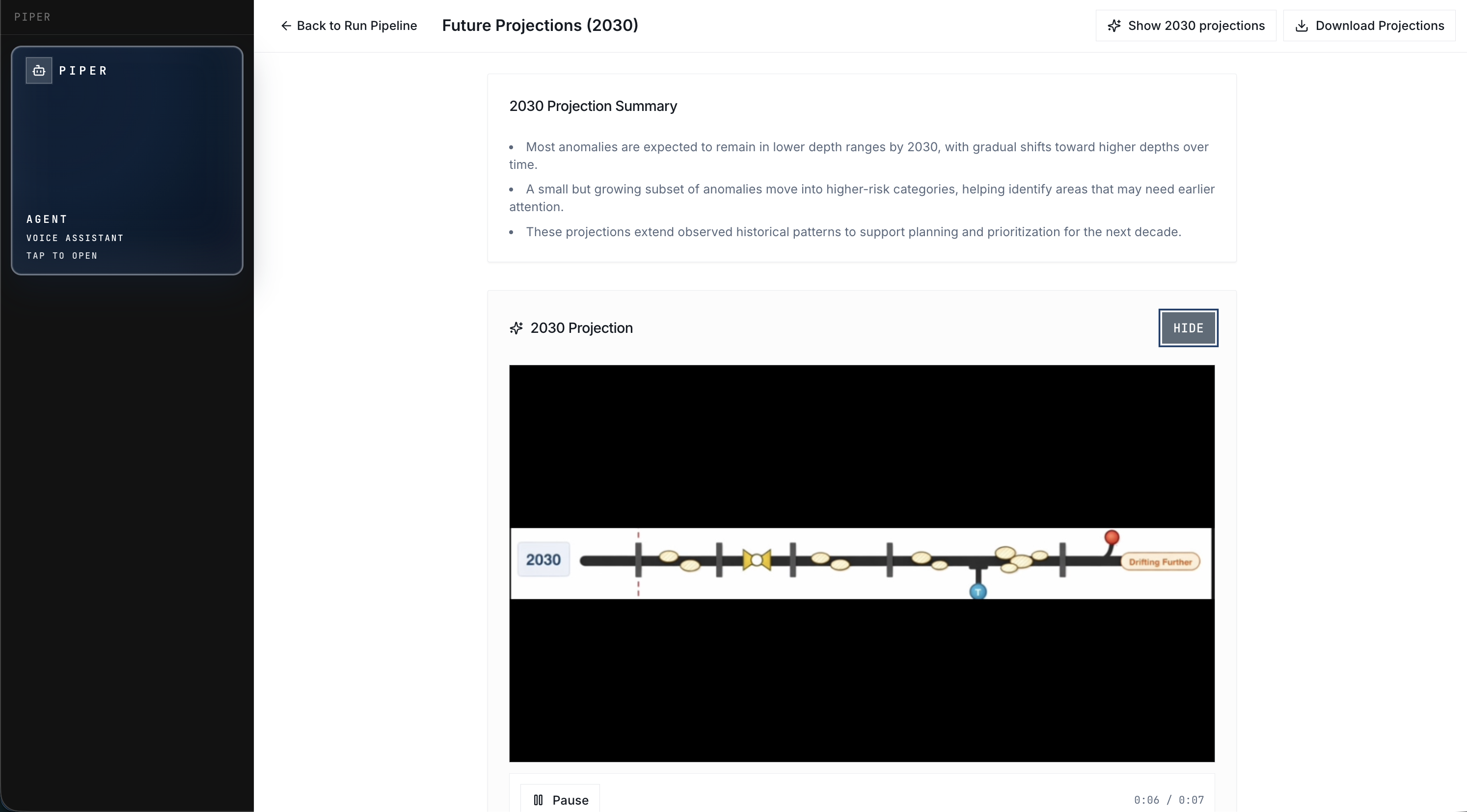
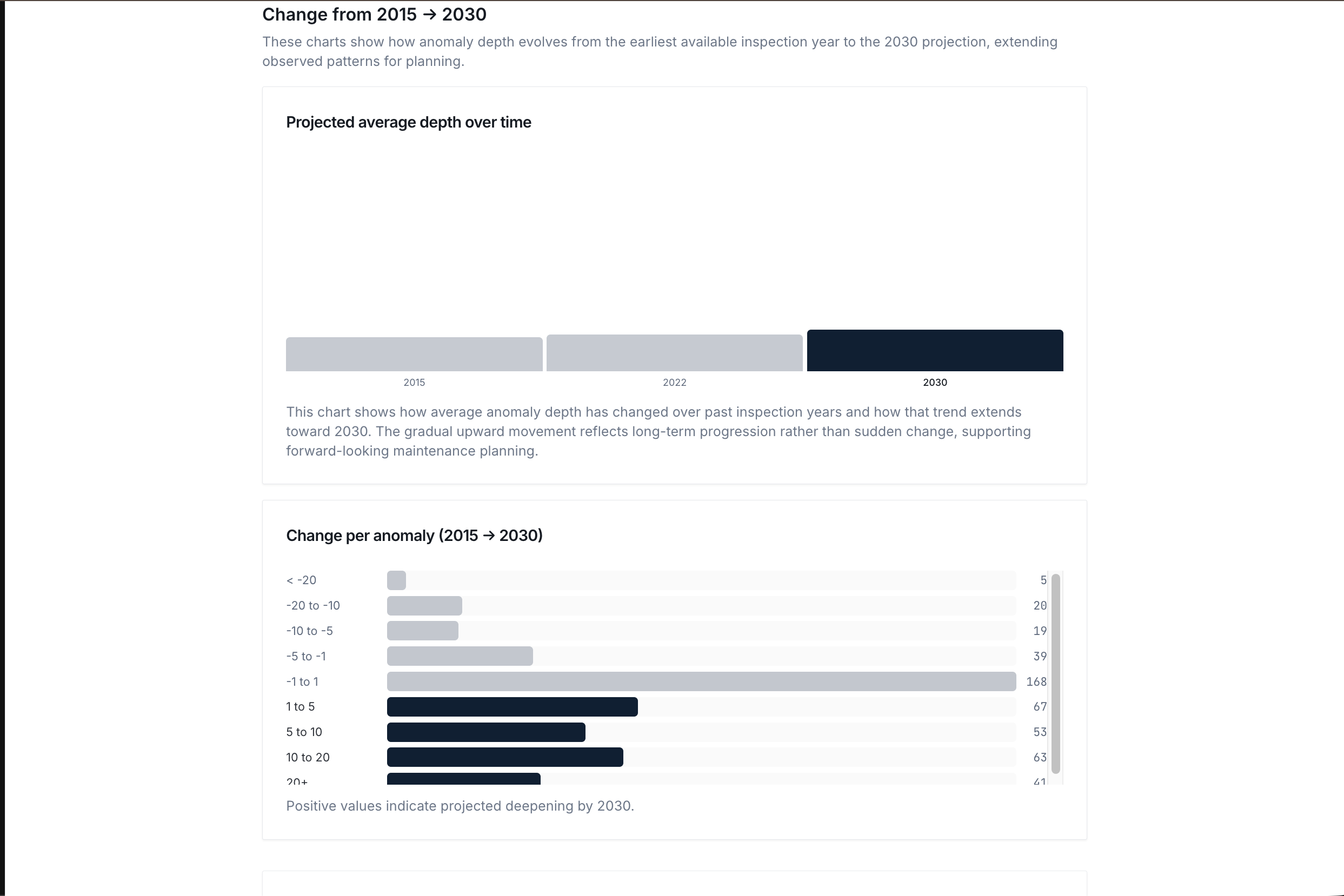
- Projects integrity trends through 2030 (deterministic + optional ML)
How It Works
PipeAlign is deterministic by design. All core logic is explainable, auditable, and conservative.
1. Normalization
All runs are converted into a canonical physical representation:
- Distance → meters
- Clock position → degrees (0–360, circular)
- Depth → percent wall thickness
- Length / width → millimeters
This guarantees apples-to-apples comparison across vendors and years.
2. Weld-Anchored Alignment (Odometer Drift Correction)
Runs are aligned segment-by-segment using matching girth welds as fixed landmarks.
For each segment bounded by two adjacent welds:
scale  = (d_prev2 - d_prev1) / (d_later2 - d_later1)
offset = d_prev1 - scale * d_later1
For any feature with raw distance d_raw in the later run:
d_corrected = scale * d_raw + offset
This piecewise linear mapping corrects odometer drift without smoothing or overfitting, preserving physical traceability.
3. Deterministic Anomaly Matching
After alignment, anomalies are matched using hard physical constraints:
- Axial distance tolerance
- Circular clock difference
- Feature type compatibility
Candidates failing any constraint are discarded.
Each remaining candidate pair is scored:
score =
  w_d   * |Δd| +
  w_c   * Δθ +
  w_dep * |Δdepth| +
  w_len * |Δlength| +
  w_wid * |Δwidth|
Lower score = higher physical similarity.
Ambiguity rule:
If the two best scores are within a small threshold ε, the anomaly is marked Ambiguous instead of forcing a match. This prevents false continuity in dense regions.
4. Growth & Projections
For matched anomalies:
growth_rate = (depth_2 - depth_1) / Δt
- Deterministic projections: bounded extrapolation through 2030
- Optional ML projections: advisory only; never override deterministic matching
Why This Matters
| Problem | PipeAlign Approach |
|---|---|
| Vendor inconsistency | Canonical schema + unit normalization |
| Odometer drift | Weld-anchored segment alignment |
| Dense anomalies | Explicit ambiguity, no guessing |
| Trust gap | Deterministic math over black-box models |
Key insight: In infrastructure analytics, defensibility beats sophistication. Engineers trust results they can audit.
Accomplishments
- Replaced hours of manual spreadsheet alignment
- Deterministic matching with explicit uncertainty
- Outputs aligned with professional integrity workflows
What’s Next
- Tolerance calibration using labeled review data
- Multi-run continuity (e.g., 2007 → 2015 → 2022)
- Hardened deployment with audit logs and persistence
Bottom Line
PipeAlign delivers accurate, auditable multi-run ILI alignment, with transparent math and explicit uncertainty — optimized for real integrity decisions.
Built With
- excel-(openpyxl)
- fastapi
- numpy
- pandas
- python
- react
- recharts
- scikit-learn
- tailwind-css
- typescript
- vite

Log in or sign up for Devpost to join the conversation.